
The best USB-C hard drive docking stations make it easier to access bare SATA drives, M.2 SSDs, and older backup disks without installing them in a computer. They can also simplify drive cloning, data recovery, and routine file transfers.
This roundup compares 10 options across USB-C speeds, drive compatibility, bay count, cloning features, and everyday usability, so you can choose a dock that fits your storage setup.
Best 10 USB C Hard Drive Docking Stations Picks for 2026
Most Versatile
ICY BOX Triple-Bay NVMe and SATA Dock

- Supports M.2 NVMe and 2.5-/3.5-inch SATA drives
- Three bays with one-touch offline cloning
- USB 3.2 Gen 2 up to 10Gbps
Best For: Mixed-drive workflows and multi-drive cloning
Best Desk Setup

- Dual HDMI supports up to 4K 60Hz per display
- Includes USB, Ethernet, audio, and 65W charging
- Driverless on compatible Windows and ChromeOS systems
Best For: Dual-monitor laptop workstations with peripherals
Best Dual-Format Value
SABRENT Lay-Flat NVMe/SATA Dock

- Handles M.2 NVMe and 2.5-/3.5-inch SATA drives
- Includes USB-C and USB-A connection cables
- 10Gbps interface with offline cloning
Best For: Mixed-format drive access and occasional cloning
Best SATA Cloner

- Two tool-free bays for 2.5- and 3.5-inch SATA drives
- Offline cloning without a computer
- USB 3.0 up to 5Gbps with hot-swap support
Best For: Simple SATA drive cloning and two-drive access
Best 10Gbps Single-Bay Pick

- 10Gbps USB 3.2 Gen 2 interface
- Handles 2.5-inch and 3.5-inch SATA drives
- Tool-free, hot-swappable single-bay design
Best For: Fast single-drive backups and transfers
Best Dual-Bay Cloning Option

- Offline cloning without a computer
- Two bays for 2.5-inch or 3.5-inch SATA drives
- Supports up to 32TB per drive
Best For: Drive cloning and two-drive workflows
Best Basic USB-A Value
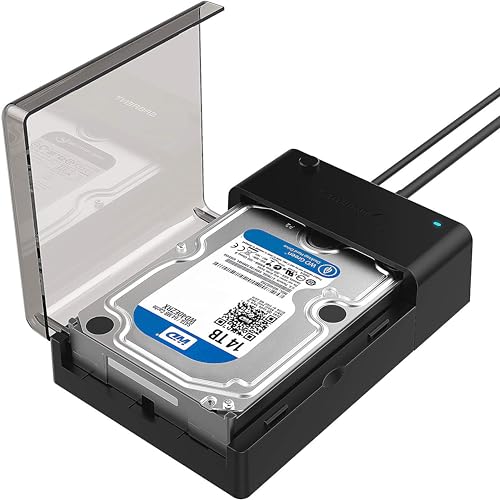
- Supports 2.5-inch and 3.5-inch SATA drives
- Tool-free, hot-swappable single-bay design
- Includes power adapter for 3.5-inch drives
Best For: Simple SATA access on USB-A computers
Best for Fast Cloning

- Offline cloning without a PC
- Supports 2.5-inch and 3.5-inch drives
- UASP transfers up to 5Gbps
Best For: Drive migration, backups, and two-drive management
Best for Proven Dual-Bay Value

- Supports 2.5-inch and 3.5-inch SATA drives
- Offline duplication without a computer
- Up to 20TB storage support
Best For: Simple SATA cloning and plug-and-play drive access
Best for Large-Capacity Storage

- Supports drives up to approximately 30TB
- Tool-free access for 2.5-inch and 3.5-inch drives
- Works with Windows, macOS, and Linux
Best For: Large SATA drive libraries and cross-platform use
Most Versatile – ICY BOX Triple-Bay NVMe and SATA Dock
If you need usb c hard drive docking stations for mixed storage setups, the ICY BOX Triple-Bay model offers unusually broad drive support. It combines M.2 NVMe and 2.5- or 3.5-inch SATA compatibility with standalone cloning and three independent bays.
Best For: Users managing multiple NVMe and SATA drives who want flexible offline cloning and fast USB-C connectivity.
Pros:
- Supports M.2 PCIe NVMe plus 2.5- and 3.5-inch SATA SSDs and HDDs.
- Three independent bays allow simultaneous drive access.
- One-touch offline cloning requires no computer software.
- USB 3.2 Gen 2 reaches up to 10Gbps and includes USB-C and USB-A cable options.
Cons:
- The three-bay design is more specialized than a simple single-drive dock.
- Cloning direction and drive compatibility should be checked carefully before migration.
This is the strongest choice here for mixed-format storage work. Its triple-bay layout and broad cloning support make it especially useful for technicians, creators, and users maintaining several types of drives.
Best Desk Setup – Plugable Dual-4K USB-C Dock
Among usb c hard drive docking stations, this Plugable model is primarily a laptop workstation dock rather than a bare-drive reader. It adds external storage connectivity alongside dual HDMI, Ethernet, USB ports, audio, and host charging through one cable.
Best For: Windows and ChromeOS users building a dual-monitor desk setup with external storage and everyday peripherals.
Pros:
- Supports up to two HDMI displays at 4K 60Hz on compatible host systems.
- Provides 10-in-1 connectivity, including USB, Gigabit Ethernet, audio, and dual HDMI.
- Offers 65W charging and a 110W power adapter.
- Driverless setup is supported on compatible Windows and ChromeOS systems.
Cons:
- It does not function as a dedicated bare SATA or NVMe drive dock.
- Dual extended displays are not recommended for macOS; host USB-C video support is required.
This is the practical pick when “docking station” means a complete desktop expansion hub. Choose it for monitors, peripherals, networking, and external USB storage—not for offline drive cloning.
Best Dual-Format Value – SABRENT Lay-Flat NVMe/SATA Dock
The SABRENT DS-UFNC is a flexible option for shoppers comparing usb c hard drive docking stations for both modern NVMe modules and traditional SATA drives. Its lay-flat, tool-free design accepts M.2 PCIe NVMe drives as well as 2.5- and 3.5-inch SATA storage, with cables for USB-C and USB-A computers.
Best For: Users who need one compact dock for drive access, backups, and occasional offline cloning across Windows, macOS, and Linux.
Pros:
- Reads M.2 2242, 2260, and 2280 NVMe drives plus 2.5- and 3.5-inch SATA drives.
- USB 3.2 Gen 2 provides up to 10Gbps with the appropriate drive and host.
- Includes USB-C-to-USB-C and USB-A-to-USB-C cables.
- Supports tool-free swaps and offline cloning without a PC.
Cons:
- It supports one installed drive at a time.
- Offline cloning requires the target drive to be equal to or larger than the source.
- 3.5-inch drives require the included 12V power adapter.
With broad format support and a straightforward layout, this dock is a strong all-purpose choice. It is especially appealing if your storage collection includes both M.2 NVMe modules and full-size SATA hard drives.
Best SATA Cloner – SABRENT Dual-Bay USB-C Dock
For straightforward SATA work, this SABRENT dual-bay unit is a practical entry in the usb c hard drive docking stations category. It accepts bare 2.5- and 3.5-inch SATA drives, lets both bays appear separately on a computer, and supports button-operated offline cloning.
Best For: Users cloning or accessing two SATA HDDs or SSDs without needing M.2 NVMe support.
Pros:
- Supports two 2.5- or 3.5-inch SATA drives at once.
- Offline 1-to-1 cloning works without a connected computer.
- Tool-free, hot-swappable bays include individual drive-access LEDs.
- USB 3.0 provides up to 5Gbps for computer-connected transfers.
Cons:
- It does not support M.2, NVMe, IDE/PATA, or Molex-powered drives.
- The dock uses a USB-C cable, so computers with only USB-A ports need a separate compatible cable or adapter.
- Offline cloning runs at up to 60MBps by design.
This model keeps the feature set focused and easy to use. It is a good fit for SATA-only upgrades, backups, and drive-to-drive transfers, but shoppers with NVMe storage should choose a dual-format alternative.
Best 10Gbps Single-Bay Pick – Sabrent USB-C SATA Dock
For shoppers comparing usb c hard drive docking stations, the SABRENT DS-UC1B is a straightforward single-drive option for 2.5-inch and 3.5-inch SATA SSDs and HDDs. Its USB 3.2 Gen 2 connection supports up to 10Gbps, and both USB-A and USB-C cables are included.
Best For: Users who want a fast, tool-free dock for swapping one SATA drive at a time.
Pros:
- Supports 2.5-inch and 3.5-inch SATA SSDs and HDDs.
- Up to 10Gbps USB 3.2 Gen 2 transfer interface.
- Tool-free, hot-swappable design with USB-A and USB-C cables included.
- Supports drives up to 20TB and works with Windows, macOS, and Linux.
Cons:
- Single-bay design cannot clone or access two drives simultaneously.
- Designed for SATA drives, not M.2 or other interfaces.
The DS-UC1B is a strong fit when speed and broad SATA compatibility matter more than multi-drive functionality. Its included power adapter also supports reliable use with 3.5-inch drives.
Best Dual-Bay Cloning Option – UGREEN Dual-Bay SATA Dock
The UGREEN CM198 is a practical choice among usb c hard drive docking stations when you need to work with two SATA drives at once. It supports offline cloning without a computer, while its dual bays accept both 2.5-inch and 3.5-inch drives.
Best For: Users who need dual-drive access, offline cloning, and high combined storage capacity.
Pros:
- Dual bays support simultaneous use of 2.5-inch and 3.5-inch SATA drives.
- Offline cloning works without connecting to a computer, with the source drive capacity no larger than the destination.
- Supports up to 32TB per drive and SATA I, II, and III compatibility.
- Includes a USB-B-to-USB-C cable, dust cover, cooling, and anti-slip pads.
Cons:
- USB 3.0 transfer speed is limited to 5Gbps.
- Offline cloning requires the destination drive to be at least as large as the source.
- Larger dual-bay design is less compact than a single-drive dock.
Choose the UGREEN dock if cloning and two-drive workflows are priorities. It sacrifices some interface speed compared with newer 10Gbps docks, but adds useful duplication functionality and substantial capacity support.
Best Basic USB-A Value – Sabrent Lay-Flat SATA Dock
The SABRENT EC-DFLT is a simple, tool-free option for users who need to read or swap one bare SATA drive. It belongs in a usb c hard drive docking stations comparison only with an important caveat: its host connection is USB-A, so USB-C-only computers require a separate adapter.
Best For: Desktop and laptop users with USB 3.0 Type-A ports who want an affordable single-bay SATA dock.
Pros:
- Works with 2.5-inch and 3.5-inch SATA I, II, and III drives.
- Tool-free, plug-and-play, hot-swappable design with activity LED.
- Includes a 12V/2A power adapter required for 3.5-inch drives.
- Supports UASP and is backward compatible with USB 2.0 and USB 1.1.
Cons:
- Uses a USB-A host cable rather than a USB-C port.
- USB-C-only computers need an adapter, which is not included.
- Does not support IDE/PATA, M.2 NVMe, M.2 SATA, or SAS drives.
The EC-DFLT makes sense for basic SATA access when your computer has a USB-A port. Confirm your drive interface and host-port requirements before buying, especially if you use a newer USB-C-only laptop.
Best for Fast Cloning – BENFEI USB-C Dual-Bay Dock
If you want a USB C hard drive docking station for simultaneous drive access and straightforward system migration, the BENFEI dual-bay dock is a practical choice. It supports 2.5-inch and 3.5-inch HDDs and SSDs, offers USB 3.2 Gen 1 transfers up to 5Gbps, and includes offline cloning without a computer.
Best For: Users who need convenient two-drive backups, migrations, or offline cloning with stable power for 3.5-inch drives.
Pros:
- Reads, writes, and transfers data between two 2.5-inch or 3.5-inch drives simultaneously.
- One-button offline cloning works without a connected computer.
- UASP support and transfer speeds up to 5Gbps help reduce backup time.
- Includes a 12V/2.5A power adapter and an 18-month warranty.
Cons:
- The target drive must have greater capacity than the source for cloning.
- The power switch should be turned off before connecting or removing drives.
Choose this BENFEI model when offline cloning and dependable dual-bay power matter more than adding extra connectivity features. Its tool-free design and USB-C interface make it well suited to routine storage upgrades and backups.
Best for Proven Dual-Bay Value – SABRENT USB 3.0 Drive Cloner
The SABRENT EC-HD2B is a straightforward USB C hard drive docking station alternative for working with two standard SATA drives. It supports 2.5-inch and 3.5-inch HDDs or SSDs, plug-and-play operation, offline cloning, and transfer speeds up to 5Gbps over USB 3.0.
Best For: Users seeking a simple dual-bay SATA dock with offline duplication and support for high-capacity drives.
Pros:
- Supports standard 2.5-inch and 3.5-inch SATA hard drives and SSDs.
- Offline cloning works without requiring a computer connection.
- Supports drives up to 10TB and transfer speeds up to 5Gbps.
- Plug-and-play setup requires no drivers.
Cons:
- Uses USB 3.0 rather than a newer USB-C interface.
- Offline cloning is listed at speeds up to 60Mbps, which may be slower than USB transfer performance.
The EC-HD2B is a sensible pick for basic drive reading and duplication when broad SATA compatibility is the priority. Its included power supply, cable, and user manual make it ready for a simple desktop setup.
Best for Large-Capacity Storage – ICY BOX Dual-Bay Dock
For buyers comparing USB C hard drive docking stations for large media libraries or mixed drive collections, the ICY BOX dual-bay dock offers tool-free access to 2.5-inch and 3.5-inch SATA HDDs and SSDs. It provides USB 3.0 transfers up to 5Gbps, UASP support, and offline cloning.
Best For: Users managing large-capacity SATA drives across Windows, macOS, or Linux systems.
Pros:
- Works with both 2.5-inch and 3.5-inch SATA I/II/III drives.
- Tool-free plug-and-play design requires no screws or drivers.
- Supports capacities up to approximately 30TB and transfer speeds up to 5Gbps.
- Compatible with Windows, macOS, and Linux.
Cons:
- Uses USB 3.0 connectivity rather than a newer USB-C standard.
- The supplied information does not specify a warranty.
The ICY BOX stands out for capacity and operating-system flexibility. It is a practical option for frequent drive access, data recovery tasks, and expanding storage without installing drives inside a computer.
How We Picked the Best USB C Hard Drive Docking Stations
We focused on docks that provide practical access to bare internal drives rather than conventional laptop docking stations. The selection includes USB-C models for SATA HDDs and SSDs, NVMe-compatible docks, dual- and triple-bay designs, and systems with offline cloning support.
We also considered connection speed, support for both 2.5-inch and 3.5-inch drives, tool-free operation, maximum stated capacity, operating-system compatibility, and whether the layout is suitable for occasional backups or frequent drive work. USB 3.0 models remain included because they can offer good value for older SATA drives and basic cloning tasks.
Quick Comparison
| Best For | Look For | Why It Matters |
|---|---|---|
| NVMe and SATA users | Dual-interface support | Lets one dock handle newer M.2 SSDs and conventional drives. |
| Drive cloning | Offline clone function | Copies one drive to another without a host computer, when source and target requirements are met. |
| Large desktop HDDs | 2.5/3.5-inch bay support | Accommodates both laptop-size and full-size SATA drives. |
| Frequent transfers | USB 10Gbps connection | Provides more bandwidth than USB 3.0, assuming the computer, cable, and drive support it. |
| Multiple drives | Dual- or triple-bay design | Makes backups, comparisons, and cloning workflows more convenient. |
Key Buying Factors for USB-C Hard Drive Docking Stations
Drive Compatibility
Check whether the dock supports SATA only or also accepts M.2 NVMe drives. SATA docks generally work with 2.5-inch and 3.5-inch HDDs and SSDs, while NVMe support depends on the drive form factor and interface. Do not assume that every M.2 slot supports both SATA and NVMe.
Speed and Ports
A USB 10Gbps connection can reduce transfer bottlenecks, but real-world performance is limited by the installed drive and the computer’s USB port. USB 3.0 docks can still be sufficient for hard disks, which often cannot saturate faster links.
Cloning and Backup Features
Offline cloning is useful for migrating a drive or creating a direct duplicate. Verify how the dock indicates progress, whether the target must be equal to or larger than the source, and whether cloning erases existing target data. For routine file copying, host-based software may offer more control.
Power and Physical Design
3.5-inch desktop drives require dedicated power, so confirm that the included adapter is suitable for your setup. A lay-flat design may be convenient for M.2 drives, while upright dual-bay docks can save desk space but need stable placement.
Who Should Buy Which USB C Hard Drive Docking Stations?
Choose an NVMe/SATA dock if your storage collection includes both modern M.2 SSDs and older SATA drives. A dual-bay cloner is the better choice for frequent migrations, backups, or drive-to-drive duplication. For a single 2.5- or 3.5-inch SATA drive, a simpler one-bay dock is usually cheaper and easier to store.
Buy a USB 10Gbps model when you regularly move large files and your computer supports the standard. Choose a USB 3.0 dock when you mainly use mechanical hard drives, need basic access, or want to keep costs down. Finally, confirm your operating system, cable type, drive capacity, and cloning requirements before ordering—these details determine whether a dock works smoothly with your existing hardware.