
The best hard drive docking stations for Mac make it easier to access bare SATA drives, NVMe SSDs, and backup media without installing them inside an enclosure. They can also streamline drive cloning, data transfers, and desktop storage upgrades.
This roundup compares 10 options across USB-A and USB-C connectivity, dual-bay designs, Mac mini stands, NVMe support, and multi-port functionality, so you can choose a dock that matches your drives and workflow.
Best 10 Hard Drive Docking Stations for Mac Picks for 2026
Dual-Bay Cloning Pick

- Dual bays for 2.5-inch and 3.5-inch SATA drives
- Offline cloning without a computer
- USB 3.0 transfers up to 5Gbps
Best For: SATA drive access, backups, and offline drive duplication
Mac mini Expansion Pick

- Adds an M.2 NVMe SSD enclosure and stand
- Supports up to 8TB and 10Gbps transfers
- Includes 11 ports plus SD and TF card readers
Best For: Mac mini users building a compact storage and connectivity hub
USB-C Cloner Pick

- Mounts two 2.5-inch or 3.5-inch SATA drives
- Offline cloning without a computer
- USB-C connection with hot-swappable bays
Best For: USB-C Mac setups using SATA drives for transfers or cloning
Compact Mac mini Stand

- Adds up to 4TB of M.2 NVMe storage
- Includes two 10Gbps USB-A ports and UHS-II SD
- Compact aluminum stand with cooling vents
Best For: Compatible Mac mini setups needing integrated NVMe expansion
Best Budget SATA Dock
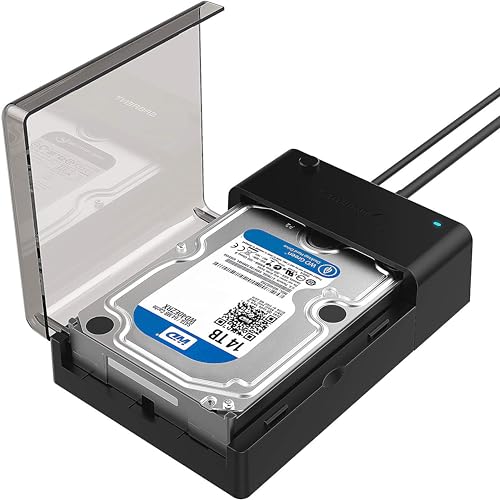
- Handles one bare 2.5-inch or 3.5-inch SATA drive
- Includes 12V power for 3.5-inch HDDs
- USB-A host cable; USB-C adapter may be needed
Best For: Affordable single-drive SATA access on Mac
Best Dual-Bay Dock

- Accesses two 2.5-inch or 3.5-inch SATA drives
- USB-C connectivity with up to 522MB/s listed speed
- Includes USB-C and USB-A connection cables
Best For: Simultaneous two-drive Mac workflows
Best USB-C SATA Dock

- USB-C 10Gbps connection with USB-A compatibility
- Supports 2.5-inch, 3.5-inch, and 20TB-plus SATA drives
- Tool-free, hot-swappable single-drive bay
Best For: Modern Macs and high-capacity SATA storage
Best Dual-Bay Drive Dock
- Dual bays for SATA and U.2 NVMe drives
- USB 3.2 10Gb/s with USB-C and USB-A cables
- Quiet fanless aluminum design with internal power
Best For: Mac users managing two drives at once
Best for Offline Cloning

- Handles M.2 NVMe and 2.5/3.5-inch SATA drives
- Offline cloning requires no computer
- USB-C and USB-A cables included
Best For: Mac users cloning and swapping mixed drive types
Best All-in-One Workstation Dock

- Supports M.2 plus 2.5/3.5-inch SATA storage
- Adds dual HDMI, Ethernet, card readers, and audio
- Includes 10Gbps USB-C and 100W power delivery
Best For: Mac desk setups needing storage and broad connectivity
Dual-Bay Cloning Pick – Sabrent USB 3.0 HDD Dock
For shoppers comparing hard drive docking stations for Mac, the SABRENT EC-HD2B is a practical dual-bay option for standard 2.5-inch and 3.5-inch SATA drives. It connects over USB 3.0, requires no drivers, and can clone drives offline.
Best For: Mac users who need to read two SATA drives or duplicate one drive to another without a computer.
Pros:
- Supports 2.5-inch and 3.5-inch SATA HDDs and SSDs.
- Offers two drive bays and offline cloning.
- Supports up to 10TB per drive and USB 3.0 transfer speeds up to 5Gbps.
- Plug-and-play setup with no drivers required.
Cons:
- Designed for SATA drives rather than M.2 or NVMe storage.
- Offline cloning is rated up to 60Mbps, while actual file transfers depend on the drives.
This is a straightforward choice when your Mac workflow involves bare SATA drives, backups, or drive migration. Its dual-bay design adds flexibility, while the included power supply and USB cable make it ready to use.
Mac mini Expansion Pick – UGREEN Mac mini NVMe Dock
The UGREEN Mac mini dock combines an NVMe SSD enclosure, stand, and multiport hub in one Mac-focused accessory. It supports compatible M.2 NVMe sizes, adds up to 8TB of expandable storage, and provides 10Gbps connectivity for demanding file transfers and backups.
Best For: Mac mini owners who want internal-style NVMe expansion, front-accessible ports, and a cleaner desktop setup.
Pros:
- Supports M.2 NVMe SSDs in 2230, 2242, 2260, and 2280 sizes.
- Provides up to 8TB of expandable storage; SSD is not included.
- Includes 11 ports, USB-A and USB-C connectivity, and SD/TF card readers.
- Designed to match the Mac mini and includes a short cable and anti-slip pads.
Cons:
- It is designed for specified Mac mini models rather than a general-purpose hard drive dock.
- NVMe SSD must be purchased separately.
- External power is recommended for multi-device setups.
Among hard drive docking stations for Mac, this is the most integrated option for a compatible Mac mini workspace. It prioritizes NVMe storage and hub functionality over support for bare 2.5-inch or 3.5-inch SATA drives.
USB-C Cloner Pick – Sabrent Dual-Bay Drive Dock
The SABRENT EC-CH2B is a USB-C dual-bay docking station for Mac users working with bare SATA drives. It can mount two drives independently for simultaneous access or clone one SATA drive to another offline, with no computer required for the cloning process.
Best For: Mac users who need USB-C connectivity, hot-swappable SATA bays, and simple one-to-one drive cloning.
Pros:
- Reads and writes two 2.5-inch or 3.5-inch SATA drives at once.
- Offline cloning requires no computer and reaches up to 60MBps.
- Includes a USB-C cable and supports plug-and-play use on Mac and Windows.
- Tool-free, hot-swappable design with an access LED for each bay.
Cons:
- Does not support IDE/PATA, Molex-powered, M.2, or NVMe drives.
- The target drive must be the same size as or larger than the source for cloning.
- Actual USB transfer performance depends on the installed drives.
This dock is a strong fit when your storage collection consists of conventional SATA drives and your computer has USB-C. Confirm the drive type and available port before buying, especially if you use NVMe or older IDE hardware.
Compact Mac mini Stand – Satechi Mac mini NVMe Hub
The Satechi Mac mini hub and stand adds NVMe storage, front-facing ports, and a compact aluminum platform for compatible Mac mini models. It supports a single-sided M.2 NVMe SSD up to 4TB and provides up to 10Gbps storage connectivity without taking up much desk space.
Best For: Mac mini users who want a streamlined stand with NVMe expansion, fast USB-A ports, and an SD card reader.
Pros:
- Supports M.2 NVMe SSDs in 2230, 2242, 2260, and 2280 sizes.
- Adds up to 4TB of storage with up to 10Gbps data transfer.
- Includes two 10Gbps USB-A ports, an additional USB-A port, and an UHS-II SD reader.
- Aluminum construction, cooling vents, and a dedicated power button support a tidy setup.
Cons:
- SSD is not included, and heatsink-equipped or double-sided SSDs are incompatible.
- Designed exclusively for specified Mac mini models and requires macOS 14 Sonoma or later.
- USB-A ports do not support CD readers, Apple SuperDrive, or iPad charging.
This is a purpose-built alternative to general hard drive docking stations for Mac, best suited to Mac mini owners who prefer integrated NVMe storage rather than exposed SATA drive bays. Check SSD dimensions and compatibility carefully before installation.
Best Budget SATA Dock – Sabrent USB 3.0 SATA Dock
If you need a straightforward option among hard drive docking stations for Mac, the Sabrent EC-DFLT provides tool-free access to one bare 2.5-inch or 3.5-inch SATA drive at a time. It works with macOS without extra drivers, but Mac users with only USB-C ports will need their own USB-C-to-USB-A adapter.
Best For: Mac users who need an affordable, single-drive dock for bare SATA HDDs or SSDs.
Pros:
- Supports 2.5-inch and 3.5-inch SATA I/II/III drives.
- Tool-free, hot-swappable design with power and activity indicators.
- Includes the required 12V adapter for 3.5-inch drives.
- Supports UASP and works with macOS, Windows, and Linux.
Cons:
- Uses a USB Type-A host connection rather than USB-C.
- Does not support IDE/PATA, M.2, SAS, or drives inside USB enclosures.
- S.M.A.R.T. diagnostics do not pass through the USB bridge.
This is a practical choice for occasional backups, drive transfers, and basic SATA troubleshooting. Confirm both the drive connector and your Mac’s available ports before ordering.
Best Dual-Bay Dock – OWC Drive Dock USB 10Gb/s
The OWC Drive Dock is a strong fit for Mac users comparing hard drive docking stations for Mac who need to access two bare SATA drives simultaneously. Its USB-C connectivity, included USB-C-to-USB-C and USB-C-to-USB-A cables, and independent power switches make it useful for side-by-side drive work.
Best For: Mac users who regularly compare, copy, or manage two 2.5-inch or 3.5-inch SATA drives at once.
Pros:
- Dual-bay design supports simultaneous operation of two drives.
- USB-C connectivity with speeds listed up to 522MB/s.
- Includes both USB-C-to-C and USB-C-to-A cables.
- Independent power switches and an internal power supply simplify operation.
Cons:
- Designed for SATA drives; the supplied notes do not indicate support for IDE or M.2 drives.
- Larger and heavier than a basic single-bay dock.
Choose this model when two-drive workflow flexibility matters more than compact size. It is particularly convenient for Mac-to-drive transfers, cloning workflows, and comparing two bare SATA disks without repeatedly swapping them.
Best USB-C SATA Dock – Sabrent 10Gbps Drive Dock
For newer Macs, the Sabrent DS-UC1B is a versatile choice among hard drive docking stations for Mac. It connects over USB-C at up to 10Gbps, includes both USB-C and USB-A connection cables, and accepts one bare 2.5-inch or 3.5-inch SATA HDD or SSD without tools.
Best For: Mac users who want a modern USB-C dock with broad SATA-drive compatibility and support for high-capacity storage.
Pros:
- USB 3.2 Gen 2×1 connection supports up to 10Gbps.
- Includes both USB-C-to-C and USB-A cables for flexible setup.
- Supports 2.5-inch and 3.5-inch SATA drives, including capacities of 20TB and larger.
- Tool-free, hot-swappable design with a retractable dust cover.
Cons:
- Single-bay design allows access to only one drive at a time.
- 3.5-inch drives require the included power adapter and a wall outlet.
- Supports SATA drives only, not IDE/PATA, M.2, or SAS formats.
This is the most flexible single-drive option in the group for Macs with USB-C, while the included USB-A cable also supports older systems. Its 10Gbps interface is well suited to SATA SSDs, though mechanical-drive speeds remain limited by the drive itself.
Best Dual-Bay Drive Dock – OWC Drive Dock
The OWC Drive Dock is a strong choice among hard drive docking stations for Mac when you need to access two drives at once. Its dual bays support 2.5-inch and 3.5-inch SATA drives plus U.2 NVMe drives, with USB 3.2 10Gb/s connectivity and both USB-C and USB-A cables included.
Best For: Mac users who need simultaneous access to multiple SATA or U.2 drives, hot swapping, and a built-in power supply.
Pros:
- Supports two drives simultaneously, including 2.5-inch and 3.5-inch SATA and U.2 NVMe formats.
- Offers up to 1010MB/s USB 3.2 10Gb/s connectivity.
- Includes USB-C and USB-A cables for broad computer compatibility.
- Fanless aluminum enclosure operates quietly, with independent power switches.
Cons:
- Its 3.1-pound dual-bay design is less portable than a single-drive dock.
- U.2 support may be unnecessary if you only use standard SATA drives.
Choose the OWC when flexible drive support and two-drive operation matter more than compact size. The internal power supply also keeps the desktop setup cleaner than models that rely on a separate power brick.
Best for Offline Cloning – SABRENT NVMe & SATA Dock
The SABRENT DS-UFNC is a practical option among hard drive docking stations for Mac if you want one tool for M.2 NVMe, 2.5-inch SATA, and 3.5-inch SATA drives. It connects over USB-C at up to 10Gbps and adds offline cloning, so compatible drives can be copied without a computer.
Best For: Mac users who want quick drive swaps and standalone cloning alongside everyday storage access.
Pros:
- Supports M.2 PCIe NVMe drives and 2.5-inch or 3.5-inch SATA SSDs and HDDs.
- Includes both USB-C-to-USB-C and USB-A-to-USB-C cables.
- Offline clone function works without a PC, with a direction switch, button, and progress LEDs.
- Tool-free lay-flat design makes drive changes straightforward.
Cons:
- Drives are not included.
- Cloning requires the target drive to be equal to or larger than the source.
- 3.5-inch drives require the included 12V power adapter.
The DS-UFNC is especially useful for mixed drive collections and migration projects. Its real-world transfer speed will depend on the drive installed, but the 10Gbps interface gives fast SSDs room to perform.
Best All-in-One Workstation Dock – YOTUO 16-in-1 Dock
The YOTUO 16-in-1 combines storage access with monitor, networking, charging, and card-reader features, making it a versatile alternative to simpler hard drive docking stations for Mac. It supports an M.2 NVMe or SATA SSD plus a 2.5-inch or 3.5-inch SATA drive, along with dual HDMI outputs and 100W USB-C power delivery.
Best For: Mac users building a feature-rich desk setup around external storage, displays, wired networking, and peripherals.
Pros:
- Combines M.2 storage with 2.5-inch or 3.5-inch SATA drive support.
- Provides dual 4K HDMI outputs, Gigabit Ethernet, SD and TF readers, and audio.
- Offers 10Gbps USB-C data and up to 100W power delivery.
- Built-in fan and vertical stand help with cooling and desk organization.
Cons:
- Apple Silicon Macs support only one extended external display; the second mirrors.
- SATA drives require the included 12V power adapter.
- M.2 storage is not hot-swappable, and the dock can become warm under heavy use.
The YOTUO is best viewed as a complete workstation hub rather than a dedicated drive dock. It makes sense when display expansion and connectivity are as important as storage, but users seeking silent operation may prefer a fanless model.
How We Picked the Best Hard Drive Docking Stations for Mac
We focused on compatibility, drive support, connection speed, usability, and the type of work each dock is designed to handle. The selection includes single- and dual-bay SATA docks, USB 3.0 and USB-C models, NVMe-compatible docks, drive cloners, Mac mini stands, and full desktop hubs.
We also considered whether a dock supports both 2.5-inch and 3.5-inch drives, whether it offers tool-free insertion, and whether its layout is practical for repeated backups or occasional data recovery. A Mac-compatible dock should work with macOS storage utilities, Time Machine workflows, and common disk formats, although the drives themselves may need to be formatted for your intended use.
Quick Comparison
- Best for basic SATA access: A single-bay USB 3.0 or USB-C dock is simple and affordable.
- Best for cloning: Choose a dual-bay model with a dedicated offline clone function.
- Best for Mac mini setups: A stand-and-hub design can add ports while concealing an NVMe SSD.
- Best for mixed drive collections: Look for support for 2.5-inch, 3.5-inch, SATA, and NVMe media.
- Best for high-speed transfers: Prioritize USB 10Gbps connectivity and a compatible Mac port.
Key Buying Factors for Hard Drive Docking Stations for Mac
Drive Type and Bay Layout
Check whether your drives are SATA or NVMe before buying. Most conventional 2.5-inch and 3.5-inch hard drives use SATA, while many newer SSDs use M.2 NVMe. Dual-bay docks are useful when copying between two drives or keeping multiple disks accessible.
Connection Speed
USB 3.0 is adequate for many hard drives, but USB-C models rated at 10Gbps can reduce transfer bottlenecks with faster SATA SSDs. Actual performance depends on the drive, cable, Mac port, and file workload.
Power and Cooling
3.5-inch desktop drives require dedicated power, so confirm that the dock includes an appropriate adapter. For long transfers, cloning, or frequent use, a stable enclosure with ventilation is preferable to an improvised adapter.
Extra Features
Offline cloning can copy one drive to another without a computer, while a Mac mini hub may add USB ports, HDMI, Ethernet, and card or storage expansion. Verify macOS support and port placement before choosing a feature-heavy model.
Who Should Buy Which Hard Drive Docking Stations for Mac?
Choose a basic single-bay dock if you occasionally need to read an old drive or recover files. Pick a dual-bay cloner if you maintain backups, upgrade drives regularly, or want a straightforward disk-to-disk workflow. An NVMe-compatible dock is the better choice for modern SSDs and faster scratch storage.
Mac mini owners should consider a stand-style hub when desk organization and extra connectivity matter as much as drive access. For users with several drive formats and peripherals, a multi-function dock offers the broadest flexibility, but confirm that its combined port speeds and power delivery meet your setup’s requirements.