
Video editors can gain a wider timeline, full-size preview, and space for bins or audio controls without replacing a capable laptop. The best laptop screen extenders for video editing turn a compact setup into a portable multi-display workstation.
We selected 10 portable extenders in common 14- and 15.6-inch sizes, focusing on resolution, laptop fit, connection options, weight, adjustability, and travel practicality. Use the guide below to narrow the choices before checking the individual product details.
Best 10 Laptop Screen Extenders for Video Editing Picks for 2026
Lightest Travel Choice
Blackview 14.1" Triple-Screen Extender

- Listed at only 2 pounds
- Single USB-C connection on compatible systems
- TÜV-certified eye-care features
Best For: Mobile video editors who value low carry weight
Stable Stand Design
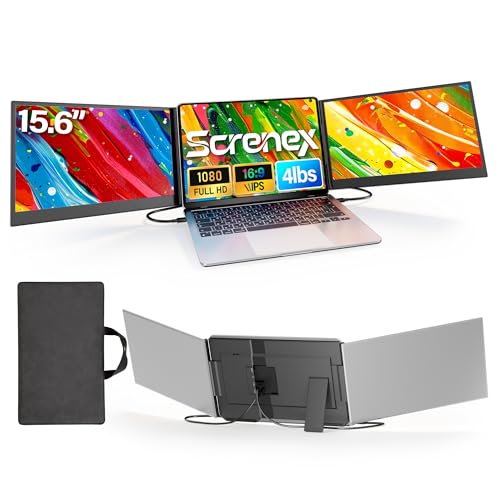
- Two 15.6-inch 1080p IPS panels
- Free-standing, non-clamping design
- Includes power adapter, cables, and carrying bag
Best For: Editors wanting large screens without loading the laptop hinge
Best Lightweight Dual-Screen Pick
Ultra-Portable 14.2" FHD Extender

- 1.87-pound, 0.27-inch-thin design
- 1080p IPS display with 300-nit brightness
- Driver-free USB-C setup plus HDMI/USB-A options
Best For: Traveling video editors who want one extra screen
Best Rugged Triple-Screen Pick

- 1080p IPS display with anti-glare and TÜV SÜD eye-care
- Six-point mounting system and adjustable stand
- Supports triple-screen modes across major operating systems
Best For: Editors needing a stable three-screen mobile workspace
Best Large Triple-Screen Value
15.6" One-Cable Triple Extender

- Large 15.6-inch 1080p IPS display
- One full-featured USB-C port can power both screens
- Includes cables, power adapter, and carrying bag
Best For: Editors prioritizing screen size and triple-screen workspace
Best for Color-Conscious Editors
Enzion 14-inch Triple Monitor Extender

- Dual 1080p IPS screens with 100% sRGB coverage
- Supports portrait, mirrored, and extended modes
- Slim design with a 90-degree adjustable stand
Best For: Editors needing portable workspace and broad color coverage
Color-Accurate Triple-Screen Pick – KEFEYA 15.6" FHD Extender
For video editors who need more room for timelines, previews, and editing panels, this KEFEYA model adds two 15.6-inch Full HD IPS displays to create a portable triple-screen workstation. Its claimed 100% sRGB coverage, 300-nit brightness, and independent display adjustments make it especially appealing for color-conscious workflows, although compatibility should be checked carefully before buying.
Best For: Video editors using compatible Windows, Chrome, Linux, Android, or Samsung DeX laptops who want large, color-focused screens on the go.
Pros:
- Two 15.6-inch 1080p IPS displays with claimed 100% sRGB coverage
- Multiple display modes, including extended, mirrored, landscape, and portrait
- Includes connection cables and a carrying bag
- Ultra-thin 0.16-inch design with a 3.9-pound listed weight
Cons:
- Not directly compatible with Mac M1, M2, or M3 chips without a separate adapter
- Its larger dual-panel design is heavier than some compact extenders
- HDMI connections require additional USB power
The KEFEYA is a strong choice when screen size and stated color coverage matter more than minimum carry weight. Confirm that your laptop has compatible video-capable ports, particularly if you use a newer MacBook.
Lightest Travel Choice – Blackview 14.1" Triple-Screen Extender
Among laptop screen extenders for video editing, the Blackview DCM6 Pro stands out for portability. At a listed 2 pounds, it adds a 14.1-inch 1080p IPS display while using a single USB-C cable on compatible systems, giving mobile editors extra workspace without the bulk of larger dual-panel designs.
Best For: Traveling editors who prioritize low weight, a clean setup, and comfortable long-session viewing.
Pros:
- Listed at just 2 pounds for easier business and coffee-shop travel
- One USB-C cable connection on compatible laptops
- Flicker-free, low-blue-light display with TÜV certifications
- 1920×1080 IPS screen with claimed 100% sRGB color gamut
Cons:
- The 14.1-inch screen provides less workspace than 15.6-inch alternatives
- Initial driver installation may be required
- One-cable operation depends on a compatible full-function USB-C port
The Blackview makes the most sense for editors who regularly work away from a desk and want a lighter setup. Its 100% sRGB claim is useful for preview and editing tasks, but users should verify port and driver compatibility before relying on it for a travel workflow.
Most Flexible Setup – 15.6" Rotating Detachable Extender
This 15.6-inch extender is a flexible option for laptop screen extenders for video editing, with 235-degree horizontal rotation, 90-degree vertical rotation, and detachable panels. Editors can arrange screens in landscape, portrait, or stacked configurations, then use each 2.1-pound side independently when traveling.
Best For: Editors who need adaptable screen positioning for timelines, vertical footage, client presentations, or collaborative viewing.
Pros:
- 235-degree horizontal and 90-degree vertical adjustment
- Detachable sides can be used as independent 2.1-pound displays
- 15.6-inch 1080p IPS screens with anti-glare and low-blue-light features
- Supports USB-C, USB-A, and HDMI connection options
Cons:
- HDMI use requires a separate USB-A-to-USB-C power connection
- Not compatible with standard M1, M2, or M3 Mac chips according to the notes
- Glossy screen finish may be less convenient in bright environments
Choose this model if positioning flexibility is more important than the simplest physical design. The detachable format is useful for presentations and travel, while the 15.6-inch panels provide ample room for editing controls and media previews.
Stable Stand Design – P7 15.6" FHD Triple Monitor
The P7 takes a different approach to laptop screen extenders for video editing by standing behind the laptop instead of hanging from its display. Its two 15.6-inch 1080p IPS panels offer generous room for a timeline, preview window, and editing tools, while the widened non-slip stand is designed to reduce hinge and screen stress.
Best For: Desk-based or traveling editors who want large screens with a free-standing setup that does not clamp onto the laptop display.
Pros:
- Two 15.6-inch 1080p IPS panels with 178-degree viewing angles
- Free-standing design avoids hanging weight on the laptop screen
- Two USB-C cables provide plug-and-play setup on compatible laptops
- Includes cables, power adapter, carrying handbag, and guides
Cons:
- Listed weight is 3.9 pounds, so it is not among the lightest options
- M1–M3 MacBooks require an extra H5-T cable and driver installation
- Two-cable setup requires two full-function USB-C ports for the simplest connection
The P7 is a sensible pick for editors who prefer a stable freestanding arrangement and want two large side screens. Before buying, check your laptop’s ports and account for the extra adapter and driver requirements if you use a newer MacBook.
Best Lightweight Dual-Screen Pick – Ultra-Portable 14.2" FHD Extender
For shoppers comparing laptop screen extenders for video editing, this 14.2-inch model offers a practical balance of workspace and portability. Its 1080p IPS panel supports extend, mirror, and portrait modes, helping keep editing tools, reference material, or media controls visible without constant tab switching.
Best For: Video editors, remote workers, students, and frequent travelers using 14- to 17.3-inch laptops.
Pros:
- 1080p IPS display with 300-nit brightness and a 226-degree adjustable viewing range.
- Lightweight 1.87-pound, 0.27-inch-thin design for travel setups.
- Driver-free USB-C setup, with HDMI and USB-A connectivity for compatible laptops.
- Supports Windows, macOS, ChromeOS, Linux, and Android.
Cons:
- It is a single additional screen rather than a triple-screen setup.
- Full-function USB-C is needed for the simplest one-cable connection.
This is a strong choice when portability matters as much as extra editing space. The 1080p resolution is useful for timelines and panels, while the lightweight design keeps a mobile workstation manageable.
Best Rugged Triple-Screen Pick – Blackview 14.1" FHD Extender
Among laptop screen extenders for video editing, the Blackview model stands out for adding a third-screen workflow in a relatively portable package. Its 14.1-inch 1080p IPS display, anti-glare treatment, and adjustable stand can help editors keep a timeline, preview, and supporting panels visible at once.
Best For: Editors and professionals who want triple-screen multitasking with a durable mounting system.
Pros:
- 1080p IPS display with 300-nit brightness, anti-glare support, and TÜV SÜD eye-care certification.
- Six-point mounting system, reinforced pads, and a 90-degree adjustable stand for stability.
- Supports mirror, extend, and portrait modes through USB-C or HDMI.
- Compatible with 13- to 17.3-inch laptops and Windows, Mac, ChromeOS, Android, and Linux.
Cons:
- Dual-screen functionality works best with two full-featured USB-C ports or USB-C plus HDMI.
- The supplied details describe a replacement-only warranty policy.
The Blackview is a practical fit for editing workflows that benefit from three active displays. Its stable construction and eye-care features are appealing for long sessions, but buyers should verify their laptop’s ports before ordering.
Best Large Triple-Screen Value – 15.6" One-Cable Triple Extender
This 15.6-inch model is a useful option for laptop screen extenders for video editing when a larger secondary display and triple-screen layout are priorities. It can connect both screens through one full-featured USB-C port after driver installation, giving editors more room for timelines, previews, and tool panels.
Best For: Video editors and multitaskers who prefer a larger 15.6-inch triple-screen setup.
Pros:
- 15.6-inch 1080p IPS screen with a 178-degree viewing angle.
- One-cable connection can operate both screens through one full-featured USB-C port.
- Includes two Type-C cables, a USB-A-to-USB-C cable, power adapter, guide, and carrying bag.
- Supports Windows, Mac, ChromeOS, Android, Linux, DeX, and Switch.
Cons:
- Driver installation is required before use.
- An extra power supply may be needed if the laptop cannot provide enough power.
- The listed package weight is 4 pounds, making it less travel-friendly than lighter models.
The larger screen and included accessories make this extender appealing for spacious mobile editing stations. Its one-cable approach is convenient after setup, but the driver requirement and possible extra-power needs add some preparation.
Best for Color-Conscious Editors – Enzion 14-inch Triple Monitor Extender
For video editors who need more workspace without carrying a full desktop setup, this laptop screen extender for video editing adds two 14-inch 1080p displays to compatible laptops. Its IPS panels, 100% sRGB gamut, matte finish, and adjustable display controls are useful for organizing timelines, media bins, and editing tools across multiple screens.
Best For: Editors and creative professionals who prioritize color coverage, flexible screen modes, and a portable triple-display setup.
Pros:
- Dual 1080p IPS displays with 100% sRGB coverage, 300-nit brightness, and a 178-degree viewing angle.
- Supports extended, mirrored, portrait, and presentation modes for flexible editing workflows.
- Ultra-slim 0.3-inch design with a built-in stand adjustable up to 90 degrees.
- Works with 13- to 17-inch laptops and supports Windows, Mac, Chrome, and Switch devices.
Cons:
- Some laptops need an H5-T cable, including systems without full-featured USB-C and M1/M2/M3 MacBooks.
- At roughly 3.37 pounds, it adds noticeable weight to a travel setup.
This is a strong choice when editing benefits from accurate-looking color and substantial workspace. Check your laptop ports carefully before ordering, since compatibility may require an additional cable and, in some configurations, driver installation.
Best Portable Dual-Screen Value – CIDETTY 14-inch FHD Extender
This CIDETTY model is a practical laptop screen extender for video editing when you want extra room for a timeline, preview window, and editing controls. The 14-inch 1080p IPS display connects through USB-C or HDMI and includes a protective case, making it suited to mobile editing setups.
Best For: Laptop editors who want a lightweight dual-screen workflow with built-in speakers and included connection cables.
Pros:
- 14-inch 1080p IPS display with a 178-degree viewing angle and 1000:1 contrast ratio.
- Supports mirrored and extended display modes for multitasking.
- Includes built-in speakers, protective case, USB-C cables, HDMI-to-USB-C cable, and power cables.
- Compatible with Windows, macOS, Linux, Android, PS, Xbox, and Switch when the required ports are available.
Cons:
- Not compatible with MacBooks using M1, M2, or M3 chips according to the supplied notes.
- Some Surface devices with only one Type-C port are unsupported.
- The listed screen finish is glossy, which may produce more reflections than a matte panel.
Its included accessories and protective case make this a convenient option for editors who frequently work away from a desk. Confirm that your laptop has either two full-featured USB-C ports or one full-featured USB-C port plus HDMI before purchase.
Best for Cable-Simple Setups – Macsecor 14-inch Triple Extender
For editors who want a quick triple-screen arrangement, this Macsecor laptop screen extender for video editing uses a two-cable plug-and-play design with two 14-inch 1080p screens. The extra displays can keep editing panels and reference material visible while the laptop handles the main preview or timeline.
Best For: Editors and multitaskers who value a streamlined setup, multiple viewing modes, and a travel-friendly design.
Pros:
- Adds two 14-inch 1080p screens with HDR mode, blue-light filtering, anti-glare technology, and 178-degree viewing angles.
- Supports extended, mirrored, duplicate, portrait, and landscape modes.
- Two-cable plug-and-play design works with 13- to 17.3-inch laptops and requires no driver according to the notes.
- Includes a built-in aluminum stand, 180-degree rotation, and a one-year replacement warranty.
Cons:
- Laptops without full-featured USB-C ports and M1/M2/M3 MacBooks require an additional H5-T cable.
- The supplied details identify the screens as glossy, which may be less suitable for glare-prone workspaces.
This model stands out for editors who want triple-screen flexibility without a complicated cable arrangement. It remains important to verify port compatibility, and the manufacturer recommends connecting external power if the screen reports no signal or insufficient brightness.
How We Picked the Best Laptop Screen Extenders for Video Editing
We evaluated these extenders as workflow tools rather than ordinary second screens. Selection factors included advertised 1080p resolution, IPS or comparable panel construction, screen size, hinge or rotation flexibility, laptop-size compatibility, USB-C and HDMI support, cable requirements, portability, and stated eye-care features. We also considered whether a model uses one cable or requires separate video and power connections, since that affects setup speed and desk clutter.
Before buying, verify the exact ports and operating-system support for your laptop. A USB-C port may support data and video, or it may provide power only; that distinction can determine whether an extender works as advertised.
Quick Comparison
| Priority | Look for | Best fit |
|---|---|---|
| Largest editing workspace | 15.6-inch 1080p panels | Desktop-based video editors |
| Travel weight | 14-inch models around 2 pounds | Frequent commuters and creators |
| Simple setup | One-cable USB-C connection | Modern laptops with video-capable USB-C |
| Flexible positioning | Detachable or rotating displays | Editors who change layouts often |
| Broad compatibility | USB-C plus HDMI support | Mixed laptop fleets and older systems |
Key Buying Factors for Laptop Screen Extenders for Video Editing
Resolution and Panel Size
Most options here use 1920-by-1080 resolution. That is adequate for timelines, bins, scopes, and reference windows, but it does not provide a true 4K editing workspace. A 15.6-inch panel offers more usable interface room, while a 14-inch model generally reduces bulk.
Ports, Power, and Cable Management
USB-C is convenient when the laptop supports DisplayPort video and sufficient power. HDMI models may need a separate USB power cable, adapter, or hub. Count the available ports before purchasing, especially if your laptop already uses USB-C for storage, charging, or card readers.
Fit, Weight, and Stability
Check the supported laptop-width range and screen thickness limits. A lightweight extender is easier to carry, but a larger dual-screen assembly can place more load on the laptop hinge. Confirm that the mounting design suits your computer and that the combined setup will fit your bag.
Color and Viewing Comfort
For editing, a stable image, usable brightness, and consistent viewing angles matter more than headline contrast claims. These portable displays can help with arrangement and monitoring, but serious color grading should still use a calibrated, color-accurate reference display.
Who Should Buy Which Laptop Screen Extenders for Video Editing?
Choose a 15.6-inch extender if you prioritize a larger timeline and frequently edit at a desk. Select a 14-inch or ultra-light model if you travel regularly and mainly need bins, notes, audio controls, or a browser on a secondary screen. A one-cable design is best for compatible modern laptops and fast setup, while USB-C-and-HDMI models are safer for users who switch between computers.
Editors who need adaptable layouts should favor detachable or rotating designs. If eye comfort is a priority, look for models with stated TÜV or similar eye-care features, then adjust brightness and viewing distance manually. Finally, treat every extender as a productivity upgrade—not a substitute for checking your laptop’s GPU, editing software support, and port bandwidth.