
The best hard drive docking stations for backups make it easier to connect bare SATA drives, transfer files, and maintain multiple backup copies without installing disks in an enclosure.
We selected 10 options covering simple single-drive docks, dual-bay cloning stations, four-bay models, and versatile SATA/NVMe solutions. Use the guide below to match capacity, speed, connectivity, and workflow to your backup setup.
Best 10 Hard Drive Docking Stations for Backups Picks for 2026
Best Simple SATA Dock
Compact Single-Bay Backup Station
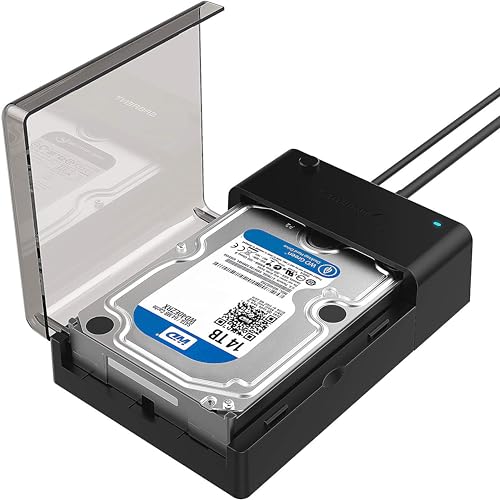
- Accepts one bare 2.5- or 3.5-inch SATA drive
- Tool-free access with hot-swap support
- Includes 12V power adapter for 3.5-inch drives
Best For: Single-drive SATA backups and quick drive access
Best Dual-Bay Dock
USB-C Drive Dock for Two SATA Drives

- Accesses two 2.5- or 3.5-inch SATA drives
- Includes USB-C and USB-A connection cables
- Independent power switches and simultaneous operation
Best For: Two-drive backup and data-access workflows
Best Four-Bay Cloner

- Supports up to four 2.5- or 3.5-inch SATA drives
- Performs offline drive-to-drive cloning
- Trayless design with external power adapter
Best For: Multi-drive backups and offline SATA cloning
Best Hub-Equipped Cloner

- Supports dual 2.5- or 3.5-inch SATA drives
- Offline cloning with progress indicators
- Adds three USB 3.0 Type-A hub ports
Best For: Dual-drive backups, cloning, and USB expansion
High-Capacity Cloning Choice

- Holds two 2.5-inch or 3.5-inch SATA drives
- Offline cloning without a computer
- Supports up to 32TB per drive
Best For: Two-drive backups and offline cloning
Budget Cloning Workhorse

- Dual-bay support for 2.5-inch and 3.5-inch SATA drives
- Offline cloning up to 60Mbps
- Plug-and-play USB 3.0 connectivity
Best For: Basic cloning and backups with drives up to 10TB
Best Multi-Drive Versatility

- Supports two NVMe and two SATA drives
- USB-C 10Gbps transfers
- Individual power switches
Best For: Mixed-drive workflows and large storage collections
Best for Offline Cloning

- Clones drives without a computer
- Supports 2.5- and 3.5-inch SATA drives
- Tool-free plug-and-play design
Best For: Two-drive SATA backups and duplication
Best Simple SATA Backup Dock

- Supports 2.5- and 3.5-inch SATA drives
- Offline clone and duplicator function
- Tool-free USB 3.0 operation
Best For: Easy two-drive SATA backups and cloning
Best Simple SATA Dock – Compact Single-Bay Backup Station
The SABRENT EC-DFLT is a straightforward option for anyone who needs hard drive docking stations for backups involving one bare 2.5- or 3.5-inch SATA drive. Its trayless design supports plug-and-play access, hot-swapping, and USB 3.0 transfers, but you will need the included 12V adapter for a 3.5-inch drive.
Best For: Users backing up or accessing a single bare SATA HDD or SSD at a time.
Pros:
- Supports 2.5- and 3.5-inch SATA I/II/III drives.
- Tool-free, trayless design with hot-swap support.
- Includes a required 12V power adapter for 3.5-inch drives.
- Works without drivers on Windows 10/11, macOS, and Linux.
Cons:
- Supports SATA drives only; it does not support IDE/PATA, M.2, or SAS drives.
- Uses a USB Type-A host connection rather than USB-C.
- S.M.A.R.T. diagnostics are not passed through the USB bridge.
Choose this dock when simplicity and low-profile single-drive access matter most. Confirm your drive has a bare SATA connector and ensure your computer has a compatible USB-A port or adapter.
Best Dual-Bay Dock – USB-C Drive Dock for Two SATA Drives
The OWC Drive Dock is designed for backup workflows that involve two bare SATA drives. It provides dual-bay access for 2.5- and 3.5-inch drives, independent power switches, simultaneous operation, and USB-C connectivity, with both USB-C-to-C and USB-C-to-A cables included.
Best For: Mac and PC users who need to access or manage two SATA drives simultaneously.
Pros:
- Supports two 2.5- or 3.5-inch SATA drives at the same time.
- Includes USB-C-to-C and USB-C-to-A cables.
- Independent power switches allow separate drive control.
- Internal power supply offers universal compatibility.
Cons:
- It is larger and heavier than a basic single-bay dock.
- The supplied details do not indicate support for non-SATA drive types.
- The listing information gives conflicting warranty details, so verify coverage before buying.
For dual-drive backup tasks, the OWC’s two bays and independent switches are more flexible than a single-drive reader. Its included cables also make it easier to connect to computers with either USB-C or USB-A ports.
Best Four-Bay Cloner – Multi-Drive SATA Backup Dock
The SABRENT DS-U3B4 is a strong fit for users who regularly handle several drives. Among hard drive docking stations for backups, its four trayless bays stand out, letting you access up to four 2.5- or 3.5-inch SATA HDDs or SSDs from one USB 3.0 dock. It also supports offline drive-to-drive cloning without a computer.
Best For: Multi-drive backup management and offline cloning of compatible SATA drives.
Pros:
- Holds up to four 2.5- or 3.5-inch SATA drives.
- Supports offline cloning without requiring a computer or software.
- Trayless design allows direct drive insertion without tools.
- Includes an external power adapter for multiple installed drives.
Cons:
- USB 3.0 provides up to 5Gbps interface bandwidth, rather than newer USB speeds.
- Offline cloning is intended for compatible SATA drives and requires careful source/target selection.
- Its four-bay footprint is less compact than a single-drive dock.
This dock makes the most sense for backup routines involving multiple bare SATA drives or repeated cloning jobs. Its offline clone function is especially useful when you want a direct drive-to-drive copy without tying up a computer.
Best Hub-Equipped Cloner – Dual-Bay SATA Backup Station
The MAIWO dual-bay dock combines SATA drive access, offline cloning, and three USB 3.0 hub ports. It supports 2.5- and 3.5-inch SATA HDDs and SSDs, with up to 24TB per bay according to the supplied notes, making it a practical choice for large-capacity backup and data-transfer tasks.
Best For: Users who want dual-drive cloning plus extra USB-A ports for peripherals or flash storage.
Pros:
- Supports two 2.5- or 3.5-inch SATA HDDs or SSDs.
- Performs offline cloning without a computer or drivers.
- Provides three USB 3.0 Type-A hub ports, including one with 2.4A charging.
- Includes a 12V/3A power supply for stable operation.
Cons:
- Uses a USB Type-A data connection rather than USB-C.
- Supports SATA drives only, not other drive interfaces.
- Offline cloning requires a suitable target drive and overwrites the target during duplication.
The MAIWO is a versatile pick when a backup dock also needs to serve as a small USB expansion hub. Its dual bays and offline cloning make it more capable than a basic SATA-to-USB reader, while the included power supply supports both drive sizes.
Reliable Single-Drive Pick – SABRENT USB 3.0 SATA Dock
For straightforward hard drive docking stations for backups, the SABRENT EC-UBLB offers a simple way to access one 2.5-inch or 3.5-inch SATA hard drive or SSD. It supports USB 3.0 transfer speeds up to 5Gbps and includes the required AC adapter, but blank drives must first be initialized in Windows Disk Management or macOS Disk Utility.
Best For: Users who need a compact, single-drive SATA dock for routine backups or drive access.
Pros:
- Works with both 2.5-inch and 3.5-inch SATA drives and SSDs.
- USB 3.0 with UASP supports speeds up to 5Gbps.
- Hot-swap support, LED activity indicators, and automatic sleep after 30 minutes of idle time.
Cons:
- Only supports one drive at a time.
- Not compatible with SAS or M.2 NVMe drives.
- Requires the included AC adapter and initial setup for new or blank drives.
This is a practical choice when you want uncomplicated access to standard SATA drives. Its single-bay design limits drive-to-drive workflows, but the broad 2.5/3.5-inch compatibility makes it useful for everyday backup tasks.
High-Capacity Cloning Choice – UGREEN Dual-Bay SATA Dock
Among hard drive docking stations for backups, the UGREEN CM198 stands out for its two-bay layout and offline cloning mode. It accepts two 2.5-inch or 3.5-inch SATA drives simultaneously, supports up to 32TB per drive, and connects over USB 3.0 at up to 5Gbps.
Best For: Users who regularly manage two SATA drives or want computer-free offline cloning.
Pros:
- Dual-bay design supports two 2.5-inch or 3.5-inch SATA drives at once.
- Offline cloning works without connecting the dock to a computer, provided the target drive is at least as large as the source.
- Includes a USB-C data cable, 12V/3A power adapter, cooling design, dust cover, and anti-slip pads.
Cons:
- Offline cloning requires the destination drive to meet the source drive’s capacity.
- Supports SATA drives, not other drive interfaces.
- The two-drive design takes more space than a single-bay dock.
The CM198 is the most versatile option here for users handling multiple drives. Its offline cloning feature can simplify drive duplication, while the dual-bay capacity also suits backup workflows that involve separate source and destination drives.
Budget Cloning Workhorse – SABRENT Dual-Bay Dock
The SABRENT EC-HD2B is a practical option among hard drive docking stations for backups when you want two drive bays and offline cloning without installing drivers. It supports standard 2.5-inch and 3.5-inch SATA hard drives or SSDs, with USB 3.0 transfer speeds up to 5Gbps and offline cloning up to 60Mbps.
Best For: Users who want a plug-and-play dual-bay SATA dock for cloning and backup transfers.
Pros:
- Supports two standard 2.5-inch or 3.5-inch SATA HDDs or SSDs.
- Offline cloning can duplicate drives without requiring a computer connection.
- Plug-and-play operation requires no drivers, and USB 3.0 supports up to 5Gbps transfer speeds.
Cons:
- Offline cloning is specified at up to 60Mbps, slower than its USB-connected transfer rating.
- Drive support is limited to SATA storage.
- The supplied notes specify support for drives up to 10TB.
This dock balances a useful dual-bay layout with simple plug-and-play operation. It is a good fit for basic cloning and backup duties, especially if your drives fall within the stated 10TB support limit.
Best Multi-Drive Versatility – 4-Bay NVMe & SATA Dock
For demanding hard drive docking stations for backups, the ICY BOX 4-Bay Dock combines two NVMe M.2 slots with two SATA bays. Its USB-C 10Gbps connection, tool-free design, and individual drive switches suit users who regularly access several different drives.
Best For: IT professionals, video editors, and data hoarders managing mixed NVMe and SATA storage.
Pros:
- Accommodates up to two NVMe M.2 and two SATA drives simultaneously.
- USB-C 10Gbps connectivity supports fast file transfers.
- Individual power switches let you control each drive separately.
- Tool-free, plug-and-play operation works with Windows, Mac, and Linux.
Cons:
- Provides data transfer only and does not include an offline cloning function.
- Its four-drive capacity may be more than needed for occasional backup tasks.
This is the most flexible option here for mixed-drive workflows and large storage collections. Choose it when broad compatibility and per-drive control matter more than standalone cloning.
Best for Offline Cloning – WAVLINK Dual-Bay SATA Dock
Among hard drive docking stations for backups, the WAVLINK Dual Bay stands out for its offline cloning feature. It accepts two 2.5- or 3.5-inch SATA drives and can copy between them without a computer, while USB 3.0 provides a convenient connection for file transfers.
Best For: Users who want a straightforward two-drive SATA backup and duplication station.
Pros:
- Offline clone function works without a connected computer.
- Supports 2.5- and 3.5-inch SATA I/II/III HDDs and SSDs.
- Tool-free, hot-swappable, plug-and-play operation requires no driver.
- UASP support can improve USB 3.0 transfer performance.
Cons:
- Designed for SATA drives and does not support NVMe M.2 storage.
- The target drive must have capacity equal to or greater than the source for offline cloning.
- USB 3.0 is slower than the 10Gbps USB-C connection on the four-bay option.
The WAVLINK is a practical pick when independent, computer-free drive duplication is the priority. Its dual-bay layout keeps the setup simple, though users needing NVMe support or more than two drives should look elsewhere.
Best Simple SATA Backup Dock – ICY BOX Dual-Bay Dock
The ICY BOX Dual-Bay Dock is a straightforward choice among hard drive docking stations for backups. It supports both 2.5- and 3.5-inch SATA drives, offers offline cloning, and connects over USB 3.0 without requiring drivers or tools.
Best For: Home and professional users who need easy access to two SATA HDDs or SSDs.
Pros:
- Supports both 2.5-inch and 3.5-inch SATA SSDs and HDDs.
- Includes an offline clone and duplicator function.
- Tool-free plug-and-play setup works with Windows, macOS, and Linux.
- Supports large-capacity drives up to approximately 30TB.
Cons:
- USB 3.0 transfer speeds are limited to up to 5Gbps.
- Supports two drives rather than the four drives accepted by the ICY BOX multi-bay model.
- Does not support NVMe M.2 drives.
This dock balances broad SATA compatibility with convenient offline cloning. It is a sensible everyday backup tool for users who do not need NVMe support or a higher-speed USB-C interface.
How We Picked the Best Hard Drive Docking Stations for Backups
We focused on practical features that affect everyday backup work: drive compatibility, bay count, connection speed, offline cloning, power delivery, supported capacity, and ease of use. The selection includes docks for 2.5-inch and 3.5-inch SATA HDDs and SSDs, along with models that add USB hubs or support M.2 NVMe storage.
Because a docking station is often used with bare drives, we also considered stability and accessibility. A good dock should hold a drive securely, provide clear status indicators, and make it straightforward to swap storage without tools. Compatibility claims should still be checked against the manufacturer’s current specifications before purchase.
Quick Comparison
Single-bay docks are the simplest choice for occasional file transfers or rotating one backup drive at a time. Dual-bay models are more useful for copying between drives and may support offline cloning. Four-bay stations suit users who manage several disks, while hybrid SATA/NVMe units offer broader flexibility for mixed storage collections.
USB 3.0 is sufficient for many hard drives, but USB 10Gbps or USB-C can reduce transfer bottlenecks when using SATA SSDs or newer computers. A dock’s real-world speed also depends on the drive, host port, cable, filesystem, and workload.
Key Buying Factors for Hard Drive Docking Stations for Backups
Drive Size and Interface
Confirm whether the station accepts both 2.5-inch and 3.5-inch SATA drives. Most listed docks support SATA I, II, and III, but NVMe M.2 drives require a compatible slot and cannot be used in a standard SATA-only bay.
Number of Bays and Cloning
Choose one bay for straightforward access, two bays for drive-to-drive workflows, or four bays for larger archives. Offline cloning is useful when duplicating a source drive without a computer, but source and target capacity requirements vary by model.
Connection and Power
Check the host connector, USB generation, included cable, and power adapter. Desktop 3.5-inch drives require external power, and multi-bay docks need an adapter capable of supporting several spinning disks during startup.
Capacity and Safety
Large-capacity support is important for modern backup libraries, but advertised limits can depend on firmware and drive type. Use safe eject procedures, avoid moving a dock while hard disks are spinning, and maintain at least one additional backup copy off the device.
Who Should Buy Which Hard Drive Docking Stations for Backups?
Occasional home users: Choose a compact single-bay SATA dock for quick access to one spare drive. Backup-focused users: A dual-bay dock with offline cloning offers a convenient way to duplicate disks and rotate backup media. Power users and small offices: A four-bay model is better for organizing several drives, though it needs more desk space and power. Mixed-storage owners: Select a hybrid SATA and NVMe station if your backup collection includes both traditional drives and M.2 SSDs.
Whichever model you choose, verify operating-system support, maximum capacity, cloning requirements, and the return policy before buying. The right dock should complement a tested backup routine rather than serve as the only copy of important data.