
The best hard drive docking stations make it easier to read, clone, back up, and reuse bare drives without installing them inside a computer. They are especially useful for upgrades, data recovery, and managing multiple HDDs or SSDs.
This roundup covers compact single-drive docks, dual-bay cloners, four-bay storage tools, and versatile models with USB-C, UASP, or NVMe support. Use the guide below to match the dock’s drive compatibility, speed, and workflow to your needs.
Best 10 Hard Drive Docking Stations Picks for 2026
Best Dual-Bay Cloning Dock

- Supports 2.5-inch and 3.5-inch SATA drives
- Offline cloning without a computer
- USB 3.0 transfers up to 5Gbps
Best For: Dual-drive backups and drive migration
Best Four-Bay Dock

- Holds up to four SATA HDDs or SSDs
- Trayless, tool-free drive access
- Offline cloning with progress LEDs
Best For: Multi-drive management and technician workflows
Best Hub-Equipped Cloner

- Supports up to 48TB across two bays
- Offline cloning with LED progress stages
- Adds three USB 3.0 hub ports
Best For: High-capacity cloning with extra USB connectivity
Simple SATA Access
Single-Bay SATA Hard Drive Dock
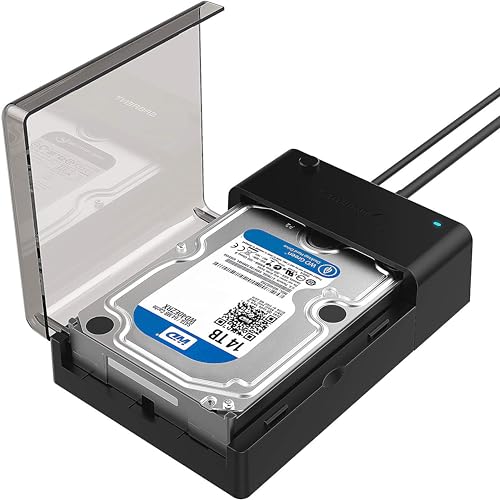
- Supports one 2.5- or 3.5-inch SATA drive
- Includes 12V power adapter for 3.5-inch drives
- Tool-free USB 3.0 access with hot-swap support
Best For: Single-drive SATA access from a USB-A computer
Dual-Bay Cloning Pick

- Holds two 2.5- or 3.5-inch SATA drives
- Supports offline cloning without a computer
- USB 3.0 and UASP-ready drive access
Best For: Two-drive workflows and standalone SATA cloning
Versatile Dual-Bay Pick

- Dual bays fit 2.5-inch and 3.5-inch SATA drives
- UASP support with USB 3.0 connectivity
- Offline cloning and hot-swapping included
Best For: SATA drive access, backups, and standalone cloning
Simple USB-C Cloner

- Two independent SATA drive bays
- Button-operated offline cloning
- USB-C connectivity with hot-swapping
Best For: Users working with bare 2.5-inch and 3.5-inch SATA drives
Most Flexible Three-Bay Option

- Three bays for NVMe and SATA drives
- One-touch offline cloning across drive types
- USB 3.2 Gen 2 speeds up to 10Gbps
Best For: Mixed-drive workflows and frequent storage migrations
Best Dual-Bay Cloning Dock – Dual-Bay SATA Dock
The SABRENT EC-HD2B is a practical choice among hard drive docking stations when you need to access or clone two 2.5-inch or 3.5-inch SATA drives. Its USB 3.0 connection supports transfers up to 5Gbps, and the tool-free design requires no drivers.
Best For: Home users, technicians, and anyone needing dual-drive access or offline cloning.
Pros:
- Supports 2.5-inch and 3.5-inch SATA HDDs and SSDs.
- Supports drives up to 10TB and up to 20TB total capacity.
- Offers offline cloning without a computer.
- Plug-and-play setup with USB 3.0 and UASP support.
Cons:
- Offline cloning is rated at up to 60Mbps, slower than its USB transfer rating.
- Limited to two installed drives.
With broad SATA compatibility and a dedicated cloning function, this dock is a balanced option for routine backups, drive migration, and file access.
Best Single-Bay High-Capacity Dock – 22TB SATA Dock
The ORICO DD18 is a compact single-bay option among hard drive docking stations for reading 2.5-inch or 3.5-inch SATA drives. It supports drives up to 22TB, uses USB 3.0 with UASP, and includes a 12V power adapter for stable operation.
Best For: Users who need straightforward access to one high-capacity SATA HDD or SSD.
Pros:
- Supports SATA I, II, and III 2.5-inch and 3.5-inch drives.
- Handles drives up to 22TB.
- Works with Windows, macOS, Linux, and other listed platforms.
- Includes hot-swapping, LED indicators, and automatic sleep after inactivity.
Cons:
- Only one drive can be connected at a time.
- Does not support IDE or SAS drives.
- New or unallocated drives must be initialized and formatted before recognition.
This ORICO dock emphasizes capacity and broad device compatibility, making it well suited to occasional drive access, backups, and data transfers.
Best Four-Bay Dock – Four-Bay SATA Clone Dock
The SABRENT DS-U3B4 is designed for managing several drives at once. Among hard drive docking stations, its four trayless bays make it useful for accessing up to four 2.5-inch or 3.5-inch SATA HDDs and SSDs, while its offline clone function works without a computer.
Best For: Technicians and power users managing multiple SATA drives, backups, or drive clones.
Pros:
- Holds up to four 2.5-inch or 3.5-inch SATA drives.
- Supports USB 3.0 transfers up to 5Gbps with USB 2.0 backward compatibility.
- Trayless design allows direct drive insertion without tools.
- Offline cloning includes LED progress indicators.
Cons:
- Larger than single- and dual-bay alternatives.
- The supplied notes do not specify a maximum drive capacity.
Its main advantage is workflow flexibility: four bays reduce repeated drive swapping and simplify multi-drive access, while plug-and-play operation keeps setup uncomplicated.
Best Hub-Equipped Cloner – 48TB Dual-Bay Hub
The MAIWO dual-bay dock combines drive cloning with extra connectivity. For shoppers comparing hard drive docking stations, it supports 2.5-inch and 3.5-inch SATA drives, offers up to 48TB total capacity, and adds three USB 3.0 Type-A hub ports.
Best For: Users who want offline cloning, high-capacity drive support, and additional USB ports in one device.
Pros:
- Supports two SATA drives with up to 24TB per bay.
- Provides offline cloning without requiring a computer.
- Includes three USB 3.0 Type-A hub ports.
- Uses a 12V 3A power supply for stable operation.
Cons:
- Drive cloning is limited to compatible SATA HDDs and SSDs.
- Connected phones must support OTG to read a hard drive.
This MAIWO model stands out for combining a dual-bay cloner with a USB hub, making it a versatile workstation accessory for backups, file transfers, and data processing.
Simple SATA Access – Single-Bay SATA Hard Drive Dock
For straightforward hard drive docking stations use, the SABRENT EC-DFLT provides a tool-free way to access one bare 2.5- or 3.5-inch SATA drive. It supports USB 3.0 with UASP and works with Windows 10/11, macOS, and Linux without requiring drivers.
Best For: Users who need a compact single-bay dock for SATA HDDs or SSDs and have a USB-A computer port.
Pros:
- Accepts both 2.5- and 3.5-inch SATA drives.
- Includes the 12V/2A adapter required for 3.5-inch drives.
- Tool-free, plug-and-play design supports hot-swapping.
- UASP support can improve transfers with a compatible host.
Cons:
- Does not support IDE/PATA, M.2, SAS, or USB-enclosed drives.
- Uses a USB Type-A host cable; a USB-C adapter is not included.
- S.M.A.R.T. diagnostics do not pass through the USB bridge.
This is a practical choice when you want uncomplicated access to a single bare SATA drive. Confirm the drive connector and your computer’s USB port before ordering, especially if you use a USB-C-only laptop.
Dual-Bay Cloning Pick – FIDECO Dual-Bay SATA Dock
The FIDECO YPZ04-S2 stands out among hard drive docking stations for its dual-bay layout and offline cloning feature. It can connect two 2.5- or 3.5-inch SATA HDDs or SSDs to a computer over USB 3.0, or clone between inserted drives without a computer.
Best For: Users who need to work with two SATA drives at once or perform a computer-free drive clone.
Pros:
- Dual bays accept two 2.5- or 3.5-inch SATA drives simultaneously.
- Offline clone function works without a connected computer.
- USB 3.0 supports transfer rates up to 5Gbps.
- Supports Windows, macOS, and Linux with plug-and-play operation.
Cons:
- Supports SATA HDDs and SSDs only.
- New drives must be initialized before the computer can recognize them.
- Offline cloning requires inserting two drives into the correct bays and holding the Clone button.
Choose this model if dual-drive flexibility matters more than a minimal single-bay footprint. Its offline cloning feature is especially useful for drive migrations, while the included power adapter supports the dock’s two-drive design.
Reliable Powered Access – SABRENT SATA Dock with Auto-Sleep
The SABRENT EC-UBLB is a powered single-bay option for accessing 2.5- and 3.5-inch SATA drives. Among hard drive docking stations, it adds useful status indicators and an automatic sleep mode while retaining USB 3.0, UASP, and hot-swap support.
Best For: Users who want a powered SATA dock with visible activity indicators and automatic idle sleep.
Pros:
- Supports 2.5- and 3.5-inch SATA HDDs and SSDs up to 20TB.
- Includes the required AC power adapter and USB 3.0 cable.
- Auto-sleeps after 30 minutes of idle time and wakes on access.
- Power and transfer LEDs make activity easy to monitor.
Cons:
- Supports SATA drives only, not SAS or M.2 NVMe drives.
- AC power and the supplied adapter are required for operation.
- New or blank drives must be initialized or formatted before appearing.
This dock is a sensible fit for routine backups, drive checks, and storage swaps when you appreciate clear status lighting. Remember to connect and switch on the adapter, and avoid removing a drive while it is being accessed.
Versatile Dual-Bay Pick – WAVLINK USB 3.0/SATA Dock
The WAVLINK dual-bay docking station is a practical choice for users who need to access or clone two 2.5-inch or 3.5-inch SATA HDDs or SSDs. It supports USB 3.0 connectivity, UASP, hot-swapping, and tool-free setup across Windows, macOS, and Linux systems, though M1/M2-based Macs are not supported.
Best For: Users who need an affordable dual-bay SATA dock with offline cloning and broad operating-system compatibility.
Pros:
- Supports both 2.5-inch and 3.5-inch SATA HDDs and SSDs.
- Offers USB 3.0 transfer speeds with UASP support up to 6Gbps.
- Offline cloning works without a computer, with a target drive capacity equal to or greater than the source.
- Includes hot-swapping, automatic sleep after 30 minutes, and a built-in power switch.
Cons:
- Not compatible with M1/M2-based Macs.
- Offline cloning is limited to source-to-target copying and does not support online cloning.
- Supports SATA drives only; the supplied notes do not indicate compatibility with M.2 or NVMe drives.
For straightforward SATA drive access and occasional standalone cloning, this hard drive docking station provides useful features without requiring drivers. Its dual-bay layout is especially convenient for transfers, backups, and drive upgrades.
Simple USB-C Cloner – SABRENT Dual-Bay SATA Dock
The SABRENT EC-CH2B is a focused hard drive docking station for two bare 2.5-inch or 3.5-inch SATA drives. Its USB-C connection lets both installed drives appear separately on a computer, while the dedicated offline-clone function copies one drive to another without requiring a PC.
Best For: Users who want a compact USB-C dock for simultaneous SATA drive access and uncomplicated offline cloning.
Pros:
- Reads and writes two SATA HDDs or SSDs at the same time when connected to a computer.
- Offline cloning starts at the press of a button and does not require a computer.
- Tool-free, hot-swappable bays accommodate both 2.5-inch and 3.5-inch SATA drives.
- Includes a USB-C cable and supports USB 3.0 speeds up to 5Gbps.
Cons:
- Does not support IDE/PATA, M.2, NVMe, or 4-pin Molex-powered drives.
- The included cable is USB-C on the dock end, so computers without USB-C may require a separate cable.
- Mechanical hard drives will not reach the advertised 5Gbps interface limit.
This model keeps its feature set focused on SATA media, making it easy to use for drive-to-drive transfers and routine file work. Check your computer’s port configuration and drive type before buying.
Most Flexible Three-Bay Option – ICY BOX NVMe/SATA Dock
The ICY BOX triple-bay hard drive docking station is designed for mixed storage environments, combining an M.2 PCIe NVMe slot with bays for 2.5-inch and 3.5-inch SATA HDDs and SSDs. It supports one-touch offline cloning, three independent drive slots, and USB 3.2 Gen 2 connectivity up to 10Gbps.
Best For: Professionals and enthusiasts who regularly manage NVMe and SATA drives or need to access up to three drives at once.
Pros:
- Supports cloning between M.2 PCIe NVMe, 2.5-inch SATA, and 3.5-inch SATA drives.
- Three independent bays allow multiple drives to be connected simultaneously.
- USB 3.2 Gen 2 provides transfer speeds up to 10Gbps.
- Includes both USB-C-to-USB-C and USB-C-to-USB-A connectivity, plus a 24-month warranty.
Cons:
- The enclosure is plastic rather than metal.
- Its broader feature set may be more than needed for users who only work with standard SATA drives.
- Actual transfer performance depends on the installed drives and connected system.
Among these hard drive docking stations, the ICY BOX offers the most flexible drive-format support and the greatest bay capacity. It is a strong fit for mixed-drive workflows, migration projects, and users who want NVMe compatibility alongside traditional SATA access.
How We Picked the Best Hard Drive Docking Stations
We focused on practical features that affect everyday use: supported drive sizes and interfaces, USB connectivity, cloning capability, bay count, power requirements, and ease of setup. The selection includes docks for 2.5-inch and 3.5-inch SATA drives, as well as options that support NVMe SSDs or multiple drives at once.
We also considered whether each model suits a specific use case, such as occasional drive access, full-disk cloning, desktop backups, or managing several bare drives. Specifications can vary by revision, so confirm the manufacturer’s compatibility details before buying.
Quick Comparison
| Best For | Recommended Type | Important Features |
|---|---|---|
| Basic drive access | Single-bay SATA dock | Simple setup, broad 2.5/3.5-inch support |
| Drive cloning | Dual-bay cloner | Offline cloning, independent source and target bays |
| Several drives | Four-bay dock | Higher capacity and multi-drive management |
| Modern laptops | USB-C dock | Reversible connector and wider host compatibility |
| Fast SSD workflows | NVMe or 10Gbps dock | Higher interface bandwidth and SSD support |
Key Buying Factors for Hard Drive Docking Stations
Drive Compatibility
Check whether the dock supports 2.5-inch drives, 3.5-inch drives, or both. Most SATA models work with common HDDs and SSDs, but an NVMe SSD requires a compatible M.2 slot and the correct key or protocol. A SATA M.2 drive is not automatically compatible with an NVMe bay.
Bay Count and Cloning
A single-bay model is suitable for accessing one bare drive at a time. Dual-bay docks are more useful for disk-to-disk cloning, provided they support offline cloning and the target drive is equal to or larger than the source. Four-bay designs are better for users who regularly rotate or compare multiple drives.
Connection Speed and Host Ports
USB 3.0 is adequate for many hard drives, while USB-C and USB 3.2 connections can offer easier compatibility or greater bandwidth. UASP can improve performance with supported computers and drives, but real-world speeds remain limited by the drive, USB port, and file workload.
Power and Capacity
3.5-inch hard drives require more power than 2.5-inch drives, so choose a dock with a suitable external adapter. Check stated maximum capacity if you plan to use high-capacity disks, and remember that cloning and storage limits may differ between models.
Who Should Buy Which Hard Drive Docking Stations?
Choose a compact single-bay SATA dock if you need occasional access to an old laptop drive or a spare desktop disk. Pick a dual-bay cloner if you are replacing a drive and want a straightforward offline migration process. A four-bay dock makes more sense for IT work, media storage, or frequent drive testing.
USB-C models are a convenient choice for newer laptops, but verify that the included cable matches your computer’s port and that the dock does not require a separate adapter. If your workflow includes M.2 NVMe drives, choose a model explicitly designed for NVMe rather than relying on a standard SATA docking station.