
Choosing among the best resin printers for prototypes means balancing detail, speed, build volume, material performance, and workflow convenience. The right machine can help you move from a digital concept to accurate visual models, fit checks, and functional test parts with fewer delays.
This roundup compares 10 selected resin printers, resins, and printer bundles to help designers, engineers, makers, and small teams find a practical setup for prototype development.
Best 10 Resin Printers for Prototypes Picks for 2026
High-Resolution Pick

- 16K detail with 14 x 19 μm XY resolution
- Automatic resin heating and leveling
- AI monitoring and up to 150 mm/h printing
Best For: Detailed prototypes and larger intricate models
Industrial Resin Pick

- 14K detail with 16.8 x 24.8 μm pixels
- Supports resin viscosity up to 8,000 cps
- Auto-leveling and AI inspection features
Best For: Detailed prototypes using advanced or high-viscosity resins
Tough Prototype Material

- Designed for bending and repeated stress
- Over 20% higher impact strength
- Low shrinkage supports accurate assemblies
Best For: Functional prototypes and durable everyday parts
Precision Speed Pick

- 566:1 high-contrast amber screen
- One-click repair, slicing, and support generation
- Real-time force monitoring and ≤2 μm Z repeatability
Best For: Professional, speed-focused prototype production
Best Beginner-Friendly Pick
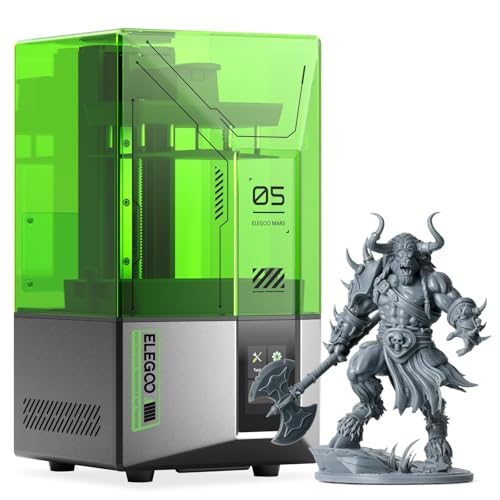
- One-click automatic leveling
- 4K detail with COB lighting
- Sensors help prevent waste and damage
Best For: Beginners and makers seeking simple, detailed prototype printing
Best Large-Format Pick

- 18.3L build volume for large parts
- 14-inch 12K screen for fine detail
- Heated 1900ml resin tank supports stable flow
Best For: Large prototypes and high-volume batch production
Best Fast High-Resolution Pick

- Up to 150mm/h printing
- 16K LCD with 14 × 19μm XY resolution
- AI camera and heated resin tray
Best For: Fast, highly detailed prototypes with active monitoring
Budget-Friendly Precision

- Low-shrinkage formula for accurate parts
- Works with 365–405nm LCD, DLP, and SLA printers
- Smooth, paintable surfaces at an affordable cost
Best For: Affordable everyday prototypes and models
Complete Prototype Workflow
ELEGOO Saturn 4 Ultra 16K Bundle

- 16K resin printer with 150mm/h listed speed
- 30°C smart tank heating
- Includes 7.5-liter Mercury Plus V3.0 wash-and-cure station
Best For: Detailed prototypes with an all-in-one workflow
High-Resolution Pick – ELEGOO Saturn 4 Ultra 16K
For resin printers for prototypes that need fine detail, generous build space, and streamlined operation, the ELEGOO Saturn 4 Ultra 16K is a strong fit. Its 16K screen, automatic resin heating, and automatic leveling are geared toward repeatable prototype work.
Best For: Detailed prototypes, larger models, and users who value high resolution with automated monitoring.
Pros:
- 16K resolution with a 14 x 19 μm XY resolution for intricate models.
- Automatic resin-tank heating helps maintain suitable printing temperatures.
- AI camera, resin monitoring, foreign-object detection, and automatic leveling support easier operation.
- Up to 150 mm/h printing speed, plus Wi-Fi transfer and power-on resume.
Cons:
- Its 35.4-pound weight and larger footprint require a sturdy, dedicated workspace.
- The feature-rich system may be more than needed for simple prototype projects.
The Saturn 4 Ultra 16K stands out when prototype detail and workflow automation matter. Choose it if you want a large, high-resolution platform with built-in checks designed to reduce hands-on troubleshooting.
Industrial Resin Pick – ANYCUBIC Photon P1 14K
The ANYCUBIC Photon P1 is a practical option among resin printers for prototypes when you need crisp detail, stable motion, and compatibility with high-viscosity materials. Its factory-calibrated leveling and monitoring features are designed to simplify repeatable printing.
Best For: Prototype users working with detailed parts, industrial resins, or demanding material viscosities.
Pros:
- 14K LCD provides a 16.8 x 24.8 μm XY pixel size for fine details.
- Ball screws and precision guide rails help reduce vibration and wobble.
- Wave Release Technology is designed to reduce release force by 60%.
- Handles resins with viscosity up to 8,000 cps and includes AI inspection features.
Cons:
- Its 16.93 x 24.41 x 16.54-inch dimensions call for substantial workspace.
- The advanced material capability may be unnecessary for basic resin prototypes.
With its stable mechanical structure, auto-leveling system, and broad viscosity support, the Photon P1 is suited to prototype workflows that extend beyond standard resin. It is especially compelling when material flexibility and detail accuracy are priorities.
Tough Prototype Material – ELEGOO Tough 2.0 Resin
The ELEGOO Tough 2.0 Resin is a material choice for resin printers for prototypes when parts need more resilience than standard models. Its tougher formulation, higher impact strength, and low shrinkage are aimed at functional parts and assemblies.
Best For: Functional prototypes, durable everyday parts, and assemblies that need dependable fit.
Pros:
- Enhanced toughness helps parts withstand bending and repeated stress.
- Over 20% higher impact strength is designed to resist drops and knocks.
- Low shrinkage supports dimensional accuracy for prototypes and assemblies.
- Lower viscosity promotes smoother flow and more consistent surfaces.
Cons:
- This is resin rather than a printer, so a compatible resin printer is required.
- The 1,000g bottle adds storage and handling considerations for smaller projects.
For prototype parts that must be handled, fitted, or tested repeatedly, Tough 2.0 is more relevant than a detail-only modeling resin. Its combination of toughness, impact resistance, and low shrinkage makes it a sensible functional-prototyping consumable.
Precision Speed Pick – Reflex RS Turbo Resin Printer
The Reflex RS Turbo targets prototype teams that prioritize speed, dimensional consistency, and automated process control. Its high-contrast amber screen, one-click preparation, and real-time force monitoring make it an advanced option among resin printers for prototypes.
Best For: Professional prototype workflows needing fast production, precise positioning, and detailed diagnostics.
Pros:
- High-contrast 566:1 amber screen supports sharp details and faster curing.
- One-click slicing can repair model defects and generate supports automatically.
- Force sensors can detect fine resin residue and auto-pause prints.
- C5 ball-screw Z-axis offers ≤2 μm repeat positioning accuracy, with stated ≤0.05 mm tolerances.
Cons:
- At 50.6 pounds, it is substantially heavier than many compact resin printers.
- Its professional controls and monitoring systems may be excessive for casual prototyping.
- The supplied notes do not specify a build volume or screen resolution.
The Reflex RS Turbo is best considered when throughput and process diagnostics justify a more specialized machine. Its adaptive motion, precision Z-axis, and automated failure protection are particularly relevant to demanding prototype production.
Best Beginner-Friendly Pick – ELEGOO Mars 5
For makers seeking resin printers for prototypes without a complicated setup, the ELEGOO Mars 5 emphasizes quick calibration and dependable operation. Its one-click automatic leveling, self-check function, and 4K mono LCD make it a practical choice for detailed prototype work.
Best For: Beginners and makers who want detailed prototypes with minimal setup.
Pros:
- One-click automatic leveling simplifies setup.
- 4K mono LCD and COB lighting reproduce fine details and textures.
- Residue detection, resin shortage alerts, and leveling-failure alarms help reduce waste.
- Overheat protection automatically stops printing if LED temperature exceeds 80°C.
Cons:
- Its listed features do not indicate a large-format build volume for oversized prototypes.
- The supplied notes do not specify a maximum print speed.
The Mars 5 is a straightforward option for prototype makers who value guided setup and print safeguards over large capacity or speed-focused features.
Best Large-Format Pick – ANYCUBIC Photon P1 Max
The ANYCUBIC Photon P1 Max is built for resin printers for prototypes that need substantial capacity. Its 18.3L build volume supports oversized parts or dense batch runs, while the heated resin tank and automatic leveling are designed to keep production consistent.
Best For: Workshops producing large prototypes or multiple parts in one cycle.
Pros:
- 285.5 × 214 × 300mm build volume accommodates large prototypes and batch production.
- 14-inch 12K monochrome screen delivers fine detail with 24.8 × 24.8μm pixels.
- 1900ml heated resin tank maintains temperatures up to 35°C for more stable resin flow.
- Auto-Leveling 3.0 includes self-checking and real-time force feedback.
Cons:
- Its large 68.9-pound body requires significant workspace and handling capacity.
- Large-format operation may be more printer than small prototype projects require.
Choose the P1 Max when throughput and physical build size matter most. Its large footprint is a trade-off for the ability to print oversized or densely arranged prototype runs.
Best Fast High-Resolution Pick – ELEGOO Saturn 4 Ultra 16K
For resin printers for prototypes where speed and surface detail are equally important, the ELEGOO Saturn 4 Ultra 16K combines tilt-release technology with a 16K mono LCD. Its monitoring camera, resin-tray heating, and mechanical sensors add practical safeguards during longer prototype runs.
Best For: Prototype teams prioritizing fast production, very fine detail, and print monitoring.
Pros:
- Print speeds reach up to 150mm/h using tilt-release technology.
- 16K resolution and 14 × 19μm XY resolution support highly detailed prints.
- AI camera detects empty build plates and model warping for real-time monitoring.
- Automatic tray heating maintains resin at 25°C and supports preheating.
Cons:
- The supplied notes do not specify the printer’s build volume.
- Its advanced features may be unnecessary for simple, low-detail prototypes.
The Saturn 4 Ultra 16K is a strong fit for demanding prototype workflows that benefit from rapid printing and fine resolution, especially when active monitoring and temperature control are useful.
Budget-Friendly Precision – SUNLU Standard Resin Plus
For makers comparing resin printers for prototypes, SUNLU Standard Resin Plus is a practical material choice for producing accurate, smooth parts without a premium price. Its low shrinkage, broad printer compatibility, and easy post-processing make it approachable for both beginners and general prototyping work.
Best For: Budget-conscious users making detailed prototypes, models, and hand-finished parts.
Pros:
- Low shrinkage supports accurate part dimensions and shapes.
- Compatible with 365–405nm LCD, DLP, and SLA printers.
- Hard, smooth surfaces are easy to clean and paint.
- Minimal odor and a leak-resistant bottle design improve handling.
Cons:
- Standard resin may be less suitable than specialty formulations for demanding functional prototypes.
- Requires cleaning with isopropyl alcohol or ethanol after printing.
SUNLU Standard Resin Plus offers a sensible balance of precision, usability, and cost. It is a strong everyday option when prototype appearance and dimensional consistency matter more than specialized material performance.
Large-Format Detail – ELEGOO Jupiter 2
For resin printers for prototypes that need substantial build capacity, the ELEGOO Jupiter 2 combines a 302.4 × 161.98 × 300 mm build volume with 16K resolution. It is designed for larger parts, batch production, and detailed prints, while automated features simplify setup and monitoring.
Best For: Professionals and advanced makers producing large prototypes or multiple parts in one job.
Pros:
- Large build volume supports oversized objects and batch printing.
- 16K resolution and 20 × 26 μm XY resolution target fine detail.
- Auto leveling, smart tank heating, and automated resin replenishment streamline printing.
- Built-in camera, Wi-Fi, alarms, and power-loss recovery support remote oversight.
Cons:
- At 63.8 pounds, it is a substantial printer that requires dedicated space.
- Its large-format feature set may be more than casual users need.
The Jupiter 2 is the strongest fit here when prototype scale and throughput are priorities. Its high-resolution system and automation make it capable, but the large footprint and advanced feature set suit a more serious workspace.
Complete Prototype Workflow – ELEGOO Saturn 4 Ultra 16K Bundle
ELEGOO Saturn 4 Ultra 16K Resin 3D Printer and ELEGOO Mercury Plus V3.0 Wash and Cure Station
Check Price On AmazonFor buyers seeking resin printers for prototypes with post-processing included, this ELEGOO bundle pairs the Saturn 4 Ultra 16K printer with a Mercury Plus V3.0 wash and cure station. Smart tank heating, fast printing, and a large-capacity cleaning station create a more complete workflow from print to finished part.
Best For: Users who want a coordinated printing, washing, and curing setup for detailed prototypes.
Pros:
- 16K printer provides a detailed-resolution platform for prototype work.
- 150mm/h listed print speed supports faster production cycles.
- 30°C smart tank heating helps maintain a controlled printing environment.
- Mercury Plus V3.0 offers a 7.5-liter wash-and-cure capacity.
Cons:
- The bundled setup requires space for both the printer and wash-and-cure station.
- Its included workflow may be unnecessary for buyers who already own post-processing equipment.
This bundle is convenient for anyone building a resin workflow from the ground up. The printer’s resolution and speed address detailed prototype production, while the included station reduces the need to source compatible cleaning and curing equipment separately.
How We Picked the Best Resin Printers for Prototypes
We evaluated the selected products against the needs of prototype work rather than treating resolution as the only priority. Our comparison considers print detail, build volume, printing speed, leveling and automation features, resin compatibility, post-processing requirements, and overall workflow value.
Printer bundles and materials are included because a usable prototyping setup often depends on more than the printer itself. Wash-and-cure equipment can simplify finishing, while tough or fast-curing resins may be better suited to repeated design iterations than basic display materials.
Quick Comparison
| Best For | Recommended Type | Why It Matters |
|---|---|---|
| Fine surface detail | 16K resin printer | Produces crisp edges and smooth small features. |
| Fast iteration | High-speed resin printer | Shortens the time between design changes. |
| Large prototypes | Large-format resin printer | Prints bigger parts or multiple components together. |
| Impact-resistant parts | Tough engineering resin | Better suited to handling and fit testing. |
| Simple finishing | Printer and wash-cure bundle | Reduces manual post-processing steps. |
Key Buying Factors for Resin Printers for Prototypes
Resolution and Accuracy
High pixel resolution can improve fine text, holes, mechanical details, and surface quality, but real-world accuracy also depends on exposure settings, calibration, resin behavior, and model orientation. Look for a printer with dependable exposure control and a reliable motion system, not just a high resolution number.
Build Volume
Choose a compact printer for small components and quick individual tests. A larger build platform is more useful when prototypes are oversized, when several parts must be printed at once, or when reducing assembly work is important.
Speed and Workflow Features
Fast printing can accelerate iteration, but only if the printer maintains consistent results. Auto-leveling, dependable release behavior, resin monitoring, and straightforward software can save more time than headline speed alone.
Resin Compatibility
Standard resin is suitable for visual models and many form studies, while tough or engineering-focused materials are preferable for clips, housings, snap fits, and repeated handling. Check the printer’s supported wavelength and follow the resin manufacturer’s exposure guidance.
Post-Processing and Safety
Resin printing requires washing, curing, ventilation, gloves, and careful handling of uncured material. A wash-and-cure station can make the process cleaner and more repeatable, especially for teams producing prototypes regularly.
Who Should Buy Which Resin Printers for Prototypes?
Choose a high-resolution 16K model if your prototypes contain small lettering, intricate textures, or fine mechanical features. A compact desktop printer is usually the better value for designers and hobbyists testing individual parts. Select a large-format machine when prototype size or batch output matters more than a small footprint.
For frequent design revisions, prioritize reliable automation and faster print cycles. If prototypes will be handled, assembled, or stress-tested, pair the printer with a tough resin rather than relying on standard resin alone. Buyers new to the workflow should consider a printer bundle that includes washing and curing equipment, while experienced users may prefer choosing materials and accessories separately.