
Resin printing can produce remarkably detailed miniatures, models, and small functional parts, but the right printer makes the learning curve far easier. Beginner-friendly features such as simple leveling, guided setup, reliable exposure controls, and accessible replacement supplies matter as much as resolution.
We compared 10 resin-focused options across different budgets and sizes, including compact starter machines and higher-resolution printers for users who want more detail from their first setup.
Best 10 Resin Printers for Beginners Picks for 2026
Fast Detail Specialist
- 9K mono LCD with 18 μm XY resolution
- Up to 150 mm/h with tilt release
- AI camera and smart error alerts
Best For: Beginners wanting detailed, fast, and closely monitored resin printing
Speedy FDM Alternative

- Automatic bed leveling
- Up to 600 mm/s travel speed
- Remote monitoring through Flash Studio
Best For: Beginners who prefer fast filament printing over resin workflows
High-Resolution Starter

- 7-inch 10K mono LCD
- Beginner-friendly four-point leveling
- 153.4 × 87 × 165 mm build volume
Best For: Beginners focused on detailed models and simple initial setup
Easy Setup Pick
- One-click automatic leveling
- 4K mono LCD with COB light source
- Self-check and overheat protection
Best For: First-time resin users seeking simpler setup and safeguards
Best Plug-and-Play Pick

- 9K LCD with 18 μm XY resolution
- Factory pre-leveled platform
- USB, Wi-Fi, and Creality Cloud support
Best For: Beginners making detailed miniatures and compact models
Best Smart-Speed Option

- 9K resolution with 18 μm XY detail
- Up to 150 mm/h printing speed
- Automatic leveling and AI camera
Best For: Beginners wanting speed, automation, and remote monitoring
Best High-Precision Upgrade

- 16K resolution with fine pixel size
- Factory pre-leveling and resin heating
- Remote control and real-time monitoring
Best For: Detail-focused users wanting stable, feature-rich printing
Best with Extra Features
- 10K screen with 17×17μm pixel precision
- Stable 1.5-second exposure performance
- Preassembled with power-failure recovery
Best For: Beginners who want highly detailed resin prints
Best Compact Beginner Pick

- Automatic calibration and leveling
- Magnetic removable build plate
- Compact 115 × 65 × 110 mm print area
Best For: First-time users printing smaller models in limited space
Best for Larger Detailed Prints

- 10K resolution with 17×17μm pixels
- 153.4 × 87 × 165 mm build volume
- Assembled, calibrated, and power-outage recovery
Best For: Beginners who want detailed prints and room for larger projects
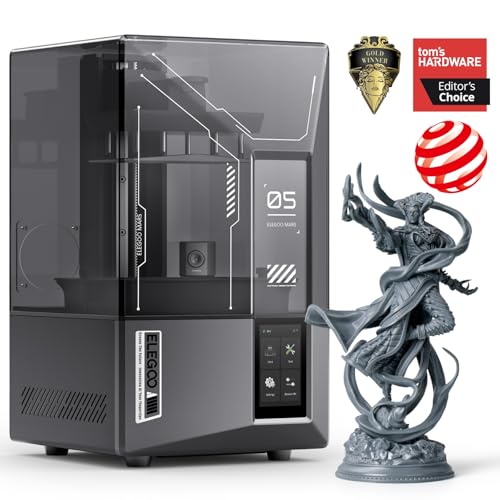
Fast Detail Specialist – ELEGOO Mars 5 Ultra
For beginners seeking resin printers for beginners with room to grow, the ELEGOO Mars 5 Ultra combines a high-resolution 9K LCD with fast printing and automated monitoring features.
Best For: Beginners who want detailed prints, faster production, and helpful error monitoring.
Pros:
- 9K mono LCD delivers 18 μm XY resolution for fine detail.
- Tilt release technology supports speeds up to 150 mm/h.
- AI camera can detect issues such as empty build plates and model warps.
- Residue detection, resin-shortage alerts, and leveling-failure alarms add convenience.
Cons:
- AI detection results can vary with the environment, model, and resin type.
- Its 19.36-pound weight and larger footprint may require dedicated workspace.
The Mars 5 Ultra is a strong choice when print detail and workflow automation matter more than minimizing size or weight. Wi-Fi cluster printing also gives it appeal for users planning to operate multiple compatible printers.
Speedy FDM Alternative – FLASHFORGE Adventurer 5M
Although it is not a resin printer, the FLASHFORGE Adventurer 5M is worth considering alongside resin printers for beginners if you prefer fast, low-intervention filament printing with a larger build area.
Best For: Beginners prioritizing automatic leveling, rapid prototypes, and remote monitoring.
Pros:
- Automatic bed leveling simplifies first-layer setup.
- CoreXY design supports up to 600 mm/s travel speed and 20,000 mm/s² acceleration.
- Quick-change nozzle and 35-second warm-up to 200°C streamline operation.
- Flash Studio enables remote monitoring, adjustments, and status alerts.
Cons:
- It uses filament rather than resin, so it is not a direct resin-printing substitute.
- The supplied notes do not specify resin-related features or workflows.
The Adventurer 5M makes the most sense for beginners who value speed, automatic setup, and a 220 × 220 × 220 mm build volume. Choose it as an alternative category rather than a resin option.
High-Resolution Starter – ANYCUBIC Photon Mono 4
The ANYCUBIC Photon Mono 4 is a straightforward pick among resin printers for beginners, pairing a sharp 10K screen with a simplified four-point leveling process and a practical build volume.
Best For: Beginners who want highly detailed models and a relatively simple initial leveling routine.
Pros:
- 7-inch 10K LCD provides 17 × 17 μm pixel size and detailed resolution.
- LighTurbo matrix lighting helps produce uniform exposure and smoother surfaces.
- Laser-engraved platform improves adhesion while remaining easy to remove.
- Four-point leveling does not need repeating after the first leveling and screw tightening.
Cons:
- Anycubic APP service is not supported.
- The 7.7-pound printer has a smaller listed footprint but less information is provided about workflow automation.
Photon Mono 4 is appealing for detail-focused beginners who want a simple leveling routine and reliable recovery after power restoration. Its lack of app support is the main convenience trade-off.
Easy Setup Pick – ELEGOO Mars 5
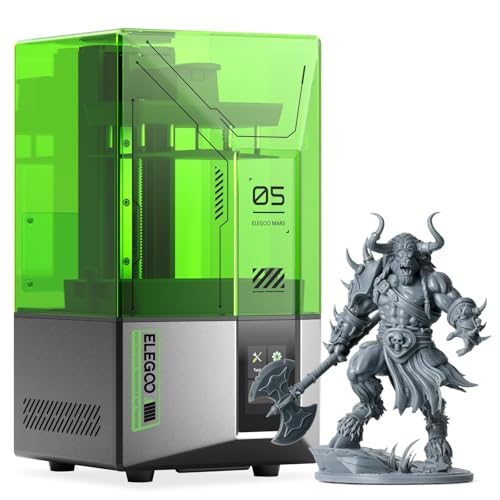
For newcomers comparing resin printers for beginners, the ELEGOO Mars 5 emphasizes simple setup with one-click automatic leveling, self-checks, and safeguards designed to reduce avoidable printing problems.
Best For: First-time resin users who want guided setup, dependable checks, and detailed 4K prints.
Pros:
- One-click automatic leveling helps users start printing with minimal calibration.
- Self-check function verifies key components before printing.
- 4K mono LCD and COB light source support detailed models.
- Residue detection, resin alerts, and overheat protection improve convenience and safety.
Cons:
- Its 4K display offers less stated resolution than the 9K Mars 5 Ultra.
- The supplied notes do not list wireless or app-based control.
The Mars 5 is a sensible entry point for users who value ease of setup over maximum resolution. Its automated checks and protective features can make the first resin-printing experience less intimidating.
Best Plug-and-Play Pick – Creality HALOT-X1 Neo
For beginners comparing resin printers for beginners, the Creality HALOT-X1 Neo is designed to reduce setup friction. Its factory pre-leveled build platform, tutorial access, and compact footprint make it a practical starting point for miniatures, figurines, and detailed desktop models.
Best For: Beginners who want high-resolution miniature printing with flexible file-transfer options and AI-assisted model creation.
Pros:
- 9K LCD and 18 μm XY resolution support finely detailed prints.
- Factory pre-leveled platform helps simplify initial setup.
- Supports USB, 2.4GHz Wi-Fi, and Creality Cloud transfers.
- AI-powered 2D-to-3D generation can turn images into models.
Cons:
- Its 153.36 × 77.76 × 160 mm build volume is better suited to smaller models than large projects.
- The AI model-generation feature depends on the FanForge workflow.
The HALOT-X1 Neo is a well-rounded entry point when ease of setup and fine detail matter more than a large build area. It is especially appealing for tabletop gamers and hobbyists making compact models.
Best Smart-Speed Option – ELEGOO Mars 5 Ultra
The ELEGOO Mars 5 Ultra is a strong choice for beginners seeking resin printers for beginners with more automation and monitoring features. Automatic leveling, one-button self-checks, and a built-in AI camera help make the printing process easier to oversee.
Best For: New users who value fast printing, automated checks, remote file transfer, and print monitoring.
Pros:
- 9K resolution and 18 × 18 μm XY resolution capture fine model details.
- Tilting release technology supports printing speeds up to 150 mm/h.
- Automatic leveling and one-button self-checks reduce setup tasks.
- AI camera, Wi-Fi transfer, and foreign-object detection add monitoring convenience.
Cons:
- At 19.36 pounds, it is less portable than smaller desktop resin printers.
- The listed dimensions require a relatively generous workspace.
The Mars 5 Ultra stands out for combining detailed output with speed and automated safeguards. It is a sensible fit for beginners who want fewer manual checks and the ability to monitor prints remotely.
Best High-Precision Upgrade – UniFormation GK3T
For beginners who want maximum detail from resin printers for beginners, the UniFormation GK3T combines a 16K display with several workflow-focused features. Factory pre-leveling, resin heating, smart feeding, and remote monitoring aim to make detailed printing more consistent and manageable.
Best For: Detail-focused hobbyists who want stable operation, climate-conscious resin handling, and an integrated printing workflow.
Pros:
- 16K resolution and 14 × 19 μm pixel size target highly detailed, smooth prints.
- Factory pre-leveling and smart resin-feeding features simplify operation.
- Built-in heating helps maintain resin fluidity in temperatures as low as 0°C/32°F.
- App-based remote control, progress monitoring, and timelapse support add convenience.
Cons:
- At 52.8 pounds, it is substantially heavier than the other listed options.
- Its larger footprint may be challenging for smaller workspaces.
- The highest-resolution features may exceed the needs of casual beginners.
The GK3T is aimed at users who prioritize precision and stable operation over portability. Its heating system and workflow features are particularly useful for hobbyists printing detailed models throughout the year.
Best with Extra Features – ANYCUBIC Photon Mono 4
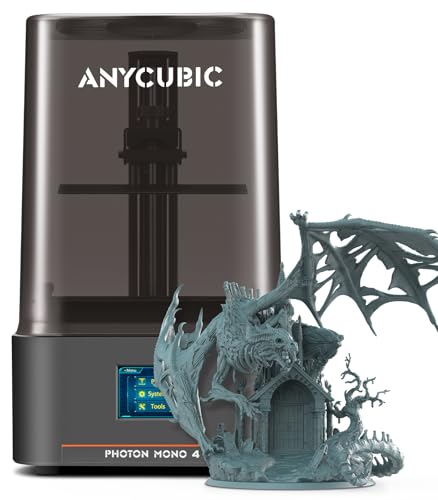
For beginners seeking detailed resin printers for beginners, the ANYCUBIC Photon Mono 4 combines a 10K display, stabilized lighting, and a preassembled setup. Its factory calibration and quick leveling check help simplify the first print.
Best For: Beginners who prioritize fine detail and a straightforward setup.
Pros:
- 10K screen with 17×17μm pixel precision for highly detailed models
- LighTurbo matrix light source supports smooth surfaces and 1.5-second exposures
- Laser-engraved build plate improves adhesion and helps reduce warping
- Power-failure recovery can resume a print after downtime
Cons:
- Requires a 4-point leveling check before use
- Resin printing still involves the usual handling and cleanup requirements
The Photon Mono 4 is a strong beginner choice when print detail matters most. Its ready-to-use design and recovery feature add convenience without compromising resolution.
Best Compact Beginner Pick – MALYAN S100 Mini
The MALYAN S100 Mini is a compact option for beginners comparing resin printers for beginners. Its automatic calibration and leveling, magnetic build plate, and small footprint make the printing process easier to start and manage.
Best For: First-time users with limited space who mainly print smaller models.
Pros:
- Automatic calibration and leveling simplify setup
- Magnetic build plate is easy to remove for cleaning and preparation
- Parallel LED array helps reduce layer lines and grid lines
- Laser-engraved platform supports model adhesion
Cons:
- Smaller 115 × 65 × 110 mm print area limits model size
- 2K resolution offers less detail than the 10K alternatives here
- Different resins may require matching print parameters
With automatic leveling and a compact design, the S100 Mini removes several common setup hurdles. It is best suited to small projects rather than larger, highly detailed prints.
Best for Larger Detailed Prints – ANYCUBIC Photon Mono 4
For beginners who want room to grow, this ANYCUBIC Photon Mono 4 offers the detail of a 10K screen with a 153.4 × 87 × 165 mm build volume. It arrives assembled, calibrated, and tested, making it a practical entry point for resin printers for beginners.
Best For: Beginners and hobbyists who want high detail plus more build space for larger projects.
Pros:
- 10K mono LCD and 17×17μm pixels support exceptionally detailed models
- 153.4 × 87 × 165 mm build volume accommodates larger projects
- LighTurbo matrix lighting helps create smooth, balanced exposure
- Resume printing after a power outage to reduce wasted resin and time
Cons:
- Larger 20 × 10 × 15-inch dimensions require more workspace
- Needs initial leveling before printing
- High-resolution features may be more than needed for basic small models
The larger build volume distinguishes this Mono 4 from compact beginner machines, while its tested and calibrated setup keeps the learning curve manageable. Choose it when future project size matters as much as print detail.
How We Picked the Best Resin Printers for Beginners
We focused on the factors that most affect a first resin-printing experience: setup simplicity, leveling method, screen resolution, build volume, software support, ventilation considerations, and the availability of consumables. We also considered whether the printer offers useful automation, such as pre-leveled platforms, resin monitoring, Wi-Fi control, or guided calibration.
Resolution alone does not determine print quality. A dependable motion system, accurate exposure settings, stable build platform, and properly supported slicer often matter more than the highest advertised pixel count. Because the selections span several sizes and price levels, the best choice depends on what you plan to print and how much hands-on adjustment you are comfortable with.
Quick Comparison
- Best for compact, detailed prints: ELEGOO Mars 5 Ultra, ELEGOO Mars 5, or an ANYCUBIC Photon Mono 4 model.
- Best for maximum detail: UniFormation GK3T, with its 16K display and larger-format focus.
- Best for guided automation: Creality HALOT-X1 Neo or a Mars 5 Ultra configuration with smart setup features.
- Best for a small workspace: MALYAN S100 Mini, provided its limited build area matches your projects.
- Not a resin printer: The FLASHFORGE Adventurer 5M is an FDM printer, so it is better suited to larger, tougher, lower-detail parts than miniature resin work.
Key Buying Factors for Resin Printers for Beginners
Setup and Leveling
Look for a pre-leveled or assisted platform if you want to reduce initial adjustments. Even with automation, follow the manufacturer’s calibration instructions and verify the build plate is secure before printing.
Resolution and Build Volume
Higher XY resolution can reveal finer facial features, textures, and lettering, but it does not make every print better. Choose enough build volume for your typical models; a compact printer is often easier to place, clean, and manage.
Workflow and Software
Check slicer compatibility, file-transfer options, touchscreen controls, and whether replacement FEP films, vats, screens, and build plates are easy to find. Wi-Fi can be convenient, but USB transfer is useful as a dependable fallback.
Safety and Cleanup
Resin requires gloves, eye protection, ventilation, washing, and UV curing. Budget for wash-and-cure equipment, disposable supplies, and a suitable work area. These ongoing needs are essential—not optional accessories.
Who Should Buy Which Resin Printers for Beginners?
Choose the MALYAN S100 Mini for very small projects and the smallest possible footprint. The ELEGOO Mars 5 or ANYCUBIC Photon Mono 4 models are sensible starting points for hobbyists who want a balanced combination of detail, cost, and manageable size. Step up to the Mars 5 Ultra or Creality HALOT-X1 Neo if guided features and a more streamlined workflow matter most.
For users who expect to print larger batches or demand extremely fine detail, the UniFormation GK3T is the more ambitious option. If your priority is fast, larger, durable household parts rather than miniature-level detail, consider the FLASHFORGE Adventurer 5M—but treat it as a different FDM category, not a substitute for Resin Printers for Beginners.