
Fine details, clean edges, and reliable layer curing matter more than headline speed when you are printing tabletop miniatures. The right resin printer can capture armor plates, facial features, weapons, and textured bases with far less cleanup.
This roundup compares 10 printer and resin options across resolution, ease of use, print volume, workflow, and value. Use the guide below to match your experience level and miniature-printing goals with the right setup.
Best 10 Resin Printers for Miniatures Picks for 2026
Best Detail on a Budget

- 22-micron XY resolution with an 8K monochrome LCD
- Compact build area for tabletop models and figures
- Supports Lychee, Chitubox, Tango, and open-source software
Best For: Beginners seeking detailed miniature prints in a compact machine
Best Durable Material
Chitu Systems Conjure Rigid Resin

- Low reported shrinkage of 0.2%-0.7%
- Tough, rigid formulation with 37% elongation at break
- Compatible with 385-405nm LCD resin printers
Best For: Durable articulated figures, mechanical parts, and functional prototypes
Best Smart Features

- 9K mono LCD for detailed miniature models
- Up to 150mm/h printing with tilt-release technology
- Automatic leveling, AI camera, and Wi-Fi cluster printing
Best For: Makers wanting fast, monitored, and highly automated printing
Best High-Resolution Value

- 7-inch 10K LCD with 17 x 17-micron XY pixels
- LighTurbo matrix light source for uniform exposure
- 6.04 x 3.42 x 6.49-inch build volume
Best For: Detailed miniature printing with an approachable setup
Best High-Speed Detail
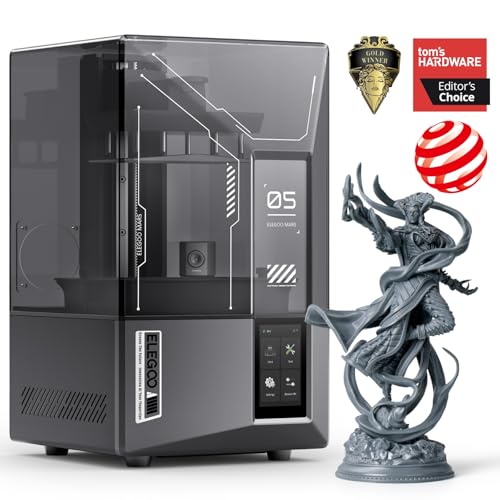
- 9K mono LCD with 18 μm XY resolution
- Up to 150 mm/h with tilt release
- AI camera and Wi-Fi cluster printing
Best For: Detailed miniature printing with speed and workflow automation
Best Ultra-High-Resolution Workflow

- 16K LCD with 14×19 μm pixel size
- Factory pre-leveling and smart resin feeding
- Heating and remote print monitoring
Best For: High-detail miniature work with stable, guided operation
Best Easy-Start Value
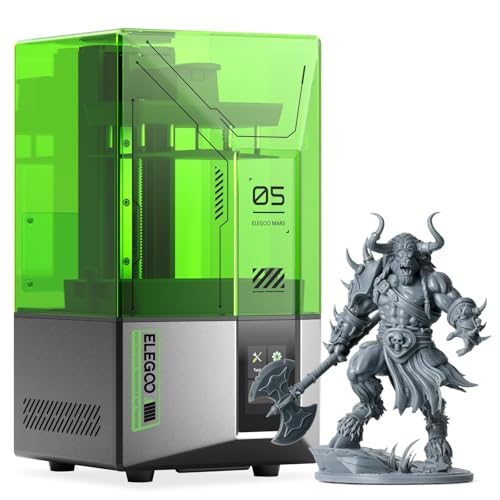
- One-click automatic leveling
- 4K mono LCD with COB light source
- Self-check, residue detection, and overheat protection
Best For: Beginners who want detailed prints with minimal setup
Best Budget Starter
MALYAN S100 Mini Resin Printer

- 2K LCD for detailed small models
- Auto calibration and leveling
- Compact magnetic build plate
Best For: Beginners printing small miniatures in limited workspace
Best Smart Upgrade
ELEGOO Mars 5 MSLA Resin Printer

- 6.6-inch 4K monochrome LCD
- Automatic leveling and issue detection
- 92% uniform COB light uniformity
Best For: Hobbyists wanting detailed prints with more automation
Best Easy-Cleanup Resin
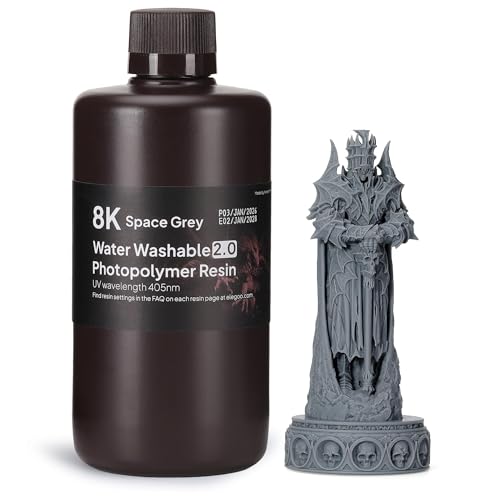
- 8K detail for miniature textures
- Rinses with water instead of alcohol
- Improved toughness and low odor
Best For: Detailed miniatures with simpler post-processing
Best Detail on a Budget – Phrozen Sonic Mini 8K S
If you want finely resolved tabletop figures without stepping up to a larger machine, the Phrozen Sonic Mini 8K S is a practical choice among resin printers for miniatures. Its 22-micron XY resolution, compact footprint, and support for popular slicers make it approachable for beginners while still suited to detailed models.
Best For: Beginners and miniature makers who prioritize sharp detail in a compact resin printer.
Pros:
- 22-micron XY resolution and an 8K monochrome LCD help capture fine miniature details.
- Compact 16.5 x 7.2 x 17 cm printing volume suits tabletop models and figures.
- Works with open-source software and slicers including Lychee and Chitubox.
- Precise Z-axis calibration supports even, accurate printing.
Cons:
- The build volume is more limited than that of larger-format resin printers.
- Its feature set is focused on core printing rather than advanced monitoring or networking.
The Sonic Mini 8K S stands out when miniature detail and accessible software support matter more than maximum capacity. It is a sensible fit for hobbyists starting with resin printing or upgrading to sharper output.
Best Durable Material – Chitu Systems Conjure Rigid Resin
Unlike the other entries, this product is resin rather than a printer, but it can be useful when choosing materials for resin printers for miniatures. Chitu Systems Conjure Rigid Resin is designed for durable, functional parts, with low shrinkage and a combination of toughness and rigidity.
Best For: Makers printing articulated figures, mechanical components, prototypes, and other parts that need more durability than standard display resin.
Pros:
- Reported 0.2%-0.7% shrinkage can help preserve dimensional accuracy.
- 85-90D hardness and 37% elongation at break support tougher, less brittle prints.
- Can be turned, milled, and tapped after post-curing.
- Compatible with LCD printers using 385-405nm UV light.
Cons:
- Its higher viscosity may require more careful handling and printer settings.
- Rigid engineering properties may be unnecessary for purely decorative miniatures.
This black 1000g resin is a specialized choice for miniature components that need functional strength or repeated handling. For display-only figures, a standard miniature-focused resin may be a simpler match.
Best Smart Features – ELEGOO Mars 5 Ultra
The ELEGOO Mars 5 Ultra combines high-resolution output with automation and monitoring features that can simplify miniature printing. Its 9K mono LCD is aimed at fine detail, while automatic leveling, an AI camera, and Wi-Fi support make it a strong option among resin printers for miniatures.
Best For: Hobbyists who want detailed prints, faster workflows, and built-in checks for common printing problems.
Pros:
- 7-inch 9K mono LCD produces sharp details for complex models.
- Tilt-release technology enables speeds up to 150mm/h, with fast and slow modes.
- Automatic leveling and smart sensors help detect resin, film, temperature, and power issues.
- Built-in AI camera supports real-time monitoring and time-lapse recording.
Cons:
- The larger feature set may be more than beginners need for basic printing.
- Its 6.04 x 3.06 x 6.49-inch print area remains suited primarily to small and medium models.
For users who value convenience as much as resolution, the Mars 5 Ultra offers a well-rounded package. Its monitoring, calibration, and wireless features can reduce routine friction while preserving the detail needed for miniatures.
Best High-Resolution Value – ANYCUBIC Photon Mono 4
The ANYCUBIC Photon Mono 4 is a compact resin printer built around a 7-inch 10K monochrome LCD and 17 x 17-micron pixels. For shoppers comparing resin printers for miniatures, it offers a strong detail-focused specification, a useful build area, and a setup intended to be straightforward after initial leveling.
Best For: Beginners and experienced hobbyists who want high-resolution miniature prints with a simple setup.
Pros:
- 10K resolution and 17 x 17-micron XY pixels support highly detailed models.
- LighTurbo matrix lighting is designed for stable, uniform exposure and smoother surfaces.
- The 6.04 x 3.42 x 6.49-inch build volume provides room for routine projects.
- Power-loss resume, pre-shipment testing, and a redesigned build platform support easier operation.
Cons:
- It requires first-time leveling before printing.
- It does not list advanced monitoring features such as an AI camera or Wi-Fi control.
The Photon Mono 4 is a sensible choice when resolution and ease of entry are the main priorities. Its balanced build volume and uniform light source make it well suited to detailed tabletop models without an overly complicated workflow.
Best High-Speed Detail – ELEGOO Mars 5 Ultra
For shoppers comparing resin printers for miniatures, the ELEGOO Mars 5 Ultra stands out with a 9K mono LCD, 18 μm XY resolution, and a claimed print speed of up to 150 mm/h. Its AI camera and automated monitoring features are designed to help catch common print problems before they waste resin.
Best For: Miniature makers who want fine detail, faster printing, and connected workflow features.
Pros:
- 9K resolution and 18 μm XY resolution for intricate miniature details.
- Tilt release technology and fast mode support speeds of up to 150 mm/h.
- AI camera can monitor for issues such as warping and empty build plates.
- Wi-Fi cluster printing supports control of multiple Mars 5 Ultra printers.
Cons:
- AI detection results may vary with the environment, model, and resin type.
- Its advanced monitoring and cluster-printing features may be more than occasional users need.
The Mars 5 Ultra is a strong option when miniature detail and throughput matter equally. Its built-in sensors, alerts, and AI camera add convenience, while the high-resolution screen is aimed at preserving small facial features, textures, and other fine elements.
Best Ultra-High-Resolution Workflow – UniFormation GK3T
The UniFormation GK3T is built for users who want exceptionally fine detail from resin printers for miniatures without giving up convenience. Its 16K LCD, factory pre-leveling, resin heating, and remote monitoring features create a feature-rich setup for detailed, repeatable printing.
Best For: Serious miniature hobbyists who prioritize maximum resolution, stable operation, and streamlined handling.
Pros:
- 16K resolution and 14×19 μm pixel size target extremely fine miniature detail.
- Factory pre-leveling, smart resin feeding, and a quick-release build plate simplify operation.
- Built-in heating helps maintain resin fluidity in temperatures as low as 0°C/32°F.
- Smartphone and slicing-software control provide remote monitoring and print management.
Cons:
- At 52.8 pounds, it is substantially heavier than the other listed options.
- Its advanced feature set and compatible wash-and-cure ecosystem may be excessive for casual users.
Choose the GK3T if your priority is capturing tiny sculpted features with minimal manual setup. The combination of 16K resolution, temperature management, and remote oversight makes it especially appealing for demanding projects and users who print throughout the year.
Best Easy-Start Value – ELEGOO Mars 5
The ELEGOO Mars 5 is a practical entry point for shoppers seeking resin printers for miniatures with less setup. One-click automatic leveling, a pre-print self-check, and a 4K mono LCD make it approachable while still supporting detailed models.
Best For: Beginners and hobbyists who want straightforward setup, dependable checks, and detailed miniature prints.
Pros:
- One-click automatic leveling reduces initial calibration work.
- 4K mono LCD and COB light source support crisp miniature details.
- Residue detection, resin-shortage alerts, and leveling-failure alarms help reduce wasted materials.
- Self-check and overheat protection add extra operational safeguards.
Cons:
- Its 4K resolution is lower than the 9K and 16K options in this roundup.
- The supplied notes do not list remote monitoring or Wi-Fi cluster-printing features.
The Mars 5 favors simplicity over a long list of advanced connectivity features. It is a sensible choice for newcomers who want automatic leveling and safety checks, while the 4K mono LCD remains capable of producing finely textured miniature models.
Best Budget Starter – MALYAN S100 Mini Resin Printer
The MALYAN S100 is a compact entry point for shoppers comparing resin printers for miniatures. Its 2K LCD, parallel LED array, auto-leveling system, and 115 x 65 x 110 mm build volume are suited to small, detail-focused projects.
Best For: Beginners printing small miniatures and tabletop models in limited workspace.
Pros:
- 5.5-inch 2K LCD supports detailed textures and model features.
- One-click calibration and automatic leveling simplify setup.
- Magnetic, laser-engraved build plate supports easier removal and adhesion.
- 57W parallel LED array is designed to reduce layer and grid lines.
Cons:
- The 115 x 65 x 110 mm build volume limits larger models.
- Resin-specific printing parameters still need to be matched for reliable results.
Choose the S100 when compact size and beginner-friendly setup matter more than maximum print capacity. Its small build area is a practical fit for individual miniatures and other modest projects.
Best Smart Upgrade – ELEGOO Mars 5 MSLA Resin Printer
The ELEGOO Mars 5 is a strong option for shoppers seeking resin printers for miniatures with more automation and monitoring. Its 6.6-inch 4K monochrome LCD, 35 × 35μm XY resolution, automatic leveling, and issue-detection sensors support detailed, streamlined printing.
Best For: Hobbyists who want high-resolution miniature printing with automated setup and printer checks.
Pros:
- 4K monochrome LCD and 35 × 35μm XY resolution support fine detail.
- Intelligent sensors can detect low resin, foreign objects, film replacement, and overheating.
- Automatic leveling and a laser-engraved build plate simplify preparation.
- COB lighting with 92% uniformity supports smooth model surfaces.
Cons:
- Successful results still depend on correct machine settings and properly supported models.
- The resin tank should be cleaned promptly after printing to help protect the printer.
The Mars 5 is the more feature-rich printer here for users who value resolution and convenience. Its automated systems reduce setup friction, while the included printing guidance reinforces the need for careful slicing and maintenance.
Best Easy-Cleanup Resin – ELEGOO 8K Water-Washable 2.0
The ELEGOO 8K Water-Washable 2.0 is a material choice for shoppers building a miniature-printing setup around detailed, easier-to-clean results. It is formulated for 385–405nm MSLA, DLP, and LCD printers and is designed for crisp edges, fine textures, and reduced post-processing hassle.
Best For: Miniature and display-model hobbyists who prefer water-based cleanup and high-detail output.
Pros:
- 8K formulation targets crisp edges and fine miniature textures.
- Water-washable cleanup avoids the need for alcohol baths.
- Improved toughness and warping resistance support more durable prints.
- Low-viscosity, low-odor formula is designed for smoother, more comfortable printing.
Cons:
- It is resin rather than a complete printer, so compatible 385–405nm equipment is required.
- Water-washable prints still require appropriate printing and post-processing practices.
This resin makes sense when miniature detail and simpler cleanup are priorities. Its compatibility with common MSLA, DLP, and LCD systems adds flexibility, while the improved toughness is useful for models that will be handled.
How We Picked the Best Resin Printers for Miniatures
We focused on features that directly affect miniature quality and day-to-day usability: XY resolution, LCD technology, build volume, leveling and sensor systems, print speed, connectivity, and beginner-friendly setup. We also included compatible resin options because material choice has a major effect on detail, durability, odor, washing, and curing requirements.
Resolution is not the only measure of quality. A stable motion system, consistent exposure, dependable release from the build plate, and accurate support placement can matter just as much. The selected products cover compact entry-level machines, high-resolution printers, larger-capacity options, and resin choices for different finishing preferences.
Quick Comparison
For the sharpest miniature details, prioritize models with a high-resolution monochrome or comparable LCD and a small XY pixel size. Beginner-focused printers with automatic leveling or mechanical sensors can reduce setup errors. Compact machines suit occasional hobby use, while larger printers are better for terrain, batches, or multiple figures at once.
Before buying, confirm the printer’s actual build volume, supported file workflow, replacement screen availability, and whether the included accessories are sufficient for washing and curing. A printer may be affordable initially but require additional spending on resin, protective equipment, ventilation, cleaning supplies, and a curing station.
Key Buying Factors for Resin Printers for Miniatures
Detail and Resolution
Look for a small XY resolution and a quality LCD if your priority is facial detail, fine weapons, or intricate textures. Higher resolution can improve visible detail, but exposure settings, resin quality, supports, and model orientation still determine the final result.
Build Volume and Workflow
A compact build area is often enough for individual figures and small squads. Choose a larger platform if you print armies, scenic bases, vehicles, or terrain. Also consider whether the printer’s software, Wi-Fi features, and file transfer process fit your preferred workflow.
Ease of Setup and Reliability
Automatic leveling, mechanical sensors, rigid construction, and clear calibration controls can make a meaningful difference for new users. Reliable resin-vat handling and readily available replacement parts are valuable for long-term ownership.
Resin Characteristics and Safety
Standard resin usually delivers excellent detail, while rigid or specialty formulas may improve strength for thin parts. Water-washable resin can simplify cleanup but still requires careful handling and proper curing. Use gloves, eye protection, ventilation, and follow the resin manufacturer’s safety instructions.
Who Should Buy Which Resin Printers for Miniatures?
Beginners: Choose a compact printer with automatic leveling, guided setup, or sensor-assisted operation. These features can reduce failed first layers while you learn exposure and support settings.
Detail-focused hobbyists: Select a high-resolution model with a small XY pixel size, then pair it with a resin designed for crisp detail. This is the best route for display figures and finely sculpted tabletop characters.
Batch printers and terrain makers: Favor a larger build volume and dependable long-print stability over maximum resolution alone. A bigger platform can reduce the number of print runs needed for armies, bases, and scenery.
Value shoppers: A lower-cost printer can be a strong choice if replacement parts, resin availability, and software support are easy to find. Budget for washing, curing, ventilation, and protective equipment before comparing final prices.