
Large format resin printers make it easier to produce bigger models, batches of small parts, and highly detailed prototypes without splitting every project into multiple prints. The right choice depends on more than screen resolution: build volume, reliability, workflow automation, and material handling matter just as much.
We’ve gathered 10 notable options for 2026, from high-resolution production machines to more accessible printers with useful automation and color or material flexibility. Use the guide below to narrow the list by your workspace, budget, and typical print jobs.
Best 10 Large Format Resin Printers Picks for 2026
Best for Cold-Weather Productivity
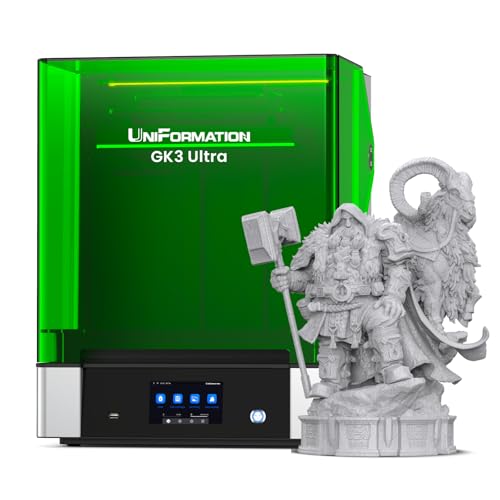
- 300 × 160 × 300 mm build volume
- 16K detail with 20 × 26 μm pixels
- Heated resin system and automatic feeder
Best For: Large models, batch production, and professional studios
Best for Fast Large-Scale Printing

- 298 × 164 × 300 mm build volume
- Print speeds up to 60 mm/h
- 1300 ml vat with automatic resin management
Best For: Large models, batch printing, and throughput-focused workflows
Best for Industrial-Resin Flexibility

- 14K LCD with 16.8 × 24.8 μm pixels
- Handles resins up to 8,000 cps
- Auto-leveling and AI-assisted monitoring
Best For: Advanced creators using high-viscosity or industrial resins
Best for High-Volume Production

- 33 × 18.5 × 30 cm build plate
- 43 µm detail with 15-inch 8K LCD
- Designed for fast batch production
Best For: Professional studios and high-volume model production
Best for Flexible Material Workflows

- Supports dual-color or dual-material printing
- Automatic leveling and AI monitoring
- Works with resins up to 8,000 cps
Best For: Material experimentation and automated resin printing
Best for Automated Precision Printing

- 16K mono LCD with 14 × 19 µm pixels
- Up to 170 mm/h printing speed
- Automated heating, feeding, and resin recycling
Best For: Detailed prints with streamlined resin management
Speed and Detail

- Up to 170mm/h with high-speed resin
- 14K screen with 16.8 × 24.8μm XY resolution
- Six intelligent detection systems
Best For: Detailed models and higher-throughput resin printing
Compact Precision

- 7-inch 10K monochrome LCD
- 153.4 × 87 × 165mm build volume
- Beginner-friendly four-point leveling
Best For: Detailed everyday models and first-time resin users
Best for Cold-Weather Productivity – UniFormation GK3 Ultra
The UniFormation GK3 Ultra is one of the more capable large format resin printers for users who need a substantial build area without giving up fine detail. Its 300 × 160 × 300 mm volume, 16K LCD, heated resin system, and automatic refilling support larger models, batch production, and more consistent workflows.
Best For: Industrial prototyping, professional studios, small and medium-sized businesses, and large-scale model production in colder environments.
Pros:
- Large 300 × 160 × 300 mm build volume supports big models or multiple parts.
- 16K resolution and 20 × 26 μm pixel size are designed for sharp detail.
- Built-in heating, automatic resin feeding, and a rigid KK60 Z-axis support consistent printing.
- Quick-release vat, drip hanger, and carbon filter help simplify maintenance.
Cons:
- At 85.8 pounds, it is a substantial printer to position and move.
- Its 19 × 21 × 26-inch footprint requires considerable workspace.
The GK3 Ultra stands out when capacity, detail, and unattended resin management matter more than a compact setup. The heated vat and automatic feeder are especially useful for long prints and demanding production schedules.
Best for Fast Large-Scale Printing – ANYCUBIC Photon Mono M7 MAX
The ANYCUBIC Photon Mono M7 MAX is a practical choice among large format resin printers when you want a high-capacity machine with speed-focused features. Its 298 × 164 × 300 mm build volume, 1300 ml vat, automatic resin management, and claimed speeds up to 60 mm/h are suited to large or repeated print jobs.
Best For: Users who want to print large models in one piece or improve throughput through batch printing.
Pros:
- Ultra-large 298 × 164 × 300 mm build volume reduces the need to split models.
- 7K screen with 46 × 46 μm XY pixel size supports detailed textures.
- Automatic material management adds resin as needed and the 1300 ml vat suits long prints.
- Self-check features monitor residue, resin levels, failed prints, and printer status.
Cons:
- The 30.91-inch depth makes it demanding on bench space.
- Its 7K resolution and 46 μm pixel size are less fine on paper than the 14K and 16K alternatives listed here.
The M7 MAX emphasizes convenience and throughput. Its flip-top access, resin temperature control, automated feeding, and inspection features make it a strong fit for users prioritizing efficient large-format production.
Best Feature-Rich 16K Option – ELEGOO Jupiter 2
The ELEGOO Jupiter 2 combines a large 302.4 × 161.98 × 300 mm build volume with 16K exposure detail, making it a strong contender among large format resin printers for detailed, oversized work. Automated resin handling, smart tank heating, monitoring, and a quick-swap release film are aimed at reducing hands-on maintenance.
Best For: Detailed large models, multi-part print jobs, and users who value automation, monitoring, and connected features.
Pros:
- Large build volume accommodates bigger objects or multiple smaller parts.
- 16K resolution and 20 × 26 μm XY resolution target fine detail and uniform exposure.
- Auto leveling, tank heating, and automated resin supply simplify setup and long prints.
- Camera monitoring, Wi-Fi, power-loss recovery, and safety alarms add workflow convenience.
Cons:
- The 27.95-inch depth and 63.8-pound weight call for a sturdy, dedicated location.
- Its extensive feature set may be more than casual users need.
Jupiter 2 is appealing for production-minded creators who want both generous capacity and a broad set of quality-of-life tools. Its monitoring, safety systems, and quick-swap components make it particularly well equipped for regular use.
Best for Industrial-Resin Flexibility – ANYCUBIC Photon P1
The ANYCUBIC Photon P1 takes a different approach to large format resin printers, pairing 14K detail with a sturdy motion system, factory-calibrated auto-leveling, and support for ultra-high-viscosity resins up to 8,000 cps. It is a compelling option for advanced creators who prioritize release reliability and material flexibility.
Best For: Advanced creators and users working with high-viscosity or industrial-oriented resins.
Pros:
- 14K LCD with 16.8 × 24.8 μm pixel dimensions supports crisp fine details.
- Ball screws, precision guide rails, and a rigid platform help minimize motion vibration.
- Factory-calibrated automatic leveling and pre-print self-checks reduce setup work.
- Supports resins up to 8,000 cps, with AI monitoring for plate installation, separation, residue, and resin level.
Cons:
- The supplied notes do not specify a build volume, making direct capacity comparisons difficult.
- Its feature set is geared more toward advanced users than simple entry-level printing.
The Photon P1 is best considered when resin compatibility and dependable operation are central buying criteria. Wave Release Technology, automatic leveling, and industrial-resin support give it a practical focus beyond resolution alone.
Best for High-Volume Production – Phrozen Sonic Mega 8K S
The Phrozen Sonic Mega 8K S is one of the most production-focused large format resin printers in this roundup. Its 33 × 18.5 × 30 cm build plate, 43 µm XY resolution, and 15-inch 8K mono LCD are suited to studios that need both substantial output and fine detail.
Best For: Professional studios, collectible production, jewelry masters, dental prototypes, and other high-volume projects.
Pros:
- Large build volume can accommodate batches of models, including up to 80 1/32-scale miniatures in the stated example.
- 43 µm XY resolution and an 8K mono LCD support sharp, detailed prints.
- ACF film and TR300 resin enable claimed speeds up to 10 times faster than standard mid-size printers.
- Lift-up lid and built-in metal drip hanger improve workspace access and resin recovery.
Cons:
- Its 57.3-pound weight and large footprint require a sturdy, dedicated workspace.
- The speed-focused ACF and TR300 setup may be less relevant for occasional hobby printing.
The Sonic Mega 8K S is the strongest fit when throughput matters as much as resolution. It offers unusually large capacity and production-oriented workflow features, but its size and professional positioning make it a better choice for serious users than casual beginners.
Best for Flexible Material Workflows – Anycubic Photon P1
The Anycubic Photon P1 stands out among large format resin printers for its dual-color and dual-material capability. Automatic leveling, AI monitoring, and support for resins up to 8,000 cps make it a practical option for creators who want a more automated workflow.
Best For: Designers experimenting with multiple colors or materials, professional users printing high-viscosity resins, and creators who prioritize setup assistance.
Pros:
- Dual-color or dual-material printing expands design flexibility and can reduce waste of costly resin on small models.
- Factory-calibrated Smart Leveling 3.0 removes the need for manual bed leveling.
- AI inspection checks build plate installation, bottom-layer separation, resin level, and vat residue.
- Handles ultra-high-viscosity resins up to 8,000 cps with pre-configured Anycubic settings.
Cons:
- The supplied specifications do not state the printer’s build volume or LCD resolution.
- Dual-material capability may be unnecessary if you primarily print single-color models.
The Photon P1 is appealing for users who value material flexibility and automated checks over a clearly advertised large build volume. Before choosing it specifically for large-format work, confirm that its available build area matches your project requirements.
Best for Automated Precision Printing – Creality Halot-X1 Combo
The Creality Halot-X1 Combo combines a 211.68 × 118.37 × 200 mm build volume with a 16K mono LCD and 14 × 19 µm pixel size. Its resin heating, RFID parameter recognition, and automatic feeding and recycling features make it a compelling choice for users seeking a streamlined large format resin printer.
Best For: Detail-focused makers and professionals who want automated resin handling, stable motion, and minimal manual setup.
Pros:
- 16K resolution and 14 × 19 µm pixels support highly detailed prints.
- Build volume reaches 211.68 × 118.37 × 200 mm, with speeds up to 170 mm/h.
- AFU system heats resin, recognizes RFID parameters, monitors weight, and recycles leftover material.
- Fixed build plate design eliminates leveling, while dual rails and lead screws provide 0.01 mm positioning precision.
Cons:
- The build volume is smaller than the Phrozen Sonic Mega 8K S’s stated capacity.
- Its advanced automated systems may add complexity compared with a simpler resin printer.
The Halot-X1 Combo is a strong middle ground for buyers who want high-resolution output without giving up convenience. Its automated resin management and fixed build plate reduce routine setup, while the stable motion system is designed to support consistent precision.
Maximum Workspace – Photon Mono M7 Max
The Anycubic Photon Mono M7 Max is designed for shoppers comparing large format resin printers and needing substantial vertical and horizontal workspace. Its 298 × 164 × 300mm build volume accommodates full-size masks, cosplay props, game terrain, and other large models without splitting them into multiple parts.
Best For: Large models, cosplay props, masks, terrain, and users who want automatic resin-management features.
Pros:
- Large 298 × 164 × 300mm build volume
- COB/Fresnel LighTurbo 3.0 system with over 90% light uniformity
- Temperature-controlled vat, resin auto-fill, and one-key resin recycling
- Flip-open cover and suspended-model design improve day-to-day convenience
Cons:
- Large 52.8-pound chassis requires substantial setup space
- Maximum listed speed is 60mm/h, below the M7 Pro’s rated speed
Choose the M7 Max when build volume matters more than compactness. Its 1300ml vat and automated resin features are particularly useful for larger print jobs, while the calibrated light system is intended to reduce visible layer lines and aliasing.
Speed and Detail – Photon Mono M7 Pro
The Anycubic Photon Mono M7 Pro is a strong option among large format resin printers for buyers prioritizing fast production and fine detail. Its 14K screen targets small features, while the printer reaches up to 170mm/h with high-speed resin in the supplied test conditions.
Best For: Detailed models, faster print workflows, and users who value automated monitoring and resin handling.
Pros:
- Up to 170mm/h with high-speed resin and 130mm/h with standard resin
- 14K resolution with 16.8 × 24.8μm XY resolution
- Dynamic temperature control and automatic resin filling
- Six detection systems help monitor setup, resin, residue, failures, and the build plate
Cons:
- High-speed result depends on using high-speed resin and specified test conditions
- Its supplied notes emphasize speed and precision rather than a large build-volume figure
The M7 Pro makes the most sense when throughput and detail are your main criteria. Its detection systems can reduce setup mistakes, while the temperature-controlled vat and resin recycling features help streamline repeated printing sessions.
Compact Precision – Photon Mono 4
The Anycubic Photon Mono 4 offers a more compact entry point for shoppers comparing large format resin printers with everyday project needs. Its 7-inch 10K monochrome LCD and 153.4 × 87 × 165mm build volume support detailed models while keeping the printer’s listed weight to 7.7 pounds.
Best For: Beginners, detailed small-to-medium models, and users who want a lighter printer with straightforward leveling.
Pros:
- 10K resolution with 17 × 17μm pixel size
- 153.4 × 87 × 165mm build volume for routine projects
- Laser-engraved platform improves adhesion while keeping removal manageable
- Four-point leveling and power-resume functionality simplify operation
Cons:
- Build volume is smaller than the M7 Max’s large-format workspace
- Anycubic APP service is not supported
The Photon Mono 4 is best viewed as a practical, lighter-duty choice rather than a full-size prop printer. Its high-resolution screen, beginner-friendly leveling method, and power-resume feature make it suitable for detailed day-to-day printing where maximum build volume is not essential.
How We Picked the Best Large Format Resin Printers
We focused on printers that offer meaningfully larger-than-typical resin build areas, while also considering resolution, print speed, ease of setup, and practical workflow features. The selection includes machines with 7K, 10K, 14K, and 16K-class monochrome LCDs, as well as models designed for faster production or more automated operation.
Because specifications can vary by firmware, resin, slicer settings, and region, treat advertised speed and resolution as useful reference points rather than guaranteed output. A printer’s ecosystem, replacement parts, software support, and ventilation requirements are equally important for long-term ownership.
Quick Comparison
| Priority | What to look for | Best fit |
|---|---|---|
| Maximum detail | 14K or 16K LCD, precise motion system, and stable exposure control | Miniatures, display models, and intricate prototypes |
| Larger production runs | Generous build volume, reliable resin handling, and efficient printing | Studios, workshops, and batch production |
| Faster workflow | High-speed exposure profiles, auto-leveling, and monitoring features | Frequent users who value reduced setup time |
| Material flexibility | Compatible vat systems and support for multiple resin types or colors | Designers experimenting with finishes and applications |
Key Buying Factors for Large Format Resin Printers
Build Volume and Printer Footprint
Check the actual X, Y, and Z dimensions rather than relying only on the word “large.” A taller Z axis helps with statues and architectural models, while more X/Y area is better for batch printing. Also measure your bench, including room for the lid, power connections, ventilation, and resin cleanup.
Resolution, Pixel Size, and Detail
Higher LCD resolution can improve fine detail, but pixel size, optics, exposure calibration, and mechanical stability affect the finished surface too. For large models, consistent exposure and accurate motion may matter more than choosing the highest advertised pixel count.
Speed and Reliability
Fast printing claims typically assume specific resin, layer height, and exposure settings. Look for dependable leveling, a rigid Z-axis, useful failure detection, and readily available replacement screens or vats. These features can save more time than peak movement speed.
Resin Handling and Safety
All resin printers require gloves, careful spill management, washing and curing equipment, and suitable ventilation. Confirm that the printer’s vat, build plate, and cleaning workflow suit the resin types you plan to use. Enclosed designs may help contain odors but do not eliminate the need for ventilation.
Who Should Buy Which Large Format Resin Printers?
Choose a 14K or 16K machine if crisp small details and premium surface quality are central to your work. A large 7K model can be the better value when you prioritize bigger parts, batch capacity, or lower operating costs over maximum fine detail. Buyers who print frequently should favor auto-leveling, monitoring, and mature software support. If you need unusual finishes or streamlined experimentation, consider a dual-color or dual-material model where its workflow matches your projects.
Before buying, confirm current dimensions, included accessories, regional warranty terms, resin compatibility, and replacement-part availability. The best Large Format Resin Printers are the ones whose capacity you can use regularly without making setup, ventilation, or post-processing impractical.