
Hard drive docking stations can make routine backups, drive migrations, diagnostics, and data transfers much simpler for a small business. The right model lets you connect bare SATA drives without installing them in an enclosure.
Our 2026 shortlist covers compact single-bay docks, dual-bay cloners, four-bay workstations, and newer USB-C models. Compare connectivity, cloning features, drive support, and workflow capacity before choosing.
Best 10 Hard Drive Docking Stations for Small Businesses Picks for 2026
Best Dual-Bay Cloner

- Dual bays for two SATA drives
- Offline cloning without a computer
- Supports 2.5-inch and 3.5-inch drives
Best For: Drive migrations and cloning workflows
Best Simple Single-Bay Dock
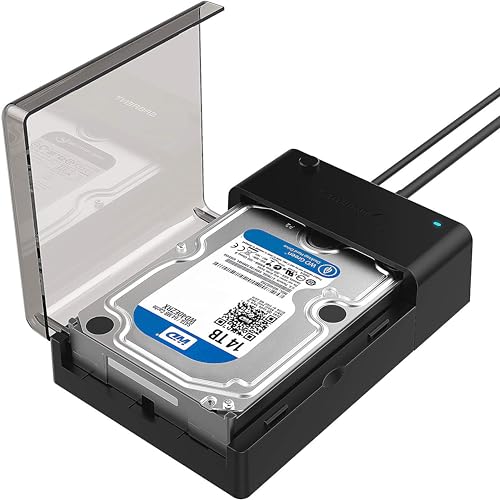
- Tool-free single-drive bay
- Supports 2.5-inch and 3.5-inch SATA
- Includes 12V adapter for 3.5-inch drives
Best For: Routine SATA drive access
Best High-Capacity Dual-Bay Dock

- Supports two SATA drives at once
- Up to 32TB per drive
- Offline cloning and USB-C cable included
Best For: Large-capacity transfers and cloning
Best USB-C Performance

- 10Gbps USB-C interface
- Includes USB-A and USB-C cables
- Tool-free hot-swapping for SATA drives
Best For: Fast transfers on modern USB-C workstations
Best Dual-Bay Value

- Works with two 2.5-inch or 3.5-inch drives
- Computer-free offline cloning
- 5Gbps USB-C/UASP transfers
Best For: Small teams needing an affordable two-drive dock
Best for Multi-Drive Workflows

- Holds up to four SATA drives
- Trayless, tool-free drive access
- Offline cloning with LED progress
Best For: Teams managing multiple SATA drives from one workstation
Best Versatility and Speed
ICY BOX Triple-Bay NVMe/SATA Dock

- Supports NVMe and 2.5/3.5-inch SATA drives
- Cross-format offline cloning
- 10Gbps USB 3.2 Gen 2 connectivity
Best For: IT work involving mixed NVMe and SATA storage
Best for Offline Cloning

- Clones SATA drives without a computer
- Handles two 2.5-inch or 3.5-inch drives
- USB-C connectivity with USB 3.0 speeds
Best For: Small offices that regularly duplicate SATA drives
Best for Broad OS Compatibility

- Supports Windows, Mac OS, and Linux
- Offers offline cloning with two drive bays
- Reads two SATA drives over USB 3.0
Best For: Mixed-platform offices needing a simple SATA drive reader
Best for High-Capacity Storage

- Supports up to two 20TB SATA drives
- Includes offline cloning and UASP
- Comes with USB-A and USB-C connection options
Best For: Teams handling large SATA drives and frequent backups
Best Dual-Bay Cloner – Sabrent EC-HD2B
For small businesses that need to read, copy, and clone drives regularly, this dual-bay Sabrent is a practical choice among hard drive docking stations for small businesses. It accepts both 2.5-inch and 3.5-inch SATA HDDs and SSDs, supports up to 10TB per drive, and offers offline cloning without requiring a computer.
Best For: IT workstations, drive migrations, and businesses handling two SATA drives at once.
Pros:
- Supports both 2.5-inch and 3.5-inch SATA HDDs and SSDs.
- Dual bays allow simultaneous drive access and offline cloning.
- USB 3.0 transfer speeds reach up to 5Gbps, with plug-and-play operation.
- Supports up to 20TB total capacity according to the listed specifications.
Cons:
- Offline cloning is listed at up to 60Mbps, slower than the USB 3.0 interface maximum.
- Designed for SATA drives rather than IDE, NVMe, or other interfaces.
This model stands out when cloning and two-drive workflows matter more than a compact single-bay setup. Its included power supply and USB 3.0 cable make it ready for a small-business service desk or backup station.
Best Simple Single-Bay Dock – Sabrent EC-DFLT
The Sabrent EC-DFLT is a straightforward option for small businesses that need occasional access to bare SATA drives. This lay-flat dock supports 2.5-inch and 3.5-inch SATA HDDs and SSDs, connects through USB 3.0 Type-A, and requires no drivers on Windows 10/11, macOS, or Linux.
Best For: Basic drive reading, hot-swapping, and one-drive maintenance at a time.
Pros:
- Tool-free bay supports SATA I/II/III 2.5-inch and 3.5-inch drives.
- Plug-and-play operation with hot-swapping and an activity LED.
- Includes a 12V power adapter required for stable 3.5-inch drive operation.
- UASP support and USB 3.0 provide up to 5Gbps interface speed.
Cons:
- Supports only one drive at a time.
- Uses a USB Type-A host cable rather than a USB-C port.
- Does not support IDE/PATA, M.2 NVMe, M.2 SATA, SAS, or drives already inside USB enclosures.
This is a sensible budget-friendly dock when the business primarily works with standard bare SATA drives. Confirm the computer has a USB-A port, and plan on using the included adapter whenever a 3.5-inch drive is connected.
Best High-Capacity Dual-Bay Dock – UGREEN CM198
Businesses managing larger storage volumes may appreciate the UGREEN CM198, a dual-bay option among hard drive docking stations for small businesses. It supports two 2.5-inch or 3.5-inch SATA drives simultaneously, offers offline cloning, and is rated for up to 32TB per drive.
Best For: High-capacity storage transfers, two-drive access, and offline cloning projects.
Pros:
- Supports two 2.5-inch or 3.5-inch SATA I/II/III drives.
- Listed capacity support reaches 32TB per drive.
- Offline cloning works without connecting the dock to a computer, provided the target drive is at least as large as the source.
- Includes a USB-B to USB-C cable, 12V/3A power adapter, dust cover, and anti-slip pads.
Cons:
- Offline cloning requires the destination drive to have equal or greater capacity.
- Supports SATA drives, not M.2 or other drive interfaces.
- The listed USB 3.0 maximum is 5Gbps, rather than 10Gbps.
With its broad capacity rating and two-bay design, the CM198 is suited to storage-heavy office workflows. Its cooling design, dust cover, and included USB-C cable add practical convenience for repeated use.
Best USB-C Performance – Sabrent DS-UC1B
The Sabrent DS-UC1B is a strong fit for modern offices that want a fast, tool-free SATA dock. Its USB 3.2 Gen 2×1 connection is rated up to 10Gbps, and it includes both USB-A and USB-C cables for connecting compatible Windows, macOS, and Linux systems.
Best For: USB-C-equipped workstations, fast SATA transfers, and frequent drive swapping.
Pros:
- 10Gbps USB-C interface helps maximize performance from compatible SATA SSDs.
- Supports both 2.5-inch and 3.5-inch SATA HDDs and SSDs.
- Tool-free, hot-swappable design includes a retractable dust cover.
- Includes USB-A and USB-C to USB-C cables plus a power adapter for 3.5-inch drives.
Cons:
- Single-bay design handles one drive at a time.
- Actual performance depends on the SATA drive and host connection.
- Designed for SATA drives rather than NVMe or other interfaces.
This dock is the most connectivity-focused choice in the group, especially for businesses standardizing on USB-C laptops and desktops. It also remains flexible for older USB-A systems, while its 2.5-inch and 3.5-inch compatibility covers common SATA service tasks.
Best Dual-Bay Value – BENFEI USB-C Dual-Bay Dock
For small businesses seeking hard drive docking stations for small businesses, the BENFEI dual-bay dock offers a practical setup for handling two 2.5-inch or 3.5-inch SATA HDDs or SSDs at once. Its USB-C connection, UASP support, and offline cloning function suit routine backups, drive migrations, and storage expansion.
Best For: Small teams that need an affordable two-drive dock with computer-free cloning.
Pros:
- Supports simultaneous access to two 2.5-inch or 3.5-inch drives.
- Offline cloning works without a computer when the target drive is larger than the source.
- USB 3.2 Gen 1 and UASP support provide transfer speeds up to 5Gbps.
- Includes a dedicated power adapter and an 18-month warranty.
Cons:
- Cloning requires the target drive to have greater capacity than the source.
- Users should switch off the dock before connecting or removing drives.
The BENFEI is a sensible choice when two drive bays are enough and straightforward cloning matters more than maximum bay capacity. Its powered design also accommodates two 3.5-inch drives.
Best for Multi-Drive Workflows – SABRENT 4-Bay USB 3.0 Dock
The SABRENT 4-Bay dock is designed for businesses managing several SATA drives from one workstation. As one of the more capacious hard drive docking stations for small businesses, it supports four 2.5-inch or 3.5-inch HDDs or SSDs, with trayless access and offline cloning for routine maintenance and backups.
Best For: Offices, repair desks, and IT users who regularly access multiple SATA drives.
Pros:
- Accommodates up to four 2.5-inch or 3.5-inch SATA drives.
- Trayless design allows direct drive insertion without tools.
- Offline cloning operates without a computer, with LED progress indicators.
- USB 3.0 supports transfers up to 5Gbps and works with USB 2.0 systems.
Cons:
- Uses USB 3.0 rather than a faster USB-C or USB 3.2 Gen 2 interface.
- Offline cloning is intended for direct drive-to-drive operations.
- Includes a one-year limited warranty.
Choose the SABRENT when four-bay capacity is the priority. It provides a convenient central station for SATA drive access, though users seeking the fastest modern host connection may prefer a newer USB-C model.
Best Versatility and Speed – ICY BOX Triple-Bay NVMe/SATA Dock
The ICY BOX triple-bay cloner is a strong fit for small businesses working with mixed storage formats. It combines an M.2 PCIe NVMe slot with support for 2.5-inch and 3.5-inch SATA drives, while USB 3.2 Gen 2 connectivity reaches up to 10Gbps for compatible systems.
Best For: Mixed-environment IT work involving NVMe, SATA SSD, and SATA HDD migration.
Pros:
- Supports three drives, including M.2 PCIe NVMe and 2.5-inch or 3.5-inch SATA models.
- Can clone between NVMe and SATA drive types without software.
- USB 3.2 Gen 2 offers transfer speeds up to 10Gbps.
- Includes USB-C-to-USB-C and USB-C-to-USB-A connectivity plus a 24-month warranty.
Cons:
- Its broader compatibility may be unnecessary for teams using SATA drives only.
- Actual transfer performance depends on the connected drives and host system.
- The enclosure is plastic.
For businesses upgrading from SATA to NVMe or supporting several storage standards, the ICY BOX offers the most flexible platform here. Its triple-bay layout and faster USB interface make it particularly useful for recurring migration work.
Best for Offline Cloning – Sabrent Dual-Bay USB-C Dock
For small businesses that need a straightforward way to access or duplicate SATA drives, this Sabrent dock combines two drive bays with a computer-free cloning mode. It supports bare 2.5-inch and 3.5-inch SATA HDDs and SSDs, with USB-C connectivity for compatible computers.
Best For: Small offices that regularly clone or transfer data between two SATA drives.
Pros:
- Offline 1-to-1 cloning works without a connected computer.
- Reads and writes two drives simultaneously when connected over USB.
- Tool-free, hot-swappable bays accommodate 2.5-inch and 3.5-inch SATA drives.
- Includes a USB-C cable and supports USB 3.0 speeds up to 5Gbps.
Cons:
- Supports SATA drives only; IDE/PATA, M.2, and NVMe drives are not compatible.
- The included cable requires a computer with USB-C, unless you supply a USB-C-to-USB-A cable.
- Offline cloning runs at up to 60MBps, and the target drive must be the same size or larger.
This is a practical choice when offline cloning is a priority, provided your business uses SATA storage and has the appropriate computer connection.
Best for Broad OS Compatibility – FIDECO Dual-Bay SATA Dock
This FIDECO dock is a flexible option for small businesses needing to connect two bare SATA drives to a workstation. It supports Windows, macOS, Linux, and older Windows versions, while also offering USB 3.0 transfers and offline cloning.
Best For: Mixed-platform offices that need a dual-bay SATA reader with simple plug-and-play operation.
Pros:
- Works with two 2.5-inch or 3.5-inch SATA HDDs or SSDs at once.
- Supports offline cloning without requiring a computer.
- Compatible with Windows XP through Windows 10, Mac OS, and Linux.
- Plug-and-play USB 3.0 connectivity requires no driver installation.
Cons:
- Only SATA HDDs and SSDs are supported.
- New drives may need to be initialized before the computer recognizes them.
- The supplied notes do not specify support for newer Windows 11 systems.
FIDECO stands out for offices using multiple operating systems. It offers useful cloning and two-drive access, though users should account for drive initialization and SATA-only compatibility.
Best for High-Capacity Storage – WAVLINK Dual-Bay SATA Dock
For small businesses working with larger SATA disks, this WAVLINK dual-bay dock supports up to two 20TB drives and includes fixed bezels for added drive stability. It also provides offline cloning, UASP support, and accessories for USB-A or USB-C connections.
Best For: Teams that need to access, back up, or clone high-capacity 2.5-inch and 3.5-inch SATA drives.
Pros:
- Supports two SATA drives with capacities up to 20TB each.
- Offline cloning works without a computer when the target drive is at least as large as the source.
- UASP support is designed to improve transfer performance over conventional USB 3.0.
- Includes fixed bezels, a USB-A-to-C adapter, and a USB 3.0 cable.
Cons:
- Supports SATA I, II, and III drives only; M.2 and NVMe compatibility is not indicated.
- Offline cloning requires the target drive to be equal to or larger than the source.
- Compatibility with phones depends on OTG support.
The WAVLINK is a strong fit for capacity-focused workflows, especially when a business wants two large SATA drives available at once. Its included connection accessories also make it convenient for computers with USB-A or USB-C ports.
How We Picked the Best Hard Drive Docking Stations for Small Businesses
We focused on the features that matter in day-to-day office and IT work: compatibility with 2.5-inch and 3.5-inch SATA HDDs and SSDs, USB transfer standards, independent power supplies, cloning capability, bay count, and ease of use. We also considered whether a dock suits occasional maintenance or repeated business workflows such as workstation upgrades, backup rotation, and drive diagnostics.
Offline cloning is useful when duplicating a source drive without a computer, but it should not be treated as a substitute for a verified backup. For business data, confirm the destination capacity and use encryption, access controls, and a separate backup strategy where appropriate.
Quick Comparison
| Dock type | Best suited to | Key advantage |
|---|---|---|
| Single-bay SATA dock | Occasional drive access | Simple, compact, and usually affordable |
| Dual-bay dock | Cloning and backup rotation | Works with two drives at once |
| Four-bay dock | IT teams and frequent transfers | Higher capacity for multi-drive workflows |
| USB-C 10Gbps dock | Modern laptops and faster storage | Higher potential transfer bandwidth |
| NVMe/SATA multi-bay dock | Mixed-drive environments | Supports more current SSD formats |
Key Buying Factors for Hard Drive Docking Stations for Small Businesses
Drive Compatibility
Check whether the dock accepts both 2.5-inch and 3.5-inch SATA drives. A 3.5-inch HDD generally needs the dock’s external power adapter, while 2.5-inch SSDs and laptop drives may draw less power. If your team uses M.2 NVMe drives, choose a model that explicitly supports NVMe; SATA M.2 and NVMe are not interchangeable.
Connection Speed and Host Ports
USB 3.0 or 5Gbps is adequate for many backup tasks, while USB-C 10Gbps can reduce transfer times with compatible computers and drives. The connector shape alone does not guarantee higher speed, so check the dock’s stated standard and your computer’s port capabilities.
Cloning and Bay Layout
Dual-bay and four-bay docks are more practical for cloning, source-to-destination transfers, and rotating backup media. Confirm whether cloning is offline, whether the destination must be equal to or larger than the source, and whether the bays support the drive sizes you use.
Reliability and Security
Look for stable power delivery, clear drive indicators, tool-free installation, and a firm fit. For sensitive business data, use trusted computers, safely eject drives, and select docks from a manufacturer that provides current documentation and support.
Who Should Buy Which Hard Drive Docking Stations for Small Businesses?
Choose a single-bay dock if you occasionally read or replace one SATA drive and want the smallest setup. A dual-bay model is the better all-around choice for small offices handling routine cloning, migrations, or rotating backups. Choose a four-bay dock when an IT administrator regularly works with several drives at once. USB-C 10Gbps models fit newer laptops and users who prioritize faster transfers, while an NVMe/SATA dock is the most flexible option for businesses supporting both legacy SATA storage and modern M.2 SSDs.