
Choosing the right 3D scanner for jewelry requires more than chasing the smallest accuracy number. Jewelry work demands reliable capture of fine edges, prongs, curves, textures, and reflective surfaces, often on objects that are small enough to challenge general-purpose scanners.
This roundup compares 10 selected scanners across precision, scanning modes, tracking, portability, color capture, and workflow compatibility. Use the guide below to narrow the options based on whether you design, repair, reproduce, customize, or digitally archive jewelry.
Best 10 3d Scanner for Jewelry Picks for 2026
Best Precision Pick

- Up to 0.03 mm accuracy
- 15–1,500 mm object range
- Turntable and color capture included
Best For: Detailed indoor scans of jewelry and medium-sized objects
Best Professional Option

- Up to 0.01 mm precision
- Five laser and structured-light modes
- Handles dark and shiny surfaces without spray
Best For: Professional jewelry scanning, inspection, and reverse engineering
Best Versatile Scanner

- 0.05 mm accuracy at up to 30 fps
- Scans dark and metallic surfaces without spray
- Supports 0.8–78 inch objects and full-color capture
Best For: Mixed jewelry materials, colors, and object sizes
Best Lightweight Choice

- 190 g portable design with Wi-Fi 6
- Up to 0.05 mm accuracy
- Includes color capture and optical zoom
Best For: Portable jewelry scanning indoors or in shaded outdoor settings
Best Wireless Precision Pick

- Up to 0.03mm accuracy with blue laser mode
- Scans dark and metallic surfaces without spray
- Wireless, portable design with dual batteries
Best For: Jewelry makers needing portability and versatile scanning
Best Fine-Detail Specialist
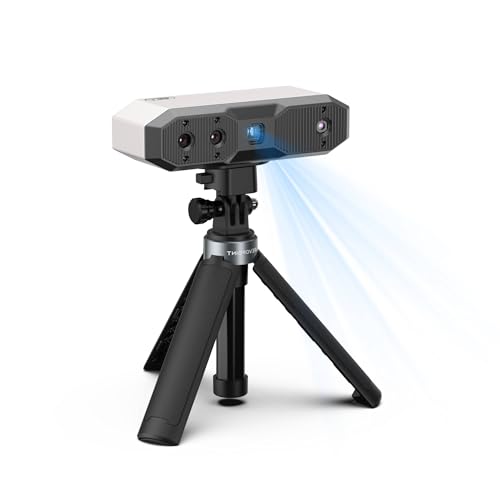
- Up to 0.02mm single-frame precision
- Industrial blue light with RGB color capture
- Compact 175g body with USB-C and Wi-Fi 6
Best For: Small jewelry pieces requiring intricate detail capture
Best Small-Format Value

- Up to 0.02mm accuracy for 10–300mm objects
- Blue LED captures fine edges and surface dents
- Includes tripod and turntable for indoor scanning
Best For: Indoor scanning of small jewelry and similar objects
Best with Extra Features
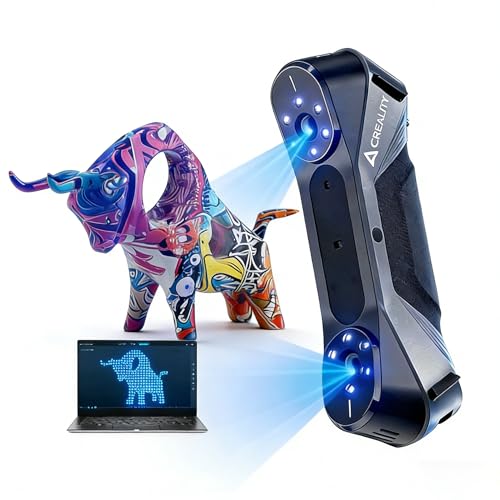
- Up to 0.02mm maximum accuracy
- Blue laser and full-color scanning
- Handles 5mm to 2000mm objects
Best For: Detailed jewelry and versatile object scanning
Beginner-Friendly Option
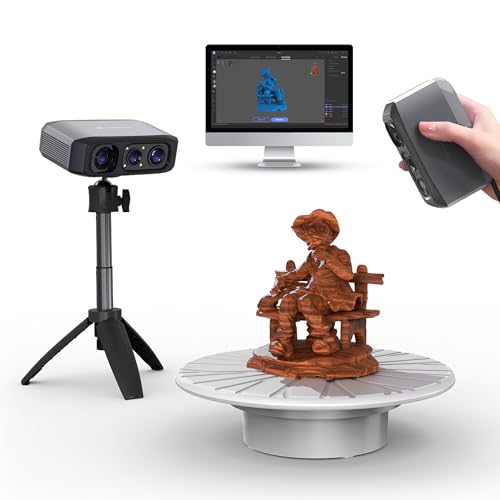
- 0.05mm precision with 10FPS scanning
- Marker-free scanning for easier setup
- AI repair and optical anti-shake features
Best For: Accessible handheld scanning for new users
Wireless Choice

- Wireless Wi-Fi 6 scanning with 30FPS capture
- Quad-lens system for small and large objects
- 330g body with up to 3 hours of battery life
Best For: Portable jewelry and on-the-go scanning
Best Precision Pick – 3DMakerpro Moose Premium
For jewelry makers who need a 3D scanner for jewelry and other medium-sized objects, the 3DMakerpro Moose Premium combines blue LED structured light with accuracy up to 0.03 mm. Its color capture, turntable, and automatic alignment tools make it suited to creating detailed digital models for 3D printing.
Best For: Scanning medium-sized jewelry pieces, ornaments, and related objects in an indoor workspace.
Pros:
- Up to 0.03 mm accuracy and 0.07 mm resolution for detailed captures
- Supports objects from 15 mm to 1,500 mm, with 24-bit color acquisition
- Includes a turntable and tripod, with software exporting OBJ, STL, PLY, and ASC files
Cons:
- Handheld operation may require practice to master
- Requires a capable computer for smooth performance
- Best results are recommended in indoor environments
The Moose Premium is a balanced choice when fine detail and a complete starter setup matter more than maximum scanning speed. Its included turntable and software features are especially useful for repeatable jewelry-modeling projects.
Best Professional Option – Revopoint MetroY Pro
The Revopoint MetroY Pro is a 3D scanner for jewelry aimed at demanding measurement, reverse-engineering, and 3D-printing workflows. Its blue laser system offers precision up to 0.01 mm, while multiple scanning modes help address detailed, recessed, shiny, or dark surfaces.
Best For: Professional jewelry digitization, dimensional inspection, and users who need highly precise laser scanning.
Pros:
- Up to 0.01 mm precision and 0.02 mm accuracy
- Five scanning modes, including deep-hole and auto-turntable modes
- Can scan shiny and dark surfaces without scanning spray in laser modes
- Wi-Fi 6 connectivity and speeds up to 2,000,000 points per second
Cons:
- Requires a powerful Windows computer for the listed professional setup
- Revo Design and Revo Measure are paid separately and support Windows only
- Its professional capabilities may be more than casual users need
The MetroY Pro stands out when measurement confidence and surface versatility are priorities. It is the strongest fit here for professional workflows, though the computer requirements and separate software costs should be considered.
Best Versatile Scanner – Creality Otter Lite Basic
The Creality Otter Lite Basic gives jewelry creators a flexible 3D scanner for jewelry, from small pieces to much larger objects. Its quad-camera design, 0.05 mm accuracy, and ability to scan dark or metallic surfaces without spray make it practical for varied collections and materials.
Best For: Jewelry makers who want easy handling of dark, shiny, and mixed-size objects with full-color texture capture.
Pros:
- Up to 0.05 mm accuracy and scanning speeds up to 30 frames per second
- Scans objects from 0.8 to 78 inches using four cameras
- Captures dark and metallic surfaces without powder or spray
- Supports 24-bit color and exports PLY, OBJ, STL, ASC, 3MF, GLTF, and FBX
Cons:
- Optional Scan Bridge handle is sold separately
- Warranty coverage is listed as one year
- Large-object capabilities may be unnecessary for users scanning only small jewelry
The Otter Lite Basic is a strong all-around choice for jewelry work that extends beyond tiny, highly detailed pieces. Its broad size range, color capture, and surface handling reduce the need to prepare difficult materials before scanning.
Best Lightweight Choice – Revopoint INSPIRE 2
The Revopoint INSPIRE 2 is a lightweight 3D scanner for jewelry that supports wireless scanning, full-color texture capture, and multiple scanning methods. Its adjustable optical zoom and infrared laser lines help users work with mixed surfaces, while the 190 g body is convenient for mobile or outdoor use.
Best For: Portable jewelry scanning, outdoor-capable workflows, and users who want wireless operation with color capture.
Pros:
- Weighs only 190 g and supports Wi-Fi 6 wireless scanning
- Offers accuracy up to 0.05 mm and precision up to 0.03 mm
- Uses infrared structured light and multi-line laser scanning modes
- Includes optical zoom, RGB color capture, tripod, markers, and mini turntable
Cons:
- Outdoor scanning is specified for lighting up to 20,000 lux
- Revo Design is paid separately and supports Windows only
- Listed point-distance resolution is 0.1 mm
The INSPIRE 2 is appealing when portability and flexible scanning matter more than the highest stated precision. It offers a well-rounded kit for jewelry makers who scan in different locations or need synchronized color and geometry.
Best Wireless Precision Pick – Creality Pika
If you need a versatile 3d scanner for jewelry and other small objects, the Creality Pika stands out for its blue-laser detail capture, up to 0.03mm accuracy, and wireless portability. Its 7-line blue laser mode is suited to intricate surfaces, while the scanner can also handle larger subjects and export files for common 3D printing and CAD workflows.
Best For: Jewelry makers and designers who want a portable scanner with fine-detail capture, broad scanning-size support, and flexible wireless operation.
Pros:
- Blue laser mode captures fine details with up to 0.03mm accuracy and 0.1mm 3D resolution.
- Can scan dark and metallic surfaces without scanning spray, a useful advantage for jewelry work.
- Compact 260g design includes Wi-Fi 6, a touchscreen, and dual swappable batteries.
- Exports STL, OBJ, PLY, and ASC files and supports Windows, macOS, iOS, and Android through CrealityScan.
Cons:
- The best experience requires a compatible smartphone or computer.
- iPad compatibility and software experience are still being optimized.
- Some advanced AI features are more relevant to body scans than jewelry workflows.
Pika is the most flexible option here for users who want one scanner for jewelry, small parts, and larger subjects. Its direct scanning of dark and metallic surfaces can also reduce preparation time compared with scanners that may need spray assistance.
Best Fine-Detail Specialist – Revopoint MINI 2
The Revopoint MINI 2 is a strong candidate for a 3d scanner for jewelry when small dimensions and intricate details matter most. Its industrial-grade blue light technology reaches up to 0.02mm single-frame precision, while an RGB camera and flash LEDs help capture texture and color information.
Best For: Jewelry designers and modelers scanning small, detailed objects within the scanner’s 10 × 10 × 10mm to 0.5 × 0.5 × 0.5m range.
Pros:
- Blue light technology delivers up to 0.02mm single-frame precision.
- RGB imaging and six flash LEDs help capture color, texture, and marker details.
- Lightweight 175g body supports handheld use, with USB-C and Wi-Fi 6 connectivity.
- Exports PLY, OBJ, STL, ASC, 3MF, GLTF, and FBX files for modeling and printing workflows.
Cons:
- Results can vary by material and color, and scanning spray is recommended as an aid.
- Its scanning volume is limited to small and medium-sized objects.
- Revo Design is paid separately, Windows-only, and requires x86_64 architecture.
MINI 2 focuses on precision rather than broad subject coverage, making it especially appealing for detailed jewelry pieces. Be prepared to manage surface preparation and stay within its stated scanning volume for the most consistent results.
Best Small-Format Value – 3DMakerpro Seal Lite
For buyers seeking a focused 3d scanner for jewelry, the 3DMakerpro Seal Lite combines a blue LED light source with up to 0.02mm accuracy for small objects. It is designed for items from 10 to 300mm and includes a tripod and turntable, making it a practical setup for controlled indoor scanning.
Best For: Jewelry and other small-format objects scanned indoors by users who want a dedicated, structured-light workflow.
Pros:
- Blue LED structured light is designed to capture tiny dents and edge textures at up to 0.02mm accuracy.
- Supports small objects from 10 to 300mm with a recommended 180–280mm working distance.
- Includes a tripod, turntable, 65W charger, and data cable.
- JMStudio provides visual tracking, error correction, auto-alignment, and lifetime free updates.
Cons:
- Captures mono texture only rather than full color.
- Indoor use is suggested, and the scanner operates at a 10fps scanning rate.
- It has a learning curve and requires a relatively powerful PC for smooth operation.
Seal Lite is a sensible choice when your work centers on small jewelry pieces and controlled indoor sessions. Its included turntable and small-format design simplify setup, but users wanting color capture or a more portable workflow may prefer another option.
Best with Extra Features – Creality CR-Scan Raptor
The Creality CR-Scan Raptor is a strong option when you need a capable 3d scanner for jewelry that can also handle larger objects. Its blue laser system, 0.02mm maximum accuracy, full-color capture, and multiple scanning modes support detailed model creation for jewelry, parts, and other objects.
Best For: Detailed jewelry scanning, small components, and users who also need to scan larger objects.
Pros:
- Up to 0.02mm accuracy for detailed scans.
- Blue 7-line laser and 2.3MP camera help capture sharp edges and fine detail.
- Full-color 24-bit RGB scanning can capture many black and metal objects with limited powder coating.
- Supports objects from 5mm to 2000mm and works with Windows and macOS.
Cons:
- Requires a relatively powerful computer with at least 8 cores and 16 threads.
- Its professional feature set may be more than casual users need.
Choose the Raptor if scan precision and versatility matter more than keeping the setup minimal. Its software includes guided workflows, automatic repair, and export tools, helping streamline the path from scan to usable 3D model.
Beginner-Friendly Option – 3DMakerpro Moose Lite Premium
The 3DMakerpro Moose Lite Premium is a practical 3d scanner for jewelry if you value simple handheld operation. Marker-free scanning, AI visual tracking, optical anti-shake support, and automated model repair are designed to reduce common setup and scanning challenges.
Best For: Beginners who want marker-free scanning and software assistance when creating 3D models.
Pros:
- Offers 0.05mm precision and 10FPS scanning speed.
- Marker-free technology simplifies the scanning process.
- AI visual tracking can detect vulnerabilities and automate 3D model repair.
- Optical anti-shake support and re-scanning help when a scan is interrupted.
Cons:
- Its listed 10FPS speed may be less suitable for fast-moving scanning workflows.
- The supplied notes do not specify dedicated jewelry-focused scanning modes.
This Moose Lite package makes the most sense for users who prioritize an approachable workflow over maximum stated precision. Lifetime OTA software updates and JMStudio’s visual scanning interface add useful long-term support.
Wireless Choice – Creality Otter Lite
The Creality Otter Lite is a convenient 3d scanner for jewelry when portability and wireless operation are priorities. Its quad-lens system is designed for both small details and larger objects, while 30FPS scanning, anti-shake tracking, and Wi-Fi 6 transmission support a flexible handheld workflow.
Best For: Portable jewelry scanning, outdoor use, and users who want one scanner for small and large objects.
Pros:
- Quad-lens design supports fine details on jewelry as well as larger objects.
- Wireless Wi-Fi 6 connectivity provides low-latency data transmission without USB or HDMI tethering.
- 30FPS scanning, anti-shake tracking, and backtracking help maintain workflow continuity.
- Lightweight 330g body, 3-hour battery, and full-color scanning suit mobile use.
Cons:
- Wireless operation depends on the scanner’s built-in battery and connection system.
- The supplied notes provide a one-year warranty rather than lifetime hardware coverage.
The Otter Lite is a compelling fit when moving around an object matters as much as detail capture. Its lightweight design and broad size range make it more flexible than a jewelry-only tool, while the included software adds model processing and point-cloud editing features.
How We Picked the Best 3d Scanner for Jewelry
We evaluated these scanners by focusing on the requirements that matter most in jewelry workflows: stated accuracy, ability to capture small objects, detail retention, tracking stability, scanning modes, texture or color support, and compatibility with common computers and mobile devices. We also considered whether a scanner is better suited to controlled studio work, portable scanning, prototyping, or broader object-capture tasks.
Specifications such as 0.02mm or 0.03mm accuracy are useful starting points, but they do not guarantee finished mesh quality. Lighting, object preparation, scanning distance, software processing, and the operator’s technique can have an equally large effect on the result.
Quick Comparison
- For very small, detailed pieces: Look first at small-format scanners with high stated precision, such as the 3DMakerpro Seal Lite or Revopoint MINI 2.
- For mixed-size projects: The 3DMakerpro Moose and Moose Lite offer a broader object range for jewelry alongside larger components, settings, or display pieces.
- For flexible scanning modes: Blue-laser and structured-light models such as the Revopoint MetroY Pro and Creality Pika can adapt to different shapes and surfaces.
- For portable work: Wireless or mobile-compatible options, including the Otter Lite Wireless and Moose Lite, can simplify on-site capture.
- For color and texture references: Choose a model with full-color or texture scanning when surface appearance is important to the design record.
Key Buying Factors for a 3d Scanner for Jewelry
Accuracy and Resolution
High accuracy helps preserve fine contours, stone seats, engraving, and small dimensional differences. Confirm whether the advertised figure refers to single-frame accuracy, volumetric accuracy, or a best-case operating mode. For production parts, also check whether the scanner and software support repeatable alignment and measurement.
Scanning Small and Reflective Surfaces
Polished metal, gemstones, dark finishes, and translucent materials can confuse optical scanners. You may need removable scanning spray, adjustable lighting, markers, turntable support, or multiple passes. A scanner that advertises no-spray operation can be convenient, but test results still depend on the specific metal or stone.
Tracking and Software
Jewelry has few large, distinctive features, so stable tracking is essential. Fixed mounts, turntables, markers, texture modes, and reliable alignment tools can make a greater difference than raw speed. Review supported operating systems, export formats, editing tools, and whether advanced features require separate software.
Object Size, Speed, and Workflow
Choose a small-format scanner for rings, charms, and individual stones, or a wider-range model if you also scan mannequins, tools, settings, or presentation objects. Faster frame rates can reduce hand movement issues, while a slower controlled scan may produce better detail.
Who Should Buy Which 3d Scanner for Jewelry?
Jewelry designers and CAD users should prioritize fine accuracy, stable tracking, and clean exports over color. Repair shops and custom jewelers may prefer a portable scanner with dependable alignment and a practical workflow for irregular pieces. Students and hobbyists can choose a versatile, easier-to-use model that supports experimentation without requiring a specialized studio setup. Retailers, appraisers, and archivists should consider full-color capture when visual documentation matters alongside geometry.
Before buying, confirm your computer’s ports and graphics requirements, measure the smallest pieces you need to capture, and check whether your materials require spray or additional preparation. The best 3d Scanner for Jewelry is the one that matches your object size, surface types, accuracy needs, and post-processing workflow—not necessarily the model with the most impressive specification.