
Choosing the best 3D scanner for reverse engineering means balancing accuracy, tracking, scan speed, object size, and software workflow. The right model can turn physical parts into usable digital references for CAD, inspection, prototyping, or replacement-component design.
This roundup compares 10 scanners across a range of capabilities and budgets, including compact options for small components, full-color handheld models, and faster systems suited to larger objects.
Best 10 3d Scanner for Reverse Engineering Picks for 2026
Best All-Rounder

- Up to 0.05 mm accuracy and 0.03 mm precision
- Laser scanning handles dark and reflective surfaces without spray
- 190 g body, Wi-Fi 6, and outdoor scanning up to 20,000 lux
Best For: Portable reverse engineering and 3D printing workflows
Best for Large Parts

- 0.05 mm accuracy and up to 30fps scanning
- Handles objects from 0.8 to 78 inches
- Scans dark and metallic surfaces without spray
Best For: Large-part reverse engineering, automotive work, and inspection
Best for Precision Inspection

- Up to 0.01 mm single-frame precision
- Scanning speeds reach up to 90fps
- No-spray scanning for dark, glossy, and metallic parts
Best For: Industrial inspection and tight-tolerance reverse engineering
Best for Medium Objects

- Up to 0.03 mm accuracy and 0.07 mm resolution
- Designed for objects from 15 to 1,500 mm
- Includes turntable, tripod, and JMStudio software
Best For: Indoor medium-object scanning and 3D printing
Precision Pick
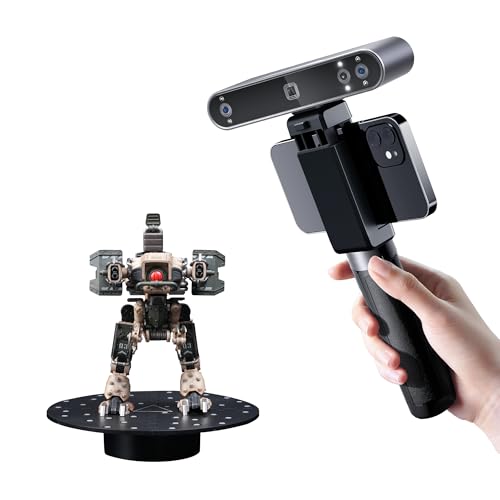
- Up to 20-micron accuracy
- Optical zoom boosts point-cloud detail
- Revo Design supports scan-to-CAD work
Best For: Detailed reverse engineering and product design
Beginner-Friendly Choice
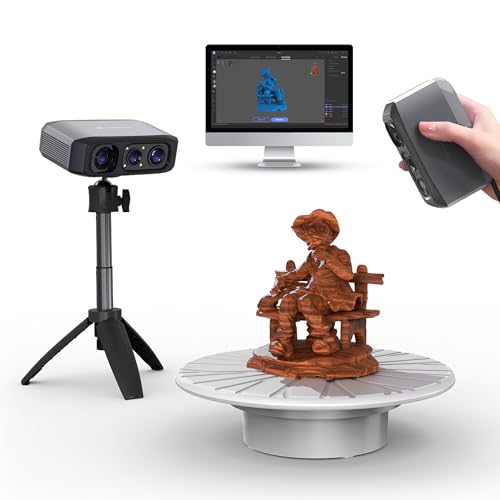
- AI-assisted model repair
- Optical anti-shake module
- Marker-free scanning with scan resume
Best For: Accessible scanning for beginners and makers
Versatile Entry Pick

- 30 fps scanning with up to 0.1 mm accuracy
- Scans dark and metallic surfaces without spray
- Supports outdoor scanning up to 30,000 lux
Best For: Portable DIY, education, and general reverse-engineering scans
Best with Extra Features

- Up to 0.01mm accuracy with blue LED scanning
- Captures 24-bit color and fine surface textures
- Includes turntable, tripod, and JMStudio exports
Best For: Detailed scans of small parts and components
Mobile-Friendly Choice

- Wireless scanning across PC, Mac, Android, and iOS
- Scans objects from 50mm to 2000mm
- Lightweight 105g kit with anti-shake tracking
Best For: Portable scanning of general-size parts and objects
Versatile Detail Option

- Up to 0.03mm accuracy with blue LED technology
- Handles objects from 15mm to 1500mm
- Includes color capture, anti-shake, and flexible exports
Best For: Medium-size components and varied 3D printing projects
Best All-Rounder – Revopoint INSPIRE 2
The Revopoint INSPIRE 2 is a versatile choice for a 3d scanner for reverse engineering, combining infrared structured light with multi-line laser scanning. Its portability, outdoor capability, and stated accuracy make it suitable for detailed parts and mixed scanning environments.
Best For: Portable reverse engineering, 3D printing, and users who need flexible scanning modes.
Pros:
- Up to 0.05 mm accuracy and 0.03 mm precision.
- Laser mode can capture reflective and dark surfaces without scanning spray.
- Lightweight 190 g design with Wi-Fi 6 and outdoor scanning support up to 20,000 lux.
- Includes Revo Metro software and one-click import to the separately sold Revo Design software.
Cons:
- Revo Design is sold separately.
- Windows AI segmentation is not available across all platforms.
- Recommended computer requirements include 16GB RAM and an RTX 3060-class GPU on Windows.
Choose the INSPIRE 2 if you want a compact scanner that balances detailed capture, wireless operation, outdoor use, and a broad range of surface types. It is especially appealing when portability matters as much as accuracy.
Best for Large Parts – Creality Otter Lite Basic
The Creality Otter Lite Basic is a practical 3d scanner for reverse engineering when projects range from small components to vehicle-sized objects. Its quad-camera design, 30fps scanning, and no-spray capture for dark or metallic surfaces support efficient work across varied parts.
Best For: Scanning objects from 0.8 to 78 inches, automotive parts, machinery, prototyping, and inspection.
Pros:
- Up to 0.05 mm accuracy with scanning speeds of up to 30fps.
- Quad-camera system combines detail capture with broad coverage.
- Scans dark, shiny, and metallic surfaces without powder or spray.
- Supports marker, geometry, and texture alignment plus PLY, OBJ, STL, ASC, 3MF, GLTF, and FBX exports.
Cons:
- The optional Scan Bridge handle is sold separately.
- Its full-color capability may be unnecessary for purely dimensional reverse engineering.
- Warranty coverage is listed as one year.
For buyers needing one handheld scanner to cover both small parts and large objects, the Otter Lite Basic offers an unusually broad stated size range. Its fast capture and surface flexibility can reduce preparation time on demanding projects.
Best for Precision Inspection – Revopoint MetroY Ultra
The Revopoint MetroY Ultra is aimed at demanding reverse engineering and inspection tasks where speed and tight geometric detail are priorities. Its blue laser system offers up to 0.01 mm single-frame precision, while five scanning modes adapt to large areas, fine details, and deep holes.
Best For: Industrial inspection, tight-tolerance parts, and production environments requiring fast data capture.
Pros:
- Up to 0.01 mm single-frame precision and stated volumetric accuracy of 0.015 + 0.04 mm × L (m).
- Scans at up to 90fps with a compatible NVIDIA GPU.
- Laser modes work on dark, glossy, and metallic parts without scanning spray.
- Supports outdoor scanning in sunlight up to 100,000 lux and includes a 5,500mAh battery grip.
Cons:
- Recommended Windows configuration includes 32GB RAM and an RTX 3060-class GPU.
- Maximum speed depends on having a compatible NVIDIA GPU.
- Its 450 g weight is higher than the INSPIRE 2 listed in this roundup.
The MetroY Ultra is the strongest fit here for users who prioritize precision, scanning speed, and industrial versatility over the simplest setup. Its deep-hole mode, outdoor rating, and wireless monitoring add useful flexibility in the field.
Best for Medium Objects – 3DMakerpro Moose Premium
The 3DMakerpro Moose Premium is a focused option for a 3d scanner for reverse engineering involving medium-sized components. Its blue LED structured light system, up to 0.03 mm accuracy, and included turntable support controlled indoor scanning and detailed model creation.
Best For: Medium objects measuring 15 to 1,500 mm, 3D printing, and indoor scanning projects.
Pros:
- Up to 0.03 mm accuracy with 0.07 mm resolution.
- Captures 24-bit color for realistic model textures.
- JMStudio provides automatic alignment, visual tracking, error correction, and lifetime free updates.
- Premium package includes a turntable, tripod, 65W power adapter, and data cable.
Cons:
- Best results are recommended indoors.
- Scanning speed is listed at 10fps.
- Handheld operation may require practice and a capable computer.
Moose Premium makes sense for hobbyists, makers, and small workshops scanning parts within its medium-object range. The included turntable and software tools can simplify repeatable indoor captures, though users should expect a learning period.
Precision Pick – Revopoint POP3 Plus
For shoppers seeking a 3d scanner for reverse engineering, the Revopoint POP3 Plus stands out with up to 20-micron accuracy, optical zoom, and scan-to-CAD tools. Its broad export support and compatibility with Revo Design make it a practical choice for turning captured parts into usable CAD models.
Best For: Product design, reverse engineering, and detailed scans of medium-sized objects.
Pros:
- Up to 20 microns of accuracy with a calibrated board and 0.05 mm fused point distance.
- Optical zoom provides up to 30% more point-cloud detail.
- Supports color scanning, 18 fps capture, marker tracking, and multiple CAD-friendly file formats.
- Revo Design helps convert scan data into CAD models.
Cons:
- Its software is compatible only with x86_64 architecture.
- The stated scanning range is intended for medium-sized objects rather than very large items.
The POP3 Plus is the strongest fit here for users who need precision and a more complete scan-to-CAD workflow. Its lightweight design, wireless or USB connectivity, and free Revo Scan software add flexibility for workshop and field use.
Beginner-Friendly Choice – 3DMakerpro Moose Lite Premium
The 3DMakerpro Moose Lite Premium is a practical 3d scanner for reverse engineering when ease of use matters. AI visual tracking, optical anti-shake features, marker-free scanning, and scan-resume functionality are designed to reduce setup and handling challenges.
Best For: Beginners and makers who want a simpler handheld workflow for 3D printing and model capture.
Pros:
- AI visual tracking can detect vulnerabilities and automatically repair 3D models.
- Optical anti-shake modules help compensate for unsteady hands.
- Marker-free technology simplifies scanning and setup.
- JMStudio includes lifetime free OTA software upgrades.
Cons:
- The supplied details do not specify a scan-to-CAD workflow or supported export formats.
- At 3.65 pounds, it is heavier than the Revopoint option listed here.
Choose the Moose Lite Premium if guided operation and recovery from interrupted scans are higher priorities than a documented professional CAD workflow. Its automation-oriented features make it approachable for new users.
Versatile Entry Pick – Creality CR-Scan Ferret Pro
The Creality CR-Scan Ferret Pro is a flexible 3d scanner for reverse engineering for DIY users, educators, and 3D printing enthusiasts. It combines 30 fps scanning with anti-shake tracking, Wi-Fi 6 transmission, and support for dark, metallic, and matte objects without scanning spray.
Best For: Portable scanning of parts and objects in indoor or outdoor settings.
Pros:
- Captures at up to 30 fps with up to 0.1 mm accuracy and 0.16 mm resolution.
- Texture mode can scan black, metallic, and matte surfaces without spray.
- Supports outdoor scanning in light levels up to 30,000 lux.
- Works with Windows, macOS, Android, and iOS devices and transfers data over Wi-Fi 6.
Cons:
- Its stated accuracy is lower than the POP3 Plus’s 20-micron specification.
- The product is positioned as an entry-level scanner, so it may be less suitable for highly exacting professional workflows.
The Ferret Pro is appealing when portability, surface flexibility, and outdoor use are central to the job. It offers a broad device-compatibility range and beginner-oriented handling, while its specifications place it below the most precision-focused option in this roundup.
Best with Extra Features – 3DMakerpro Seal Premium
For shoppers seeking a 3d scanner for reverse engineering small components, the 3DMakerpro Seal Premium emphasizes fine detail with blue LED structured light and up to 0.01mm accuracy. Its 10–300mm scanning range and texture camera make it particularly suited to compact parts, dents, edges, and color references.
Best For: Small-format reverse engineering, detailed 3D printing work, and users who need color and texture capture.
Pros:
- Blue LED source and up to 0.01mm accuracy for fine surface details.
- 24-bit full-color scanning captures textures and vibrant colors.
- JMStudio supports alignment, visual tracking, error correction, and OBJ/STL/PLY/ASC exports.
- Includes a turntable, tripod, charger, and one-year warranty.
Cons:
- Designed for small objects rather than larger components.
- Requires practice and a relatively powerful computer.
- Indoor use is recommended for optimal results.
The Seal Premium is a detail-focused option when dimensional capture of small parts matters more than portability or broad object-size coverage. Its included accessories and flexible export formats make it a practical choice for a dedicated desktop workflow.
Mobile-Friendly Choice – Creality CR-Scan Ferret Pro
The Creality CR-Scan Ferret Pro is a versatile 3d scanner for reverse engineering when portability and wireless operation are priorities. It supports Windows, macOS, Android, and iOS, scans objects from 50mm to 2000mm, and offers anti-shake tracking with up to 0.1mm accuracy.
Best For: DIY users, 3D printing enthusiasts, and teams that want to scan across phones, tablets, and computers.
Pros:
- Wi-Fi 6 enables wireless scanning with compatible devices.
- Lightweight 105g design is convenient for travel and field use.
- 24-bit full-color scanning and anti-shake technology support smoother captures.
- Includes a tripod, power bank, phone holder, Wi-Fi box, and carrying case.
Cons:
- Not intended for very small, highly detailed, jewelry, or precision parts.
- Reflective, transparent, and very dark surfaces may scan poorly.
- Device compatibility and RAM requirements vary by platform.
Ferret Pro is the most flexible pick here for users who value an easy-to-carry setup and cross-platform scanning. Its 0.1mm accuracy is better suited to general parts and larger objects than extremely fine reverse-engineering work.
Versatile Detail Option – 3DMakerpro Moose
The 3DMakerpro Moose is a practical 3d scanner for reverse engineering medium-size objects, combining blue LED structured light with a scanning range of 15–1500mm. It reaches up to 0.03mm accuracy, supports 24-bit color capture, and includes software tools for alignment and error correction.
Best For: Medium-size components, prototyping, 3D printing, and users who want a balance of detail and object-size flexibility.
Pros:
- Blue LED technology provides up to 0.03mm accuracy and 0.07mm resolution.
- Broad 15–1500mm object range covers small and medium-size scanning tasks.
- Anti-shake and scan-back functions support more reliable handheld scanning.
- JMStudio exports OBJ, STL, PLY, and ASC files and receives lifetime updates.
Cons:
- Handheld operation requires practice for consistent results.
- Indoor scanning is recommended.
- A capable computer is needed for smooth operation.
Moose offers a useful middle ground between small-object precision and broader scanning coverage. It is a strong fit for reverse-engineering workflows that move between compact parts and larger components without requiring a separate scanner for each size category.
How We Picked the Best 3d Scanner for Reverse Engineering
We focused on the specifications and workflow features that matter when capturing physical parts for measurement, modeling, and CAD reconstruction. Key considerations included stated accuracy or precision, scanning speed, tracking stability, supported object sizes, color capture, portability, connectivity, and compatibility with common computers and mobile devices.
Because advertised accuracy does not guarantee finished CAD accuracy, we treated resolution as one factor rather than the sole deciding point. Lighting, surface finish, scan strategy, calibration, alignment, and post-processing can all affect results.
Quick Comparison
| Best For | What to Prioritize | Shortlist Characteristics |
|---|---|---|
| Small, detailed parts | High precision and blue-light scanning | Compact scanners with strong detail capture |
| General-purpose reverse engineering | Reliable tracking and flexible object-size support | Handheld scanners with multiple scan modes |
| Large components | Fast frame rates and stable tracking | Scanners designed for broader coverage |
| Portable work | Wireless or mobile compatibility | Lightweight models supporting Android, iOS, or laptops |
| Color-reference workflows | Full-color capture and texture alignment | Models with integrated color scanning |
Key Buying Factors for a 3d Scanner for Reverse Engineering
Accuracy, Resolution, and Repeatability
Accuracy describes how closely a scan represents measured dimensions, while resolution affects the smallest features the scanner can distinguish. For mating parts, holes, slots, and inspection work, repeatability and calibration are just as important as the headline accuracy figure.
Object Size and Tracking
Check the scanner’s recommended object range before buying. Small-object modes can capture intricate components, while broader tracking is more practical for panels, tools, furniture, or vehicle parts. Markers, texture tracking, and anti-shake features can help maintain alignment on smooth or featureless surfaces.
Surface Finish and Lighting
Glossy, black, transparent, and reflective parts are difficult for many consumer scanners. You may need scanning spray, removable markers, controlled lighting, or multiple passes. If avoiding spray matters, prioritize a model whose tracking and capture system is designed for untreated surfaces, while still checking real-world limitations.
Software and Export Workflow
Confirm that the included software supports your operating system and exports formats compatible with your CAD or mesh tools. A scanner that produces clean alignment and manageable meshes can save more time than one with a higher specification but a cumbersome workflow.
Speed, Connectivity, and Ergonomics
Higher frame rates can make handheld scanning smoother, but fast capture is useful only when tracking remains stable. Consider cable length, wireless performance, battery requirements, weight, mobile support, and whether the scanner is comfortable during long sessions.
Who Should Buy Which 3d Scanner for Reverse Engineering?
Choose a compact, high-precision scanner if you mainly reverse-engineer small mechanical parts, prototypes, fittings, or detailed models. Choose a versatile handheld scanner for mixed projects and occasional color capture. Choose a faster, wider-range model if you regularly scan larger components or need to cover more surface area efficiently. Choose a mobile-compatible option if portability and field scanning matter more than maximum inspection precision.
Before ordering, compare the scanner’s supported size range, software requirements, surface-handling process, and export options with your actual parts and CAD workflow. Those practical matches usually matter more than a single maximum accuracy number.