
The best handheld 3D scanners make it easier to capture real-world objects for 3D printing, reverse engineering, digital modeling, and design work. This roundup compares ten options across accuracy, scanning speed, portability, tracking, connectivity, and ease of use.
Whether you need a compact scanner for occasional projects or a high-precision system for demanding workflows, the right choice depends on object size, surface characteristics, software support, and how much post-processing you are prepared to do.
Best 10 Handheld 3d Scanners Picks for 2026
Beginner-Friendly Pick
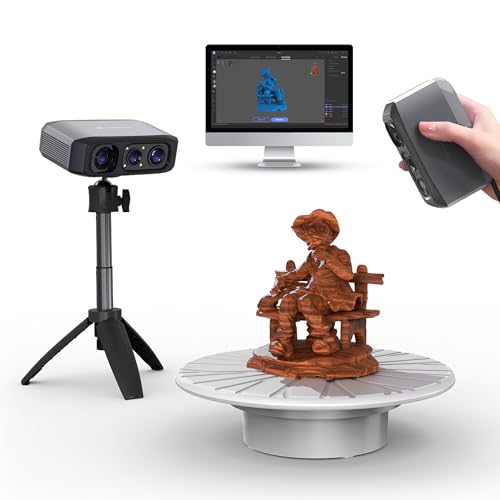
- 0.05mm precision with up to 10FPS scanning
- AI tracking and automated model repair
- Marker-free scanning with anti-shake support
Best For: Beginners and 3D printing workflows
Versatile Full-Color Pick

- 0.05mm accuracy with up to 30FPS scanning
- Quad cameras scan objects from 0.8 to 78 inches
- No spray needed for dark or metallic surfaces
Best For: Reverse engineering, inspection, and color-rich models
Fine-Detail Lightweight Pick
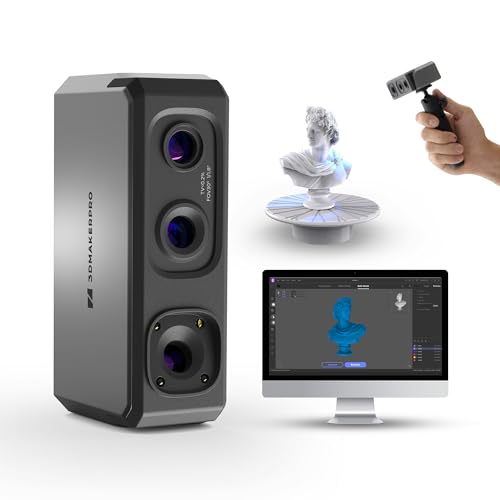
- 0.02mm stated accuracy with blue imaging
- Lightweight 225g body and quiet operation
- Nine lighting levels and optical stabilization
Best For: Detailed, portable, and quiet scanning
High-Speed Precision Pick

- 0.02mm laboratory-stated accuracy
- Up to 60FPS and 660,000 points per second
- Includes wireless Scan Bridge and color mapping
Best For: Fast, detailed scanning of small to large objects
Best Wireless Pick

- Wireless Wi-Fi 6 scanning with under-10ms latency
- 330g body with up to three hours of battery life
- Quad-lens coverage for small and large objects
Best For: Portable scanning across varied object sizes
Best Portable Value

- Up to 0.1mm precision in high-accuracy mode
- Full-color texture capture with an RGB camera
- Lightweight design supports power-bank operation
Best For: Portable 3D printing and hobbyist scanning
Best Precision Scanner

- Blue laser mode reaches up to 0.02mm accuracy
- Captures objects from 5mm parts to 2m components
- 60 FPS scanning with anti-shake and autofocus
Best For: Precision-focused design, reverse engineering, and automotive work
Best Wireless Starter Scanner

- 0.1mm accuracy with 30FPS scanning
- WiFi 6 wireless transmission
- Anti-shake tracking and flexible file exports
Best For: Beginners and makers needing portable, full-color scanning
Best Professional Precision Scanner

- 0.02mm accuracy with high-speed laser capture
- Scans 5mm to 4m objects
- Handles dark, metallic, and some transparent surfaces
Best For: Professional reverse engineering, design, and inspection
Best Portable Color Scanner

- Lightweight 105g handheld design
- Wireless iOS, Android, Mac, and Windows support
- Includes battery handle and travel accessories
Best For: Beginners and creators scanning medium-sized objects on the go
Beginner-Friendly Pick – Moose Lite Premium
The 3DMakerpro Moose Lite Premium is one of the more approachable handheld 3D scanners for users who want a smoother scanning workflow. AI visual tracking, optical anti-shake stabilization, and marker-free scanning help reduce setup and handling demands.
Best For: Beginners, 3D printing projects, and users who want automated model repair.
Pros:
- 0.05mm precision and scanning speeds up to 10FPS.
- AI visual tracking can help detect vulnerabilities and automate 3D model repair.
- Optical anti-shake modules and re-scanning support make interrupted scans easier to continue.
- No markers are required, and JMStudio includes lifetime free OTA software upgrades.
Cons:
- Its listed 10FPS speed is slower than several faster handheld 3D scanners.
- The 3.65-pound package weight may be less convenient for extended handheld sessions.
The Moose Lite Premium stands out for ease of use rather than maximum scanning speed. Its stabilization and marker-free workflow make it a practical choice for newcomers who want fewer obstacles while creating models for 3D printing.
Versatile Full-Color Pick – Creality Otter Lite Basic
The Creality Otter Lite Basic is a versatile option among handheld 3D scanners, combining 0.05mm accuracy with up to 30FPS scanning. Its quad-camera design supports objects ranging from small coins to large vehicles, while its scanning system can handle dark and metallic surfaces without spray.
Best For: Reverse engineering, prototyping, quality inspection, and full-color scanning of objects from 0.8 to 78 inches.
Pros:
- Quad-camera coverage supports both fine details and large objects.
- Scans dark and metallic surfaces without powder or spray, including outdoors in up to 30,000 lux sunlight.
- Captures 24-bit full-color textures with an RGB camera and LED fill lights.
- Supports multiple alignment modes and exports to PLY, OBJ, STL, ASC, 3MF, GLTF, and FBX.
Cons:
- The optional Scan Bridge handle is sold separately.
- The listed warranty is one year.
Otter Lite Basic is a strong all-around choice for shoppers who need broad object-size coverage and realistic color capture. Its no-spray capability is especially useful for technical or automotive scanning where surface preparation is inconvenient.
Fine-Detail Lightweight Pick – 3DMakerpro Seal Lite
The 3DMakerpro Seal Lite focuses on detailed capture in a lightweight, quiet handheld design. Its precision blue imaging system, 0.02mm accuracy, optical stabilization, and adjustable lighting make it a compelling choice for detailed models and smaller scanning projects.
Best For: Detailed scans of body parts, models, artwork, and other projects where portability and quiet operation matter.
Pros:
- Refined structured light technology delivers stated accuracy of 0.02mm.
- Weighs 225g and operates without fan noise.
- Anti-shake lenses and optical stabilization support smoother continuous scanning.
- Nine light-adjustment levels help accommodate different colors, materials, and lighting conditions.
Cons:
- Compatibility is listed for Windows 10/11 64-bit and macOS 12/13, rather than mobile devices by default.
- The optional Smart Grip for smartphone scanning is sold separately.
Seal Lite is a particularly practical handheld 3D scanner for users who value fine detail without carrying a heavier device. The lightweight body and quiet operation are useful for longer sessions, while JMStudio supports OBJ, STL, PLY, and ASC exports.
High-Speed Precision Pick – Creality Raptor Pro
The Creality Raptor Pro with Scan Bridge targets demanding scanning work with laboratory-stated 0.02mm accuracy and speeds up to 60FPS. Its blue laser line setup, wireless Scan Bridge, and broad size range make it suited to users who prioritize fast, detailed capture.
Best For: High-precision scanning of objects from 5mm to 2000mm, especially intricate parts and larger projects.
Pros:
- Reaches up to 60FPS and 660,000 points per second for rapid capture.
- Offers 0.02mm accuracy under laboratory conditions.
- Supports objects from 5mm to 2000mm with a 270mm by 170mm capture range at 300mm.
- Includes wireless Scan Bridge, full-color mapping, and marker-based alignment.
Cons:
- The listed 12.17-pound package weight suggests a less travel-friendly setup than lightweight scanner-only options.
- Marker-based alignment is required for stitching multiple scans.
Raptor Pro is the performance-oriented choice in this group. Its high frame rate, large point throughput, and included wireless scanning accessory make it attractive for detailed work where speed and precision are more important than minimal equipment weight.
Best Wireless Pick – Creality Otter Lite
For shoppers comparing handheld 3d scanners, the Creality Otter Lite stands out as a lightweight wireless option for scanning both small details and larger objects. Wi-Fi 6 connectivity, 30 FPS capture, and anti-shake tracking support a flexible workflow without a USB or power tether.
Best For: Portable scanning of objects ranging from jewelry and figurines to furniture, sculptures, and car tires.
Pros:
- Fully wireless operation with Wi-Fi 6 and low-latency transmission.
- Lightweight 330g design and battery life of up to three hours.
- Quad-lens system supports both small-object detail and larger scans.
- Free lifetime CrealityScan software includes tutorials and editing tools.
Cons:
- One-year warranty may be less extensive than some buyers expect.
- Battery-powered scanning requires recharging for extended sessions.
The Otter Lite is a practical choice when mobility matters. Its combination of low weight, wireless scanning, stable tracking, and multiple focal ranges makes it especially versatile for users who want to scan in different locations.
Best Portable Value – Creality CR-Scan Ferret
The Creality CR-Scan Ferret is a compact choice among handheld 3d scanners, offering wide-range and high-accuracy modes in a lightweight 10.2-ounce design. Its color camera, 30 FPS point-cloud capture, and support for power banks make it useful for mobile scanning.
Best For: Beginners and hobbyists who need portable full-color scanning for 3D printing and detailed object capture.
Pros:
- High-accuracy mode reaches up to 0.1mm precision with 0.16mm resolution.
- Wide-range mode supports coverage up to 560 × 820mm per scan.
- Built-in RGB camera captures full-color textures.
- Can draw power from a 5V power bank or compatible Android device.
Cons:
- Mobile scanning is limited to Android devices; iOS support is listed for the Ferret Pro.
- Requires compatible hardware, operating systems, RAM, and Wi-Fi 6 connectivity.
The Ferret balances portability and scanning capability well. Buyers should verify their computer or Android device meets the listed requirements, but those with compatible equipment get flexible scanning modes and realistic color output.
Best Precision Scanner – Creality CR-Scan Raptor
For users prioritizing precision and speed, the Creality CR-Scan Raptor is one of the more capable handheld 3d scanners in this lineup. Its blue laser and NIR modes cover objects from 5mm-scale parts to large components, while blue-light scanning reaches up to 60 FPS.
Best For: Reverse engineering, industrial design, automotive parts, miniatures, and users needing detailed scans across a broad size range.
Pros:
- Blue laser scanning offers up to 0.02mm accuracy and 0.1mm detail resolution.
- Supports objects from 5 × 5 × 5mm up to 2000 × 2000 × 2000mm.
- Anti-shake tracking, autofocus, and marker-free scanning support smoother workflows.
- 24-bit full-color scanning uses 12 LED texture lights for improved lighting.
Cons:
- Recommended Windows setup calls for a dedicated NVIDIA GPU with 6GB VRAM and 16GB RAM.
- Its advanced capabilities may be more than casual users need.
The Raptor is the strongest fit for demanding detail work and varied object sizes. Its system requirements are substantial, but the combination of laser precision, fast capture, stabilization, and full-color output supports more technical scanning projects.
Best Wireless Starter Scanner – CR-Scan Ferret Pro
The Creality CR-Scan Ferret Pro is a practical choice for shoppers comparing handheld 3D scanners for 3D printing, DIY projects, and portable scanning. It combines up to 0.1mm accuracy, 30FPS capture, WiFi 6 transmission, and anti-shake tracking in a beginner-friendly design.
Best For: Beginners and makers who want wireless, full-color scanning across compatible phones, tablets, Macs, or Windows PCs.
Pros:
- Up to 0.1mm accuracy, 0.16mm resolution, and 30FPS scanning
- WiFi 6 supports faster, stable wireless data transfer
- Anti-shake tracking helps maintain smooth scans during hand movement
- Exports OBJ, STL, and PLY files for printing and design workflows
Cons:
- Best results require avoiding reflective, transparent, or extremely dark surfaces
- Compatible devices need adequate memory and supported operating systems
Choose this model if portability and ease of use matter more than measurement-grade precision. Its outdoor capability and flexible file exports make it a versatile option for general-purpose scanning.
Best Professional Precision Scanner – CR-Scan Raptor Pro
The Creality CR-Scan Raptor Pro is aimed at buyers who need high-precision handheld 3D scanners for demanding design, inspection, and reverse-engineering work. Its blue-laser and NIR modes cover objects from 5mm to 4m, while capture speeds reach 660,000 points per second.
Best For: Professional users scanning black, metallic, transparent, automotive, industrial, medical, or full-body subjects.
Pros:
- Up to 0.02mm measurement accuracy
- Blue laser and NIR modes scan objects from 5mm to 4m
- Handles black, metallic, and up to 71% transparent glass surfaces without powder
- Supports 24-bit color and professional software including Geomagic, Rhino, and SolidWorks
Cons:
- Recommended computers require substantial hardware, including 32GB RAM and an 8GB VRAM GPU on Windows
- At 9.06 pounds, the package is less travel-friendly than lightweight scanners
The Raptor Pro is the strongest fit here for precision-focused workflows and difficult surfaces. Its broad size range and professional software compatibility justify choosing it over an entry-level scanner when accuracy and material versatility are priorities.
Best Portable Color Scanner – CR-Scan Ferret Pro Kit
The Creality CR-Scan Ferret Pro is a lightweight option for shoppers seeking handheld 3D scanners that are easy to carry and quick to use. With 105g portability, WiFi 6, full-color capture, and included accessories such as a tripod, power bank, phone holder, and case, it suits mobile scanning setups.
Best For: DIY creators, 3D-printing enthusiasts, and beginners scanning medium-sized objects from 50mm to 2000mm.
Pros:
- Lightweight 105g design for portable scanning
- Supports wireless scanning across Windows, macOS, Android, and iOS
- Full-color 24-bit scanning with anti-shake tracking
- Includes a battery handle and useful travel accessories
Cons:
- Not suitable for very small or highly detailed items such as jewelry or precision parts
- Reflective, transparent, and very dark surfaces may reduce scan quality
- iOS use requires an iPhone 11 or newer, while device memory requirements also apply
This Ferret Pro kit emphasizes convenience rather than extreme precision. It is a sensible pick for portable hobby scanning, especially when the included accessories and cross-platform wireless support can simplify setup.
How We Picked These Handheld 3d Scanners
We selected these Handheld 3d Scanners based on the specifications most likely to affect real-world results: stated accuracy, scanning frame rate, tracking features, supported operating systems, wireless capability, color capture, and compatibility with 3D-printing workflows. We also considered the range of object sizes each scanner is designed to handle and whether its feature set suits beginners, hobbyists, makers, or professional users.
Advertised accuracy is only one part of performance. Lighting, scan distance, surface texture, calibration, operator movement, and software alignment can all influence the final mesh. Treat listed specifications as useful benchmarks rather than guarantees for every project.
Quick Comparison
| Feature | What to Look For | Why It Matters |
|---|---|---|
| Accuracy | About 0.02mm to 0.1mm stated accuracy | Important for fitting parts, reverse engineering, and detailed models |
| Scanning speed | 30–60 frames per second | Helps capture moving subjects and reduces scanning time |
| Connection | USB, Wi-Fi, or wireless bridge | Determines portability and workflow flexibility |
| Tracking | Anti-shake, visual, marker, or hybrid tracking | Supports smoother scans across larger or complex objects |
| Color capture | Full-color scanning where needed | Useful for digital replicas, reference work, and textured models |
Key Buying Factors for Handheld 3d Scanners
Accuracy and Resolution
Choose a scanner according to the tolerance your project requires. A lower-cost model may be sufficient for decorative objects, cosplay parts, and general 3D printing, while a higher-precision blue-laser or structured-light scanner is better suited to mechanical components and detailed measurements.
Object Size and Surface
Check the intended scanning range before buying. Small-object scanners may struggle with large subjects, while large-object scanning can require more space and careful tracking. Dark, glossy, transparent, or reflective surfaces often need preparation spray, removable matte coating, or additional lighting.
Speed, Tracking, and Wireless Use
Higher frame rates can make scanning faster, but stable tracking is equally important. Anti-shake systems and hybrid tracking can help when moving around an object. Wireless models are convenient for field work, although wired connections may provide a steadier data path for long or detailed scans.
Software and Export Options
Confirm support for your computer or phone before purchasing. Look for software that can align scans, remove unwanted data, fill holes, edit meshes, and export common formats such as STL, OBJ, or PLY. Mobile compatibility is convenient, but desktop software often provides more control.
Who Should Buy Which Handheld 3d Scanners?
Beginners and casual makers should prioritize simple setup, broad compatibility, color capture, and dependable tracking over maximum stated precision. A compact wireless model is a practical choice for scanning household objects, props, and general 3D-printing projects.
Users working on mechanical parts, replacement components, or reverse engineering should prioritize the highest practical accuracy, stable tracking, and strong desktop software. Models advertising approximately 0.02mm accuracy and fast blue-laser or NIR capture are better suited to demanding detail work, provided the operator can manage calibration and surface preparation.
If portability is the priority, choose a scanner with Wi-Fi or a wireless bridge and support for your preferred mobile or laptop workflow. Before ordering, verify included accessories, software licensing, required system specifications, and whether the scanner needs markers or scanning spray for your typical subjects.