
The best portable 3D scanners make it easier to capture real-world objects for 3D printing, reverse engineering, design work, and digital archiving. However, scanners vary widely in accuracy, tracking, scan range, lighting requirements, and software.
Our selection includes compact entry-level models, wireless handheld scanners, and higher-precision options for users who need dependable results across different object sizes and surfaces.
Best 10 Portable 3d Scanners Picks for 2026
Best Outdoor Pick

- 190g body with Wi-Fi 6 wireless scanning
- Dual modes scan varied surfaces without spray
- Up to 0.05mm accuracy with RGB color capture
Best For: Outdoor scanning, color models, and reverse engineering
Best High-Speed Option
Creality Pika Portable 3D Scanner

- Blue laser accuracy reaches 0.03mm
- 110 FPS capture with Wi-Fi 6 and touchscreen
- AI completion, retexturing, and hole filling
Best For: Fast scans from small parts to full-body subjects
Best Entry-Level Choice

- Beginner-friendly medium-format scanner
- 0.07mm accuracy and 0.10mm resolution
- Markerless AI tracking helps recover lost alignment
Best For: Hobbyists learning 3D scanning and printing
Best for Large Objects

- Quad-camera coverage from coins to cars
- 0.05mm accuracy with 30 FPS scanning
- No-spray capture for dark and metallic surfaces
Best For: Large objects, automotive parts, and full-color scans
Best Precision Pick

- Up to 0.03mm accuracy with blue LED structured light
- Scans objects from 15mm to 1500mm
- Includes turntable, tripod, and color capture
Best For: Detailed medium-size object scanning and 3D printing
Best Wireless Option

- WiFi 6 wireless scanning with compatible mobile devices
- 30FPS scanning with up to 0.1mm accuracy
- Supports outdoor scanning and full-color capture
Best For: Mobile scanning, beginners, and flexible device compatibility
Best Small-Object Scanner
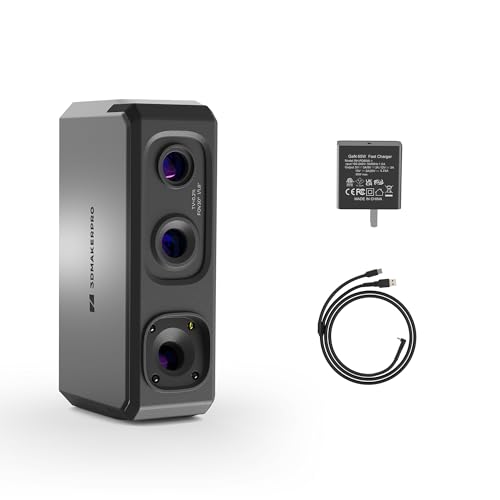
- Up to 0.02mm accuracy for 10–300mm objects
- Blue LED source captures fine surface details
- Compact 1.54-pound design with JMStudio software
Best For: Detailed indoor scanning of small objects for 3D printing
Best Compact Choice
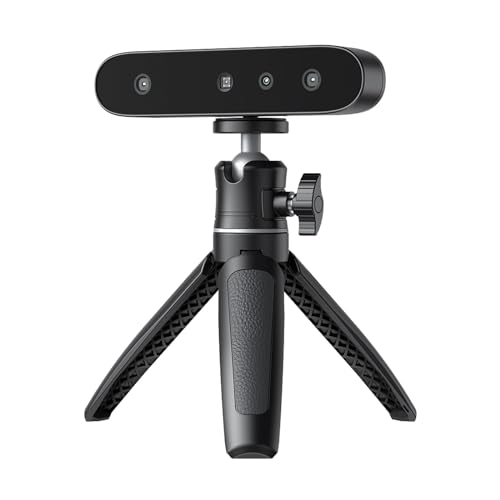
- Anti-shake tracking supports steadier scanning
- Scans black and metallic objects without spray
- Lightweight 105g design with full-color capture
Best For: Beginners using a PC for portable full-color scanning
Best for Small Details

- Blue LED system rated for up to 0.02mm accuracy
- Designed for 10–300mm small-format objects
- Includes tripod, turntable, and export-ready software
Best For: Indoor small-object scanning and detailed 3D-printing projects
Best for Flexible Scanning

- Wide-range and high-accuracy scanning modes
- Up to 30 FPS point-cloud capture
- Can run from a power bank or compatible Android device
Best For: Handheld Android and PC scanning across varied object sizes
Best Outdoor Pick – Revopoint INSPIRE 2
For shoppers comparing portable 3d scanners, the Revopoint INSPIRE 2 stands out for its lightweight 190g design, wireless scanning, and outdoor capability in shaded or semi-bright conditions. Its dual scanning modes, RGB color capture, and adjustable optical zoom make it a flexible option for detailed models, digital archiving, and scan-to-CAD workflows.
Best For: Portable outdoor scanning, color-textured models, 3D printing, reverse engineering, and detailed modeling.
Pros:
- Wi-Fi 6 supports mobile scanning and interactive PC-to-mobile streaming.
- Infrared structured light and 11-line laser modes handle varied materials, including dark and reflective surfaces without scanning spray.
- Up to 0.05mm accuracy and 0.03mm precision, supported by a high-precision calibration board.
- Lightweight body includes a tripod, turntable, markers, filters, and calibration board.
Cons:
- Revo Design scan-to-CAD software is sold separately and supports Windows only.
- Recommended computer specifications are relatively demanding, including an RTX 3060-class GPU for Windows.
The INSPIRE 2 is a strong fit when portability, wireless operation, color capture, and outdoor flexibility matter. Check device requirements before buying, especially if you plan to use a computer-based workflow.
Best High-Speed Option – Creality Pika Portable 3D Scanner
The Creality Pika is one of the most versatile portable 3d scanners for users who want laser detail and full-body scanning in one device. It combines blue laser and NIR structured-light modes with Wi-Fi 6, a built-in touchscreen, swappable batteries, and support for objects ranging from small parts to life-size scans.
Best For: High-speed scanning, small mechanical parts, collectibles, body scans, and users who want built-in AI processing tools.
Pros:
- Seven-line blue laser mode offers up to 0.03mm accuracy for fine details.
- NIR structured-light mode supports full-body scanning and 24-bit true color.
- Captures up to 110 frames per second and can scan dark or metallic surfaces without spray.
- AI tools provide body completion, retexturing, and automatic hole filling.
Cons:
- iPad compatibility and software experience are still being optimized.
- Best results require a compatible smartphone or computer.
Choose the Pika if speed, broad size coverage, and AI-assisted cleanup are higher priorities than a simple entry-level workflow. Confirm your phone or computer compatibility before purchase.
Best Entry-Level Choice – 3DMakerpro Fox
The 3DMakerpro Fox is a practical starting point among portable 3d scanners for beginners and hobbyists. Its medium-format design combines 0.07mm accuracy with markerless AI visual tracking, while JMStudio brings scanning, editing, and optimization together in one software workflow.
Best For: Beginners, hobbyists, 3D printing, modeling, measurement, and general-purpose object scanning.
Pros:
- Entry-level design is aimed at beginners and hobby users.
- Offers 0.07mm accuracy and 0.10mm resolution for detailed scans.
- Markerless AI tracking can relock onto an object if scanning movement causes tracking loss.
- JMStudio integrates scanning, editing, and optimization.
Cons:
- At 2.39 pounds, it is heavier than several highly compact handheld options.
- The supplied notes do not specify wireless connectivity or mobile-platform support.
The Fox makes the most sense for buyers who value an approachable software ecosystem and dependable detail over the lightest possible scanner. It is particularly well suited to learning and small project workflows.
Best for Large Objects – Creality Otter Lite Basic
The Creality Otter Lite Basic is a capable choice for shoppers comparing portable 3d scanners that can cover everything from coins to car-sized objects. Its quad-camera system pairs detail-focused and wide-coverage lenses, while no-spray scanning, full-color capture, and multiple alignment modes support practical 3D printing, inspection, and reverse-engineering tasks.
Best For: Large-object scanning, automotive parts, machinery, full-color models, and mixed-size projects.
Pros:
- Quad-camera design scans objects from approximately 0.8 inches to 78 inches.
- Up to 0.05mm accuracy and 30 frames per second support detailed, efficient scanning.
- Can scan dark, shiny, and metallic surfaces without powder or spray.
- Captures 24-bit color and supports marker, geometry, and texture alignment.
Cons:
- The optional Scan Bridge handle is sold separately.
- Outdoor scanning is supported up to 30,000 lux, which may limit use in brighter sunlight.
The Otter Lite Basic is especially appealing when one scanner must handle both small details and large objects. Its broad size range and no-spray surface handling make it a flexible tool for workshops and field projects.
Best Precision Pick – 3DMakerpro Moose Premium
For shoppers comparing portable 3d scanners for medium-size objects, the 3DMakerpro Moose Premium stands out for its claimed precision and flexible scanning range. Its blue LED structured-light system supports up to 0.03mm accuracy, while JMStudio provides alignment, tracking, and error correction tools.
Best For: Medium-size objects, detailed 3D printing projects, and users who want color capture plus multiple export formats.
Pros:
- Scans objects from 15mm to 1500mm, with a recommended working distance of 150–400mm.
- Supports up to 0.03mm accuracy, 0.07mm resolution, and 24-bit color acquisition.
- Includes a turntable, tripod, 65W power adapter, and lifetime software updates for Windows and macOS.
Cons:
- May require practice and a capable computer for smooth operation.
- Indoor environments are recommended for best results.
The Moose Premium is a strong choice when accuracy and a broad object-size range matter more than a quick plug-and-play learning curve. Its included accessories make it a practical starting kit for detailed indoor scanning.
Best Wireless Option – Creality CR-Scan Ferret Pro
The Creality CR-Scan Ferret Pro is one of the more flexible portable 3d scanners for users who want handheld mobility across phones and computers. Its WiFi 6 bridge supports wireless scanning on compatible Android devices and iPhone 11 or newer models, while anti-shake tracking helps maintain smoother capture.
Best For: Beginners and mobile users who want fast, full-color scanning indoors or outdoors.
Pros:
- Offers up to 0.1mm accuracy, 0.16mm resolution, and a 30FPS scanning speed.
- WiFi 6 transmission is designed for faster, stable wireless data transfer.
- Supports outdoor scanning in ambient light up to 30,000 lux and exports OBJ, STL, and PLY files.
- Works with compatible Windows, Mac, Android, and iOS setups.
Cons:
- Highly reflective, transparent, and extremely dark surfaces may be difficult to scan.
- Wireless mobile use requires the dedicated bridge and compatible devices.
- Requires at least 8GB RAM on listed Windows, Mac, and Android configurations.
Choose the Ferret Pro if portability, wireless transmission, and faster capture are priorities. It offers broad device compatibility, though surface limitations and hardware requirements should be checked before buying.
Best Small-Object Scanner – 3DMakerpro Seal Lite
For small projects, the 3DMakerpro Seal Lite is a focused choice among portable 3d scanners. Its blue LED light source is designed to capture fine dents and edge textures, with up to 0.02mm accuracy for objects measuring 10–300mm.
Best For: Small-format indoor scanning, detailed model making, and 3D printing projects where color capture is not required.
Pros:
- Provides up to 0.02mm accuracy for small objects and fine surface details.
- Supports scan-back and anti-shake features for more stable handheld scanning.
- JMStudio offers auto-alignment, visual tracking, error correction, and OBJ/STL/PLY/ASC export.
- Compact design weighs 1.54 pounds and includes a 65W charger and data cable.
Cons:
- Designed for objects from 10mm to 300mm, so it is not intended for large subjects.
- Captures mono texture only rather than color.
- May require practice and a relatively powerful PC; indoor use is recommended.
The Seal Lite makes the most sense when compact, high-detail scanning is the goal. Its small scanning range and mono-texture capture keep it specialized, but the accuracy and software tools are well suited to small 3D-printing subjects.
Best Compact Choice – Creality CR-Ferret SE
The Creality CR-Ferret SE is a practical option for shoppers comparing portable 3d scanners for desktop and field-style projects. Its 105g design, anti-shake tracking, and ability to scan black or metallic objects without spray make it especially approachable for beginners. Note that this SE model supports PC scanning only and does not include a battery handle.
Best For: Beginners who want a lightweight, full-color scanner for PC-based projects and difficult dark or reflective objects.
Pros:
- Anti-shake technology helps maintain steadier scans with unsteady hands.
- Can scan black and metallic objects without scanning spray.
- Captures full-color models with its built-in 2MP color camera.
- Compact 105g body is easy to carry.
Cons:
- Supports PC scanning only.
- Battery handle is not included.
The CR-Ferret SE stands out among portable 3d scanners for its simple setup, low weight, and forgiving tracking. Choose it when color capture and dark-object scanning matter more than mobile-device flexibility.
Best for Small Details – 3DMakerpro Seal Lite
The 3DMakerpro Seal Lite is designed for buyers seeking portable 3d scanners for small-format work. Its blue LED light source is rated for up to 0.02mm accuracy, while scan-back and anti-shake features help produce more stable results. It is intended for indoor use and requires a relatively powerful computer.
Best For: Small objects measuring roughly 10–300mm, detailed 3D-printing workflows, and users who want included tripod and turntable accessories.
Pros:
- Blue LED light source supports up to 0.02mm accuracy.
- Designed to capture small dents and edge textures.
- Includes a tripod, turntable, charger, and data cable.
- JMStudio supports Windows and macOS plus OBJ, STL, PLY, and ASC exports.
Cons:
- Captures mono texture only.
- Recommended for indoor use.
- Has a learning curve and needs a relatively powerful PC.
Seal Lite is a focused choice rather than an all-purpose scanner. Its small-format range and high stated accuracy make it compelling for detailed models, provided you are comfortable practicing and working from a capable computer.
Best for Flexible Scanning – Creality CR-Scan Ferret
The Creality CR-Scan Ferret is a versatile pick among portable 3d scanners, supporting wide-range and high-accuracy scanning modes. It offers up to 30 FPS point-cloud capture, full-color texture capture, and power from a 5V power bank or compatible Android device. Mobile scanning is limited to Android, while iOS users need the Ferret Pro model.
Best For: Users who need handheld scanning for both larger coverage and finer details, with Android-based portability.
Pros:
- Dual modes support wide-area and detailed scanning.
- High-accuracy mode reaches up to 0.1mm precision.
- ASIC processing supports up to 30 FPS point-cloud capture.
- Built-in RGB camera records full-color textures.
Cons:
- Mobile scanning supports Android devices only.
- Requires specific operating-system, RAM, and processor specifications.
- Power-bank operation still depends on compatible equipment.
The Ferret offers the broadest scanning flexibility of these three models, especially for users who want both coverage and detail modes. Check your computer or Android specifications before buying, since performance depends on meeting the stated requirements.
How We Picked These Portable 3d Scanners
We evaluated these Portable 3d Scanners by comparing their stated accuracy, scanning technology, supported object sizes, frame rates, tracking features, color and texture capture, connectivity, and intended use. We also considered how practical each model is for setup, handheld scanning, processing, and 3D-printing workflows.
Specifications can vary by scan mode and operating conditions. Accuracy claims are best treated as a guide rather than a guarantee, since lighting, surface texture, distance, calibration, and user technique all affect final results.
Quick Comparison
| What to Compare | Why It Matters | Best For |
|---|---|---|
| Accuracy | Determines how closely the scan represents the original object. | Reverse engineering, replacement parts, and detailed models |
| Scanning range | Shows whether the scanner suits small components, people, or larger objects. | Matching the scanner to your typical subjects |
| Tracking and speed | Helps maintain alignment while scanning moving around an object. | Handheld scanning and larger subjects |
| Color and texture capture | Adds visual detail to the digital model. | Figurines, product design, digital assets, and documentation |
| Connectivity | Wireless or mobile support can make field scanning more convenient. | Outdoor work and scanning away from a desk |
Key Buying Factors for Portable 3d Scanners
Accuracy and Resolution
Choose a scanner based on the tolerances your projects require. Higher stated accuracy is useful for mechanical parts and detailed prototypes, while a more forgiving model may be sufficient for basic reference models, larger objects, or hobby printing.
Object Size and Scan Mode
Check the minimum and maximum recommended object dimensions. Small-format scanners are better for miniatures, components, and intricate items. Medium- and larger-range models are more suitable for furniture parts, body scanning, vehicles, and other oversized subjects.
Surface, Lighting, and Tracking
Dark, glossy, transparent, or textureless surfaces can be difficult for many scanners. Structured light, blue-light, laser, infrared, anti-shake tracking, markers, and body-completion software can improve results, but they do not eliminate every scanning challenge. Outdoor use also requires attention to ambient light and power requirements.
Software and Workflow
Confirm operating-system compatibility, export formats, mobile support, and whether the software includes alignment, hole filling, mesh editing, or texture processing. A scanner with strong hardware can still be frustrating if its software is difficult to learn or limits how you export your models.
Who Should Buy Which Portable 3d Scanners?
Beginners and hobbyists: Look for an affordable scanner with automatic alignment, straightforward software, and a broad enough scan range for your projects.
3D-printing users: Prioritize reliable geometry, suitable small-object accuracy, and exports that work cleanly with your slicer or modeling software.
Professionals and makers: Consider higher precision, faster capture, stronger tracking, and better handling of varied surfaces. Wireless connectivity can be valuable for workshops and field work.
Users scanning people or large objects: Choose a model with an appropriate range, stable tracking, useful color capture, and features that help complete gaps when the subject or scanner moves.
Before buying, match the scanner’s accuracy and scan range to your most demanding recurring task—not just its headline specification. That approach usually produces better results than choosing solely by price or maximum resolution.