
The best 3D printers for hobbyists make it easier to turn digital designs into useful parts, creative projects, miniatures, and prototypes. Today’s options range from simple beginner machines to fast CoreXY printers with automated calibration and multicolor support.
We compared these 10 selected models across setup, print quality, speed, materials, features, and overall value so you can choose a printer that matches your experience, workspace, and project goals.
Best 10 3d Printers for Hobbyists Picks for 2026
Best Beginner Multicolor Pick

- Automatic calibration simplifies setup
- Fast, precise FDM printing
- AMS lite enables multicolor printing
Best For: Beginners and families wanting easy, quiet printing
Best High-Speed Open-Frame Pick

- 600mm/s maximum printing speed
- One-click automatic leveling
- Power-loss recovery and run-out sensing
Best For: Fast prototyping with common flexible and standard filaments
Best Enclosed Multicolor Pick
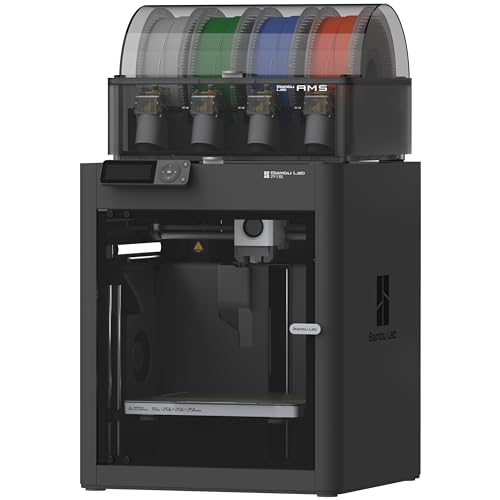
- Enclosed design supports advanced filaments
- Up to 16-color printing with AMS
- 500mm/s high-speed printing
Best For: Multicolor projects and enclosed-material versatility
Best Value Beginner Pick

- Automatic leveling and Z-offset
- 250mm/s maximum print speed
- Direct drive supports PLA, PETG, and TPU
Best For: Beginners printing practical everyday projects
Best Multi-Material Pick

- Four independent toolheads with five-second changes
- Supports multi-color and mixed-material printing
- 500 mm/s CoreXY printing with a 270 mm build volume
Best For: Ambitious multi-color and multi-material hobby projects
Best Value Starter Bundle

- Includes four packs of colorful PLA filament
- Automatic leveling and Z-offset sensing
- Supports PLA, TPU, and PETG through a direct extruder
Best For: Beginners who want an accessible, ready-to-start bundle
Best High-Speed Color Option

- Four-color printing with an Intelligent Filament System
- Up to 600 mm/s printing speed
- Core XY frame with auto leveling and TPU support
Best For: Fast, colorful models and smaller functional prints
Versatile Multicolor Pick

- Up to 16-color printing with expanded CFS setup
- Pre-assembled with automatic leveling and AI monitoring
- 260 mm cubed build volume and broad material support
Best For: Hobbyists wanting convenient multicolor printing and everyday versatility
Beginner-Friendly Speedster

- One-click automatic calibration simplifies setup
- CoreXY design supports high-speed, low-noise printing
- Quick-release nozzle and power-loss recovery add convenience
Best For: Beginners and hobbyists seeking simple, fast, maintainable printing
Large-Format Multicolor Powerhouse

- Large 350 mm cubed build volume for models or batches
- Supports up to 16 colors with four CFS units
- 60°C chamber and 350°C nozzle support demanding materials
Best For: Advanced hobbyists printing large, strong, or complex multicolor models
Best Beginner Multicolor Pick – Bambu Lab A1
The Bambu Lab A1 is a ready-to-use choice for hobbyists who want fast, low-maintenance FDM printing. Automatic calibration, active flow-rate compensation, and a quiet operating design make it a practical option among 3d printers for hobbyists.
Best For: Beginners, families, and hobbyists who want straightforward printing with optional multicolor capability.
Pros:
- Automatic bed leveling, Z-offset, and other calibration processes reduce setup work.
- 10,000 mm/s² acceleration supports fast printing while maintaining detail.
- Active flow-rate compensation helps produce consistent extrusion.
- Quiet operation and a simplified touchscreen improve everyday usability.
Cons:
- Multicolor printing requires the AMS lite, sold separately unless purchased as the A1 Combo.
- The supplied information does not indicate an enclosed design.
The A1 is a strong fit when ease of use and dependable automation matter more than advanced enclosure-based materials. Add the AMS lite if multicolor projects are part of your plans.
Best High-Speed Open-Frame Pick – FLASHFORGE Adventurer 5M
The FLASHFORGE Adventurer 5M emphasizes speed, quick setup, and first-layer consistency. Its auto leveling, vibration compensation, and Core XY design make it an appealing option for hobbyists comparing high-speed 3d printers for hobbyists.
Best For: Hobbyists who want rapid prototyping and an easy-start printer for PLA, PETG, or TPU.
Pros:
- Maximum speed is listed at 600mm/s, with up to 20,000 mm/s² acceleration.
- One-click full-auto leveling helps create a reliable first layer.
- Vibration compensation is designed to reduce ghosting.
- Filament run-out sensing and power-loss recovery support unattended jobs.
Cons:
- The open design is intended for open, well-ventilated environments.
- Multicolor printing is not listed among the supplied features.
- Some supported materials require the optional 0.6mm nozzle, such as PLA-CF and PETG-CF.
With a claimed 10-minute path from unboxing to printing, the Adventurer 5M suits users who prioritize speed and convenience. Its open frame is worth considering when choosing where to place it and which materials to use.
Best Enclosed Multicolor Pick – Bambu Lab P1S Combo
The Bambu Lab P1S Combo combines a high-speed enclosed printer with an AMS system for multicolor printing. Automatic bed leveling and a short setup process make it a capable choice for hobbyists seeking versatile 3d printers for hobbyists.
Best For: Hobbyists who want enclosed printing, high speed, and multicolor or multimaterial projects.
Pros:
- Enclosed construction is designed to improve performance with advanced filaments.
- Supports multicolor or multimaterial printing with up to 16 colors when connected to the AMS.
- 500mm/s speed and 20,000 mm/s² acceleration reduce waiting time.
- Automatic bed leveling and a stated 15-minute setup simplify operation.
Cons:
- Connecting the Bambu Lab AMS is required for multicolor printing.
- Carbon- and glass-fiber-reinforced polymers are not recommended.
- At 40.8 pounds, it is heavier than the other listed options.
The P1S Combo is the most feature-rich choice here for enclosed, high-speed, multicolor work. It is especially attractive if your projects extend beyond basic PLA and PETG, while still staying within the listed material recommendations.
Best Value Beginner Pick – Creality Ender 3 V3 SE
The Creality Ender 3 V3 SE is designed to make everyday FDM printing approachable without giving up useful speed. Simple assembly, automatic leveling, and a direct-drive extruder give this model a practical place among 3d printers for hobbyists.
Best For: Beginners and everyday hobbyists printing prototypes, functional parts, and household projects.
Pros:
- CR Touch auto leveling and automatic Z-offset calibration help simplify first-layer setup.
- Printing speeds reach up to 250mm/s for quicker project turnaround.
- Sprite direct-drive extrusion supports PLA, PETG, and TPU.
- Dual synchronized Z-axis screws and linear shafts help maintain layer alignment.
Cons:
- The supplied information does not list multicolor printing capability.
- The printer is not described as enclosed.
- Its maximum speed is lower than the listed Flashforge and Bambu Lab alternatives.
The Ender 3 V3 SE is a sensible starting point for users who want automatic setup aids and support for common filaments. Its flexible build plate and quiet mainboard also make routine printing and model removal more convenient.
Best Multi-Material Pick – Snapmaker U1
For hobbyists who want to move beyond single-color projects, the Snapmaker U1 is a capable choice among 3d printers for hobbyists. Its four independent toolheads support multi-color and mixed-material printing, while automatic calibration and remote controls help simplify the workflow.
Best For: Hobbyists and makers creating multi-color models, functional parts, prototypes, or prints using flexible, rigid, and soluble-support materials.
Pros:
- Four toolheads switch automatically in about five seconds.
- Supports mixed materials including PLA, TPU, PETG, ABS, PA, PC, and PVA.
- CoreXY system offers speeds up to 500 mm/s with a 270 × 270 × 270 mm build volume.
- Includes automatic calibration, AI print monitoring, touchscreen controls, and remote app control.
Cons:
- At 59 pounds, it is relatively heavy for a hobby workspace.
- Its advanced multi-toolhead system may be more capability than beginners need.
The Snapmaker U1 stands out when material flexibility and reduced color-change waste matter more than a simple, compact setup. It is a strong fit for hobbyists planning ambitious, multi-material projects.
Best Value Starter Bundle – Creality Ender 3 V3 SE
Creality Ender 3 V3 SE 3D Printer Bundle with PLA Filament 4 Packs(Black+White+Red+Blue)
Check Price On AmazonThe Creality Ender 3 V3 SE is a practical entry point for people comparing 3d printers for hobbyists. It combines automatic leveling, a direct-drive extruder, and a four-pack of PLA filament, giving new users the basic tools to start printing without buying filament separately.
Best For: Beginners and hobbyists printing everyday PLA, TPU, and PETG projects with an emphasis on straightforward setup and included supplies.
Pros:
- Includes four packs of PLA filament in black, white, red, and blue.
- CR Touch auto leveling and a strain sensor automate leveling and Z-offset setup.
- Direct-drive dual-gear extruder supports PLA, TPU, and PETG.
- Prints at speeds up to 250 mm/s with 2500 mm/s² acceleration.
Cons:
- The supplied notes do not specify the printer’s build volume.
- The bundle is focused on filament printing rather than multi-color toolhead operation.
With its included PLA selection and automated leveling features, the Ender 3 V3 SE is a sensible choice for first-time users who want to begin experimenting quickly. Its material support also leaves room to explore flexible filament later.
Best High-Speed Color Option – FLASHFORGE AD5X
The FLASHFORGE AD5X brings high-speed multi-color printing to hobbyists evaluating 3d printers for hobbyists. Its Intelligent Filament System manages filament changes, while a Core XY frame, automatic leveling, and TPU support make it suitable for colorful models and functional experiments.
Best For: Hobbyists who prioritize rapid four-color printing, automatic filament management, and a compact 220 mm build area.
Pros:
- Supports up to four colors with its multi-color printing system.
- Reaches speeds up to 600 mm/s with acceleration up to 20,000 mm/s².
- Intelligent Filament System automatically detects and refills filament.
- All-metal Core XY construction, auto leveling, and TPU support add versatility.
Cons:
- The 220 × 220 × 220 mm build size is smaller than the Snapmaker U1’s stated volume.
- The supplied notes do not detail the exact automatic refill limitations or supported rigid materials.
The AD5X is appealing when speed and four-color capability are central to your projects. Its moderate build area and automatic filament features make it a focused option for colorful hobby prints and smaller functional parts.
Versatile Multicolor Pick – Creality K2 Combo
For hobbyists seeking 3d printers for hobbyists that combine speed, automation, and multicolor capability, the Creality K2 Combo is a well-equipped option. It arrives mostly assembled, includes one CFS unit, and offers a 260 × 260 × 260 mm build volume for common projects.
Best For: Hobbyists who want convenient multicolor printing, quiet operation, and broad material support.
Pros:
- Supports up to 16 colors when four CFS units are connected.
- Pre-assembled design supports a quicker setup.
- Automatic leveling and an AI camera help monitor prints and detect issues.
- Supports materials including PLA, PETG, ABS, and PLA-CF.
Cons:
- The 260 mm cubed build volume may be limiting for especially large models.
- The Combo includes one CFS unit; additional units are needed for the full 16-color capability.
- At 65.9 pounds, it is not especially easy to reposition.
The K2 Combo makes a strong case for hobbyists who value an out-of-the-box experience and multicolor flexibility. Its automated monitoring and sturdy motion system add convenience, while the moderate build volume keeps it suited to everyday projects rather than oversized prints.
Beginner-Friendly Speedster – Flashforge AD5M
The Flashforge AD5M is a practical choice among 3d printers for hobbyists, especially for users who want fast printing without complicated setup. Its CoreXY structure, one-click calibration, and quick-release nozzle are designed to simplify both operation and maintenance.
Best For: Beginners and experienced hobbyists who prioritize easy calibration, fast printing, and straightforward maintenance.
Pros:
- One-click automatic leveling helps set the nozzle-to-bed offset.
- All-metal CoreXY construction is designed for stable, low-noise high-speed printing.
- Tool-free nozzle swaps can take as little as three seconds.
- Power-loss recovery and a flexible double-sided PEI plate improve convenience.
Cons:
- The 220 mm cubed print area is smaller than the larger Creality models in this lineup.
- Multicolor printing is not listed among the supplied features.
- Additional nozzle diameters are available, but they may require separate purchases.
With automatic calibration and easy nozzle maintenance, the AD5M is well suited to hobbyists who want to spend more time designing and less time tuning hardware. Its 220 mm cubed build area is best matched to small and medium-sized projects.
Large-Format Multicolor Powerhouse – Creality K2 Plus Combo
For hobbyists who need room for large models or batches, the Creality K2 Plus Combo stands out among 3d printers for hobbyists with its 350 × 350 × 350 mm build volume. It also combines multicolor CFS printing, 600 mm/s speed, dual AI cameras, and a heated chamber designed for demanding materials.
Best For: Advanced hobbyists printing large, high-strength, multicolor models or multiple smaller parts at once.
Pros:
- 350 mm cubed build volume accommodates large models and batch printing.
- Up to 16-color printing is possible with four connected CFS units.
- A heated chamber reaching 60°C and a 350°C hardened-steel-tip nozzle support demanding materials.
- Dual AI cameras, automatic bed adjustments, and 18 smart sensors provide extensive monitoring and automation.
Cons:
- Its large 70.4-pound form factor requires substantial placement space.
- The full 16-color capability requires connecting four CFS units.
- The advanced feature set may be more than casual hobbyists need.
The K2 Plus Combo is the strongest fit here for ambitious projects and high-volume hobby printing. Its large chamber, material-focused design, and extensive automation offer considerable capability, but the size and complexity make it better suited to users prepared for a substantial desktop machine.
How We Picked These 3d Printers for Hobbyists
We focused on practical ownership factors rather than headline specifications alone. The lineup includes accessible open-frame printers, enclosed high-speed models, multicolor systems, and bundles that add useful filament or accessories. We considered setup difficulty, automatic bed leveling, extruder design, print-volume needs, noise and enclosure considerations, software usability, upgrade potential, and the likely cost of consumables.
Because hobbyists have different priorities, there is no single winner for every buyer. A beginner may value dependable first layers and simple controls, while an experienced maker may prefer faster motion, broader material support, or automated color changes.
Quick Comparison
| What matters most | Best type to consider | Why |
|---|---|---|
| Simple first printer | Auto-leveling open-frame FDM model | Lower cost and easier access for basic PLA projects |
| Fast everyday printing | High-speed CoreXY or modern bedslinger | Shorter print times and improved motion control |
| Multicolor projects | Printer with AMS, CFS, IFS, or multiple toolheads | Automates filament changes for colorful designs |
| Technical materials | Enclosed printer with a heated build environment | Better temperature control for materials such as ABS or ASA |
Key Buying Factors for 3d Printers for Hobbyists
Ease of Setup and Calibration
Automatic bed leveling, guided setup, and a reliable first-layer system can save substantial time. Beginners should prioritize a printer that minimizes manual adjustments and offers clear software or touchscreen instructions.
Print Speed and Quality
Rated speed is only part of the story. Look for a rigid frame, responsive motion system, input shaping or vibration compensation, and a well-tuned slicer. These features help a fast printer maintain clean surfaces and accurate details.
Materials and Build Volume
PLA is the easiest starting material, while PETG offers more durability. ABS and ASA generally benefit from an enclosure and controlled temperatures. Also check the build volume: a compact printer suits small parts, but larger models reduce the need to split props or functional components.
Multicolor Workflow and Ownership Costs
Multicolor systems add convenience but may increase purchase price, filament waste, drying needs, and maintenance. Confirm whether the printer supports the colors and spool sizes you plan to use, and budget for nozzles, build plates, filament, and replacement parts.
Who Should Buy Which 3d Printers for Hobbyists?
Choose an entry-level auto-leveling printer if you are new to 3D printing, mainly use PLA, or want an affordable learning platform. Choose a fast enclosed model if you print frequently, need stronger materials, or want a cleaner workspace. A printer with an automated multicolor system is best for display pieces, signs, toys, and decorative models where color changes matter. Buyers who make large props or functional parts should prioritize build volume and frame rigidity over the highest advertised speed.