
Large-format 3D printers make it possible to produce bigger prototypes, functional parts, cosplay pieces, organizers, and small-batch products without splitting models into multiple sections. The best choice depends on more than build volume: speed, material support, calibration, enclosure design, and workflow convenience all affect the results.
We selected 10 standout models across high-speed CoreXY machines, enclosed printers, multicolor combos, and beginner-friendly systems. Use the comparison and buying advice below to match your workspace, materials, and printing goals with the right machine.
Best 10 Large Format 3d Printers Picks for 2026
Best for Print Farms

- 400 × 400 × 400 mm build volume
- Up to 700 mm/s CoreXY printing
- WLAN control for multiple printers
Best For: Print farms, oversized prototypes, and batch production
Best Ready-to-Use Option

- 500 mm/s high-speed printing
- Enclosed design for advanced filaments
- Optional AMS supports up to 16 colors
Best For: Makers seeking fast setup and convenient enclosed printing
Best for Oversized Prototypes
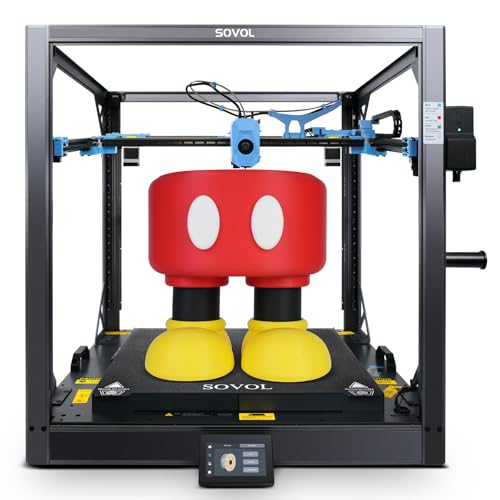
- 500 × 500 × 500 mm build space
- Up to 700 mm/s CoreXY performance
- Camera and automated bed scanning
Best For: Industrial parts, full-scale prototypes, and oversized props
Best for Engineering Materials
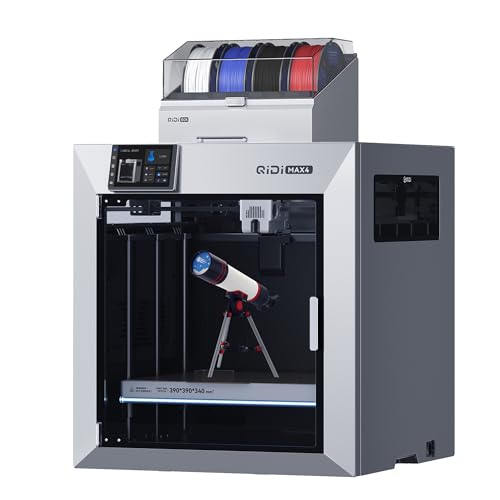
- 390 × 390 × 340 mm build volume
- 65°C active heated chamber
- Hardened hotend for abrasive materials
Best For: Large engineering prototypes and high-temperature materials
Best Quiet Large Format 3D Printer

- 600mm/s CoreXY printing with vibration compensation
- Auto-leveling and three-second quick-swap nozzles
- Enclosed under-50dB design with dual filtration
Best For: Quiet home, office, and classroom printing
Best High-Temperature Large Format 3D Printer

- 320 × 320 × 300mm build volume
- 370°C extrusion with a 65°C heated chamber
- Optional up-to-16-color printing with active drying
Best For: Engineering prototypes and functional production parts
Best Beginner-Friendly Large Format 3D Printer

- 600mm/s CoreXY printing with auto-leveling
- Enclosed design with HEPA13 and carbon filtration
- Remote monitoring and multi-printer network support
Best For: Home projects, teaching, repairs, and creative printing
Fast Multicolor Pick
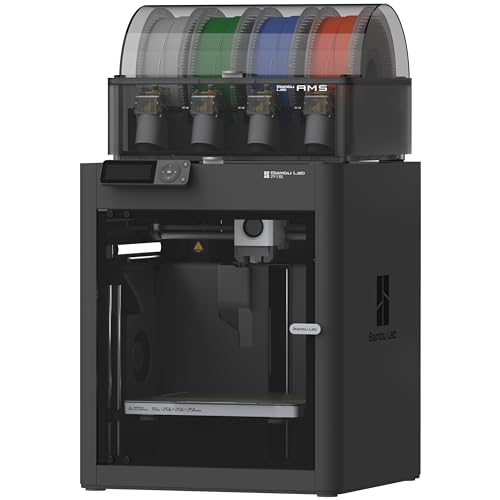
- Up to 500 mm/s printing with 20,000 mm/s² acceleration
- AMS enables up to 16-color printing
- Enclosed design and automatic bed leveling
Best For: Fast, enclosed multicolor printing
Quiet High-Speed Option

- Up to 600 mm/s printing with a 260 mm cube build volume
- CFS system can support up to 16 colors
- 95% pre-assembled with AI camera and auto leveling
Best For: Quiet, automated multicolor printing
Advanced Workflow Pick

- Up to 600 mm/s printing with active flowrate compensation
- AMS 2 Pro adds multicolor printing and filament drying
- AI detection, auto calibration, and adaptive airflow
Best For: Automated, high-speed multicolor workflows
Best for Print Farms – Creality Ender 5 Max
The Creality Ender 5 Max is a practical choice among large format 3d printers when you need a 400 × 400 × 400 mm build volume, rapid output, and tools suited to repeat production. Its CoreXY system, automatic leveling, and WLAN multi-printer control support larger prototypes and organized print-farm workflows.
Best For: Print farms, oversized prototypes, batch production, and users who need a rigid, high-capacity machine.
Pros:
- 400 × 400 × 400 mm build volume supports large models or multiple parts.
- CoreXY motion system offers speeds up to 700 mm/s.
- 64-point automatic leveling and auto Z-offset simplify setup.
- WLAN multi-printer control is useful for scaled production.
Cons:
- Its 70.4-pound weight and large footprint require substantial space.
- The feature set may be more than casual users need.
- Although it supports several materials, the notes do not specify an actively heated chamber.
The Ender 5 Max stands out when build volume and throughput matter more than compactness. Its reinforced frame, dual-gear extruder, and production-oriented controls make it a strong fit for demanding workflows.
Best Ready-to-Use Option – Bambu Lab P1S
The Bambu Lab P1S is a convenient option among large format 3d printers for users who prioritize quick setup, high speed, and an enclosed design. It arrives ready to use, includes automatic bed leveling, and can support multi-color printing when paired with the Bambu Lab AMS.
Best For: Enthusiasts and makers who want fast, straightforward FDM printing with enclosure benefits.
Pros:
- Sets up in about 15 minutes.
- Prints at up to 500 mm/s with 20,000 mm/s² acceleration.
- Enclosed design improves performance with advanced filaments.
- Optional AMS connection enables up to 16 colors.
Cons:
- Multi-color printing requires the separately connected Bambu Lab AMS.
- Its build volume is less expansive than the other large-format models listed here.
- Carbon- and glass-fiber-reinforced polymers are not recommended.
The P1S is best viewed as a speed-and-convenience choice rather than a maximum-capacity printer. Its enclosure, automation, and quick setup make it approachable for a wide range of users.
Best for Oversized Prototypes – Sovol SV08 Max
The Sovol SV08 Max is built for genuinely large-format work, offering a 500 × 500 × 500 mm print space and speeds up to 700 mm/s. For buyers comparing large format 3d printers, its CoreXY motion, contactless bed scanning, remote camera, and broad filament support make it suitable for full-scale prototypes and oversized parts.
Best For: Industrial parts, large prototypes, oversized props, and users who need maximum build volume with high-speed operation.
Pros:
- 500 × 500 × 500 mm build space accommodates very large prints.
- CoreXY system supports up to 700 mm/s and 40,000 mm/s² acceleration.
- Eddy-current scanning and pressure sensing automate bed calibration.
- Built-in HD camera enables remote monitoring and time-lapse recording.
Cons:
- Its 86.8-pound weight and large dimensions demand dedicated space.
- The heated chamber module is an optional upgrade.
- Optional 0.6 mm and 0.8 mm nozzles are sold separately.
The SV08 Max is the capacity leader in this group. It is a compelling fit when printing large objects in one piece is more important than having a compact or lightweight machine.
Best for Engineering Materials – QIDI Max4 Combo
The QIDI Max4 Combo combines a 390 × 390 × 340 mm build volume with a 65°C active heated chamber, making it a strong contender among large format 3d printers for demanding materials. Closed-loop motors, a high-flow hardened-steel hotend, and optional multi-color expansion give it a professional, engineering-focused feature set.
Best For: Professionals and advanced enthusiasts printing large prototypes, molds, and high-temperature or abrasive materials.
Pros:
- 390 × 390 × 340 mm build volume supports large parts without splitting.
- 65°C heated chamber helps with materials such as ABS-CF, PC, and PPS-CF.
- Hardened-steel nozzle and 40 mm³/s hotend support abrasive filaments.
- AI camera can detect abnormalities and pause printing.
Cons:
- At 120 pounds, it is a substantial and relatively immobile machine.
- The Polar Cooler is not included and must be purchased separately.
- QIDI BOX is required for 16-color and multi-material printing.
The Max4 Combo is the most materials-oriented option here. Its heated chamber and hardened hotend make it especially attractive for users whose projects extend beyond basic PLA and PETG.
Best Quiet Large Format 3D Printer – FlashForge Adventurer 5M Pro
The FlashForge Adventurer 5M Pro is a practical choice for users who want large format 3D printers with fast CoreXY motion, automatic calibration, and an enclosed design. Its 280°C nozzle, 110°C heated bed, quick-swap nozzles, and dual filtration support a broad range of everyday and engineering-oriented projects.
Best For: Home, office, and classroom users who prioritize quiet operation, easy setup, and versatile filament compatibility.
Pros:
- Print speeds up to 600mm/s with vibration compensation for smoother surfaces.
- One-click auto-leveling and tool-free, three-second nozzle changes simplify operation.
- Enclosed, under-50dB design with dual filtration supports cleaner, quieter printing.
- Built-in camera, filament detection, power-loss recovery, and mobile monitoring add convenience.
Cons:
- The build volume and 280°C nozzle are less suited to very large parts or the most demanding high-temperature materials.
- At 22 pounds, it is not the lightest option for frequent relocation.
Choose this model when ease of use and quiet, enclosed printing matter more than maximum build size. It offers a strong balance of speed, automation, and material flexibility for general-purpose projects.
Best High-Temperature Large Format 3D Printer – QIDI Plus5 Combo
The QIDI Plus5 Combo stands out among large format 3D printers with its 320 × 320 × 300mm build volume, heated chamber, and high-temperature extrusion system. It is designed for larger prototypes, batch production, and functional parts made from demanding engineering filaments.
Best For: Engineers, professional makers, and production users printing large functional parts or multi-color models.
Pros:
- Large 320 × 320 × 300mm build volume accommodates full-scale prototypes and batch printing.
- 370°C extrusion and an actively heated 65°C chamber support PPS-CF, PPA-CF, PC, nylon, and other advanced materials.
- CoreXY motion reaches up to 600mm/s with 20,000mm/s² acceleration.
- Optional QIDI BOX support enables up to 16-color printing with active filament drying.
Cons:
- At 96.8 pounds and 22 × 22 × 24 inches, it requires substantial space and a sturdy placement area.
- Some multi-color functionality depends on the optional QIDI BOX.
- Its advanced capabilities may be more than casual users need.
The Plus5 is the strongest fit here for demanding materials and larger production workflows. Its heated chamber, substantial build area, monitoring features, and optional multi-color system make it a capable professional-oriented platform.
Best Beginner-Friendly Large Format 3D Printer – FlashForge 5M Pro
The FlashForge 5M Pro is a convenient option for buyers comparing large format 3D printers for home projects, repairs, education, and creative work. It combines 600mm/s CoreXY printing with full auto-leveling, an enclosed dual-filtered chamber, and support for several common and composite filaments.
Best For: Families, educators, and general users who want easy remote monitoring and quiet enclosed printing.
Pros:
- Up to 600mm/s printing with a CoreXY structure and auxiliary chamber cooling.
- One-click automatic leveling helps produce consistent first layers without manual Z calibration.
- HEPA13 and activated-carbon filtration are designed to block particulate matter and VOCs.
- Supports TPU, ASA, PLA, ABS, PETG, PLA-CF, and PETG-CF with interchangeable nozzle sizes.
Cons:
- Its enclosed design and 280°C extruder do not match the QIDI Plus5’s high-temperature capabilities.
- Advanced monitoring and network features may require additional software setup.
- The 33-pound weight makes it less portable than compact open-frame printers.
This 5M Pro is a sensible pick for accessible, enclosed printing rather than maximum material performance. Auto-leveling, filtration, quiet modes, and app-based monitoring make it especially practical for shared spaces and beginner-oriented workflows.
Fast Multicolor Pick – Bambu Lab P1S Combo
For shoppers comparing large format 3d printers, the Bambu Lab P1S Combo is a streamlined enclosed option with fast printing, automatic bed leveling, and included AMS support for multicolor work. Its 256 × 256 × 256 mm build volume suits many everyday models, though it is not the largest printer in this roundup.
Best For: Makers who want fast, enclosed printing and multicolor capability with a relatively quick setup.
Pros:
- Supports multicolor or multimaterial printing with AMS, up to 16 colors.
- Prints at up to 500 mm/s with 20,000 mm/s² acceleration.
- Enclosed design, automatic bed leveling, and approximately 15-minute setup.
- Supports common materials including PLA, PETG, TPU, PVA, PET ABS, and ASA.
Cons:
- AMS is required for multicolor printing.
- Carbon- and glass-fiber-reinforced polymers are not recommended.
- Its build volume may be limiting for especially large models.
The P1S Combo is a practical choice when speed, ease of use, and multicolor output matter more than maximum build size. Its enclosure also makes it a flexible fit for users working with advanced filaments supported by the machine.
Quiet High-Speed Option – Creality K2 Combo
Among large format 3d printers, the Creality K2 Combo stands out for its 600 mm/s speed, sturdy frame, and 260 × 260 × 260 mm build volume. It arrives 95% pre-assembled and combines multicolor support, automatic leveling, and AI-assisted monitoring for a ready-to-use workflow.
Best For: Users who want a pre-assembled, quiet printer with multicolor expansion and automated print monitoring.
Pros:
- Supports up to 16 colors when as many as four CFS units are connected.
- Offers up to 600 mm/s printing and a 260 × 260 × 260 mm build volume.
- Pre-assembled design, automatic bed leveling, and AI camera monitoring.
- Silent mode, step-servo motors, and support for materials such as PLA, PETG, ABS, and PLA-CF.
Cons:
- The included K2 Combo package contains one CFS unit; additional units are needed for the full 16-color setup.
- At 65.9 pounds, it is relatively heavy to move.
- AI monitoring may detect failures, but it does not eliminate the need for user oversight.
The K2 Combo balances a moderate build volume with unusually high advertised speed and a plug-and-play setup. It is especially appealing if quieter operation and multicolor expansion are priorities.
Advanced Workflow Pick – Bambu Lab P2S Combo
For buyers seeking large format 3d printers with a more advanced workflow, the Bambu Lab P2S Combo pairs up to 600 mm/s printing with the AMS 2 Pro multicolor system. Automatic calibration, AI failure detection, active filament drying, and adaptive airflow make it a feature-rich option for varied projects.
Best For: Makers who want high-speed precision, automatic monitoring, and managed multicolor printing with filament drying.
Pros:
- Prints at up to 600 mm/s with active flowrate compensation for consistent layers.
- AMS 2 Pro supports multicolor and multimaterial printing while drying filament up to 65 °C.
- Includes AI failure detection, automatic calibration, and quick-swap nozzles.
- Adaptive airflow can cool overhangs or maintain a 50 °C chamber for engineering-grade materials.
Cons:
- The standalone P2S does not support multicolor printing; the Combo version is required.
- Its 18 × 22 × 18-inch footprint may require substantial workspace.
- The feature-rich system may be more than beginners need for basic single-color printing.
The P2S Combo is the strongest fit here for users who value automation and material management alongside speed. Its airflow control and AMS 2 Pro make it a particularly versatile choice for demanding, multicolor workflows.
How We Picked the Best Large Format 3d Printers
We compared these printers by usable build volume, motion system, advertised speed, enclosure and chamber features, automatic calibration, material compatibility, multicolor options, software workflow, and overall practicality. We also considered whether each model suits a specific buyer, from first-time users to experienced makers printing engineering-grade parts or production runs.
Specifications can vary by material, nozzle, layer height, and print geometry, so maximum speed figures should be treated as upper limits rather than typical everyday settings. A printer with slightly lower headline speed may deliver better consistency, easier maintenance, or more useful material support.
Quick Comparison
| What to compare | Why it matters |
|---|---|
| Build volume | Determines the maximum model size and how often large parts must be split. |
| Printer design | CoreXY and rigid frames can improve high-speed accuracy; enclosed designs better control temperature and protect prints. |
| Automation | Auto-leveling, calibration, monitoring, and recovery features reduce setup and failed prints. |
| Multicolor support | AMS or CFS-style systems add color and material flexibility, but require more space, setup, and filament management. |
| Material capability | Heated chambers, hardened nozzles, and higher hotend temperatures are important for ABS, ASA, nylon, and composite filaments. |
Key Buying Factors for Large-Format 3D Printers
Build Volume and Workspace
Measure the printer, spool holders, ventilation clearance, and access around the doors—not just the advertised build area. A 400mm-class machine can produce substantially larger parts, while a more compact 300mm-class printer may be easier to place and maintain.
Speed Versus Print Quality
High-speed printing is most useful when paired with a rigid frame, dependable motion system, strong cooling, and reliable input shaping. For detailed models, functional parts, and tall prints, stability and acceleration control matter as much as the top speed.
Materials and Temperature Control
PLA and PETG are broadly accessible, but enclosed printers are preferable for ABS and ASA. If you plan to print nylon, polycarbonate, or carbon-fiber blends, look for a heated chamber where available, a high-temperature hotend, and hardened components.
Ease of Use and Ongoing Costs
Automatic leveling and first-layer checks simplify ownership, but consider replacement nozzles, build plates, filters, drying requirements, and the space needed for multicolor filament systems. A simpler single-color setup can be faster and cheaper for functional work.
Who Should Buy Which Large Format 3d Printers?
Choose the largest build-volume model if you regularly print oversized parts or want to minimize assembly seams. A fast CoreXY printer is a strong fit for makers producing multiple parts or prototypes. Enclosed QIDI and similar systems make more sense for users working with higher-temperature materials, while Flashforge models appeal to buyers who prioritize guided setup and straightforward operation.
For multicolor projects, choose a combo that includes its material-management system rather than adding one later. Bambu Lab, Creality, and QIDI combo models are suited to users who value automated color changes and connected workflows. If reliability, simplicity, and everyday PLA or PETG printing matter most, a ready-to-use enclosed printer may be the better value than paying for advanced chamber or multicolor features you will rarely use.