
The best 3D printers in 2026 make it easier to move from a digital model to a reliable finished part, whether you are learning at home, prototyping, or creating multicolor designs.
This roundup compares ten standout options across ease of use, print speed, automation, build design, and material flexibility so you can choose a printer that fits your workspace and projects.
Best 10 3d Printers Picks for 2026
Best Enclosed High-Speed 3D Printer

- 500 mm/s printing and 20,000 mm/s² acceleration
- Enclosed design with automatic bed leveling
- Up to 16 colors with optional Bambu Lab AMS
Best For: Makers seeking fast, enclosed FDM printing
Best Multimaterial Tool-Changing 3D Printer

- Four toolheads with five-second automatic changes
- Prints mixed materials with less waste
- 270 mm cubed build volume and 500 mm/s speed
Best For: Workshops and creators making multicolor or functional parts
Best Beginner-Friendly Multicolor 3D Printer

- Full-auto calibration for simpler setup
- Quiet, high-speed printing with flow compensation
- Multicolor capability with optional AMS lite
Best For: Beginners, families, and kids learning FDM printing
Best Fast Auto-Leveling 3D Printer

- Up to 600 mm/s printing speed
- One-click fully automatic bed leveling
- Power-loss recovery and filament run-out sensing
Best For: Hobbyists wanting fast, convenient open-frame printing
Best Multi-Color Pick
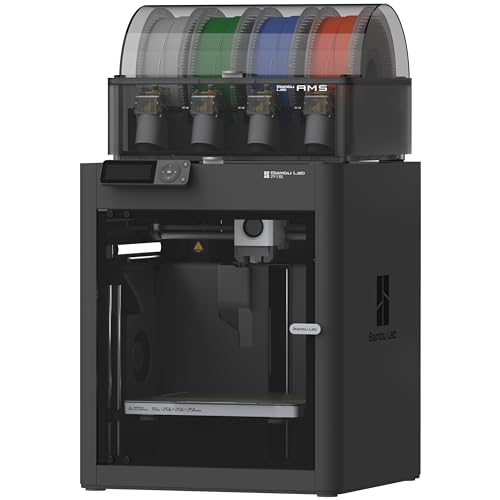
- Up to 16-color printing with AMS
- 500 mm/s high-speed printing
- Enclosed design with auto leveling
Best For: Creators seeking fast, enclosed multi-color printing
Best Beginner Value

- 250 mm/s high-speed printing
- Auto leveling and Z-offset calibration
- Direct-drive extruder for PLA, PETG, and TPU
Best For: Beginners printing everyday projects and prototypes
Best Advanced Performance

- Up to 600 mm/s precision printing
- AMS 2 Pro with filament drying
- AI detection and adaptive airflow
Best For: Users wanting automated, high-speed multi-color printing
Quiet High-Speed Pick

- 600mm/s CoreXY printing with vibration compensation
- One-click leveling and quick-swap nozzle
- Enclosed, filtered design operating under 50dB
Best For: Quiet, convenient printing at home, in offices, or classrooms
Best Multicolor Creative Pick
FlashForge AD5X Multi-Color 3D Printer

- Prints with up to four colors simultaneously
- 600mm/s CoreXY speed with vibration compensation
- 300°C direct-drive extruder and one-click leveling
Best For: Colorful models, rapid prototyping, and remote-supervised printing
Best Enclosed High-Speed 3D Printer – Bambu Lab P1S
The Bambu Lab P1S is a ready-to-use choice for shoppers comparing 3d printers that combine fast performance, automatic calibration, and an enclosed design. It supports common materials such as PLA, PETG, TPU, and ASA, while optional Bambu Lab AMS hardware enables multicolor or multimaterial printing.
Best For: Makers who want a fast, enclosed FDM printer with straightforward setup and room to expand into multicolor printing.
Pros:
- Print speeds up to 500 mm/s with 20,000 mm/s² acceleration.
- Enclosed body is suited to advanced filaments and improved print performance.
- Automatic bed leveling and a setup time of about 15 minutes simplify use.
- Supports up to 16 colors when paired with Bambu Lab AMS.
Cons:
- AMS is required for multicolor printing.
- Carbon- or glass-fiber-reinforced polymers are not recommended.
- At 38.9 pounds, it is less convenient to move than lighter models.
The P1S is a strong all-around option when enclosure, speed, and easy calibration matter more than portability. Its material guidance should be considered if you plan to print reinforced composites.
Best Multimaterial Tool-Changing 3D Printer – Snapmaker U1
The Snapmaker U1 stands out among 3d printers for its four independent toolheads and five-second automatic tool changing. This setup supports true multicolor and multimaterial prints with less purging, while its 270 x 270 x 270 mm build volume suits functional parts, prototypes, and detailed models.
Best For: Makers, workshops, small businesses, and creators who need efficient multicolor or mixed-material printing.
Pros:
- Four preloaded toolheads switch automatically in about five seconds.
- Reduces filament waste during color and material changes.
- Supports materials including PLA, PVA, TPU, PETG, ABS, ASA, PA, and PC.
- Automatic calibration, AI print monitoring, touchscreen controls, and remote app control improve usability.
Cons:
- At 59 pounds, it is a substantial printer to position.
- Its broader feature set may be more than beginners need for basic single-material prints.
- Multitool operation requires managing multiple toolheads and filaments.
The U1 is particularly compelling when material changes are central to your projects. Its combination of toolhead automation, large build volume, and broad material support gives it a productivity focus beyond simple color swapping.
Best Beginner-Friendly Multicolor 3D Printer – Bambu Lab A1
The Bambu Lab A1 is a practical entry point for shoppers comparing 3d printers for home, hobby, or educational use. Its full-auto calibration, active flow-rate compensation, quiet operation, and simplified touchscreen aim to reduce the adjustment usually associated with FDM printing.
Best For: Beginners, families, and kids who want an easy-to-use printer with optional multicolor capability.
Pros:
- Automatic Z-offset, bed leveling, and other calibration processes simplify setup.
- Up to 10,000 mm/s² acceleration supports fast printing.
- Active flow-rate compensation helps maintain smooth extrusion.
- Quiet operation and a one-clip quick-swap nozzle make everyday use and maintenance easier.
Cons:
- AMS lite is required for multicolor printing and is sold separately unless buying the A1 Combo.
- The supplied notes do not describe an enclosed design for advanced filament printing.
- Its feature set is focused on accessible FDM printing rather than specialized composite materials.
The A1 makes sense when convenience and approachable operation are top priorities. Choose the Combo or add AMS lite if multicolor prints are part of your plans.
Best Fast Auto-Leveling 3D Printer – FLASHFORGE Adventurer 5M
The FLASHFORGE Adventurer 5M is a strong contender among 3d printers for users who want quick startup and high-speed performance without manual bed leveling. It combines CoreXY motion, vibration compensation, a direct extruder, and a 220 x 220 x 220 mm print area in an open design.
Best For: Home makers and hobbyists who prioritize fast PLA, PETG, or TPU printing in a well-ventilated space.
Pros:
- Print speeds reach 600 mm/s with up to 20,000 mm/s² acceleration.
- One-click fully automatic leveling helps produce a consistent first layer.
- Vibration compensation helps reduce ghosting, while the 32 mm³/s flow rate supports shorter wait times.
- Filament run-out sensing and power-loss recovery can resume interrupted prints.
Cons:
- The open design requires use in an open, well-ventilated environment.
- The standard 0.4 mm nozzle supports PLA, PETG, and TPU; carbon-fiber options require a 0.6 mm nozzle.
- The 220 mm cubed build volume is smaller than the Snapmaker U1’s stated volume.
The Adventurer 5M is a practical choice for fast everyday printing when an open-frame design is acceptable. Its automatic leveling and recovery features add useful convenience for hobby projects and repeated prints.
Best Multi-Color Pick – Bambu Lab P1S Combo
For shoppers comparing 3d printers, the Bambu Lab P1S Combo stands out for fast, enclosed printing and included multi-color capability through its AMS system. Automatic bed leveling and a setup time of about 15 minutes make it approachable, while the enclosure supports a wider range of filament types.
Best For: Creators who want high-speed, multi-color printing and support for advanced filaments.
Pros:
- Supports up to 16 colors with the required Bambu Lab AMS connection.
- Prints at up to 500 mm/s with 20,000 mm/s² acceleration.
- Enclosed design, automatic bed leveling, and quick setup.
- Supports PLA, PETG, TPU, PVA, PET ABS, ASA, PA, and PC.
Cons:
- Weighs 40.8 pounds, making it less convenient to move.
- Carbon- and glass-fiber-reinforced polymers are not recommended.
- Multi-color printing requires the AMS connection.
The P1S Combo is a strong choice when color versatility and speed matter more than a compact footprint. Its enclosure and automatic calibration reduce setup friction, while the material limitations are worth noting for specialized composite filaments.
Best Beginner Value – Creality Ender 3 V3 SE
Among entry-level 3d printers, the Creality Ender 3 V3 SE is designed to make setup and everyday printing straightforward. Auto leveling, automatic Z-offset calibration, and a direct-drive extruder help simplify printing with common materials such as PLA, PETG, and TPU.
Best For: Beginners and hobbyists who want an easy-to-set-up printer for everyday projects and prototypes.
Pros:
- Prints at up to 250 mm/s with 2,500 mm/s² acceleration.
- CR Touch auto leveling and automatic Z-offset calibration support reliable first layers.
- Sprite direct-drive extrusion supports PLA, PETG, and TPU.
- Quiet 32-bit mainboard and flexible PC spring steel build plate.
Cons:
- Its feature set is focused on everyday compatible materials rather than specialized filaments.
- Open-frame construction does not provide the enclosed design of some competing printers.
The Ender 3 V3 SE is a practical starting point for new users who value simple calibration and easy print removal. Its 250 mm/s speed is useful for routine projects, while the stable motion system helps support consistent layer alignment during longer jobs.
Best Advanced Performance – Bambu Lab P2S Combo
For buyers seeking highly capable 3d printers, the Bambu Lab P2S Combo combines up to 600 mm/s printing with automated calibration, AI failure detection, and multi-color printing through the included AMS 2 Pro. Its adaptive airflow system is designed to balance cooling and heat retention across different filament needs.
Best For: Users who want premium speed, automated monitoring, multi-color printing, and filament drying.
Pros:
- Prints at up to 600 mm/s with PMSM Servo Extruder and active flowrate compensation.
- AMS 2 Pro supports multi-color printing and filament drying up to 65 °C.
- Includes AI failure detection, automatic calibration, and quick-swap nozzles.
- Adaptive airflow can maintain a chamber temperature of up to 50 °C for engineering-grade materials.
Cons:
- The printer itself does not support multi-color printing; the Combo version is required.
- At 47.5 pounds, it is the heaviest option in this roundup.
- Its 18 x 22 x 18-inch dimensions require substantial workspace.
The P2S Combo is aimed at users who want a more automated workflow and advanced material management. Its high speed, drying-enabled AMS 2 Pro, and adaptive airflow make it especially compelling for demanding projects, provided you have room for its larger footprint.
Quiet High-Speed Pick – FlashForge Adventurer 5M Pro
For shoppers comparing 3d printers, the FlashForge Adventurer 5M Pro combines fast CoreXY movement with automatic setup and an enclosed design. Its 600mm/s top speed, one-click leveling, and broad material support make it a practical choice for both everyday models and more demanding projects.
Best For: Home, office, or classroom users who want fast, quieter printing with enclosure and filtration.
Pros:
- CoreXY platform reaches up to 600mm/s with vibration compensation for smoother surfaces.
- One-click auto-leveling and a 3-second quick-swap nozzle simplify setup and maintenance.
- Enclosed chamber, dual filtration, and operation under 50dB suit shared spaces.
- 280°C nozzle and 110°C heated bed support PLA, PETG, ABS, ASA, and PETG-CF.
Cons:
- The 220 × 220 × 220mm-class printer has less room than larger-format models.
- Its advanced materials and enclosed design may be more than casual PLA users need.
The Adventurer 5M Pro is a well-rounded option when speed, convenience, and a cleaner, quieter workspace matter as much as print capability. Its camera, mobile controls, filament detection, and power-loss recovery add useful oversight for longer jobs.
Expandable Multicolor Workhorse – Creality K2 SE
Among today’s 3d printers, the Creality K2 SE stands out for its rigid metal construction, quick setup, and upgrade path to multicolor printing. It delivers up to 500mm/s, automatic leveling, and a direct-drive extruder in a platform designed for both detailed models and functional parts.
Best For: Beginners and makers who want reliable high-speed printing now with optional Creality CFS multicolor expansion later.
Pros:
- CoreXY motion, 500mm/s speed, and input shaping help reduce ringing at high speeds.
- Die-cast aluminum construction and reinforced beams support stable, precise printing.
- Fully automatic leveling, fan calibration, and a five-minute assembly simplify the first setup.
- Compatible with the Creality CFS system for automatic multicolor printing when upgraded.
Cons:
- The CFS multicolor system is sold separately.
- Its feature-rich software and expert settings may take time to learn.
The K2 SE is a sensible pick for buyers who want an easy starting experience without closing off future options. Its direct-drive, quick-swap extruder and run-out detection support consistent workflows, while Creality OS and cloud tools add remote-control flexibility.
Best Multicolor Creative Pick – FlashForge AD5X Multi-Color 3D Printer
The FlashForge AD5X is one of the more versatile 3d printers for colorful models and rapid iteration. It combines four-color capability with a 600mm/s CoreXY platform, one-click leveling, and a 300°C direct-drive extruder for a broad mix of creative and practical work.
Best For: Creators who want up to four-color printing, fast prototyping, and remote monitoring.
Pros:
- Supports up to four colors simultaneously for more expressive finished models.
- CoreXY motion reaches 600mm/s with 20,000mm/s² acceleration for rapid printing.
- One-click leveling, automatic filament feeding, and resume printing simplify operation.
- 300°C direct-drive extrusion, dual-channel cooling, and four nozzle-size options support varied projects.
Cons:
- Its 220 × 220 × 220mm build volume limits especially large models.
- Multi-color capability and its related workflow add complexity compared with single-color printing.
The AD5X is a strong match when color is central to the buying decision. It balances high speed with practical automation, while the Flash Maker app enables remote monitoring and control for projects that need supervision without constant hands-on attention.
How We Picked the Best 3d Printers
We focused on practical features that affect everyday printing: setup difficulty, automatic leveling, extrusion design, build volume, print speed, enclosure options, material support, noise, and multicolor compatibility. We also considered whether each model is a sensible choice for beginners, families, hobbyists, or more demanding makers.
Ready-to-use printers received extra consideration because they reduce calibration and assembly work. For advanced users, we looked more closely at CoreXY platforms, higher-temperature hot ends, tool-changing systems, and accessory ecosystems.
Quick Comparison
| Best For | Recommended Models | What Stands Out |
|---|---|---|
| Beginners and kids | Bambu Lab A1, Creality Ender 3 V3 SE | Simple setup and automated leveling |
| Fast everyday printing | FLASHFORGE Adventurer 5M, Creality K2 SE | High speed with convenient automation |
| Multicolor printing | Bambu Lab P1S Combo, Bambu Lab P2S Combo | Printer-and-AMS packages |
| Enclosed printing | Bambu Lab P1S, FLASHFORGE Adventurer 5M Pro | Better workspace protection and material versatility |
| Advanced color or material changes | Snapmaker U1, FLASHFORGE AD5X | Toolhead or multicolor-focused designs |
Key Buying Factors for 3d Printers
Print Technology and Materials
All of these models use FDM printing, which works well for practical parts, prototypes, organizers, toys, and replacement components. Check the supported filament temperatures before buying. PLA is easiest, while PETG, TPU, ABS, and other technical materials may require a hotter nozzle, a heated bed, or an enclosure.
Speed Versus Reliability
Advertised speeds are maximum figures, not guarantees for every model or material. A rigid frame, accurate motion system, automatic calibration, and reliable first-layer performance matter more than headline speed. Choose a fast machine only if its software and maintenance workflow are also convenient.
Build Volume and Workspace
Measure your available space, including room to open doors, load filament, and perform maintenance. A larger build area is useful for helmets, batches, and large functional parts, but it can increase the printer’s footprint and heating time.
Multicolor Systems and Operating Costs
Multicolor printing adds creative flexibility but can increase filament waste, print time, and complexity. Tool-changing systems may reduce purge waste, while AMS-style systems offer a simpler way to switch spools. Factor in accessory prices and the amount of single-color printing you expect to do.
Who Should Buy Which 3d Printers?
Choose the Bambu Lab A1 or Ender 3 V3 SE if you want an approachable first printer and primarily use common filaments. The Adventurer 5M is a strong fit for users who prioritize speed and simple operation. For a more protected setup, consider the Bambu Lab P1S or Adventurer 5M Pro.
Buy the P1S Combo or P2S Combo when dependable multicolor printing is a central goal. The Snapmaker U1 suits makers interested in fast tool changes and more specialized workflows, while the AD5X and Creality K2 SE are appealing alternatives for high-speed multicolor projects. Before ordering, confirm enclosure needs, filament compatibility, software support, and the cost of replacement parts and accessories.