
Finding the best 3D printer for beginners means balancing simple setup, dependable first layers, useful safety features, and room to grow. The right machine should make it easy to move from basic test prints to practical projects without requiring constant troubleshooting.
This roundup compares 10 beginner-friendly options across compact, budget, high-speed, and multicolor categories, so you can choose a printer that fits your space, skill level, and long-term plans.
Best 10 3d Printer for Beginners Picks for 2026
Best Beginner All-Rounder

- Automatic calibration simplifies setup
- Fast, quiet, precise printing
- Supports optional AMS lite multicolor printing
Best For: Beginners seeking an easy, versatile printer
Best High-Speed Starter

- 600 mm/s maximum print speed
- One-click automatic leveling
- Power-loss recovery and filament sensing
Best For: Beginners who want fast, low-fuss printing
Best Compact Creative Kit

- Automatic calibration and simple setup
- Quiet printing with app and model-library access
- Includes an LED Lamp Kit for creative projects
Best For: Home users and beginners making compact projects
Best Value Upgrade

- 250 mm/s maximum print speed
- Auto leveling and automatic Z-offset
- Direct extruder supports PLA, TPU, and PETG
Best For: Beginners wanting automation and material flexibility
Best Beginner Starter Kit

- Fully assembled for quick setup
- Auto-leveling and magnetic build plate
- Includes PLA filament and model files
Best For: Kids, classrooms, dorms, and first-time users
Best Multi-Color Upgrade
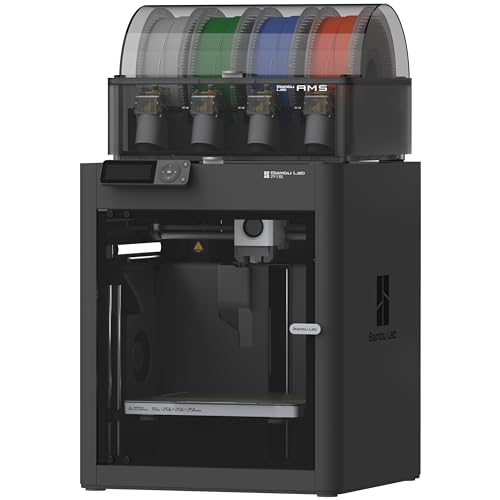
- Prints up to 16 colors with AMS
- Fast, enclosed printing platform
- Automatic bed leveling and quick setup
Best For: Beginners wanting multi-color projects and higher speed
Fast CoreXY Pick

- Up to 600mm/s printing with auto bed leveling
- Direct drive, PEI plate, and quick-change nozzle system
- Optional enclosure and app-based remote monitoring
Best For: Beginners who want speed and upgrade flexibility
Best Beginner All-Rounder – Bambu Lab A1
If you want a capable 3d printer for beginners without spending much time on setup and calibration, the Bambu Lab A1 is a strong all-around option. It combines automatic calibration, fast printing, flow-rate compensation, and a quiet operating design in a ready-to-use package.
Best For: Beginners and families who want easy, quiet printing with the option to add multicolor capability.
Pros:
- Automatic calibration handles Z-offset, bed leveling, and other setup tasks.
- High-speed printing with 10,000 mm/s² acceleration while maintaining detail.
- Quiet operation, a simplified touchscreen, and a quick-swap nozzle support easier maintenance.
- Optional AMS lite enables multicolor printing.
Cons:
- The AMS lite is required for multicolor printing and is not included with this standard version.
- The printer weighs 22 pounds and has a fairly large footprint for a beginner model.
The A1 is especially appealing if convenience matters more than hands-on tuning. Choose the A1 Combo or add an AMS lite later if you want to expand into multicolor projects.
Best High-Speed Starter – FLASHFORGE Adventurer 5M
The FLASHFORGE Adventurer 5M is a practical 3d printer for beginners who want quick startup and high print speeds. Its one-click auto leveling, Core XY design, vibration compensation, and removable PEI plate are aimed at reducing common setup and print-quality frustrations.
Best For: New users who prioritize rapid printing, an easy first layer, and a 220 x 220 x 220 mm build volume.
Pros:
- One-click full-auto leveling helps produce a consistent first layer.
- Maximum speed reaches 600 mm/s with up to 20,000 mm/s² acceleration.
- Vibration compensation helps reduce ghosting and supports cleaner prints.
- Filament run-out sensing and power-loss recovery can resume interrupted jobs.
Cons:
- The open design is intended for open, well-ventilated environments.
- Material support varies by nozzle: PLA, PETG, and TPU use the 0.4 mm nozzle, while composite options require a 0.6 mm nozzle.
With a claimed unboxing-to-printing time of about 10 minutes, the Adventurer 5M suits beginners who want to start quickly while retaining useful reliability features for longer prints.
Best Compact Creative Kit – Bambu Lab A1 mini
The Bambu Lab A1 mini is a compact 3d printer for beginners designed for straightforward everyday projects. Automatic calibration, simple setup, app-based print management, and access to MakerWorld models make it approachable, while the included LED Lamp Kit adds a creative project path beyond ordinary prints.
Best For: Beginners, home users, and creative hobbyists who want a compact printer with an included light-project kit.
Pros:
- Automatic calibration and simple setup reduce initial troubleshooting.
- Quiet, high-speed operation fits home, studio, or workspace use.
- MakerWorld and the Bambu Handy app provide a connected beginner workflow.
- The included LED Lamp Kit supports decorative lights, gifts, and DIY projects.
Cons:
- The compact design may be less suitable for users who need larger prints.
- The LED Lamp Kit is most useful with compatible lamp models.
The A1 mini is a particularly inviting starting point for creative beginners. Its smaller format keeps the experience approachable, while the lamp kit gives new users an immediate project to build.
Best Value Upgrade – Creality Ender 3 V3 SE
The Creality Ender 3 V3 SE is a capable 3d printer for beginners who want useful automation and a proven upgrade path. It arrives partially assembled, includes CR Touch auto leveling and automatic Z-offset sensing, and uses a direct extruder suited to common materials such as PLA, TPU, and PETG.
Best For: Beginners who want a relatively quick assembly process, flexible filament handling, and a larger 8.66 x 8.66 x 9.84 inch print area.
Pros:
- 250 mm/s maximum speed and 2,500 mm/s² acceleration shorten print times.
- CR Touch auto leveling and strain-sensor Z-offset reduce manual bed setup.
- Sprite dual-gear direct extruder supports PLA, TPU, and PETG.
- Preassembly, automatic filament loading, and automatic unloading make startup easier.
Cons:
- Assembly still takes about 20 minutes despite the preassembled design.
- The open-frame format may require more attention to the surrounding environment than an enclosed printer.
The Ender 3 V3 SE is a sensible pick for newcomers who want automation without giving up material flexibility. Its stable dual Z-axis and Y-axis linear shafts also support consistent positioning over time.
Best Beginner Starter Kit – TINA2S Mini 3D Printer
If you want a compact 3d printer for beginners, the TINA2S is designed to minimize setup and make the first projects approachable. It arrives fully assembled and includes PLA filament, a microSD card with model designs and splicing software, and other accessories.
Best For: Kids, first-time users, classrooms, dorms, and other small workspaces.
Pros:
- Fully assembled and compact at 8.3 x 8.3 x 11.4 inches.
- Auto-leveling, dual Z-axis rails, and a flexible magnetic build plate simplify printing.
- One-touch filament loading and compatibility with PLA, PLA Pro, and TPU.
- Works with Mac, Windows, Linux, Wi-Fi, and several popular slicers.
Cons:
- Its mini size provides less build space than standard desktop printers.
- The proximity sensor requires the included or another magnetically attachable metal plate.
The TINA2S is a straightforward entry point for users who value convenience and a ready-to-print setup over a larger build volume. Its included materials and beginner-focused controls make it especially practical for learning at home or in a classroom.
Best Multi-Color Upgrade – Bambu Lab P1S Combo
The Bambu Lab P1S Combo is a capable 3d printer for beginners who want an easier path into fast, enclosed, multi-color printing. It combines automatic bed leveling, a setup time of about 15 minutes, and an AMS system capable of supporting designs with up to 16 colors.
Best For: New users who want high speed, enclosure benefits, and multi-color or multi-material projects.
Pros:
- Supports multi-color and multi-material printing with the connected AMS.
- High-speed printing rated up to 500 mm/s with 20,000 mm/s² acceleration.
- Enclosed design improves performance with advanced filaments.
- Automatic bed leveling and a user-oriented setup process reduce initial effort.
Cons:
- The printer and AMS together weigh 40.8 pounds and require substantial space.
- AMS connection is required for the advertised multi-color capability.
- Carbon- and glass-fiber-reinforced polymers are not recommended.
The P1S Combo is more feature-rich than a basic starter printer, but its enclosure, automation, and speed can make ambitious projects easier to manage. Choose it if multi-color output and broader filament capability matter more than a compact footprint.
Best Traditional Desktop Value – ELEGOO Neptune 3 Pro
The ELEGOO Neptune 3 Pro is a practical 3d printer for beginners who want a standard-size build area and hands-on control without assembling every major component. Pre-assembled main parts, a full toolkit, and 36-point auto bed leveling help shorten the path from setup to the first print.
Best For: Beginners who want a versatile desktop printer for regular PLA, TPU, PETG, and ABS projects.
Pros:
- Offers an 8.85 x 8.85 x 11-inch build volume for everyday projects.
- 36-point auto leveling helps simplify first-layer setup.
- Direct-drive extruder supports PLA, TPU, PETG, and ABS.
- Filament runout detection and power-loss resume add convenience during longer prints.
Cons:
- Its 23 x 9 x 19-inch dimensions require more workspace than a mini printer.
- Quick assembly still involves more setup than a fully assembled model.
The Neptune 3 Pro balances a useful build volume with beginner-friendly automation and a broad selection of supported filaments. It is a solid fit for users who expect to move beyond small introductory models while keeping setup and maintenance manageable.
Fast CoreXY Pick – Flashforge Adventurer 5M
The Flashforge Adventurer 5M is a strong 3d printer for beginners who want quick, mostly automated printing without giving up room for larger projects. Its auto-leveling system, direct-drive extruder, PEI plate, and fast CoreXY design make it suited to home workshops, schools, and makerspaces.
Best For: Beginners who prioritize fast printing, dependable first layers, and future upgrade flexibility.
Pros:
- Up to 600mm/s printing with high acceleration for rapid prototypes and batch projects.
- Automatic 25-point bed leveling and pressure-sensor compensation simplify first-layer setup.
- 8.7-inch-square build volume, quick-change nozzle system, removable PEI plate, and optional enclosure support.
- Filament sensing and remote monitoring through the Flashforge app add convenience.
Cons:
- The optional enclosure and some multi-material capabilities require additional purchases or setup.
- Its rapid-printing features may be more than casual users need.
Choose the Adventurer 5M if speed and expandability matter most. It offers a beginner-friendly starting point while leaving room for larger nozzles, enclosure upgrades, and more demanding functional prints.
Expandable Multicolor Choice – Creality K2 SE
The Creality K2 SE is a capable 3d printer for beginners seeking a simple setup with room to grow. It combines five-minute assembly, automatic leveling, a rigid metal frame, and a 220 × 215 × 245mm build area, while offering compatibility with Creality’s optional CFS multicolor system.
Best For: New users who want automatic setup today and a path toward larger or multicolor projects later.
Pros:
- Up to 500mm/s printing with vibration sensing and input shaping to help reduce ringing.
- Fully automatic leveling, fan calibration, and a touchscreen quick guide simplify setup.
- Solid die-cast aluminum construction supports stable, precise printing.
- Direct-drive extruder includes quick-swap nozzle, hardened dual-drive gears, and filament run-out sensing.
Cons:
- The CFS multicolor system is sold separately.
- Its advanced software and tuning options may take time for absolute beginners to learn.
The K2 SE is a versatile choice when ease of setup and future capability are equally important. Its automatic calibration suits beginners, while the sturdy frame, larger build area, and optional CFS support provide useful growth potential.
Simple Starter Kit – Fully Assembled Mini 3D Printer
This fully assembled mini 3d printer is an approachable 3d printer for beginners, especially children, students, and families. It arrives with PLA filament and an SD card, and its one-button leveling, automatic nozzle cleaning, and one-touch filament loading reduce the setup required for a first print.
Best For: Kids, schools, and first-time users who want a compact printer ready to use out of the box.
Pros:
- Fully assembled starter package includes a test roll of PLA filament and an SD card.
- One-button auto-leveling, automatic nozzle cleaning, and one-touch filament loading simplify operation.
- Up to 250mm/s printing, 0.01mm stated precision, and a PEI heated bed.
- Includes 30-day return/replacement coverage, 12-month repair service, and lifetime technical support.
Cons:
- The mini format provides less working space than the larger printers in this roundup.
- Using a 1kg filament spool requires printing a compatible holder from the included TF card.
For a first classroom or home machine, this kit emphasizes convenience over advanced expansion. Its included accessories and automated controls make it a practical entry point for basic PLA projects and learning 3D printing fundamentals.
How We Picked the Best 3d Printer for Beginners
We focused on features that reduce the learning curve and improve everyday reliability: automatic bed leveling, guided setup, direct-drive extrusion, sensible print speeds, removable build plates, and accessible replacement parts. We also considered whether each printer is fully assembled or quick to assemble, because setup complexity can strongly affect a first-time user’s experience.
Other factors included build volume, filament compatibility, enclosure or safety considerations, multicolor expansion, noise expectations, and overall upgrade potential. A good beginner printer does not need every advanced feature, but it should deliver consistent first layers and provide a clear path to learning more.
Quick Comparison
| Best For | Look For | Models in This Roundup |
|---|---|---|
| Young users and small spaces | Compact size, simple controls, enclosed or protected moving parts | A1 mini, TINA2S, mini starter kits |
| General home printing | Automatic leveling, flexible build plate, reliable filament feeding | Bambu Lab A1, Ender 3 V3 SE, Neptune 3 Pro |
| Fast printing | Stable frame, direct drive, automatic calibration | Adventurer 5M models, Creality K2 SE |
| Multicolor projects | Compatible material system and sufficient workflow automation | Bambu Lab P1S Combo, Creality K2 SE |
Key Buying Factors for a 3d Printer for Beginners
Setup and Calibration
Automatic leveling is one of the most valuable beginner features because it helps compensate for small bed-height differences. A preassembled or quick-assembly design can also get you printing sooner, though basic assembly may provide useful insight into how the machine works.
Print Quality and Reliability
Look for a rigid frame, dependable extrusion, a heated bed, and a removable build surface. Direct-drive extruders can make flexible materials easier to manage, while a well-supported filament path helps prevent jams and under-extrusion.
Speed, Size, and Materials
Advertised maximum speed is not the same as practical speed. Stability, cooling, acceleration, and the chosen model all affect results. Check the build volume against the objects you expect to make, and confirm that the printer supports the filaments you plan to use, such as PLA, PETG, or TPU.
Software and Maintenance
A beginner-friendly slicer, clear instructions, active community, and readily available nozzles or build plates can matter as much as hardware specifications. Every FDM printer needs occasional cleaning, filament changes, and basic troubleshooting.
Who Should Buy Which 3d Printer for Beginners?
Choose a compact mini printer if you want a simple introduction, have limited desk space, or are buying for supervised use by a child. Choose a general-purpose Bambu Lab, Creality, Flashforge, or ELEGOO model if you want room for larger projects and a more capable everyday machine.
Prioritize the fastest models if shorter print times matter and you are comfortable learning slicer settings. For multicolor work, a printer bundle with a material system is the most convenient route, but it typically costs more and uses additional filament during color changes. If you are uncertain, start with a reliable single-color machine and upgrade after you understand your printing habits.