
The best channel strips for podcasting bring microphone gain, tone shaping, compression, and noise control into a single recording chain. That can simplify your setup while helping spoken-word audio sound clearer and more consistent.
This roundup compares eight options for home studios, mobile production, live podcasting, and professional voice work, with attention to connectivity, workflow, control, and value.
Best 8 Channel Strips for Podcasting Picks for 2026
Low-Noise Cleanup
Rodweil RO05 Analog Noise Gate

- Reduces ambient and preamp-floor noise
- Fully analog, near-zero-latency design
- Requires connection after a mic preamp
Best For: Beginner home-studio podcast chains
Mobile Multitrack Hub
Zoom LiveTrak L-6 Mixer Bundle

- Six-channel mixer with flexible inputs
- 12-track 32-bit float SD recording
- Includes ATH-M20x monitoring headphones
Best For: Portable, multi-source podcast production
Tube Voice Shaping
ART VoiceChannel Tube Channel Strip

- Tube preamp for warmth and definition
- Compressor, expander, de-esser, and gate
- Broad digital and USB connectivity
Best For: Dedicated single-mic vocal chains
Classic Analog Control

- Class A vacuum-tube preamp
- Variable VCA compressor
- Three-band parametric EQ
Best For: Stationary single-voice recording setups
USB Vocal Control

- Single-channel mic/line preamp
- USB interface for Windows and Mac
- Compressor, gate, expander, and de-esser
Best For: Solo computer-based podcast recording
Portable Multitrack Hub
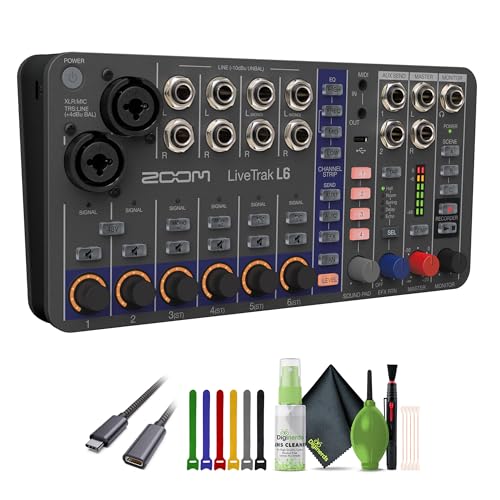
- Six-channel digital mixer with USB-C
- 12-track 32-bit float SD recording
- Battery-powered with EQ, effects, and sound pads
Best For: Mobile multi-source podcasting and live recording
Premium Analog Voice Chain

- Discrete mono preamp with Lundahl transformers
- Transient Designer and tube saturation
- Dedicated compressor for voice shaping
Best For: Studio-based single-mic vocal recording
Tube EQ and Compression

- Mono tube channel-strip design
- Opto/FET compression voicings
- 4-band semi-parametric EQ
Best For: Studio voice processing with hands-on analog control
Low-Noise Cleanup – Rodweil RO05 Analog Noise Gate
For podcasters building a simple recording chain, the Rodweil RO05 is a focused option among channel strips for podcasting. Its fully analog design is intended to reduce ambient and preamp-floor noise while preserving vocal detail, but it must be connected after a microphone preamp or elsewhere in a line-level chain.
Best For: Beginner home-studio users who need analog noise reduction after a microphone preamp.
Pros:
- Designed to reduce ambient background and preamp-floor noise.
- Fully analog signal path avoids analog-to-digital conversion and associated latency.
- Continuous processing is intended to sound smoother than a basic cutoff-style gate.
Cons:
- It is not a complete microphone preamp and should not receive a raw microphone signal directly.
- The complex circuit has relatively high power consumption.
- A slight circuit echo when powering off may occur as components release voltage.
The RO05 makes the most sense when your main problem is noise rather than full channel-strip tone shaping. Confirm that your setup provides the required preamp or line-level connection before buying.
Mobile Multitrack Hub – Zoom LiveTrak L-6 Mixer Bundle
The Zoom LiveTrak L-6 is a versatile choice among channel strips for podcasting when you need several sources, onboard control, and recording in a portable format. It combines six channels, multitrack SD recording, and a bundled pair of ATH-M20x headphones for monitoring.
Best For: Mobile podcasters and creators mixing multiple microphones, instruments, or other line-level sources.
Pros:
- Two XLR-1/4-inch combo inputs plus four stereo 1/4-inch line inputs support flexible setups.
- Records up to 12 tracks simultaneously in 32-bit float directly to an SD card.
- Includes channel-strip controls, two aux sends, five internal send effects, sound pads, MIDI, and USB.
- Compact and battery-powered for portable recording.
Cons:
- It is a mixer and multitrack recorder rather than a traditional single-channel analog strip.
- The supplied input layout may require adapters or additional gear for larger microphone-based setups.
The L-6 is particularly appealing if podcasting is part of a broader mobile production workflow. Its recording, effects, and routing features offer more flexibility than a basic one-channel strip, though the compact input arrangement should match your planned sources.
Tube Voice Shaping – ART VoiceChannel Tube Channel Strip
The ART VoiceChannel is a full-featured single-channel option among channel strips for podcasting, combining a tube preamp with dynamics processing and extensive digital connectivity. Its compressor, expander, de-esser, and gate can help shape a vocal signal before it reaches the rest of the recording system.
Best For: Podcasters who want tube-preamp character, vocal dynamics control, and digital output options in one channel.
Pros:
- ART tube preamp design is intended to provide warmth and definition.
- Includes compressor, expander, de-esser, and gate processing.
- Supports ADAT, AES/EBU, S/PDIF, TOSLink, and USB connectivity.
- Offers up to a 192 kHz maximum sample rate and compatibility with major desktop operating systems.
Cons:
- One channel may be limiting for interviews or multi-microphone podcasts.
- Its 5.5 kg weight makes it less suitable for highly portable setups.
For a host who wants substantial pre-recording vocal control, the VoiceChannel is a strong all-in-one hardware candidate. Its single-channel layout favors a dedicated voice chain rather than a multi-person podcast rig.
Classic Analog Control – PreSonus Studio Channel
The PreSonus Studio Channel is a straightforward hardware choice among channel strips for podcasting, pairing a Class A vacuum-tube preamplifier with a variable VCA compressor and three-band parametric EQ. It is suited to a host who wants preamp, compression, and equalization in one rack-format unit.
Best For: Studio-based podcasters seeking basic analog vocal shaping from a dedicated channel strip.
Pros:
- Class A vacuum-tube preamplifier provides a dedicated analog front end.
- Variable VCA compressor supports dynamics control.
- Three-band parametric EQ enables frequency shaping within the same unit.
Cons:
- The supplied notes do not specify digital, USB, or multichannel connectivity.
- Its rack-format dimensions and 6.31-pound weight are less convenient for mobile podcasting.
- Only one channel is described, limiting use for multi-microphone recordings.
The Studio Channel is a practical fit when you want essential analog processing without the broader connectivity described for some competing units. Check your interface and rack-space requirements before choosing it for a podcast setup.
USB Vocal Control – Behringer UV1
The Behringer Ultravoice UV1 is a focused option for creators who want channel strips for podcasting with a single mic or line source. Its integrated USB audio interface, compressor, gate, and expander/de-esser provide useful voice-processing tools in one unit.
Best For: Solo podcasters using a computer-based Windows or Mac recording setup.
Pros:
- Combines a mic/line preamp and USB audio interface.
- Includes compressor, gate, expander, and de-esser processing.
- Supports sample rates up to 192 kHz.
Cons:
- Its single-channel design is less suitable for multi-mic recordings.
- The supplied notes do not specify onboard EQ or broader mixer features.
The UV1 makes the most sense when streamlined single-voice recording and basic dynamics control matter more than multiple inputs or extensive routing.
Portable Multitrack Hub – Zoom LiveTrak L-6
The Zoom LiveTrak L-6 suits podcasters comparing channel strips for podcasting with a portable mixer and recorder. It combines six input channels, dedicated channel-strip controls, USB-C connectivity, battery operation, and multitrack recording to an SD card.
Best For: Mobile podcast setups that need multiple sources, multitrack recording, and flexible mixing.
Pros:
- Provides two XLR-1/4-inch combo inputs plus four stereo line inputs.
- Records up to 12 tracks simultaneously in 32-bit float audio to an SD card.
- Offers 3-band EQ, two aux sends, five internal effects, sound pads, MIDI, and USB.
- Compact, battery-powered design supports portable recording.
Cons:
- Only two of the listed inputs are XLR-1/4-inch combo inputs, so microphone expansion may be limited.
- Its broader mixer and recording feature set may be more than a simple one-mic podcast requires.
The L-6 is a versatile choice for interviews, live productions, or creator setups where portability and multitrack capture are central priorities.
Premium Analog Voice Chain – SPL Channel One MK3
The SPL Channel One MK3 is a premium mono option for buyers seeking channel strips for podcasting with dedicated analog processing. Its discrete preamp, Lundahl input/output transformers, Transient Designer, tube saturation, and compressor are aimed at shaping a single source.
Best For: Single-mic voice recording where analog preamp character and detailed dynamics processing are priorities.
Pros:
- Uses a discrete preamp and Lundahl I/O transformers.
- Includes Transient Designer processing and tube saturation.
- Provides a dedicated compressor in a mono channel-strip format.
Cons:
- Mono operation is not designed for multiple microphones at once.
- The supplied notes do not mention USB connectivity or multichannel recording.
- At 16.78 pounds, it is less oriented toward portable setups.
The Channel One MK3 is best considered a studio-oriented voice front end for users who value premium analog components and tone-shaping options over portability.
Tube EQ and Compression – ART Pro Channel III
The ART Pro Channel III is a mono tube channel strip for podcasters who want flexible front-end tone shaping. Its switchable microphone impedance, selectable opto/FET compression voicings, and 4-band semi-parametric EQ make it suited to detailed processing of one source.
Best For: Studio podcasters who want tube character, selectable compression styles, and hands-on EQ control.
Pros:
- Uses a mono tube channel-strip design.
- Offers switchable microphone impedance.
- Provides opto and FET compression voicings.
- Includes a 4-band semi-parametric EQ.
Cons:
- Mono operation limits it to one channel at a time.
- The supplied notes do not specify USB connectivity or an integrated recorder.
- Its 10.61-pound weight makes it less convenient for mobile podcasting.
The Pro Channel III is a strong fit for a permanent recording position where hands-on analog EQ and varied compression responses are more important than built-in digital connectivity.
How We Picked These Channel Strips for Podcasting
We focused on the features that matter most for spoken-word production: clean preamp gain, useful dynamics control, practical equalization, noise management, monitoring, and straightforward routing. We also included both traditional analog channel strips and mixer-style systems, since podcasters often need different combinations of processing, multitrack recording, USB connectivity, and portability.
Because these products serve different workflows, the most expensive option is not automatically the best choice. A compact mixer may be more useful for a multi-person show, while a dedicated channel strip can offer finer control over one important microphone signal.
Quick Comparison
| Best For | What to Prioritize | Product Type |
|---|---|---|
| Solo home podcasting | Low noise, simple controls, USB or reliable audio interface integration | Compact channel strip or USB interface |
| Two or more speakers | Multiple inputs, independent monitoring, flexible routing | Digital mixer or multitrack mixer |
| Broadcast-style vocal tone | Quality preamp, compressor, EQ, and de-esser or expander controls | Dedicated mono channel strip |
| Live or mobile production | Fast setup, durable construction, onboard recording, and low cabling complexity | Portable mixer or integrated interface |
| Advanced studio work | Detailed processing, balanced connections, and digital expansion options | Premium analog channel strip |
Key Buying Factors for Channel Strips for Podcasting
Preamp Quality and Gain
A preamp should provide enough clean gain for your microphone without adding distracting hiss. Dynamic broadcast microphones commonly need more gain than condenser microphones, so check the available gain range and whether phantom power is included.
Processing Controls
Compression helps maintain a steady speaking level, while EQ can improve intelligibility and reduce muddiness. An expander or gate may help control room noise, but aggressive settings can cut off quiet words. Look for controls you can adjust confidently rather than features you will rarely use.
Connectivity and Routing
USB connectivity can simplify computer recording, but not every analog channel strip includes it. Check for balanced outputs, digital outputs, headphone monitoring, insert points, and the number of microphone inputs required for your show. A mixer may be a better fit when several hosts, guests, or remote sources must be monitored at once.
Recording and Monitoring Workflow
Multitrack recording gives you more flexibility during editing, while a stereo mix can be faster for live publishing. Zero- or low-latency monitoring is especially valuable when recording through software, and separate headphone controls help prevent guests from hearing an uncomfortable mix.
Who Should Buy Which Channel Strips for Podcasting?
Choose a compact processor or USB-enabled channel strip if you record mainly one voice and want a tidy, repeatable setup. Select a LiveTrak-style mixer when your podcast includes multiple microphones, live segments, or a need to record without relying entirely on a computer. A traditional tube or solid-state channel strip is best for creators who want hands-on control and already own a separate audio interface.
For professional voice production, prioritize the unit with the strongest preamp, smoothest dynamics section, and most useful routing rather than simply choosing the model with the most controls. For beginners, simple gain staging, dependable headphone monitoring, and clear metering will usually improve results more than advanced processing options.