
The best audio mixers for DJs make it easier to blend sources, shape sound, connect microphones, and send a clean signal to speakers or recording equipment. The right choice depends on your setup, not simply the number of channels.
This roundup compares 10 DJ-friendly mixers across traditional DJ layouts, compact live-sound consoles, and feature-rich models with USB, Bluetooth, effects, and phantom power. Use the guide below to narrow the options by performance needs, connectivity, and budget.
Best 10 Audio Mixers for Djs Picks for 2026
Versatile DJ Control

- Four-channel layout with three-band EQ and cue controls
- USB playback and recording interface for Mac and PC
- Replaceable crossfader with broad DJ connectivity
Best For: Mobile DJs, clubs, parties, and practice setups
Clean Live Mixing

- 10-input design with D-PRE preamps
- Three-band EQ, high-pass filters, and compressors
- Rugged chassis with +48V phantom power
Best For: Live events, vocals, instruments, and small recording setups
Connected Entertainment
FULUODE CT-80S 8-Channel Mixer

- Eight channels with Bluetooth, USB, and MP3 support
- Reverb and 48V phantom power for varied sources
- Slim design for karaoke and live events
Best For: Karaoke, parties, conferences, and small live performances
Portable Effects Hub

- Six channels with 99 DSP echo presets
- USB-B, Bluetooth, and U-disk playback or recording
- Compact design for streaming and mobile use
Best For: Streaming, podcasting, karaoke, and portable recording
Value-Packed Wireless Pick
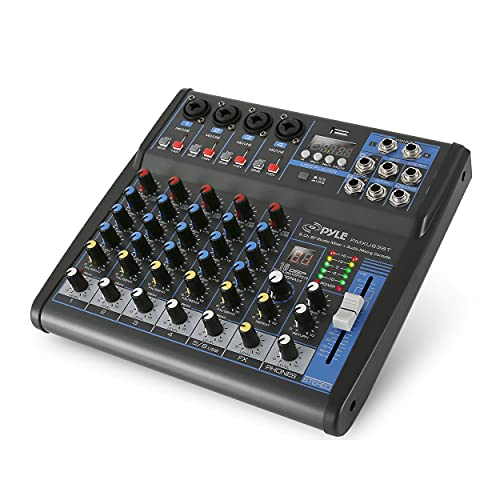
- Bluetooth, USB, flash-drive, and MP3 playback
- Six channels with XLR and 1/4-inch inputs
- 48V phantom power and 3-band EQ
Best For: Compact live, karaoke, and small studio mixing
Precision Sound-Shaping Choice
6-Channel Mixer with 7-Band EQ
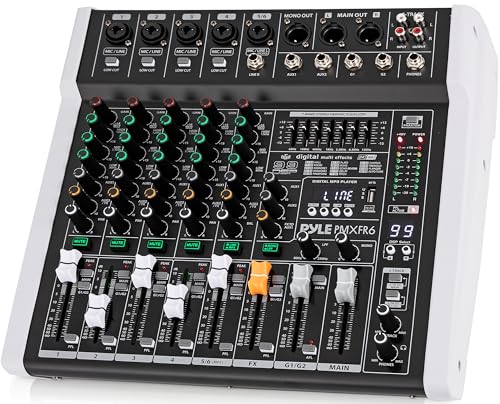
- Seven-band stereo graphic EQ
- 99 built-in DSP effects
- USB recording, Bluetooth, and flexible outputs
Best For: Live DJs, recording, and content creation
Entry-Level Effects Option
6-Channel Bluetooth Audio Mixer

- Four XLR inputs with 48V phantom power
- Bluetooth and USB playback or recording
- 16 DSP effects with 3-band EQ
Best For: Beginners, karaoke, streaming, and small live setups
Versatile Effects Mixer
Pyle PMX466 6-Channel DJ Mixer

- Six channels with four XLR mic/line inputs
- 16 preset digital effects and six sound styles
- USB, AUX, headphone, and sub outputs
Best For: DJs seeking flexible inputs and built-in effects
Studio-Ready Control
TKLBLS 6-Channel DJ Audio Mixer

- 99 DSP effects and 7-band output EQ
- Four XLR inputs with 48V phantom power
- Bluetooth and USB recording/playback options
Best For: DJs and creators needing detailed control and recording connectivity
Wireless Performance Hub
Jiayete JM6 6-Channel DJ Mixer

- 99 preset effects with reverb and delay
- Bluetooth streaming and USB media playback
- 48V phantom power for XLR microphones
Best For: DJs wanting wireless playback and USB recording flexibility
Versatile DJ Control – Numark M6 USB
The Numark M6 USB is a practical choice among audio mixers for DJs who need four channels, broad input/output connectivity, and direct computer integration. Its replaceable crossfader, channel controls, USB audio interface, and LED monitoring suit everything from practice sessions to mobile events.
Best For: DJs handling multiple sources, weddings, parties, clubs, or home practice setups.
Pros:
- Four channels with dedicated level faders, slope controls, cue controls, and three-band EQ.
- USB connectivity supports laptop playback and recording to compatible audio applications.
- Multiple phono, line, and mic inputs plus master, record, booth, and headphone outputs.
- Replaceable crossfader and portable, robust design.
Cons:
- It is corded rather than battery powered.
- Its 9-pound weight may be more than some ultra-portable setups require.
The M6 USB stands out when flexible routing and hands-on DJ controls matter more than built-in effects. It is a well-equipped four-channel option for DJs who also want simple USB recording and playback.
Clean Live Mixing – Yamaha MG10
The Yamaha MG10 brings studio-oriented preamps and straightforward control to audio mixers for DJs who also handle vocals, instruments, lectures, or live performances. Its 10-input design, three-band EQ, high-pass filters, and one-knob compressors focus on clean, controlled sound rather than DJ-specific effects.
Best For: Live performers, event DJs, speakers, and small recording or sound-reinforcement setups.
Pros:
- Ten-input stereo mixer with studio-grade D-PRE preamps.
- Three-band EQ and high-pass filters help shape sound and reduce unwanted noise.
- One-knob compressors simplify control of vocals and instruments.
- Rugged, impact-resistant powder-coated metal chassis with +48V phantom power.
Cons:
- No USB connectivity or built-in effects.
- Its feature set is less tailored to traditional DJ crossfader mixing.
The MG10 is best viewed as a compact live or production mixer with DJ-friendly versatility. Choose it when input count, microphone quality, and dependable analog control are more important than laptop integration.
Connected Entertainment – FULUODE CT-80S 8-Channel Mixer
The FULUODE CT-80S combines eight channels with Bluetooth, USB playback and recording, MP3 support, reverb, and 48V phantom power. For shoppers comparing audio mixers for DJs, its broad feature list makes it a flexible option for karaoke, parties, campus activities, and small live performances.
Best For: Karaoke, family events, live music, conferences, and casual DJ-style entertainment setups.
Pros:
- Eight-channel mixer supports cable, wireless, condenser microphone, and instrument connections.
- Built-in Bluetooth 5.0, MP3/USB input, and LED song-name display.
- Reverb and 48V phantom power expand its live-use flexibility.
- Ultra-thin 1.57-inch design for easier placement and transport.
Cons:
- The supplied specifications list a 110V American-plug power configuration.
- At 3.3 kg, it is not the lightest option in this group.
- Its broad entertainment features may be more than needed for basic two-deck mixing.
The CT-80S is aimed at feature-rich social and live audio use rather than a minimalist DJ workflow. Bluetooth, USB functions, effects, and eight inputs give it useful range for mixed-source events.
Portable Effects Hub – MW-6 White 6-Channel Mixer
The MW-6 White is a compact six-channel option for audio mixers for DJs who also stream, podcast, record, or play music from mobile devices. It adds Bluetooth, USB-B recording, U-disk playback and recording, and 99 DSP echo presets in a lightweight format.
Best For: Live streaming, podcasting, karaoke, family parties, and portable music recording.
Pros:
- Six-channel design with built-in 99-mode digital echo effects.
- USB-B audio interface supports computer or phone playback and recording.
- Bluetooth and U-disk functions provide flexible media connectivity.
- Compact, lightweight construction works with iOS, Android, tablets, and MP3 players.
Cons:
- The supplied voltage specification is 220V AC, so power compatibility should be checked.
- The listed return and exchange policy is only 30 days.
- Its compact six-channel format offers fewer channels than larger mixers.
The MW-6 White prioritizes portability and content-creation features over a traditional club-mixer layout. It is a strong fit when streaming, mobile playback, recording, and built-in effects are central to the setup.
Value-Packed Wireless Pick – Compact 6-Channel DJ Mixer
For shoppers comparing audio mixers for DJs, the Pyle PMXU63BT is a practical, compact option with Bluetooth streaming, USB and flash-drive playback, and six input channels. Its 3-band EQ, 48V phantom power, and rugged steel chassis make it suitable for straightforward live mixing, karaoke, and small studio setups.
Best For: DJs and performers who want flexible wireless, USB, microphone, and stereo-line connectivity in a compact mixer.
Pros:
- Bluetooth, USB, flash-reader, and built-in MP3 playback support
- Six channels with XLR and unbalanced 1/4-inch inputs
- 48V phantom power, 3-band EQ, LED peak indicators, and built-in DSP effects
- Rugged steel chassis and 100V-240V power compatibility
Cons:
- Provides a 3-band EQ rather than the more detailed graphic EQ found on some mixers
- Included components are limited to the unit and power cable
The PMXU63BT emphasizes convenience and portability over advanced routing. It is a sensible choice for DJs who need essential mixing features, wireless playback, and microphone support without a more elaborate control surface.
Precision Sound-Shaping Choice – 6-Channel Mixer with 7-Band EQ
Among audio mixers for DJs, the Pyle PMXFR6 stands out for detailed sound shaping and a broad built-in effects selection. Its seven-band stereo graphic EQ, low-cut filters, multiple outputs, Bluetooth, and USB recording interface give DJs and creators more control for live events, recording, and content production.
Best For: DJs, performers, and content creators who need expanded EQ control, onboard effects, and flexible recording and output options.
Pros:
- Seven-band stereo graphic EQ for more precise frequency adjustment
- 99 DSP effects reduce the need for an external effects processor
- Bluetooth streaming, USB recording, and built-in MP3 playback
- Low-cut filters, AUX sends, mono out, main out, and 2-track I/O
Cons:
- Its larger 13.94-inch footprint may require more setup space
- The extensive controls and effects may be more than casual users need
The PMXFR6 is the most feature-rich option in this group for shaping and routing audio. Choose it when detailed EQ, integrated effects, and broader connection options matter more than the smallest possible setup.
Entry-Level Effects Option – 6-Channel Bluetooth Audio Mixer
This six-channel console is a straightforward choice for shoppers seeking audio mixers for DJs with Bluetooth playback, USB support, and basic onboard effects. It combines four XLR inputs with 1/4-inch connections, 48V phantom power, 3-band EQ, and 16 DSP effects for karaoke, streaming, recording, and small live setups.
Best For: Beginners and budget-focused performers who need microphone inputs, wireless playback, simple EQ, and reverb or delay effects.
Pros:
- Four XLR inputs with selectable 48V phantom power for condenser microphones
- Bluetooth streaming and USB interface support for playback and recording
- 3-band EQ and 16 built-in DSP effects, including delay and reverb
- Supports microphones, guitars, DI boxes, wireless microphones, and stereo inputs
Cons:
- Includes only a 90-day manufacturer warranty
- Uses a basic 3-band EQ and 16 effects rather than more advanced processing
- The supplied dimensions indicate a relatively deep, taller unit for a compact mixer
This mixer covers the core connections and effects many entry-level DJ or karaoke systems require. Its broad input compatibility is useful, though buyers wanting advanced routing or a longer warranty may prefer a more feature-heavy model.
Versatile Effects Mixer – Pyle PMX466 6-Channel DJ Mixer
For DJs who need flexible connections and built-in sound shaping, the Pyle PMX466 is a practical option among audio mixers for DJs. Its six channels, four XLR mic/line inputs, USB connectivity, headphone jack, and onboard effects support home setups, small performances, and varied external sources.
Best For: DJs who want a compact mixer with multiple inputs, preset effects, and MP3 playback controls.
Pros:
- Six-channel layout with four XLR mic/line inputs.
- Includes 16 preset digital effects and six selectable sound styles.
- USB connectivity, AUX support, headphone output, and built-in sub output add flexibility.
- Rugged metal chassis in a relatively compact design.
Cons:
- The supplied notes do not specify a warranty description.
- At 1.74 kg, it may still require a dedicated case for regular transport.
The PMX466 stands out for straightforward connectivity and a useful selection of onboard effects. It is a sensible pick when you want a compact DJ mixer with practical inputs rather than an especially feature-heavy production console.
Studio-Ready Control – TKLBLS 6-Channel DJ Audio Mixer
The TKLBLS 6-Channel Professional DJ Mixer is designed for DJs and creators who want extensive tone control, wireless playback, and recording connectivity. Among audio mixers for DJs, its 99 DSP presets, 7-band main-output EQ, USB-B computer connection, and USB-A recording interface make it adaptable for live performances and studio-style setups.
Best For: DJs, podcasters, and performers who need detailed EQ control, phantom power, and computer or USB recording options.
Pros:
- Four XLR inputs, two stereo line inputs, and independent 48V phantom power.
- Offers 99 DSP effects with a screen for monitoring the selected effect.
- 7-band main-output EQ enables detailed overall sound adjustment.
- Bluetooth streaming plus USB-B playback/recording and USB-A recording support.
Cons:
- Bluetooth operation is specified for a range of approximately 15 feet.
- The extensive controls may be more than needed for a basic DJ setup.
This mixer is a strong fit when precise output shaping and multiple recording paths matter. Its combination of phantom power, DSP effects, Bluetooth, and USB connectivity gives it broader utility than a basic live-performance mixer.
Wireless Performance Hub – Jiayete JM6 6-Channel DJ Mixer
The Jiayete JM6 combines Bluetooth streaming, USB playback, recording, and 99 preset digital effects in a metal six-channel design. For shoppers comparing audio mixers for DJs, it offers useful source flexibility for live performances, music playback, podcasts, and setups using condenser or dynamic microphones.
Best For: DJs and performers who want wireless streaming, USB media support, phantom-powered microphone inputs, and onboard effects.
Pros:
- Includes 99 built-in effects featuring reverb and delay algorithms.
- Supports Bluetooth streaming from iOS, Android, tablets, and MP3 players.
- USB interface supports playback and recording of MP3, WAV, and WMA files.
- XLR inputs with 48V phantom power accommodate condenser and dynamic microphones.
Cons:
- The supplied notes list battery power, so power requirements should be confirmed for your setup.
- At 2.44 kg, it is heavier than some compact six-channel alternatives.
- The notes do not specify the exact method or device requirements for mobile monitoring.
The JM6 is appealing for mobile-friendly setups that mix streaming, USB media, and microphone sources. Its effects and file-format support add convenience, while the metal construction is suited to regular use.
How We Picked These Audio Mixers for Djs
We focused on mixers that suit common DJ, home-studio, streaming, karaoke, and small-event setups. The selection includes dedicated four-channel DJ hardware as well as six- to 10-input analog mixers that can handle microphones, instruments, playback devices, and auxiliary sources.
We compared channel capacity, input and output options, EQ controls, effects, USB and Bluetooth features, phantom power, portability, and the practicality of each design. Because feature lists can vary by version, confirm the current specifications and included cables before ordering.
Quick Comparison
| Best For | What to Look For | Typical Advantage |
|---|---|---|
| Traditional DJ sets | Four channels, cue controls, crossfader | Familiar deck-to-deck mixing |
| Small events | Multiple mic inputs, EQ, effects | Flexible sound reinforcement |
| Streaming and recording | USB interface, computer input, monitoring | Easy computer integration |
| Portable setups | Compact housing, Bluetooth, USB playback | Convenient mobile operation |
| Studio or vocal use | XLR inputs and 48V phantom power | Better microphone compatibility |
Key Buying Factors for Audio Mixers for Djs
Channel Layout and Source Compatibility
Count the sources you will use simultaneously, including decks, media players, microphones, instruments, and computers. A four-channel DJ mixer is often the most natural fit for multiple decks, while a compact live mixer may offer more total inputs but a different control layout.
Connectivity
Check whether the mixer has the connections your system requires. XLR outputs are useful for powered speakers and longer cable runs, while RCA connections are common in home DJ equipment. USB can simplify recording or computer playback, and Bluetooth is convenient for casual playback but should not replace wired connections for critical performances.
EQ, Effects, and Monitoring
Look for channel EQ controls that match your mixing style, plus a crossfader and cue monitoring if you mix decks. Built-in DSP effects can add reverb or ambience for vocals and live sound, but they are less important if you already use software or external effects.
Phantom Power and Gain Control
48V phantom power matters when using compatible condenser microphones or certain active accessories. It is not required for most DJ playback sources. Adequate gain controls, level meters, and a headphone output are more important for preventing clipping and monitoring transitions.
Who Should Buy Which Audio Mixers for Djs?
Choose a Dedicated DJ Mixer for Deck-Based Mixing
Pick a traditional four-channel model if you mainly mix multiple players and want straightforward cueing, channel control, and crossfader operation.
Choose a Compact Feature-Rich Mixer for Streaming or Parties
Six-channel boards with Bluetooth, USB playback, effects, and microphone inputs suit casual DJs, streamers, karaoke hosts, and small gatherings where flexibility matters more than club-style workflow.
Choose a Larger Analog Mixer for Expanded Setups
A 10-input mixer is a better match for users combining DJ playback with several microphones, instruments, or external devices. It may offer greater routing flexibility, though it can be less convenient for classic DJ transitions.
Choose Based on Your Upgrade Plans
If you expect to add decks, microphones, or recording equipment, leave spare channels and outputs. For a simple home setup, avoid paying for features you will not use and prioritize clean controls, reliable connections, and easy monitoring.