
The best external hard drive with RAID can add substantial capacity while helping protect important files from a single drive failure. The right setup depends on whether you want plug-and-play storage, faster performance, or the flexibility to install your own disks.
Our 2026 selection includes compact two-bay enclosures, expandable four-bay systems, and high-capacity desktop RAID drives for creative work, backups, media libraries, and small-office storage.
Best 10 External Hard Drive with Raid Picks for 2026
Best Professional RAID Drive
SanDisk Professional 24TB G-RAID Project 2

- 24TB with dual 7200RPM enterprise-class drives
- Thunderbolt 3 and USB 3.2 Gen 2 connectivity
- PRO-BLADE SSD Mag slot for expansion
Best For: Professional media workflows and fast desktop storage
Best Flexible RAID Enclosure
TERRAMASTER D2-320 2-Bay USB RAID

- Hardware RAID 0, 1, JBOD, and SINGLE modes
- Supports two SATA HDDs or SSDs
- 10Gbps USB 3.2 Gen 2 connection
Best For: Custom drive builds and flexible two-bay storage
Best High-Capacity RAID Drive

- 48TB capacity with 7200RPM enterprise-class drives
- RAID 0 and RAID 1 configuration options
- Five-year warranty with Rescue Data Recovery Services
Best For: Large professional media libraries
Best Four-Bay Expansion Enclosure
TERRAMASTER D4-320 Four-Bay DAS

- Four SATA drive bays with up to 120TB total capacity
- 10Gbps USB 3.2 Gen 2 Type-C connection
- Hot-swappable and tool-free drive management
Best For: High-capacity individual drive expansion without RAID
Best High-Capacity Desktop RAID

- 16TB desktop storage with automatic backup support
- RAID 0 ready with USB 3.1 connectivity
- 256-bit AES encryption and password protection
Best For: Large workstation backups and high-capacity personal or business storage
Best Flexible Multi-Drive Enclosure

- Four bays for 2.5- and 3.5-inch SATA drives
- Eight RAID and storage modes, including RAID 5 and 10
- USB A/C 3.0 and eSATA connectivity
Best For: Building a customizable desktop DAS from your own drives
Best Premium RAID Performance
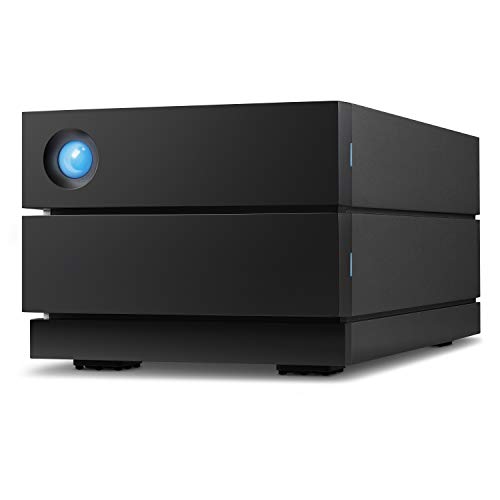
- Up to 440MB/s from 7200 RPM enterprise drives
- Guided RAID 0 or RAID 1 setup
- Five-year coverage with Rescue Data Recovery Services
Best For: Creative professionals needing fast, dependable desktop storage
Best with Extra Features

- Four modes: RAID 0, RAID 1, Normal, and JBOD
- Supports two 2.5- or 3.5-inch SATA drives
- USB 3.0 with USB-A/C cables and built-in fan
Best For: DIY external RAID storage with user-supplied drives
Secure Desktop Storage
- 20TB desktop RAID storage with RAID 0 ready
- 256-bit AES encryption and password protection
- Auto backup software plus two USB 3.0 hub ports
Best For: High-capacity desktop backups and protected file storage
Maximum Capacity RAID
- Massive 28TB desktop storage capacity
- RAID 0 ready with auto backup software
- Hardware encryption, password protection, and USB 3.1
Best For: Power users and businesses needing substantial desktop storage
Best Professional RAID Drive – SanDisk Professional 24TB G-RAID Project 2
If you need an external hard drive with RAID for demanding media workflows, the SanDisk Professional G-RAID Project 2 combines two 7200RPM enterprise-class drives with Thunderbolt 3 connectivity. It ships in RAID 0 for performance and offers a PRO-BLADE SSD Mag slot for expandable SSD-based storage.
Best For: Professional video editors, photographers, and multimedia users who prioritize fast transfers and high capacity.
Pros:
- 24TB capacity with two 7200RPM Ultrastar enterprise-class hard drives
- Thunderbolt 3 supports up to 40Gbps connectivity
- Ships configured in RAID 0 for performance
- Includes a PRO-BLADE SSD Mag slot for added SSD capacity
Cons:
- RAID 0 prioritizes speed rather than drive redundancy
- Desktop-oriented enclosure weighs 6.8 pounds
This is a performance-focused external hard drive with RAID for users who need substantial desktop storage and fast media transfers. Its expansion slot adds flexibility, but users seeking mirrored protection should consider a RAID 1 solution instead.
Best Flexible RAID Enclosure – TERRAMASTER D2-320 2-Bay USB RAID
The TERRAMASTER D2-320 is a diskless external hard drive with RAID enclosure for users who want to supply their own SATA drives. Its hardware RAID supports RAID 0, RAID 1, JBOD, and SINGLE modes over USB 3.2 Gen 2.
Best For: Buyers who already have compatible drives and want flexible RAID configurations in a compact two-bay enclosure.
Pros:
- Supports RAID 0, RAID 1, JBOD, and SINGLE modes
- Accommodates two 3.5-inch or 2.5-inch SATA drives or 2.5-inch SATA SSDs
- USB 3.2 Gen 2 provides up to 10Gbps data transmission
- Tool-free trays and intelligent temperature-controlled cooling
Cons:
- Diskless design requires separate drive purchases
- It is a DAS enclosure, not a NAS
Choose the D2-320 when configuration flexibility matters more than an all-in-one package. RAID 1 can provide mirrored backup, while RAID 0 can deliver higher performance, depending on the drives installed.
Best High-Capacity RAID Drive – LaCie 2big RAID 48TB
The LaCie 2big RAID is a high-capacity external hard drive with RAID designed for professional media storage. It includes two hot-swappable IronWolf Pro enterprise-class drives, supports RAID 0 and RAID 1, and offers USB-C compatibility for Mac and PC desktops.
Best For: Photographers, indie filmmakers, and YouTubers who need substantial desktop capacity with configurable performance or redundancy.
Pros:
- Large 48TB storage capacity
- Supports RAID 0 for performance and RAID 1 for redundancy
- Hot-swappable IronWolf Pro enterprise-class drives
- Includes five-year limited warranty and Rescue Data Recovery Services
Cons:
- Desktop enclosure is less portable than a compact external drive
- Its 48TB capacity is substantial for users with modest storage needs
With up to 550MB/s speeds and two RAID modes, the 2big RAID is a strong fit for large media libraries. Its included recovery services and long warranty add reassurance for professional storage duties.
Best Four-Bay Expansion Enclosure – TERRAMASTER D4-320 Four-Bay DAS
The TERRAMASTER D4-320 is a diskless four-bay DAS enclosure for expanding external storage over USB-C. While it can house up to four SATA drives and reach a stated total capacity of 120TB, it does not provide RAID functionality, so it is not a complete external hard drive with RAID by itself.
Best For: Users who need large, individually managed drive capacity and hot-swappable expansion rather than built-in RAID.
Pros:
- Four bays support 3.5-inch and 2.5-inch SATA drives and SSDs
- Supports up to 30TB per drive and 120TB total
- USB 3.2 Gen 2 Type-C connectivity with broad computer compatibility
- Hot-swappable, tool-free trays and temperature-controlled cooling
Cons:
- No RAID function
- Diskless design requires separately purchased drives
- Provides individual disk storage rather than a consolidated RAID array
The D4-320 is worth considering when bay count and expandability are the priority. However, shoppers specifically seeking an external hard drive with RAID should choose a RAID-enabled enclosure or add a separate software-based solution.
Best High-Capacity Desktop RAID – WD My Book Duo 16TB
If you need an external hard drive with RAID for large personal, gaming, or business backups, the WD My Book Duo provides 16TB of desktop storage in a ready-to-use enclosure. It supports RAID 0, USB 3.1 connectivity, automatic backup software, and password-protected 256-bit AES hardware encryption.
Best For: Users who want substantial capacity, straightforward desktop backup features, and built-in data protection.
Pros:
- Large 16TB capacity with auto and system backup support
- RAID 0 ready out of the box for performance-focused storage
- USB 3.1 connectivity plus two USB 3.0 hub ports
- 256-bit AES hardware encryption and password protection
Cons:
- Desktop-sized 3.5-inch enclosure requires an AC adapter
- Supplied notes highlight RAID 0 rather than multiple selectable RAID modes
The My Book Duo is a practical all-in-one choice when capacity and backup convenience matter most. Its desktop form factor and included security software make it better suited to a stationary workstation than portable use.
Best Flexible Multi-Drive Enclosure – CENMATE 4-Bay RAID Enclosure
For shoppers who already own SATA drives, this external hard drive with RAID enclosure supports up to four 2.5- or 3.5-inch HDDs or SSDs. It offers eight modes, including RAID 0/1/3/5/10, Clone, Large, and Normal, with USB A/C 3.0 and eSATA connections.
Best For: Users who want a configurable four-bay DAS enclosure for building their own storage system.
Pros:
- Four bays support 2.5- and 3.5-inch SATA HDDs and SSDs
- Supports up to 80TB total capacity, based on four 20TB drives
- Eight storage modes provide flexibility for performance, redundancy, or cloning
- USB A/C 3.0 and eSATA connectivity with Windows, Mac, and Linux support
Cons:
- Drives are not included, so total cost depends on your selected disks
- Hot-swapping is not supported
- Cooling fans may produce approximately 40–50 dB of noise
The CENMATE offers more configuration choices than a prefilled RAID drive, but it requires more setup and maintenance. Pay close attention to the eSATA and RAID limitations, and remember that changing RAID modes may cause data loss.
Best Premium RAID Performance – LaCie 2big RAID 16TB
The LaCie 2big RAID is an external hard drive with RAID designed for demanding desktop workflows. Its two 7200 RPM IronWolf Pro enterprise-class drives provide 16TB of capacity and speeds up to 440MB/s, while a guided setup supports RAID 0 or RAID 1.
Best For: Photographers, indie filmmakers, YouTubers, and other creators who need fast desktop storage with a choice between performance and redundancy.
Pros:
- 16TB capacity with speeds up to 440MB/s
- 7200 RPM IronWolf Pro enterprise-class drives
- Step-by-step wizard supports RAID 0 and RAID 1 configuration
- USB-C and USB 3.0 compatibility plus five-year coverage with Rescue Data Recovery Services
Cons:
- Desktop enclosure is less suitable for portable storage
- Only RAID 0 and RAID 1 modes are specified
- Actual available capacity may be lower than the advertised 16TB
The 2big RAID balances high throughput with a simpler two-drive design and strong included recovery coverage. Choose RAID 0 for performance or RAID 1 for redundancy, depending on whether speed or drive-failure protection is your priority.
Best with Extra Features – CENMATE 2-Bay RAID Enclosure
For shoppers building an external hard drive with RAID setup, the CENMATE 2-bay enclosure offers a flexible way to install up to two 2.5- or 3.5-inch SATA HDDs or SSDs. It supports RAID 0, RAID 1, Normal, and JBOD modes, with USB 3.0 connectivity and included USB-A/C cables.
Best For: Individuals or small businesses that want a configurable, driveless RAID enclosure.
Pros:
- Supports up to two SATA HDDs or SSDs, with up to 20TB per drive.
- Offers RAID 0, RAID 1, Normal, and JBOD modes.
- Aluminum construction and a built-in 2-inch cooling fan help manage heat.
- Works with Windows, Mac, and Linux and includes USB-A/C 3.0 connectivity.
Cons:
- Drives are not included, so the total setup cost depends on the disks you add.
- The fan operates at about 40–50 decibels and may be noticeable.
- Changing or resetting a RAID array can result in data loss; Mac does not support the RAID software.
The CENMATE is a practical choice when you already have compatible drives or want to choose your own capacity. Its four modes add flexibility, but setup and RAID changes require careful data management.
Secure Desktop Storage – WD My Book Duo 20TB RAID
The 20TB WD My Book Duo is a ready-to-use external hard drive with RAID for desktop backup, media storage, and business files. It includes RAID 0, auto and system backup software, password protection, and 256-bit AES hardware encryption in a desktop enclosure.
Best For: Desktop users who want high-capacity RAID storage with integrated backup and security features.
Pros:
- Provides 20TB of storage and is RAID 0 ready out of the box.
- Includes auto and system backup software for streamlined backups.
- Offers password protection and 256-bit AES hardware encryption.
- USB 3.1 connectivity, USB 3.0 compatibility, and two USB 3.0 hub ports add versatility.
Cons:
- It is a desktop drive intended for use with a computer rather than a compact portable setup.
- The listed configuration emphasizes RAID 0, which does not provide redundancy.
- At 5.3 pounds, it is heavier than a typical single external drive.
The My Book Duo combines substantial capacity with useful backup and security tools. It suits users who prioritize a ready-made desktop storage system, but RAID 0 users should maintain separate backups for important data.
Maximum Capacity RAID – WD My Book Duo 28TB
For users seeking an external hard drive with RAID and maximum desktop capacity, the WD My Book Duo provides 28TB in a preconfigured enclosure. It is RAID 0 ready and includes backup software, password protection, 256-bit AES hardware encryption, and USB 3.1 connectivity.
Best For: Businesses and power users who need very large desktop storage for personal or work files.
Pros:
- Offers 28TB of total storage in a desktop RAID enclosure.
- Includes auto and system backup software and is RAID 0 ready out of the box.
- Provides password protection and 256-bit AES hardware encryption.
- Includes USB-C and USB-A cables, plus two USB 3.0 hub ports.
Cons:
- The unit weighs 7.1 pounds and is designed for desktop use.
- The listed configuration is formatted NTFS for Windows and requires reformatting for other operating systems.
- RAID 0 prioritizes capacity and performance but does not provide data redundancy.
The 28TB My Book Duo is the strongest capacity option in this group and adds hardware encryption and backup software for a more complete storage workflow. Plan for a fixed desktop location and verify formatting needs before using it with a Mac or another operating system.
How We Picked the Best External Hard Drive with Raid
We focused on the features that matter most in a desktop external RAID system: usable capacity, bay count, drive type, connection options, RAID flexibility, cooling, software support, and ease of setup. The lineup includes both preconfigured products with hard drives installed and diskless enclosures that let you choose compatible SATA HDDs or SSDs.
We also considered practical differences between USB and Thunderbolt connections, enterprise-class versus general-purpose drives, included backup tools, password protection, warranty or recovery services, and the amount of desk space each design requires. Because RAID levels affect both capacity and redundancy, buyers should confirm the supported modes before purchasing.
Quick Comparison
| Type | Best For | Main Advantage | Trade-Off |
|---|---|---|---|
| Preconfigured two-drive RAID | Simple backups and media storage | Ready to use | Less flexible than a diskless enclosure |
| Diskless two-bay enclosure | Custom capacity and upgrades | Choose your own drives | Drives must be purchased separately |
| Four-bay enclosure | Large libraries and expandable storage | More capacity and RAID options | Larger footprint and higher total cost |
| High-capacity professional RAID | Video, photography, and demanding workflows | Fast interfaces and large installed capacity | Premium price |
Key Buying Factors for an External Hard Drive with Raid
Capacity and Usable Space
Advertised capacity is not the same as usable RAID capacity. RAID 1 mirrors data, so two equal drives provide roughly the capacity of one. RAID 0 combines drives for speed and capacity but offers no redundancy. RAID 5, where supported, balances capacity and protection across at least three drives. Check the manufacturer’s specifications and leave room for future growth.
Connectivity and Speed
USB 3.0 and USB 3.1 are suitable for backups and everyday file transfers, while USB-C describes the connector rather than the actual speed. Thunderbolt 3 can provide a stronger fit for high-bitrate video editing and large project files, but the computer, cable, and enclosure must all support the required standard.
Drive and Enclosure Design
Prebuilt systems simplify installation and support, whereas diskless enclosures offer more control over drive brands, capacities, and replacement schedules. Cooling fans are valuable during sustained transfers, particularly in four-bay units. Confirm support for both 2.5-inch and 3.5-inch SATA drives if you plan to mix hardware.
Who Should Buy Which External Hard Drive with Raid?
Choose a preconfigured two-drive model if you want straightforward desktop backup storage with minimal setup. A diskless two-bay enclosure is better for buyers who already own compatible drives or want to build a customized RAID array. Pick a four-bay enclosure if your storage needs are growing or you want more RAID-level flexibility.
Creative professionals working with large video, photo, or audio libraries should prioritize high-capacity drives, sustained performance, strong cooling, and Thunderbolt or high-speed USB connectivity. Whichever External Hard Drive with Raid you choose, maintain a separate backup: RAID can improve availability, but it does not replace protection against accidental deletion, theft, malware, or total device failure.