
The best audio mixers with USB interface make it easier to connect microphones and instruments, shape your sound, and send a polished mix directly to a computer. The right model can simplify podcasting, livestreaming, music recording, or small live setups without requiring a separate audio interface.
These 10 options range from compact two-channel mixers to feature-rich consoles with multiple inputs, effects, Bluetooth, phantom power, and dedicated streaming controls. Use the guide below to narrow the list by connectivity, channel count, control layout, and intended use.
Best 10 Audio Mixers with USB Interface Picks for 2026
Compact Podcast Pick
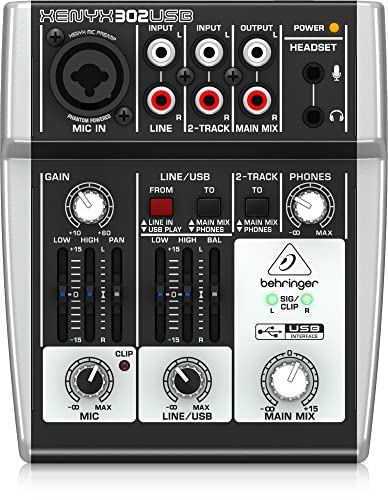
- Five inputs in an ultra-compact body
- USB interface for computer connection
- XENYX mic preamp with two-band EQ
Best For: Solo podcasting, streaming, and home studios
Feature-Rich Live Mixer

- Eight channels with XLR and 1/4-inch inputs
- Bluetooth and USB playback or recording
- 48V phantom power and onboard effects
Best For: Live performances, karaoke, podcasts, and home studios
Streaming Control Center

- Eight-input analog mixing layout
- Stereo USB interface for computer or mobile
- Mixes PC and gaming audio into streaming output
Best For: Streaming, podcasting, gaming audio, and recording
Complete Beginner Bundle

- Includes mixer, condenser mic, tripod, and cables
- Built-in voice, reverb, and sound effects
- Supports multiple devices and streaming platforms
Best For: Beginner podcasting, live streaming, and mobile content creation
Best Streaming Control

- Six-channel mixer with USB interface and LOOPBACK
- Two phantom-powered mic inputs
- Includes Cubase AI and WaveLab Cast
Best For: Live streaming, podcasting, and compact recording setups
Best Analog Mixing Capacity

- 12-input, 2-bus analog mixer
- USB/audio interface connectivity
- XENYX preamps, compressors, and British EQ
Best For: Home studios and small performance setups needing more inputs
Best Budget Effects Versatility

- Six channels with USB-B recording sound card
- 99 preset DSP echo effects
- Bluetooth and U-disk playback or recording
Best For: Casual streaming, karaoke, parties, and flexible mobile setups
Versatile Studio Mixer

- 12 inputs with four XENYX mic preamps
- Compressors, British EQ, and multi-FX processor
- Stereo USB interface with recording software
Best For: Home studios, podcasts, and multi-input recording
Portable Podcast Mixer

- Two XLR/TRS combo inputs with phantom power
- USB bus-powered Mac/PC interface
- Bluetooth 5.0 and compact metal housing
Best For: Solo or duo podcasts and mobile recording
Effects-Ready Karaoke Mixer
6-Channel Audio Interface Sound Board

- Six channels with four phantom-powered XLR inputs
- Bluetooth and USB playback support
- Three-band EQ and 16 DSP effects
Best For: Karaoke, small live shows, and streaming
Compact Podcast Pick – Behringer XENYX 302USB
The Behringer XENYX 302USB is a practical choice if you want compact audio mixers with USB interface capability for podcasting, streaming, recording, or a small home studio. Its five-input design, USB connectivity, built-in mic preamp, and included power adapter keep the setup simple without taking up much desk space.
Best For: Solo creators and small desktop recording or streaming setups.
Pros:
- Ultra-compact 5-input design with USB audio interface.
- Can run from USB or the included external power adapter.
- Includes a phantom-powered XENYX mic preamp and two-band British-style EQ.
Cons:
- Five inputs provide less expansion room than larger mixers.
- The compact layout may be limiting for multi-performer setups.
This mixer is best when portability and straightforward computer connectivity matter more than extensive channel capacity. It offers a focused feature set for basic voice, music, and streaming workflows.
Feature-Rich Live Mixer – 8-Channel Bluetooth USB Mixer
This 8-channel board is one of the more versatile audio mixers with USB interface options in the roundup, combining XLR and 1/4-inch inputs with Bluetooth and USB playback or recording. Its 48V phantom power, per-channel EQ, onboard effects, and monitoring controls suit live performance, karaoke, podcasting, and home studio use.
Best For: Users who need multiple inputs, wireless playback, and live mixing features.
Pros:
- Eight channels with XLR and 1/4-inch connectivity.
- Supports Bluetooth 5.0 and USB audio playback or recording.
- Includes 48V phantom power, three-band EQ, reverb, delay, and PFL monitoring.
Cons:
- At 3.3 kg, it is less portable than compact desktop mixers.
- The broad feature set may require more setup time for beginners.
Choose this model when flexible input options and hands-on control are priorities. Its slim 1.4-inch profile helps offset its larger footprint, while the monitoring and effects features support more involved live or recording sessions.
Streaming Control Center – Behringer XENYX 802S
Behringer XENYX 802S Premium Analog 8-Input Mixer with USB Streaming Interface
Check Price On AmazonThe Behringer XENYX 802S is designed for creators comparing audio mixers with USB interface functionality for streaming, podcasting, recording, and gaming. Its eight-input analog layout supports direct mixing of computer or gaming audio into the streaming output while providing stereo USB connectivity.
Best For: Streamers and podcasters who want analog mixing with computer or gaming audio.
Pros:
- Eight-input analog mixer for broader setup flexibility.
- Stereo USB audio interface connects to a computer or mobile device.
- Supports direct mixing of PC and gaming sounds into the streaming output.
Cons:
- Its analog workflow may be less convenient for users seeking extensive digital control.
- The supplied notes do not specify included accessories or software support.
The 802S makes the most sense for creators who want physical analog controls while integrating computer audio into a broadcast or recording chain. It is a stronger fit for multi-source streaming than a basic single-mic interface.
Complete Beginner Bundle – MAONO Podcast Equipment Kit
The MAONO bundle is a convenient entry point for shoppers seeking audio mixers with USB interface connectivity plus the essential gear to start podcasting or streaming. It includes a condenser microphone, mixer, cables, tripod, and windscreen, along with voice effects, monitoring, Bluetooth, and support for simultaneous streaming across multiple devices and platforms.
Best For: Beginners who want an all-in-one podcasting or live-streaming setup.
Pros:
- Includes the mixer, condenser microphone, cable, tripod, windscreen, and charging cable.
- Offers four recordable effects, eight built-in effects, voice changing, and reverb controls.
- Supports up to two people, four devices, and four platforms simultaneously.
Cons:
- The mixer supports 3.5mm microphones and does not support phantom power.
- Guitars and keyboards require an additional 6.35mm-to-3.5mm adapter.
- Phones without a 3.5mm jack require an OTG adapter, which is not included.
This kit prioritizes convenience and creative live-streaming features over traditional studio expansion. Its included microphone and accessible controls make it appealing for newcomers, provided the 3.5mm-only microphone setup fits your equipment needs.
Best Streaming Control – Yamaha AG06MK2
The Yamaha AG06MK2 is a strong choice among audio mixers with USB interface for live streaming, compact recording setups, and voice-focused production. It combines six channels, USB connectivity, onboard DSP effects, and LOOPBACK functionality in a relatively portable corded mixer.
Best For: Live streamers, podcasters, and creators who need two phantom-powered microphone inputs and computer-based audio routing.
Pros:
- USB audio interface with DSP effects, LOOPBACK, and a mute button for streaming.
- Two phantom-powered microphone inputs support condenser microphones.
- AG Controller offers control from Windows, Mac, and iOS devices.
- Includes Cubase AI and WaveLab Cast software.
Cons:
- Has fewer channels than larger production mixers.
- Requires corded power.
Choose the AG06MK2 if streamlined streaming features and software support matter more than extensive channel capacity. Its compact design and dedicated controls make it practical for a focused creator setup.
Best Analog Mixing Capacity – Behringer XENYX 1204USB
The Behringer XENYX 1204USB is a practical option among audio mixers with USB interface for users who want a larger analog mixing layout. Its 12-input, 2-bus design combines USB connectivity with XENYX microphone preamps, compressors, and British-style three-band EQ.
Best For: Home studios, small performance setups, and users who need more physical inputs than a compact streaming mixer provides.
Pros:
- 12-input, 2-bus configuration offers expanded mixing capacity.
- USB/audio interface supports computer-based audio connections.
- XENYX mic preamps and compressors are built in.
- British-style three-band EQ is designed for warm, musical sound.
Cons:
- Its larger dimensions and 8.4-pound weight reduce portability.
- Uses corded power.
The 1204USB makes sense when hands-on analog control and additional inputs are priorities. It is less travel-friendly than the smaller options here, but its broader layout suits more involved mixing arrangements.
Best Budget Effects Versatility – MW-6 White
The MW-6 White is a portable six-channel option among audio mixers with USB interface, designed for streaming, podcasting, karaoke, parties, and recording. It adds Bluetooth, USB-B computer connectivity, U-disk playback or recording, and 99 preset DSP effects.
Best For: Casual streamers, mobile-friendly setups, karaoke, and users who want built-in effects and flexible playback options.
Pros:
- Compact six-channel design with plug-and-play operation.
- USB-B socket includes a built-in recording sound card.
- Offers 99 DSP echo presets for varied applications.
- Supports Bluetooth, mobile devices, tablets, MP3 players, and U disks.
Cons:
- Uses a 220-volt AC power specification in the supplied details.
- Warranty information lists a 30-day return and exchange policy.
- Its feature set is aimed at versatility rather than a stated professional software bundle.
The MW-6 White is appealing when portability, wireless playback, and numerous built-in echo effects are more important than advanced production controls. Check power compatibility carefully before buying.
Versatile Studio Mixer – Behringer XENYX X1204USB
The Behringer XENYX X1204USB is a strong choice for shoppers comparing audio mixers with USB interface capability and needing more channels for vocals, instruments, or podcast production. It combines 12 inputs, four XENYX mic preamps, one-knob compressors, British-style three-band EQs, built-in effects, and direct USB connectivity to a computer.
Best For: Home studios, podcast setups, and small recording or live-mixing applications that need multiple inputs and onboard processing.
Pros:
- 12-input layout provides more connectivity than compact two-channel mixers.
- Four phantom-powered XENYX mic preamps support condenser microphones.
- Four one-knob compressors, British-style EQs, and a 24-bit multi-FX processor add practical sound-shaping options.
- Built-in stereo USB/audio interface connects directly to a computer and includes recording software and plug-ins.
Cons:
- Its larger feature set may be more than a simple one- or two-microphone setup requires.
- The unit is corded and weighs 5.8 pounds, so it is less portable than smaller mixers.
Choose this model when channel count and hands-on analog controls matter more than minimal size. Its combination of preamps, compression, EQ, effects, and USB recording makes it the most full-featured option in this group.
Portable Podcast Mixer – Rockville RockMix 2BT
The Rockville RockMix 2BT is a compact option for shoppers seeking audio mixers with USB interface support for podcasting, streaming, and simple recording. It offers two XLR/TRS combo inputs, +48V phantom power, Bluetooth playback, USB bus-powered operation, and separate main and headphone controls.
Best For: Solo or duo podcasts, mobile recording, streaming, and users who want Bluetooth audio in a small setup.
Pros:
- Compact 16-ounce design is easy to carry and use in mobile recording setups.
- USB interface supports plug-and-play connection to Mac and PC DAW software.
- Bluetooth 5.0 enables wireless playback and remote guest-call audio integration.
- +48V phantom power supports condenser microphones, while RCA and headphone outputs add flexible monitoring options.
Cons:
- Two channels limit the number of microphones or instruments that can be connected at once.
- The two-band EQ offers less tonal control than mixers with three-band EQ sections.
This is the practical pick when portability and straightforward podcast connectivity take priority. Its two-channel design is best suited to small productions rather than larger music or live setups.
Effects-Ready Karaoke Mixer – 6-Channel Audio Interface Sound Board
This six-channel sound board is a budget-oriented choice for shoppers comparing audio mixers with USB interface functionality for karaoke, streaming, live use, and basic recording. It combines four XLR inputs with phantom power, stereo inputs, Bluetooth, USB playback, three-band EQ, and 16 built-in DSP effects.
Best For: Karaoke, small live performances, streaming, and home setups that benefit from Bluetooth playback and built-in reverb or delay.
Pros:
- Six channels accommodate multiple microphones, instruments, and stereo sources.
- Four XLR inputs offer switchable +48V phantom power for condenser microphones.
- Bluetooth and USB support wireless streaming, USB-stick playback, and mixing or recording workflows.
- Three-band EQ and 16 DSP effects provide hands-on tone shaping, reverb, and delay.
Cons:
- The supplied warranty description is limited to 90 days from purchase.
- At 2.3 kg, it is less lightweight than the compact two-channel alternative.
- The product notes describe it as a traditional analog mixer, so users should expect hands-on operation rather than a software-focused workflow.
This mixer stands out for flexible source connections and built-in effects at a modest channel count. It is a sensible fit for karaoke and small performance applications where Bluetooth playback and onboard reverb are useful.
How We Picked These Audio Mixers with USB Interface
We focused on mixers that combine practical analog controls with USB connectivity for computer recording, streaming, or playback. The selection covers compact podcast mixers, portable Bluetooth models, entry-level recording boards, and larger consoles for bands or multi-microphone setups.
We also considered input capacity, microphone preamp functionality, phantom-power support, onboard effects, loopback or streaming features, monitoring options, portability, and overall value. Because mixer layouts vary significantly, the best choice depends more on your workflow than on channel count alone.
Quick Comparison
| Best For | What to Prioritize |
|---|---|
| Solo podcasting | Simple controls, a quality mic input, headphone monitoring, and USB playback |
| Livestreaming | Loopback, Bluetooth or auxiliary input, quick level adjustment, and compact size |
| Home recording | Clean preamps, phantom power, reliable USB drivers, and flexible routing |
| Small live setups | More channels, durable construction, EQ, effects, and multiple outputs |
| DJ or mobile use | Portable design, Bluetooth, DSP effects, and convenient stereo inputs |
Key Buying Factors for Audio Mixers with USB Interface
Channel Count and Input Types
Count the sources you expect to connect at the same time. A compact mixer may suit one or two microphones, while a band, panel podcast, or live event may need several mic and line inputs. Check whether inputs are mono, stereo, balanced, or compatible with instruments.
USB Functionality and Routing
USB may provide two-channel recording, playback, or more advanced routing. If you stream, look for loopback or an easy way to combine computer audio with microphone input. Confirm operating-system compatibility and whether the mixer is class-compliant or requires dedicated drivers.
Phantom Power and Preamps
Condenser microphones generally require +48V phantom power. Dynamic microphones may not need it, but clean preamps and sufficient gain still matter, especially for quiet spoken-word sources. Avoid enabling phantom power when connected equipment is not designed to accept it.
Effects, Bluetooth, and Monitoring
Built-in reverb, compression, or DSP effects can be useful for live performance and streaming, but they are not essential for basic recording. Bluetooth is convenient for background music or calls, while independent headphone and monitor controls make troubleshooting easier.
Size and Workflow
A larger console offers more hands-on control but takes up more desk space. Compact mixers are easier to travel with, though their smaller controls and limited routing may become restrictive as your setup grows.
Who Should Buy Which Audio Mixers with USB Interface?
Choose a compact five- or six-input model for solo creators, simple podcasts, and portable livestreaming. These mixers keep setup straightforward while providing the essential USB connection and microphone controls.
Choose an eight-channel mixer if you need room for multiple microphones, instruments, or stereo playback but still want a manageable desktop footprint. Models with streaming-focused routing are especially useful for creators who mix computer audio with live sources.
Move to a 12-input mixer for bands, panel discussions, rehearsal spaces, or more permanent home studios. The additional channels, EQ controls, inserts, and effects provide flexibility, but the larger chassis is less convenient for travel.
Finally, prioritize Bluetooth and onboard DSP when convenience matters most for live entertainment, mobile DJ work, or casual streaming. For serious multitrack production, verify the USB channel configuration before buying, since many analog mixers send only a stereo mix to the computer rather than separate tracks.