
USB-C NAS enclosures make it easier to combine multiple hard drives into a flexible storage system without buying a complete network-attached storage appliance. They can add capacity for backups, media libraries, file archiving, and workstation storage while keeping your existing drives useful.
This roundup compares 10 multi-bay options, from compact two-drive RAID enclosures to six-bay desktop units. The right choice depends on drive compatibility, RAID support, transfer speed, cooling, power delivery, and whether you need direct-attached storage or true network access.
Best 10 USB C Nas Enclosures Picks for 2026
Best RAID Pick
TERRAMASTER D2-320 2-Bay RAID Enclosure

- Hardware RAID 0, 1, JBOD, and Single modes
- USB 3.2 Gen 2 Type-C up to 10Gbps
- Supports two drives up to 22TB each
Best For: Two-drive RAID storage and mirrored backups
Best for Drive Cloning
ORICO 5-Bay USB-C Docking Station

- Offline one-button duplication for four copies
- Five bays and up to 100TB capacity
- USB-C-to-C and USB-C-to-A cables included
Best For: Offline cloning and large multi-drive backups
Best Four-Bay RAID Flexibility

- Eight modes including RAID 5 and Clone
- Up to 96TB with four 24TB drives
- Dual cooling fans and USB-C connectivity
Best For: Professional four-drive RAID and backup setups
Best High-Capacity Expansion
TERRAMASTER D6-320 6-Bay Enclosure

- Six bays support up to 132TB total
- USB 3.2 Gen 2 Type-C up to 10Gbps
- Hot-swappable individual disks
Best For: Large local storage expansion without RAID
Maximum Capacity Pick
SABRENT 5-Bay USB-C DAS Enclosure

- Five 3.5-inch bays, up to 100TB
- 10Gbps USB-C with independent bay controllers
- Quiet PWM cooling and trayless hot-swap
Best For: Large direct-attached storage setups
Quiet 4-Bay Value
TERRAMASTER D4-320 USB-C Enclosure

- Four bays with up to 120TB total capacity
- 10Gbps USB-C and hot-swappable trays
- Temperature-controlled fan with noise reduction features
Best For: Quiet plug-and-play DAS storage
Compact Metal 4-Bay
SABRENT DS-SC4B USB-C Enclosure
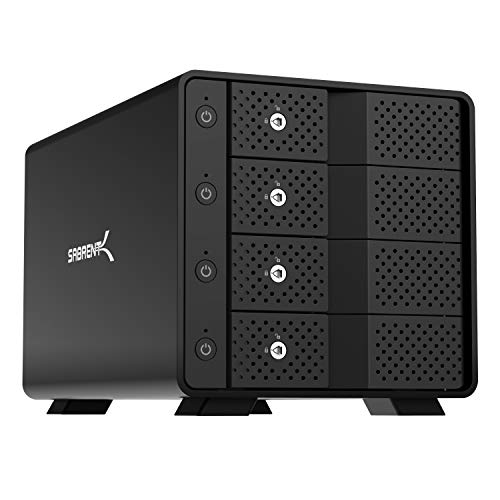
- Four 3.5-inch bays, up to 80TB
- 10Gbps USB-C with independent drive access
- Metal housing, active cooling, and per-bay switches
Best For: Durable four-drive workstation storage
Best High-Capacity Pick

- Five SATA bays with up to 110TB stated capacity
- Up to 5Gbps USB-C transfer speeds
- 80mm fan and 12V/10A power supply
Best For: Home users building a large, organized desktop storage setup
Best Multifunctional Dock

- Four bays and up to 128TB stated capacity
- 10Gbps USB-C plus 4K HDMI output
- Temperature-controlled dual-fan cooling
Best For: Workstations needing storage, display, and peripheral expansion
Best Expansion-Ready Option

- 10Gbps USB 3.2 Gen 2 connectivity
- Daisy-chain support up to a stated 264TB
- 150W supply and 80mm cooling fan
Best For: Professionals managing large, expandable local data libraries
Best RAID Pick – TERRAMASTER D2-320 2-Bay RAID Enclosure
The TERRAMASTER D2-320 is a practical choice among USB C NAS enclosures if you need a compact, diskless DAS with hardware RAID. Its USB 3.2 Gen 2 Type-C connection supports up to 10Gbps, while RAID 0, RAID 1, JBOD, and Single modes cover both performance and redundancy needs.
Best For: Users who want a two-drive enclosure with hardware RAID, mirrored backup, and support for large SATA HDDs or SSDs.
Pros:
- Supports RAID 0, RAID 1, JBOD, and Single modes.
- USB 3.2 Gen 2 offers up to 10Gbps data transfer.
- Accepts two SATA drives up to 22TB each.
- Tool-free trays and temperature-controlled cooling simplify setup and operation.
Cons:
- It is a DAS, not a network-attached storage device.
- Only provides two drive bays.
- Drives are not included.
Choose the D2-320 when RAID flexibility matters more than bay count. RAID 1 provides a useful mirrored-data option, while the 10Gbps interface gives it room for fast SSD-based workflows.
Best for Drive Cloning – ORICO 5-Bay USB-C Docking Station
The ORICO 5-Bay USB-C Docking Station stands out among USB C NAS enclosures for offline duplication rather than network storage. Its one-button duplicator can create four copies simultaneously, and the five bays accommodate 2.5-inch or 3.5-inch SATA SSDs and HDDs.
Best For: Photographers, professionals, and backup-focused users who need high-capacity drive access and offline cloning.
Pros:
- Offline duplicator can make four copies simultaneously.
- Five bays support up to five 20TB drives, for up to 100TB.
- Includes USB-C-to-C and USB-C-to-A connectivity.
- Aluminum construction and vertical design support heat dissipation.
Cons:
- USB 3.2 Gen 1 is slower than 10Gbps USB 3.2 Gen 2 designs.
- Cloning overwrites the target disk, so backups require care.
- It is a docking station, not a network-attached storage system.
The ORICO is a strong fit when offline cloning and broad device compatibility are priorities. Its five-bay capacity is useful for handling multiple disks, but users seeking RAID should consider a dedicated RAID enclosure instead.
Best Four-Bay RAID Flexibility – MAIWO 4-Bay RAID Enclosure
The MAIWO 4-Bay RAID Enclosure is a flexible option among USB C NAS enclosures for users who want several RAID choices in a direct-attached setup. It supports eight modes, including RAID 0, 1/10, 3, 5, Clone, Normal, and Large JBOD, with USB-C transfer speeds up to 5Gbps.
Best For: Professionals and power users building a four-drive backup, surveillance, or media-storage system.
Pros:
- Offers eight storage and RAID modes, including RAID 5 and Clone.
- Supports four 3.5-inch SATA drives up to 24TB each.
- Provides up to 96TB of stated capacity.
- Includes two cooling fans and USB-A-to-C and USB-C-to-C cables.
Cons:
- USB-C transfer speed is limited to up to 5Gbps.
- Designed for 3.5-inch SATA HDDs rather than a mix of listed drive sizes.
- Fan control is limited to an on/off switch.
Consider the MAIWO when RAID 5, cloning, or other multi-drive layouts are more important than maximum interface speed. Its four-bay design and active cooling make it suited to larger local storage projects.
Best High-Capacity Expansion – TERRAMASTER D6-320 6-Bay Enclosure
The TERRAMASTER D6-320 is a high-capacity choice among USB C NAS enclosures for expanding local storage with six individual disks. Its USB 3.2 Gen 2 Type-C interface reaches up to 10Gbps, and plug-and-play compatibility covers Windows, Mac, and Linux systems.
Best For: Users who need up to six independently accessible SATA drives, hot swapping, and substantial local capacity.
Pros:
- Six bays support drives up to 22TB each, for up to 132TB.
- USB 3.2 Gen 2 Type-C supports up to 10Gbps.
- Hot-swapping allows drive replacement without powering down.
- Temperature-controlled, low-noise cooling adjusts to drive conditions.
Cons:
- Does not support RAID or other arrays.
- Drives are not included.
- Its six-bay design is larger and heavier than a compact enclosure.
The D6-320 makes sense when maximum local capacity and individual-disk access are the priority. Avoid it if you need built-in redundancy; its key advantage is six-drive expansion rather than RAID protection.
Maximum Capacity Pick – SABRENT 5-Bay USB-C DAS Enclosure
If you need usb c nas enclosures for a large local storage setup, the SABRENT DS-SC5B provides five 3.5-inch SATA bays and a single 10Gbps USB-C connection. Keep in mind that it is direct-attached storage, not a network-attached storage device or RAID enclosure.
Best For: Users who want five independently mounted drives, tool-free hot-swapping, and up to 100TB of disk capacity attached directly to a computer.
Pros:
- Five 3.5-inch SATA bays support up to 100TB total capacity.
- Dedicated controller for each bay is designed for stable, independent drive access.
- PWM-controlled 120mm fan adjusts cooling to drive temperatures.
- Trayless hot-swap design includes per-bay switches, activity LEDs, and a locking key.
Cons:
- Drives are not included.
- It offers JBOD-style DAS rather than RAID or network access.
- The five-bay enclosure is relatively large and heavy.
The DS-SC5B is the strongest capacity-focused option here, especially for users managing several large drives from one workstation. Its independent bay controllers and active cooling suit sustained multi-drive use, while the lack of RAID means storage management remains the responsibility of the host computer.
Quiet 4-Bay Value – TERRAMASTER D4-320 USB-C Enclosure
The TERRAMASTER D4-320 is a practical choice among usb c nas enclosures when you want four drive bays in a plug-and-play DAS. Its USB 3.2 Gen 2 Type-C interface supports up to 10Gbps, while hot-swappable, tool-free trays simplify drive changes.
Best For: Users seeking a quieter four-drive enclosure for Windows, macOS, or Linux systems, with support for up to 120TB total capacity.
Pros:
- Supports four individual 3.5-inch or compatible 2.5-inch SATA drives.
- Supports up to 30TB per drive and 120TB total capacity.
- Tool-free Push-lock trays enable hot-swappable drive replacement.
- Temperature-controlled cooling and vibration-damping features target quieter operation.
Cons:
- It has no RAID function.
- Drives are not included.
- It is DAS, so it connects directly to a computer rather than a network.
The D4-320 balances capacity, convenience, and noise control in a compact four-bay design. Its broad operating-system compatibility and included power adapter make setup straightforward, but buyers should choose it for direct computer storage—not for shared network storage or hardware RAID.
Compact Metal 4-Bay – SABRENT DS-SC4B USB-C Enclosure
For shoppers comparing usb c nas enclosures for a sturdy four-drive workstation setup, the SABRENT DS-SC4B offers four 3.5-inch SATA bays over a 10Gbps USB-C connection. It is a direct-attached, JBOD-style enclosure rather than a NAS or hardware RAID system.
Best For: Users who want independently managed drives, tool-free hot-swapping, and a durable aluminum-and-metal enclosure with active cooling.
Pros:
- Four bays support up to 80TB using 3.5-inch SATA HDDs or SSDs.
- Dedicated controller per bay is designed for reliable multi-drive access.
- Trayless hot-swap design includes per-bay power switches and activity LEDs.
- 92mm fan and aluminum-and-metal construction support extended operation.
Cons:
- Drives are not included.
- There is no hardware RAID or network connectivity.
- It uses an external AC adapter.
The DS-SC4B is a solid fit when four bays are enough and you value per-drive controls, physical security, and a metal housing. It provides straightforward USB-C expansion for Windows, macOS, and Linux, but it does not replace a network-accessible NAS.
Best High-Capacity Pick – ORICO 5-Bay USB-C Enclosure
The ORICO 9758C3 is a practical choice for shoppers comparing USB C NAS enclosures for centralized desktop storage. Its five bays accept 2.5-inch and 3.5-inch SATA drives, while the included USB/Type-C cable supports plug-and-play use across mainstream systems.
Best For: Home users who need expandable, multi-drive storage for data organization, media, work, or gaming.
Pros:
- Five bays support up to 22TB per drive, with a stated maximum of 110TB.
- USB-C connectivity offers up to 5Gbps transfer rates and reported read/write speeds of up to 260MB/s.
- 12V/10A power supply supports simultaneous drive activity, while the 80mm fan helps with cooling.
- Push-to-open bays and plug-and-play operation simplify everyday use.
Cons:
- It is a direct-attached enclosure rather than a standalone network-attached storage system.
- The listed USB 3.2 Gen 1 interface is slower than the 10Gbps USB-C options in this roundup.
Choose this model when five drive bays and straightforward centralized storage matter more than advanced docking features or maximum USB speed.
Best Multifunctional Dock – WAVLINK 4-Bay USB-C Enclosure
The WAVLINK 4-Bay enclosure stands out among USB C NAS enclosures for combining storage expansion with display and peripheral connectivity. Its four SATA bays support 3.5-inch and 2.5-inch drives, while USB 3.2 Type-C reaches up to 10Gbps.
Best For: Users who want a four-drive enclosure that can also support a USB-C workspace and 4K display output.
Pros:
- Four bays support up to 32TB per drive, for a stated maximum of 128TB.
- 10Gbps USB-C connectivity is suited to large file transfers.
- HDMI supports up to 4K at 60Hz when the host USB-C port supports video output and the required USB-C-to-C connection is used.
- Temperature-controlled dual fans activate at 48°C, and independent bay switches support flexible drive control.
Cons:
- 2.5-inch drives require mounting brackets, which are not included.
- HDMI functionality depends on compatible host video output over USB-C.
- The product combines enclosure and docking features, which may be unnecessary if storage is the only priority.
This is the most versatile option here for a compact workstation, provided your computer supports the stated video-output requirements and you have the needed 2.5-inch mounting hardware.
Best Expansion-Ready Option – ORICO 4-Bay USB-C DAS
The ORICO 9948C3 is a strong fit for shoppers evaluating USB C NAS enclosures for large local storage projects. It provides four independent 3.5-inch SATA bays, a 10Gbps USB 3.2 Gen 2 interface, and daisy-chain support for expanding across multiple enclosures.
Best For: Video editors and other users who need high-capacity, expandable direct-attached storage.
Pros:
- Supports up to 22TB per drive and up to 88TB in one enclosure.
- Daisy-chaining up to three devices enables a stated maximum of 264TB.
- 10Gbps USB 3.2 Gen 2 and a USB-C hub support fast, convenient connectivity.
- Independent slots with eject functions allow individual disk replacement, while the 150W supply and 80mm fan support sustained operation.
Cons:
- It supports 3.5-inch HDDs rather than listing 2.5-inch drive compatibility.
- Its expansion design is intended for direct-attached use, not standalone network storage.
- Daisy-chain capacity requires purchasing and connecting additional compatible enclosures.
For users with rapidly growing local files, this ORICO model offers the clearest expansion path in the group, though its full capacity potential depends on adding more units and drives.
How We Picked the Best USB C Nas Enclosures
We focused on multi-bay enclosures that connect over USB-C or a closely related USB standard and support common 3.5-inch SATA hard drives. The selection includes two-, four-, five-, and six-bay designs so shoppers can match capacity to their current setup and future expansion plans.
We also considered RAID functionality, advertised interface speed, cooling provisions, power supplies, installation convenience, and overall flexibility. Some models are best treated as direct-attached storage (DAS), not standalone NAS devices: they connect to a host computer rather than running their own network operating system. That distinction matters if you expect remote access without leaving a computer powered on.
Quick Comparison
- Best for a small desktop array: A two-bay enclosure such as the TERRAMASTER D2-320.
- Best for larger capacity: Six-bay models such as the TERRAMASTER D6-320.
- Best for flexible expansion: Four- and five-bay enclosures from SABRENT, ORICO, WAVLINK, and MAIWO.
- Best for RAID experimentation: A model that clearly lists multiple hardware or software RAID modes, such as the MAIWO four-bay enclosure.
Key Buying Factors for USB-C NAS Enclosures
Drive Compatibility and Capacity
Check whether the enclosure accepts 3.5-inch HDDs, 2.5-inch drives, or both. Capacity claims are usually maximum theoretical totals and may vary with drive size, formatting, RAID configuration, and operating-system limits. Confirm that your chosen drives are supported before buying.
RAID and Data Protection
RAID can improve performance or protect against a drive failure, but it is not a backup by itself. RAID 0 prioritizes speed and capacity with no redundancy, while RAID 1 mirrors data and sacrifices usable space. Larger enclosures may support RAID 5, RAID 10, spanning, or independent disks. Verify how the enclosure implements RAID and whether replacing a failed drive is straightforward.
USB Speed and Host Compatibility
USB-C describes the connector, not necessarily the performance. Look for USB 3.2 Gen 2 or a stated 10Gbps connection when faster transfers matter, and make sure the host computer has a matching port. Real-world speeds will also depend on the drives, RAID mode, cables, and file sizes.
Cooling, Noise, and Power
Multiple spinning hard drives generate heat, so a fan, ventilation, and temperature control are valuable for sustained transfers. Compare fan behavior and enclosure placement if the unit will sit near your desk. Use the supplied power adapter and avoid assuming that USB power alone can run several 3.5-inch drives.
Who Should Buy Which USB C Nas Enclosures?
Choose a two-bay enclosure if you want a compact mirror for personal backups or a simple capacity upgrade. Four-bay models are a practical middle ground for photographers, creators, and home servers that need room for expansion. Five-bay units suit users who want additional capacity without moving to a larger six-bay chassis. Choose a six-bay enclosure when you are building a substantial media archive, multi-drive backup target, or expandable workstation storage system.
If you need built-in remote access, user accounts, apps, and network sharing without relying on a connected computer, shop for a true NAS appliance instead. If direct USB-C performance and straightforward local storage are the priority, these enclosures can offer a simpler and often more affordable path.