
The best NAS enclosures make it easier to centralize files, automate backups, stream media, and expand storage without relying entirely on cloud services. The right choice depends on whether you need a simple USB-connected drive enclosure or a full network-attached storage system.
We compared these 10 NAS enclosures by bay count, storage flexibility, connectivity, ease of setup, cooling, and intended use to help you find a practical fit for your home, office, or creative workflow.
Best 10 Nas Enclosures Picks for 2026
Best Overall Home NAS Enclosure

- Centralized storage for home and office files
- Automated backups for computers and mobile devices
- IP camera recording and remote monitoring support
Best For: Home users and small offices wanting a private, easy-to-manage data hub
Best Multi-Drive External NAS Enclosure Alternative
WAVLINK 4-Bay Storage Enclosure

- Four SATA bays for up to 128TB of storage
- 10Gbps USB-C data connectivity
- 4K HDMI and temperature-controlled cooling
Best For: Desktop users needing expandable direct-attached storage
Best NAS Enclosure for Creators

- Intel N100, 8GB DDR5, and 2.5GbE networking
- Up to 80TB with HDD and NVMe storage
- Supports media, Docker, surveillance, and AI photo tools
Best For: Creators and advanced home users with demanding storage workloads
Best Budget-Friendly NAS Enclosure
- Private-cloud access and multi-platform file sharing
- Automated backups for computers and mobile devices
- Two bays with IP camera recording support
Best For: Households and small offices seeking essential NAS features
Best High-Performance NAS

- Ryzen processor with expandable RAM
- Dual 10GbE and SSD expansion
- Up to 144TB with drives purchased separately
Best For: Creators, power users, and small teams
Best Direct-Attached RAID Enclosure

- USB 3.2 Gen 2 up to 10Gbps
- RAID 0, RAID 1, JBOD, and SINGLE modes
- Supports two SATA drives up to 22TB each
Best For: Direct-attached storage and workstation RAID
Best Beginner NAS

- Simple personal storage up to 64TB
- Automatic backups across major platforms
- AI photo organization and private local storage
Best For: Beginners, families, and personal backups
High-Capacity DAS
8-Bay Aluminum Hard Drive Enclosure

- Supports up to eight 2.5- or 3.5-inch SATA drives
- USB 3.0 connectivity with USB-A and USB-C cables
- Tool-free, hot-swappable design with active cooling
Best For: Large local storage expansion without NAS software
Power-User NAS

- Intel Core i3 processor with expandable DDR5 memory
- 10GbE plus 2.5GbE networking for fast transfers
- Supports RAID, Docker, virtual machines, and M.2 SSDs
Best For: Developers, businesses, and advanced home-server users
Compact DAS
2-Bay Aluminum Hard Drive Enclosure

- Supports two 2.5- or 3.5-inch SATA drives
- USB 3.0 connectivity with USB-A and USB-C support
- Hot-swappable, tool-free design with built-in cooling
Best For: Simple two-drive storage expansion for desktop or laptop users
Best Overall Home NAS Enclosure – Synology DS223
The Synology DS223 is a practical choice among nas enclosures for households and small offices that want centralized file storage, automated backups, and private access without paying ongoing Dropbox fees. Its two-bay, diskless design lets you choose compatible drives for your capacity needs.
Best For: Home users and small offices seeking simple file management, device backups, collaboration, and basic property monitoring.
Pros:
- Centralizes files from computers, phones, and external drives.
- Supports automated backups to cloud and external destinations.
- Can work with IP cameras for recording, alerts, and remote viewing.
- Includes a 2-year warranty and ongoing software updates.
Cons:
- Diskless design requires separate storage drives.
- Two bays provide less expansion room than four-bay enclosures.
The DS223 focuses on dependable everyday storage and backup features rather than high-end hardware. It is a strong fit if you want a straightforward private data hub with added collaboration and surveillance functions.
Best Multi-Drive External NAS Enclosure Alternative – WAVLINK 4-Bay Storage Enclosure
The WAVLINK 4-Bay is a flexible storage enclosure for buyers comparing nas enclosures with direct-attached expansion. It accepts four 3.5-inch or 2.5-inch SATA drives, connects over USB-C at up to 10Gbps, and adds 4K HDMI connectivity for a broader desktop setup.
Best For: Users who need expandable direct-attached storage, fast file transfers, hot-swappable bays, and display connectivity.
Pros:
- Four SATA bays support up to 128TB with compatible drives.
- USB 3.2 Type-C offers transfer speeds up to 10Gbps.
- Temperature-controlled fans and an aluminum shell aid cooling.
- Independent bay power switches support convenient drive swapping.
Cons:
- It is an enclosure rather than a complete network NAS system.
- 2.5-inch drives require separate mounting brackets.
- HDMI video output requires a compatible host USB-C port and cable.
This WAVLINK model is best viewed as a high-capacity desktop storage dock. It offers useful hardware flexibility, but buyers specifically seeking network-based sharing and NAS software should consider a true NAS appliance instead.
Best NAS Enclosure for Creators – UGREEN DXP2800
The UGREEN DXP2800 is an advanced two-bay NAS enclosure designed for demanding home users, remote workers, and creators. Its Intel N100 processor, 8GB DDR5 RAM, 2.5GbE networking, and dual M.2 NVMe slots provide a stronger platform for large media libraries, backups, and compatible applications.
Best For: Creators and tech enthusiasts managing 4K video, RAW photos, media servers, Docker, virtual machines, and multiple devices.
Pros:
- Supports up to 80TB across two HDD bays and two M.2 NVMe slots.
- Intel N100, 8GB DDR5 RAM, and 2.5GbE suit heavier workloads.
- Offers AI photo organization and duplicate-photo detection.
- Supports local surveillance with face, people, and pet detection features.
Cons:
- HDDs and SSDs are sold separately.
- Advanced features may be more than casual users need.
- Media-server compatibility depends on the application and setup.
The DXP2800 stands out when performance and application flexibility matter more than a basic backup box. Its extra memory, faster networking, and NVMe support make it a compelling choice for advanced home workflows.
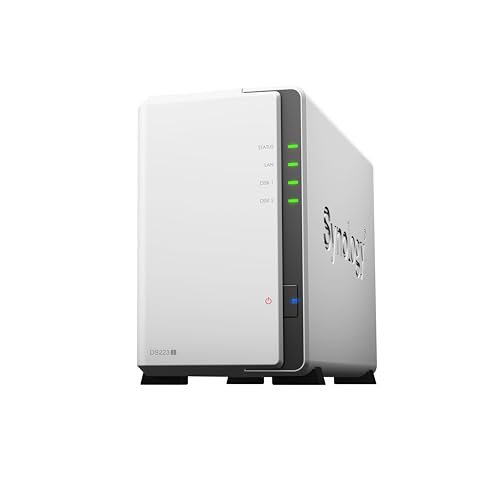
Best Budget-Friendly NAS Enclosure – Synology DS223j
The Synology DS223j is a compact two-bay nas enclosure for users who want private cloud access, file synchronization, and automated backups in a simple tabletop design. It is diskless, allowing you to install storage separately while keeping the system focused on essential home and office features.
Best For: Budget-conscious households and small offices needing private file access, backups, sharing, and home security recording.
Pros:
- Provides private-cloud access with data ownership.
- Supports file sharing and syncing across platforms.
- Automates backups for Macs, PCs, and mobile devices.
- Supports multiple IP cameras with remote viewing.
Cons:
- Diskless design requires separate drives.
- Two bays limit future storage expansion.
- Its feature set is aimed at essential NAS tasks rather than advanced workloads.
The DS223j is a sensible entry point for private storage and backup. Choose it when ease of use and core Synology services matter more than creator-focused performance or extensive hardware expansion.
Best High-Performance NAS – UGREEN DXP4800 GT 4-Bay
For creators, demanding home users, and small teams comparing nas enclosures, the UGREEN DXP4800 GT is a powerful four-bay option. Its Ryzen processor, expandable memory, dual 10GbE ports, SSD support, and broad app ecosystem are designed for fast file transfers, backups, media work, and multi-user workloads.
Best For: Creators, tech enthusiasts, and office teams that need high-speed storage, local media workflows, surveillance recording, or self-hosted applications.
Pros:
- Ryzen Embedded processor, 8GB expandable DDR4 RAM, and support for Docker and virtual machines.
- Dual 10GbE networking, SSD expansion, and 4K HDMI support suit demanding media workflows.
- Four bays and additional SSD capacity provide up to 144TB of total storage, with drives purchased separately.
- Built-in SD backup, surveillance tools, local privacy features, and flexible permissions add versatility.
Cons:
- Its advanced features may be more than beginners need.
- Hard drives and SSDs are not included.
- Full 10GbE and link-aggregation performance requires compatible networking equipment.
The DXP4800 GT is the most capable choice here for users who want a versatile NAS enclosure rather than simple attached storage. It costs more complexity than a basic backup box, but its networking, expansion, and application support give it substantial room to grow.
Best Direct-Attached RAID Enclosure – TERRAMASTER D2-320 2-Bay
If you are comparing nas enclosures but primarily need fast storage connected directly to a computer, the TERRAMASTER D2-320 is worth a look. This diskless DAS enclosure uses USB 3.2 Gen 2 and hardware RAID, making it a straightforward way to combine two SATA drives without the software and network setup of a true NAS.
Best For: Users who want direct-attached RAID storage for Windows, Mac, or Linux rather than network-based file access.
Pros:
- USB 3.2 Gen 2 offers up to 10Gbps connectivity, with claimed speeds up to 521MB/s using HDDs in RAID 0.
- Supports RAID 0, RAID 1, JBOD, and SINGLE modes.
- Accepts two 3.5-inch or 2.5-inch SATA HDDs or SSDs, up to 22TB per drive.
- Tool-free trays, push-lock installation, and temperature-controlled cooling simplify use.
Cons:
- It is a DAS, not a NAS, so it does not provide network-based storage on its own.
- Drives are not included.
- RAID 0 improves speed but does not provide drive redundancy.
The D2-320 is a practical alternative when you want RAID protection or extra capacity at a single workstation. Choose it over a network NAS only if direct USB access meets your needs; otherwise, its lack of built-in networking limits shared-storage functionality.
Best Beginner NAS – UGREEN DH2300 2-Bay
The UGREEN DH2300 is a beginner-friendly choice for shoppers seeking simple nas enclosures for personal files, photos, and phone backups. Its two-bay design, automatic cross-device backup support, AI photo organization, and private local storage make it an approachable alternative to scattered external drives or recurring cloud storage.
Best For: Individuals, families, and content creators who want easy personal backups, photo storage, and private access without advanced server features.
Pros:
- Simple two-bay design supports up to 64TB of storage, with drives purchased separately.
- Automatic backups work across Windows, iOS, Android, and macOS.
- AI tools can organize photos by faces, locations, text, and objects and identify duplicates.
- RAID modes, two-factor authentication, permissions, and encrypted transfers support data protection.
Cons:
- It does not support Docker or virtual machines.
- The 1GbE connection is less suited to demanding high-speed workflows than 10GbE models.
- Wi-Fi is not built in; wireless use requires an external USB adapter, and wired Ethernet is recommended.
The DH2300 focuses on ease of use rather than server-level flexibility. It is a sensible entry point for backups and personal media, while users needing containers, virtual machines, or faster multi-user transfers should consider a more advanced NAS enclosure.
High-Capacity DAS – 8-Bay Aluminum Hard Drive Enclosure
For shoppers comparing nas enclosures, the CENMATE 8-bay unit is better understood as a direct-attached storage (DAS) enclosure rather than a true NAS. It supports up to eight 2.5- or 3.5-inch SATA HDDs or SSDs, connects over USB 3.0, and offers tool-free, hot-swappable drive access.
Best For: Users who need substantial external storage expansion for a computer or want to connect multiple drives without setting up a network-attached storage system.
Pros:
- Accommodates up to eight 2.5- or 3.5-inch SATA drives, with a stated maximum of 160TB total.
- USB 3.0 supports transfer rates up to 5Gbps and includes both USB-A and USB-C cables.
- Aluminum construction, two cooling fans, hot swapping, and tool-free drive installation.
- Daisy chaining can expand storage across up to three devices, according to the manufacturer.
Cons:
- This is a DAS enclosure with no RAID or NAS functionality.
- The fans produce approximately 40–50 decibels, which may be noticeable in quiet spaces.
- The manufacturer recommends testing drives individually when troubleshooting detection problems.
The 8-bay layout makes this CENMATE a practical choice for large local storage libraries, backups, or media collections. However, buyers specifically seeking network access, RAID management, or NAS software should choose a dedicated NAS instead.
Power-User NAS – DXP4800 Pro 4-Bay NAS
Among nas enclosures, the UGREEN DXP4800 Pro is a full-featured network-attached storage system aimed at demanding users. Its Intel Core i3 processor, expandable DDR5 memory, fast networking, virtualization support, and UGOS Pro software make it suitable for more than basic file storage.
Best For: IT professionals, developers, video editors, and power users who need a capable private server for storage, Docker containers, virtual machines, and high-speed file transfers.
Pros:
- Intel Core i3-1315U processor, 8GB DDR5 RAM expandable to 96GB, and Intel UHD Graphics.
- Includes 10GbE and 2.5GbE networking, with claimed transfer speeds up to 1.25GB/s.
- Supports four HDDs, two PCIe 4.0 M.2 SSDs, and up to 144TB of stated capacity.
- Offers RAID 0, 1, 5, and 10, Docker and VM support, local AI photo organization, and granular user permissions.
Cons:
- Its professional hardware and broad feature set may be excessive for simple backup needs.
- Storage drives are not specified as included, so the final system cost will depend on the drives installed.
The DXP4800 Pro stands out when performance, expandability, and server-style features matter more than a basic plug-and-play archive. Its cooling system, tool-free trays, and two-year warranty add practical value for users planning continuous operation.
Compact DAS – 2-Bay Aluminum Hard Drive Enclosure
For buyers browsing nas enclosures on a smaller scale, the CENMATE 2-bay model offers straightforward desktop storage expansion, but it is a DAS enclosure rather than a true NAS. It supports two 2.5- or 3.5-inch SATA drives, connects by USB 3.0, and uses a tool-free, hot-swappable design.
Best For: Individuals and small-office users who want to add or swap two SATA drives from a Windows, Mac, or Linux computer without networking features.
Pros:
- Holds two 2.5- or 3.5-inch SATA HDDs or SSDs, with up to 20TB per drive stated.
- USB 3.0 provides up to 5Gbps transfer speeds and includes USB-A and USB-C connectivity.
- Tool-free trays and hot swapping simplify drive installation and replacement.
- Aluminum construction and a built-in fan help manage heat during operation.
Cons:
- It does not provide RAID or NAS functionality.
- The fan is rated around 40–50 decibels and may be audible in a quiet room.
- Expansion is limited compared with the manufacturer’s larger multi-bay enclosure.
This compact CENMATE enclosure is a sensible way to attach two SATA drives to an existing computer, especially for backups or extra local capacity. Choose a dedicated NAS instead if you need remote network access, RAID management, or built-in server applications.
How We Picked the Best Nas Enclosures
We focused on the features that most affect everyday storage performance and long-term value. The lineup includes compact two-bay models for personal backups, four-bay systems for growing libraries and office teams, and larger multi-drive enclosures for users who need high capacity.
We also considered whether each product is a true network-attached storage platform or a direct-attached USB enclosure. NAS systems typically include an operating system, network access, user management, and backup applications, while USB enclosures are often simpler and more affordable but depend on a connected computer or host device.
Quick Comparison
- Best for a complete home NAS: Synology and UGREEN network storage systems offer software, remote access, and automated backup features.
- Best for simple direct storage: TERRAMASTER, WAVLINK, and CENMATE enclosures connect through USB and are straightforward to deploy.
- Best for expansion: Four-bay and eight-bay designs provide more room for additional drives and larger storage pools.
- Best for beginners: Two-bay systems are easier to configure, maintain, and protect with mirrored storage.
Key Buying Factors for Nas Enclosures
Bay Count and Capacity
Two bays are sufficient for documents, photos, and routine backups, especially when using mirrored RAID for drive redundancy. Choose four or more bays if you manage video projects, large media collections, business files, or expect your storage needs to grow. Check the supported drive types and maximum capacity before buying.
NAS Software Vs. USB Connectivity
A networked NAS can serve multiple users, synchronize files across devices, run backup jobs, and provide remote access. A USB enclosure is generally easier to use and may offer high-speed 10Gbps connectivity, but it usually lacks built-in network services. Match the enclosure type to how you plan to access your data.
RAID, Backups, and Data Protection
RAID can protect against a drive failure, but it is not a complete backup. Keep a separate copy of important files on another device or cloud service. Look for support for RAID levels that match your drive count, along with snapshot, versioning, or scheduled-backup features where available.
Cooling and Drive Compatibility
Fans, temperature monitoring, and ventilation help protect drives during sustained transfers. Confirm compatibility with both 3.5-inch hard drives and 2.5-inch SSDs if you want flexibility. Tool-free or hot-swappable bays can make upgrades and replacements more convenient.
Who Should Buy Which Nas Enclosures?
Choose a two-bay NAS for household backups, personal files, and straightforward remote access. Choose a four-bay NAS for creators, small offices, and users who need more capacity or flexible RAID options. Choose a direct-attached enclosure if you want to reuse existing SATA drives, connect storage directly to a computer, and avoid managing a full NAS operating system. Choose an eight-bay enclosure when maximum local capacity and future expansion matter more than a compact footprint.
Before ordering, confirm the included accessories, drive capacity limits, network or USB speed, operating-system compatibility, and whether the product ships diskless. Budget separately for NAS-rated drives and a backup destination if your data is important.