
The best voice recorder for an interview should capture clear speech, start reliably, and make recordings easy to review or share. The right choice depends on whether you prioritize simple operation, long battery life, large storage, or automatic transcription.
We compared 10 voice recorders for interviews across recording quality, storage, controls, portability, and note-taking features to help you choose a practical match for your workflow.
Best 10 Voice Recorders for Interviews Picks for 2026
Reliable Everyday Pick

- Up to 57 hours of battery life
- Built-in USB for PC transfers
- 4GB internal storage
Best For: Straightforward interview recording and easy file transfer
Wide-Coverage Audio Choice
- 360° built-in microphone
- WAV recording with voice activation
- 8GB storage plus microSD slot
Best For: Hands-free recording and organized interview sessions
Smart Transcription Companion

- Transcribes and summarizes recordings
- 64GB storage with up to four-day battery
- MagSafe-compatible smartphone design
Best For: Turning interviews into searchable notes and action items
High-Capacity Manual Control
EVISTR 64GB Digital Voice Recorder

- 64GB storage for large recording libraries
- Seven-level gain and voice activation
- WAV/MP3 recording with USB-C transfer
Best For: Frequent interviews requiring storage, sensitivity control, and playback options
Best AI Interview Recorder
- Four microphones capture voices up to 16.4 feet away
- AI transcription and tailored summaries in 112 languages
- 64GB storage with up to 30 hours of recording
Best For: Professionals who want interview audio turned into organized notes and follow-ups
Best High-Capacity Interview Recorder

- 128GB storage holds up to 9,296 hours of recordings
- 1536kbps WAV recording with noise-cancelling microphone
- Voice activation, password protection, and playback tools
Best For: Users who want traditional recording with extensive storage
Best AI Transcription Value

- AI transcription in 113 languages with smart summaries
- 3072kbps recording, noise reduction, and voice activation
- 128GB storage, 33-hour battery, and wired OTG transfers
Best For: Users wanting portable recording with app-based transcription
Simple Interview Starter
- Simple one-button recording and playback
- Noise reduction with voice activation
- 30+ hours of recording and USB storage
Best For: Casual interviews, lectures, and straightforward everyday recording
Long-Run Interview Workhorse

- 1536 kbps PCM recording with dual microphones
- Up to 68 hours of continuous recording
- Large storage, USB-C, and one-click recording
Best For: Frequent interviewers, journalists, and extended field sessions
Feature-Rich Budget Pick

- Stereo recording with noise reduction
- Voice activation and adjustable playback speed
- Compact design with A-B repeat and timestamps
Best For: Students and casual interviewers wanting flexible recording controls
Reliable Everyday Pick – Sony ICD-PX370
Sony ICD-PX370 Mono Digital Voice Recorder with Built-In USB Voice Recorder,black
Check Price On AmazonFor shoppers comparing voice recorders for interviews, the Sony ICD-PX370 is a straightforward choice focused on dependable MP3 recording and simple file transfer. Its built-in USB connection makes moving recordings to a computer convenient, while the two AA batteries provide up to 57 hours of recording time.
Best For: Interviewers who want a familiar, easy-to-transfer recorder for extended sessions.
Pros:
- Built-in USB connection for quick PC file transfers
- Up to 57 hours of battery life
- 4GB of internal storage
- Supports MP3 recording and mono or stereo microphone operation
Cons:
- Requires two AA batteries
- Uses a built-in microphone rather than an external microphone setup
- Includes a 2.5mm headphone jack
The ICD-PX370 is a practical option when simple controls, long battery life, and direct computer connectivity matter more than advanced transcription features.
Wide-Coverage Audio Choice – Philips DVT1170 VoiceTracer
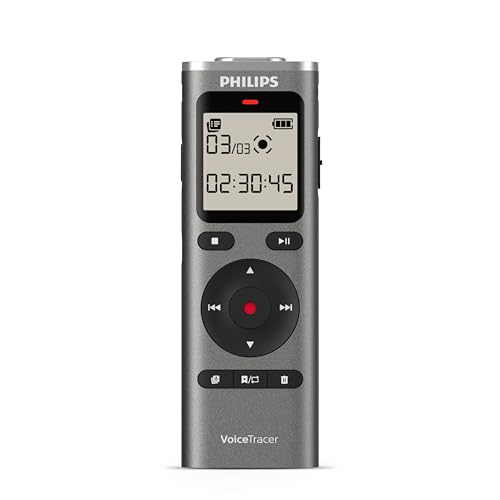
Among voice recorders for interviews, the Philips DVT1170 stands out for its 360° built-in microphone and WAV recording. Voice activation supports hands-free use, while time-stamped files and expandable storage help keep longer interview projects organized.
Best For: Users who want broad microphone coverage, WAV files, and convenient recording organization.
Pros:
- 360° microphone designed for sound capture from multiple directions
- Records in WAV format
- Voice-activated recording for hands-free operation
- 8GB internal memory plus a microSD card slot
Cons:
- Requires two AAA batteries
- Uses mono microphone operation
- Built-in microphone limits microphone-placement options
With time-stamped files, expandable capacity, and a 3.5mm headphone jack, the DVT1170 is well suited to interviews where convenient monitoring and file management are priorities.
Smart Transcription Companion – Pocket AI Voice Recorder
For voice recorders for interviews that go beyond capturing audio, the Pocket AI Voice Recorder adds transcription, summaries, action items, and searchable insights. One-tap recording, smartphone compatibility, and MagSafe mounting make it convenient for meetings and in-person conversations, though some advanced features may require an optional subscription.
Best For: Interviewers who want recordings converted into summaries, action items, and question-based insights.
Pros:
- Automatically transcribes and summarizes recordings
- Ask Pocket can answer questions grounded in recordings
- One-tap recording for meetings, calls, and conversations
- Up to four days of battery life and 64GB of storage
Cons:
- Optional premium features are available through a subscription
- Designed for smartphone connectivity rather than standalone computer transfer
- Uses a built-in microphone
Pocket is the most workflow-focused option here: it can reduce the time spent reviewing interview audio, especially for users who already rely on iOS or Android devices and want AI-assisted notes.
High-Capacity Manual Control – EVISTR 64GB Digital Voice Recorder
For shoppers seeking voice recorders for interviews with generous storage and adjustable capture settings, the EVISTR 64GB recorder offers voice activation, selectable gain, and WAV or MP3 recording. Its 500mAh battery supports up to 32 hours of continuous recording, while USB-C simplifies charging and file transfers.
Best For: Frequent interview, lecture, and meeting recording where storage capacity and playback controls are important.
Pros:
- 64GB capacity for extended recording storage
- Adjustable seven-level recording gain and voice activation
- 1536kbps stereo recording option with WAV and MP3 formats
- USB-C transfer, A-B repeat, rewind, and variable-speed playback
Cons:
- Continuous recording runtime is listed as up to 32 hours
- Voice activation may omit silent sections, which can affect pauses in interviews
- More settings may require more setup than a basic recorder
The EVISTR offers strong control for users who want to tune sensitivity, reduce silent playback, and store a large interview archive without frequently clearing files.
Best AI Interview Recorder – Plaud Note Pro
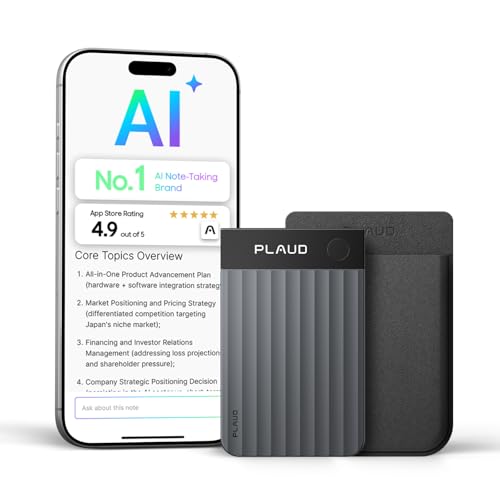
For shoppers seeking voice recorders for interviews that reduce manual note-taking, the Plaud Note Pro combines four microphones, AI transcription, and tailored summaries in an exceptionally thin design. It records in-person conversations and phone calls, while Plaud Desktop supports online meetings.
Best For: Professionals who want interview recordings converted into organized notes, decisions, and follow-up tasks.
Pros:
- Four microphones capture voices from up to 16.4 feet away.
- AI transcription supports 112 languages and creates summaries with key details and next steps.
- 64GB of storage and up to 30 hours of recording in Enhance mode.
- Includes a magnetic case, ring, charging cable, and 300 transcription minutes per month on the Starter Plan.
Cons:
- Many AI and transcription features depend on Plaud plans and its app.
- It has no headphone jack.
- The built-in microphone operates in mono or stereo rather than offering an external microphone input.
The Note Pro is a strong premium choice when the goal is to turn interviews into usable written work, not simply save audio. Its workflow tools and integrations add value for professionals, though ongoing transcription needs may make a paid plan necessary.
Best High-Capacity Interview Recorder – EVIDA 128GB Digital Recorder
The EVIDA 128GB recorder is a practical option among voice recorders for interviews when long storage capacity, playback, and straightforward file management matter most. Its noise-cancelling microphone records up to 1536kbps, and voice activation can reduce silent sections.
Best For: Students, writers, business users, and interviewers who prefer a traditional recorder with extensive storage and simple computer transfers.
Pros:
- 128GB capacity stores up to 9,296 hours of recordings at supported settings.
- Records in MP3 or WAV, including a 1536kbps WAV option.
- Voice activation offers six sensitivity levels and can reduce blank or whispering sections.
- Password protection, bookmarks, A-B repeat, and four storage folders support organized playback.
Cons:
- It does not offer AI transcription or summaries.
- The built-in microphone is mono with noise cancellation.
- It has no headphone jack.
This EVIDA model focuses on dependable recording rather than automated note-taking. Choose it if you want large capacity, long battery life, and familiar controls for capturing interviews and moving files to a computer.
Best AI Transcription Value – EVISTR L359 AI Voice Recorder
The EVISTR L359 brings recording and AI processing together for shoppers comparing voice recorders for interviews. It captures up to 3072kbps audio, supports voice activation, and works with the AI DVR Link app for transcription, summaries, speaker identification, mind maps, and Ask AI insights.
Best For: Interviewers, students, and professionals who want portable recording plus app-based transcription and summaries.
Pros:
- Transcribes in 113 languages and can create smart summaries and speaker identification.
- Records up to 3072kbps with noise reduction and voice-activated recording.
- 128GB storage holds up to 9,216 hours at 32kbps, with up to 33 hours of continuous battery life.
- One-touch recording, password encryption, a HOLD switch, and wired OTG transfers support convenient and secure use.
Cons:
- AI transcription and insights require the AI DVR Link app.
- It uses a wired OTG connection rather than Bluetooth for phone transfers.
- Its built-in microphone is mono.
The L359 is a versatile middle ground: it offers more automated processing than a basic dictaphone while retaining one-button recording and generous storage. Its wired transfer workflow may be less convenient than wireless alternatives, but it provides a direct route from interview audio to AI-generated notes.
Simple Interview Starter – Compact 16GB Voice Recorder
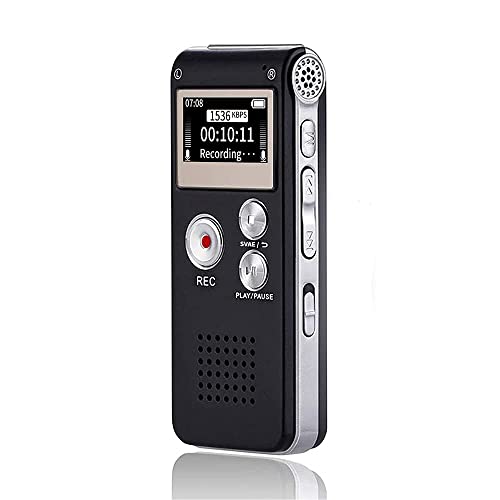
For shoppers seeking voice recorders for interviews, this compact Sunlan model offers straightforward controls, noise-reduction processing, and a built-in microphone designed to capture spoken audio. Its one-button recording approach makes it practical when you need to start quickly.
Best For: Casual interviews, lectures, meetings, and users who prioritize simple operation in a small recorder.
Pros:
- One-button recording with simple playback and A-B repeat.
- Noise-reduction technology and a sensitive built-in microphone support clearer voice capture.
- 16GB storage and more than 30 hours of continuous recording are suitable for extended use.
- Functions as a USB data-storage device and MP3 player.
Cons:
- Mono microphone operation may be less suitable for capturing wide room ambience.
- Playback battery life is listed at 7 hours, shorter than its recording runtime.
This is a sensible choice for interviewers who want an uncomplicated recorder with useful repeat and voice-activated features. Its small size and lightweight 35-gram design also make it easy to carry between appointments.
Long-Run Interview Workhorse – 136GB PCM Voice Recorder
Among voice recorders for interviews, this Tonfarb model stands out for its substantial storage, long stated battery life, and one-click recording control. Dual microphones, PCM recording, and automatic noise reduction are aimed at preserving clearer speech across extended sessions.
Best For: Journalists, researchers, and interviewers who record frequently or need long runtimes and substantial file capacity.
Pros:
- Supports 1536 kbps PCM recording with dual noise-reduction microphones.
- Up to 68 hours of continuous recording on a charge.
- 8GB built-in storage plus a complimentary 128GB TF card, with stated capacity for up to 9,775 hours in MP3 format.
- One-click recording, USB-C transfer, A-B repeat, and password protection add practical convenience.
Cons:
- At about 100 grams, it is heavier than the smallest pocket recorders.
- The very large storage setup may be more than occasional interviewers need.
This is the strongest option here for back-to-back interviews and extended fieldwork. Its large screen, durable metal casing, and quick recording switch make it particularly practical when recording opportunities arise unexpectedly.
Feature-Rich Budget Pick – 8GB Stereo Voice Recorder
This HoTiyan recorder is a practical option for voice recorders for interviews when you want stereo capture, voice activation, and playback controls without a large storage requirement. Its three-button layout is designed for quick recording, saving, and playback.
Best For: Students, casual interviewers, and meeting users who need adjustable recording quality and convenient file organization.
Pros:
- Higher-sensitivity microphone, noise reduction, and a professional recording chip support high-definition stereo recording.
- Voice control can pause recording during quieter moments and reduce empty clips.
- Supports MP3 and WAV files, A-B repeat, variable playback speed, timestamps, and password protection.
- Offers up to 20 hours of continuous recording and USB file transfer.
Cons:
- 8GB storage is considerably less than the capacity of the larger recorder in this roundup.
- Its listed recording runtime is shorter than the 68-hour model.
- The supplied connection is Micro USB rather than USB-C.
This model balances useful interview features with a compact 1.6-ounce design. It is especially appealing if stereo recording, voice activation, and playback customization matter more to you than maximum battery life or storage.
How We Picked the Best Voice Recorders for Interviews
We focused on features that matter during real interviews rather than headline specifications alone. Our comparison considers microphone design, recording formats, storage capacity, battery and charging convenience, playback controls, voice activation, and file-transfer options. We also separated traditional digital recorders from AI-enabled note takers, since transcription and summaries can be useful but may involve app, subscription, privacy, or processing requirements.
Storage claims should be treated as estimates: recording time varies with audio quality, file format, and whether the device stores other files. Likewise, microphone performance depends on distance, room acoustics, background noise, and placement.
Quick Comparison
- Best for straightforward recording: Sony ICD-PX370 and Philips VoiceTracer models offer familiar controls and simple file handling.
- Best for automated notes: Pocket AI, Plaud Note Pro, and EVISTR AI models are designed for transcription or summaries.
- Best for high storage capacity: The 128GB and 136GB recorders suit users who keep many recordings on the device.
- Best for budget flexibility: Basic 8GB, 16GB, and 64GB models can cover lectures, meetings, and occasional interviews without advanced software.
Key Buying Factors for Voice Recorders for Interviews
Microphone and Recording Quality
Look for a sensitive built-in microphone, noise-control features, and recording modes suited to speech. A 360-degree or dual-microphone design may help capture several speakers, but placement still matters. For one-on-one interviews, keep the recorder close enough to both participants without blocking gestures or creating handling noise.
Transcription and Privacy
AI transcription can reduce the time spent creating notes, especially after long interviews. Check whether processing happens through a phone app or cloud service, whether a subscription is required, which languages are supported, and how recordings are handled. For confidential conversations, a conventional recorder with local file storage may be preferable.
Storage, Battery, and File Transfer
Choose enough capacity for your normal recording schedule, but do not assume the largest advertised number is necessary. USB connectivity makes moving files to a computer easier, while a microSD slot provides expansion on compatible models. Confirm charging time and battery expectations if you record away from outlets.
Controls and Playback
Physical buttons, a visible display, pause and resume controls, and headphone playback can be more dependable than app-only operation. Voice activation may conserve storage, though it can miss quiet openings or pauses, so test it before relying on it for important interviews.
Who Should Buy Which Voice Recorders for Interviews?
Choose a simple Sony or Philips recorder if you want dependable recording, direct file access, and minimal setup. Pick a compact AI recorder if your priority is turning conversations into searchable transcripts or summaries and you are comfortable with companion software. Select a high-capacity EVISTR, EVIDA, or similar model if you archive frequent recordings or need lengthy standby storage. For occasional interviews, lectures, or meetings, an 8GB to 64GB recorder is usually sufficient and may offer better value than paying for unused capacity.