
A well-chosen patch bay can make vocal recording faster, cleaner, and easier to troubleshoot. Instead of reaching behind a rack or audio interface, you can route microphones, preamps, compressors, and monitor chains from one accessible panel.
This roundup compares 10 practical options for home studios, project rooms, and professional vocal-tracking setups, with attention to connector type, balanced signal handling, normalization, rack compatibility, and everyday workflow.
Best 10 Patch Bays for Recording Vocals Picks for 2026
Flexible Routing Pick

- 48-point fully balanced 1/4-inch TRS design
- Normalled, half-normalled, and thru modes
- Front switches and 1U rack mounting
Best For: Studios needing flexible balanced routing
XLR Studio Routing Pick

- 16-point XLR patchbay
- 32 gold-plated XLR connectors
- Designed for recording and live sound
Best For: Studios centered on XLR connections
Maximum Flexibility Pick
Behringer ULTRAPATCH PRO PX3000

- 48-point balanced patchbay
- Four selectable routing functions
- Rugged construction for studio use
Best For: Expandable studios with varied routing needs
Simple XLR Feed-Through Pick

- Eight color-coded XLR ports
- Feed-through design for quick signal tracing
- 1U rack-mount format with hardware
Best For: Small setups needing simple XLR patching
Front-Access XLR Choice

- 12 XLR patch points
- Reversible XLR3F-to-XLR3M connections
- Rack-mount steel chassis
Best For: XLR-based vocal recording setups
High-Capacity Routing Pick

- 48 front and 48 rear 1/4-inch jacks
- Compact 1U rack-mount design
- Rugged steel construction
Best For: Larger studios using 1/4-inch routing
Flexible TRS Routing Option

- 48 patch points with 96 gold-plated TRS connectors
- Three-way mode switch
- Supports up to 192 kHz
Best For: Expandable studios using TRS-based vocal routing
Studio Rack Organizer
Art Pro Audio P48-48 Balanced Patch Bay

- 48-point balanced XLR patch bay
- Fully shielded steel rack design
- Helps organize cables and protect connectors
Best For: Large XLR-based studio and live-sound setups
Flexible XLR Routing
16-Port Reversible XLR Patchbay

- 16 reversible male/female XLR ports
- Rugged steel rack-mount chassis
- Balanced 3-pin wiring for clean routing
Best For: Compact vocal studios and adaptable live rigs
TRS Signal Control
Art Pro Audio TPatch Eight-Point Bay
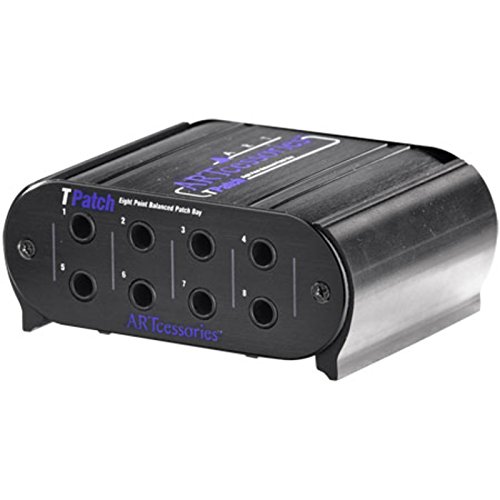
- Eight balanced 1/4-inch TRS points
- Selectable normal and half-normal modes
- Rugged extruded aluminum case
Best For: Compact TRS-based vocal recording chains
Flexible Routing Pick – Samson S-Patch Plus
Samson S-Patch Plus Balanced 48-Point 1/4" Patch Bay | 1/4 Inch Phone Connections
Check Price On AmazonThe Samson S-Patch Plus is a practical choice for patch bays for recording vocals when you need balanced connections and flexible routing in a rack-mounted studio setup. Its 48 front and 48 rear 1/4-inch TRS connections create a central patching point, while front-panel switches let you select the operating mode for each channel.
Best For: Home and project studios that need a versatile, fully balanced 1U patch bay for microphones, mixers, and rack equipment.
Pros:
- 48-point, fully balanced design with 1/4-inch connections.
- Supports normalled, half-normalled, and thru operation.
- Front-panel switching reduces the need to reach behind studio equipment.
- Rack-mountable metal construction with a stated two-year warranty.
Cons:
- Uses 1/4-inch connections rather than XLR connections.
- Its extensive routing options may be more than a very small setup requires.
Choose the S-Patch Plus if flexible signal routing and a clean, centralized connection layout matter more than having XLR patch points on the front panel.
XLR Studio Routing Pick – Black Lion Audio PBR XLR
The Black Lion Audio PBR XLR is a compact option for patch bays for recording vocals when your studio is built around XLR connections. It provides 16 patch points through 32 gold-plated XLR connectors, making it suited to straightforward signal routing in recording or live-sound environments.
Best For: Recording and live-sound studios that prefer direct XLR patching for compatible equipment.
Pros:
- Provides 16 XLR patch points through 32 connectors.
- Uses gold-plated XLR connectors.
- Designed for audio signal routing in recording or live-sound studios.
- Includes a stated two-year warranty.
Cons:
- Offers fewer patch points than the 48-point alternatives in this roundup.
- Does not list selectable normalled or half-normalled operating modes.
- XLR-only connectivity may be less convenient for 1/4-inch TRS equipment.
The PBR XLR makes the most sense when XLR compatibility is the priority and 16 patch points are sufficient for your vocal recording or live-sound workflow.
Maximum Flexibility Pick – Behringer ULTRAPATCH PRO PX3000
Behringer ULTRAPATCH PRO PX3000 Multi-Functional 48-Point 3-Mode Balanced Patchbay
Check Price On AmazonThe Behringer ULTRAPATCH PRO PX3000 is a strong option for patch bays for recording vocals when one rack unit needs to handle varied studio connections. Its 48-point balanced design supports multiple routing configurations, helping organize signal paths and reduce cable clutter around a vocal recording setup.
Best For: Studios that need a high-capacity 1/4-inch TRS patch bay with multiple selectable routing modes.
Pros:
- Offers 48 points with high-quality jack connectors.
- Channels can be configured for parallel, half-normalled, normalled, or open operation.
- Rugged construction is intended for long service life.
- Supports TRS, TS, XLR, and MIDI connectivity according to the supplied details.
Cons:
- The broad feature set may be unnecessary for a simple vocal-only rack.
- The supplied information does not specify a warranty duration.
- Its listed weight is 3.9 pounds, making it less lightweight than the compact XLR option.
Pick the PX3000 if you want extensive routing control and enough capacity to expand beyond a basic microphone-and-interface chain.
Simple XLR Feed-Through Pick – AMIMA 8-Channel XLR Patch Bay
The AMIMA 8-Channel XLR Patch Bay is a straightforward choice for patch bays for recording vocals when you want easy-to-follow XLR feed-through connections. Eight color-coded female-to-female XLR ports help identify signal paths quickly, and the 1U rack-mount format keeps the connections organized.
Best For: Small studios and live-sound systems that need simple, color-coded XLR patching.
Pros:
- Provides eight distinct color-coded XLR ports.
- Feed-through design simplifies signal tracing and setup.
- Uses gold-plated contacts according to the product description.
- Includes mounting screws and a user manual.
Cons:
- Has eight channels, fewer than the 16- and 48-point alternatives.
- Does not list selectable normalled or half-normalled routing modes.
- Designed for simple XLR feed-through use rather than broader mixed-connector routing.
The AMIMA is a sensible fit when color coding and uncomplicated XLR connectivity are more important than advanced routing modes or a high channel count.
Front-Access XLR Choice – 12-Point XLR Patchbay
For recording vocals, the Hosa PDR-369 is a practical way to bring hard-to-reach XLR mixer inputs to the front of a rack. Its 12 XLR channels and reversible XLR3F-to-XLR3M connections suit studios that primarily work with microphones, preamps, and audio mixers.
Best For: Vocal recording setups built around XLR microphones and rack-mounted gear.
Pros:
- Provides 12 XLR patch points.
- Reversible XLR3F-to-XLR3M configuration adds installation flexibility.
- One-unit rack chassis with steel construction.
- Compatible with mixers, audio interfaces, and microphone preamps.
Cons:
- Offers XLR connectivity rather than 1/4-inch TRS patching.
- Its 12-channel capacity may be limiting for larger studios.
The PDR-369 is a focused option when your vocal chain uses XLR connections throughout. It is less suited to studios that need a high-density, mixed-connector patching system.
High-Capacity Routing Pick – 48-Point 1U Patch Bay
The dbx PB-48 gives vocal studios a dense 1U solution for routing audio gear with 1/4-inch connections. With 48 front-panel jacks and 48 rear-panel jacks, it provides quick access while helping reduce wear on the jacks of connected equipment.
Best For: Larger rack-based studios that need extensive 1/4-inch rerouting for vocal and other audio equipment.
Pros:
- Offers 48 front-panel and 48 rear-panel 1/4-inch jacks.
- Supports quick access and precise rerouting.
- 1U rack-mountable format saves rack space.
- Rugged steel construction.
Cons:
- Uses 1/4-inch connections rather than dedicated XLR patching.
- The 48-point layout may be more capacity than a small vocal-only setup requires.
For studios with several processors, interfaces, or mixer connections, the PB-48 offers useful routing density in a compact rack format. Confirm that your vocal chain uses compatible 1/4-inch connections before choosing it.
Flexible TRS Routing Option – 48-Point TRS Patchbay
The Black Lion Audio PBR TRS3 is a versatile choice for patch bays for recording vocals when your setup relies on TRS connections. It provides 48 patch points through 96 gold-plated TRS connectors and includes a three-way mode switch for adapting the routing approach to your studio.
Best For: Vocal studios seeking high-density TRS patching with flexible routing modes.
Pros:
- Provides 48 patch points and 96 gold-plated TRS connectors.
- Three-way mode switch supports flexible configuration.
- Compatible with microphones, guitars, speakers, computers, and XLR-equipped devices.
- Supports a maximum sample rate of 192 kHz.
Cons:
- Designed around TRS connectivity, so it may not directly replace an all-XLR patchbay.
- Its feature set may be unnecessary for a simple single-microphone vocal chain.
The PBR TRS3 stands out when a vocal setup includes multiple line-level connections and needs configurable routing. Its 48-point capacity makes it better suited to expanding studios than minimal recording rigs.
Studio Rack Organizer – Art Pro Audio P48-48 Balanced Patch Bay
For patch bays for recording vocals, the Art Pro Audio P48 provides a rack-mounted XLR solution for organizing microphone and other balanced audio connections. Its fully shielded steel design suits both home and professional studio setups.
Best For: Recording studios that need centralized XLR routing and cleaner cable organization.
Pros:
- Provides 48 points of balanced XLR connectivity.
- Fully shielded construction helps organize connections in a rack.
- Helps reduce wear and tear on audio equipment connectors.
- Suitable for studio, PA, AV, home theater, and live-sound applications.
Cons:
- Uses XLR connectors rather than 1/4-inch TRS connections.
- The supplied notes do not specify the individual point wiring modes.
The P48 is a practical choice when your vocal setup relies on numerous XLR connections and you want a permanently organized rack installation.
Flexible XLR Routing – 16-Port Reversible XLR Patchbay
For patch bays for recording vocals, this 16-port XLR patchbay offers a compact way to route microphones, preamps, mixers, and other balanced gear. Reversible male/female connectors make it easier to adapt the panel to different studio layouts.
Best For: Vocal studios and mobile rigs that need flexible 3-pin XLR routing in a standard rack.
Pros:
- Includes 16 reversible male/female XLR ports.
- Balanced 3-pin wiring is suited to long runs and high-gain sources.
- Heavy-duty steel chassis with a black powder coat.
- Mounting screws are included for standard 19-inch rack installation.
Cons:
- Offers fewer ports than a 48-point patchbay.
- Designed around XLR connections, with no 1/4-inch TRS ports listed.
Its reversible connectors are the main advantage for changing vocal signal paths without replacing or rewiring the panel, while the 16-port layout keeps the installation relatively compact.
TRS Signal Control – Art Pro Audio TPatch Eight-Point Bay
For patch bays for recording vocals, the Art Pro Audio TPatch is a compact 1/4-inch TRS option for balanced line-level routing around a vocal recording chain. Its selectable normal and half-normal modes provide useful control over how signals pass between connected equipment.
Best For: Vocal setups using balanced 1/4-inch TRS connections and configurable insert-style routing.
Pros:
- Provides eight points of balanced direct signal connectivity.
- Includes four linked input/output pairs.
- Supports switchable half-normal, normal, and through-type connections.
- Uses a rugged extruded aluminum case.
Cons:
- Offers eight points, making it less suitable for larger installations.
- Uses 1/4-inch TRS connectors rather than XLR.
The TPatch is a strong fit when your vocal rack is built around balanced TRS hardware and you want selectable routing modes without moving cables behind the equipment.
How We Picked the Best Patch Bays for Recording Vocals
We focused on patch bays suited to microphone and line-level routing in vocal studios. The selection includes balanced TRS models, XLR feed-through panels, combination systems, and both compact and 48-point designs. We considered connector format, channel count, rack-mount construction, routing flexibility, signal integrity, labeling, and how easily each unit can fit into a typical recording chain.
Because vocal setups vary widely, there is no single best layout for everyone. A simple XLR panel may be ideal for connecting microphones to preamps, while a normalized TRS patch bay can provide more convenient access to compressors, EQs, converters, and interface inputs.
Quick Comparison
- Best for flexible studio routing: Choose a 48-point balanced patch bay with switchable or configurable normalization.
- Best for microphone connections: Look for an XLR feed-through design with clearly labeled front and rear connectors.
- Best for smaller setups: An eight- or 12-point unit can keep a compact vocal rig accessible without consuming unnecessary rack space.
- Best for mixed equipment: Select a model that matches the connector types used by your preamps, processors, interface, and outboard gear.
Key Buying Factors for Patch Bays for Recording Vocals
Connector Type and Signal Path
TRS patch bays are commonly used for balanced line-level connections between studio devices. XLR patch bays are more convenient when your workflow centers on microphones, preamp inputs, or rack-mounted audio equipment with XLR connectors. Avoid assuming that every patch bay is interchangeable: connector adapters can add clutter and may complicate troubleshooting.
Normalization and Routing Modes
Normalled connections pass a rear-panel signal to the destination automatically until a front-panel patch cable interrupts it. Half-normalled and non-normalled configurations provide different routing behaviors. For vocal recording, configurable normalization is useful when you want a default microphone-to-preamp or preamp-to-interface path that can be overridden quickly.
Channel Count and Rack Space
Estimate how many permanent connections you need now, then leave room for likely expansion. A 48-point unit offers considerable flexibility but may be excessive for a two-microphone home setup. Compact panels can be easier to organize, while larger units reduce the need to replace your patching system as the studio grows.
Build Quality and Labeling
Choose sturdy rack hardware, secure jacks, clear labeling space, and contacts designed for repeated connections. Gold-plated contacts can help resist corrosion, but careful cable management and regular inspection matter just as much. Keep microphone, line-level, and insert connections clearly identified to prevent routing mistakes.
Who Should Buy Which Patch Bays for Recording Vocals?
Home vocalists and podcasters should favor a compact XLR or balanced patch bay that simplifies access to one or two microphones and a preamp. Project studios will benefit from a 12- or 48-point balanced model with normalization and enough capacity for compressors, EQs, and multiple interface outputs. Commercial rooms and expanding engineers should prioritize a robust 48-point system with flexible routing, reliable connectors, and sufficient labeling space. Before ordering, verify every device’s connector format, balanced or unbalanced operation, rack dimensions, and intended signal level.