
The right patch bay can make a studio, live rig, or equipment rack easier to connect, troubleshoot, and expand. Models vary widely in connector type, channel count, wiring format, and whether they offer true front-panel switching.
We compare 10 options across audio and structured cabling use cases, focusing on practical installation details, routing flexibility, rack compatibility, and long-term value.
Best 10 Patch Bay with Front Panel Switches Picks for 2026
Best Switchable Routing

- 48 balanced 1/4-inch patch points
- Front switches for three routing modes
- 1U metal rack-mount design
Best For: Studios needing flexible front-panel signal routing
Best XLR Simplicity

- 16 balanced XLR channels
- Shielded all-steel 1U enclosure
- Reversible rack ears
Best For: Rack systems built around balanced XLR connections
Best High-Capacity Basic Bay

- 48 front and 48 rear 1/4-inch jacks
- Rugged metal construction
- Standard 1U rack-mount format
Best For: Studios needing dense, straightforward 1/4-inch access
Best Modular XLR Layout

- Four independent four-channel modules
- 24K gold-plated XLR pins
- Reversible ears and steel chassis
Best For: Modular XLR rack installations and easier maintenance
Structured Network Choice
Monoprice 48-Port CAT6 Patch Panel

- 48 CAT6 ports in a 2U rack panel
- 568A/B compatible punch-down terminals
- Numbered ports and rear wiring guide
Best For: High-density rack-mounted Ethernet installations
Studio Routing Workhorse
ART P48 48-Point Balanced Patch Bay

- 48-point balanced XLR patchbay
- Fully shielded 19-inch rack design
- Suitable for studio, PA, AV, and live sound
Best For: High-capacity balanced XLR audio routing
Flexible XLR Routing
16-Port Reversible XLR Patchbay

- 16 reversible male/female XLR ports
- Rugged steel rack-mount chassis
- Balanced three-pin wiring for audio routing
Best For: Configurable XLR I/O in compact professional racks
Flexible Network Foundation
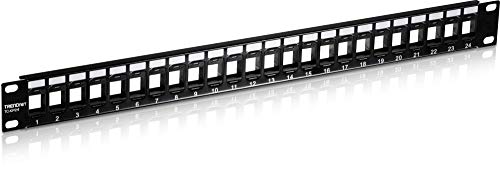
- Accepts 24 standard keystone jacks
- Pre-numbered ports aid cable identification
- Sturdy 1U SPCC steel rack design
Best For: Customizable Ethernet, audio, video, and data rack installations
Color-Coded Audio Routing

- Eight color-coded female-to-female XLR ports
- 1U rack-mount format for standard racks
- Designed for studio and live-sound patching
Best For: Organizing XLR audio connections with easy visual tracing
Pass-Through Ethernet Organization

- 24 installed RJ45 couplers plus one spare
- Supports up to 10Gbps with suitable Cat6 setups
- Removable rear cable-management bar
Best For: Organizing pre-terminated Ethernet cables in 19-inch racks
Best Switchable Routing – Samson S-Patch Plus
Samson S-Patch Plus Balanced 48-Point 1/4" Patch Bay | 1/4 Inch Phone Connections
Check Price On AmazonIf you need a patch bay with front panel switches, the Samson S-Patch Plus is a flexible choice for studio racks. Its 48 balanced 1/4-inch points support Normal, Half-normal, and Thru operation, so you can change routing without reaching behind your equipment.
Best For: Home and project studios that need versatile, switchable 1/4-inch routing in a 1U rack space.
Pros:
- Front-panel miniature toggle switches select Normal, Half-normal, or Thru modes.
- Provides 48 balanced front connections and 48 rear connections.
- Rack-mountable 1U design with a solid metal construction.
- Helps reduce the need to access the back of mixers and rack gear.
Cons:
- Uses 1/4-inch phone connections rather than XLR.
- The many routing points may be more than a small setup requires.
The S-Patch Plus is the strongest match here for buyers specifically seeking switchable front-panel routing. Its three operating modes offer useful flexibility for changing studio signal paths.
Best XLR Simplicity – ART P16 XLR Balanced Patchbay
The ART P16 is a straightforward XLR patchbay for balanced connections. It places 16 female XLR connectors on the front and 16 male XLR connectors on the rear in a shielded 1U steel enclosure, making it suitable for organized rack-based signal access.
Best For: Audio systems that use balanced XLR connections and need a compact, rack-mounted patching point.
Pros:
- Provides 16 XLR channels through front and rear connections.
- Uses PCB wiring for the connections.
- Rugged, fully shielded black all-steel enclosure.
- Reversible rack ears allow flexible installation.
Cons:
- It does not include front-panel switching features in the supplied specifications.
- Offers fewer channels than 48-point 1/4-inch alternatives.
- XLR connectivity may not suit systems built around 1/4-inch cables.
The P16 favors uncomplicated XLR access over configurable front-panel switching. Choose it when connector format, shielding, and rack durability matter more than selectable routing modes.
Best High-Capacity Basic Bay – dbx PB-48
The dbx PB-48 provides a high-capacity patching point with 48 quarter-inch jacks on both the front and rear. While it is not specified as a patch bay with front panel switches, its direct access design can simplify rerouting and reduce wear on the jacks of connected equipment.
Best For: Studio users who want many 1/4-inch patch points in a rugged 1U rack-mount enclosure.
Pros:
- Offers 48 front-panel and 48 rear-panel 1/4-inch jacks.
- Provides quick access for rerouting mixer and other audio connections.
- Rugged metal construction.
- Fits a standard 1U rack space.
Cons:
- Front-panel switches are not listed in the supplied specifications.
- Does not provide the documented Normal, Half-normal, and Thru selection of the Samson model.
- Its 48-point capacity may be excessive for smaller systems.
The PB-48 is a practical choice when connection density is the priority. It delivers broad 1/4-inch access, but buyers specifically requiring switchable front-panel modes should look for a model with those controls documented.
Best Modular XLR Layout – AP16 XLR Balanced Patchbay
The AP16 is a 16-channel XLR patchbay built around four independent four-channel modular blocks. It is not specified as a patch bay with front panel switches, but its removable modules and reversible rack ears make it useful for organized installations where maintenance and zone management are important.
Best For: Studio or live racks that need modular XLR organization and easier channel-by-channel maintenance.
Pros:
- Four factory-assembled modular blocks support 4, 8, 12, or 16-channel configurations.
- Individual modules can be removed or replaced without reworking the entire PCB.
- 24K gold-plated XLR pins are designed for corrosion resistance and low signal loss.
- Full-steel chassis and reversible rack ears support flexible installation.
Cons:
- Front-panel switches are not listed in the supplied specifications.
- Uses XLR connectivity rather than 1/4-inch patch cables.
- Its modular configuration may be unnecessary for a simple fixed installation.
The AP16 stands out for modular servicing and flexible rack integration rather than selectable front-panel routing. It is a good fit when clean XLR organization and replaceable channel blocks are more valuable than switching controls.
Structured Network Choice – Monoprice 48-Port CAT6 Patch Panel
If you need a patch bay with front panel switches for organized Ethernet connections, this Monoprice panel provides 48 numbered CAT6 ports in a standard 19-inch rack format. Its punch-down design and 568A/B compatibility make it suited to structured network wiring rather than audio signal routing.
Best For: Rack-mounted Ethernet installations requiring high port density and clear labeling.
Pros:
- Provides 48 CAT6 ports in a 2U, 19-inch rack panel.
- Supports both 568A and 568B wiring standards.
- Includes numbered ports, white labeling blanks, and a color-coded rear wiring diagram.
- Uses a black painted steel construction and is UL listed.
Cons:
- Uses punch-down terminals rather than front-panel switching.
- Designed for Ethernet cabling, not balanced audio patching.
This is a practical choice when the priority is dense, clearly identified network termination in a rack. Buyers specifically seeking front-panel switches or audio connectivity should consider a dedicated audio patchbay instead.
Studio Routing Workhorse – ART P48 48-Point Balanced Patch Bay
For shoppers comparing a patch bay with front panel switches for studio or live audio routing, the ART P48 offers 48 balanced points in a fully shielded 19-inch rack unit. Its XLR connectivity is intended to centralize audio connections and reduce wear on equipment sockets.
Best For: Professional and home recording studios, installed PA or AV systems, home theaters, and live sound setups using balanced XLR connections.
Pros:
- Offers 48 balanced patch points in a rack-mount format.
- Fully shielded construction helps organize cabling.
- Works with a broad range of audio equipment, including mixers, amplifiers, microphones, instruments, and speakers.
- Can help reduce wear and tear on audio equipment connectors.
Cons:
- Uses XLR connectors rather than switch-based front-panel controls.
- The supplied notes do not specify individual switching or normalization options.
The P48 is a strong fit when you need many balanced XLR connections in a rack and want a cleaner, more serviceable audio setup. Confirm the connector arrangement and routing requirements before buying if switchable front-panel operation is essential.
Flexible XLR Routing – 16-Port Reversible XLR Patchbay
This 16-port unit is worth considering if you want a patch bay with front panel switches for a compact rack setup, while prioritizing flexible XLR connections. Its reversible male/female ports support different panel configurations without rewiring, and its balanced three-pin wiring is designed to help maintain a clean signal path.
Best For: Studios, live sound rigs, theaters, houses of worship, and broadcast carts needing configurable XLR I/O.
Pros:
- Provides 16 XLR ports with reversible male/female connectors.
- Supports panel changes and customized I/O configurations without rewiring.
- Uses a heavy-duty steel chassis with a black powder coat.
- Includes mounting screws for standard 19-inch rack installation.
Cons:
- Offers fewer ports than a 48-point patchbay.
- The supplied notes do not confirm front-panel switches or specific normalization modes.
- Audio-focused XLR connectivity is not intended for Ethernet patching.
The reversible connectors make this a practical option for installations where I/O direction may change over time. It is especially appealing for users who value rugged construction and configurable balanced audio routing in a smaller rack footprint.
Flexible Network Foundation – 24-Port Blank Keystone Panel
The TRENDnet TC-KP24 is a practical choice when you need a patch bay with front panel switches—or, more accurately, a customizable front panel—for organizing Ethernet, audio, video, or data connections. Its blank 1U layout accepts standard keystone jacks, letting you build the port configuration your rack requires.
Best For: Network installations that need flexible, labeled keystone ports in a standard 19-inch rack.
Pros:
- Holds 24 standard-sized keystone jacks for customizable installations.
- Pre-numbered ports and supplementary labels simplify cable identification.
- Sturdy SPCC steel 1U rack-mount construction.
- Supports gigabit and 10G copper Ethernet applications with compatible jacks and cabling.
Cons:
- Keystone jacks are sold separately.
- It does not provide built-in front-panel switches.
The TC-KP24 is best viewed as a configurable rack panel rather than a complete patch bay with front panel switches. It is a solid option when installation flexibility and cable labeling matter more than an included set of ports.
Color-Coded Audio Routing – 8-Channel XLR Patch Bay
The AMIMA 8-Channel XLR Patch Bay is designed for straightforward audio routing rather than a patch bay with front panel switches. Its feed-through female-to-female XLR connections and eight distinct port colors make signal tracing easier in studio and live-sound setups.
Best For: Studio, stage, and other indoor audio systems that use XLR connections and need quick visual port identification.
Pros:
- Eight color-coded XLR ports help reduce setup and tracing errors.
- Feed-through design provides direct female-to-female XLR connections.
- 1U, 19-inch rack-mount format fits standard rack installations.
- Gold-plated contacts are specified for the audio connections.
Cons:
- It has no front-panel switches or selectable routing controls.
- It is intended for indoor audio use rather than Ethernet networking.
Choose this model when you want clean, color-coded XLR pass-through connections in a rack. If switchable signal paths are essential, its fixed feed-through design will not replace a switched patch bay.
Pass-Through Ethernet Organization – 24-Port 10Gbps Ethernet Panel
The Jadaol 24-Port panel is a pass-through Ethernet organizer for buyers comparing a patch bay with front panel switches. Instead of switching network paths, it uses pre-installed RJ45 couplers so pre-terminated cables can connect from the front and rear without punch-down tools.
Best For: Wiring closets, server rooms, and rack installations using pre-terminated Cat5, Cat5e, or Cat6 Ethernet cables.
Pros:
- Includes 24 installed Cat6 RJ45 feed-through couplers plus one spare.
- Supports up to 10Gbps with compatible Cat6 cabling and equipment.
- Removable rear cable-management bar helps organize and support connections.
- Fits standard 19-inch racks, cabinets, and compatible wall-mount brackets.
Cons:
- It is a passive pass-through panel, not a network switch.
- It is not a punch-down panel for terminating individual wires.
- Actual network speed depends on cabling, cable length, and connected equipment.
This panel is a convenient choice for clean, tool-free organization of pre-terminated Ethernet runs. It should not be selected when you need front-panel switching or punch-down termination, but its couplers and removable cable bar simplify rack installation.
How We Picked the Best Patch Bay with Front Panel Switches
We evaluated these patch bays by looking at connector format, channel capacity, rack-mount construction, signal-routing flexibility, labeling, compatibility, and installation requirements. Because the list includes both balanced-audio units and Ethernet or keystone-style panels, the best choice depends on the system you are building rather than price alone.
For a Patch Bay with Front Panel Switches, we gave extra attention to how easily users can change routing from the front, whether the connectors are reversible or feed-through, and how clearly each port can be identified during setup or troubleshooting.
Quick Comparison
- Studio routing: Balanced 1/4-inch or XLR patch bays are suited to mixers, preamps, compressors, interfaces, and other audio hardware.
- High channel counts: 48-point models offer more routing capacity for larger racks and permanent installations.
- XLR connectivity: XLR patch panels are practical when microphone, line-level, or stage connections need front-accessible feed-through routing.
- Network and data racks: Keystone and Ethernet panels are designed for structured cabling, not interchangeable audio signals.
Key Buying Factors for a Patch Bay with Front Panel Switches
Connector Type and Signal Format
Match the panel to your cables and equipment. Balanced TRS patch bays are common in recording studios, while XLR units suit microphone and stage connections. Ethernet and blank keystone panels require compatible data modules or network cabling and should not be treated as audio patch bays.
Normalled, Through, or Reversible Routing
Check whether the unit provides normalled connections, straight feed-through wiring, or reversible connectors. Normalled designs can pass a default signal path without patch cables, while reversible or modular designs offer more installation flexibility. A front-panel switch is only useful if its function matches the routing changes you need to make.
Capacity, Rack Fit, and Labeling
Confirm the number of channels, rack width, rack height, and connector spacing before buying. Clear labels or writable strips reduce setup errors, especially when many cables are connected. Also verify whether the panel includes mounting hardware and whether rear connections are easy to access.
Build Quality and Electrical Compatibility
Look for secure connectors, durable metalwork, reliable contacts, and a layout that resists accidental cable pulls. For balanced audio, verify pinouts and wiring standards. For network panels, confirm category rating, shielding requirements, and compatibility with your cable type.
Who Should Buy Which Patch Bay with Front Panel Switches?
Home and project studios should favor a balanced 1/4-inch model with enough points for current gear and modest expansion. Professional studios and live-sound racks may benefit from a higher-capacity balanced or XLR panel with robust connectors and clear labeling. Installers building microphone or stage snakes should choose an XLR feed-through design that matches the required channel count.
Network administrators should select a rated Ethernet or keystone patch panel instead of an audio-focused product. If your priority is frequent front-access routing changes, prioritize a Patch Bay with Front Panel Switches or reversible connections, then confirm that the switching method, connector standard, and signal path suit your equipment.