
Choosing the right patch bay can make a live rig faster to connect, easier to troubleshoot, and less vulnerable to cable clutter. The best patch bays for live sound provide dependable connections while matching your system’s connector type, channel count, and routing needs.
This roundup compares 10 options ranging from compact XLR panels and balanced 1/4-inch bays to stage boxes and 500 Series rack solutions. Use the guide below to narrow the list by installation style, signal workflow, and budget.
Best 10 Patch Bays for Live Sound Picks for 2026
Flexible Routing Pick

- 48 balanced 1/4-inch points
- Normal, half-normal, and thru modes
- 1U rack-mountable metal chassis
Best For: Dense live sound and studio racks using balanced 1/4-inch connections
XLR Routing Choice

- 16-point XLR patchbay
- 32 gold-plated XLR connectors
- Aluminum construction
Best For: XLR-based live sound and recording systems
Digital Stagebox Option

- 32 programmable mic preamps
- 16 servo-balanced XLR outputs
- AES50 and Ultranet connectivity
Best For: Networked digital live sound systems
High-Capacity Analog Pick

- 48-point rack-mountable design
- Fully shielded construction
- Suitable for PA, AV, studio, and live sound use
Best For: High-capacity analog racks needing organized, shielded connections
CAT Rack Stage Box

- Carries up to 12 analog channels over three CAT lines
- Neutrik connectors with parallel IN/OUT ports
- Reversible rack ears and broad signal compatibility
Best For: Touring, stage, studio, AES3, DMX, and intercom routing
Studio Routing Essential

- Provides 48 front and 48 rear 1/4-inch jacks
- 1U rack-mountable steel construction
- Improves access and helps protect equipment jacks
Best For: High-capacity 1/4-inch studio and live sound routing
Front-Access XLR Solution
Hosa PDR-369 12-Point Patchbay

- Provides 12 balanced XLR patch points
- Brings hard-to-reach mixer inputs to the rack front
- Reversible design in a single rack chassis
Best For: XLR-based mixer, interface, and microphone-preamp racks
Color-Coded XLR Routing
AMIMA 8-Channel XLR Rack Patch Bay

- Eight color-coded female-to-female XLR ports
- 1U, 19-inch rack-mount feed-through design
- Gold-plated contacts for XLR patching
Best For: Organized studio and live XLR connections
Integrated 500 Series Control
Black Lion PBR 8-500 Rack and Patchbay
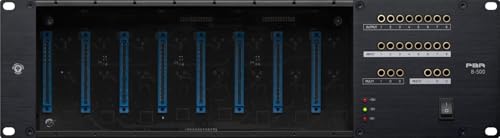
- Holds eight 500 Series modules
- Built-in rack power supply and patchbay
- Gold-plated XLR, TT, and DB25 I/O
Best For: 500 Series racks needing integrated patching
Touring-Ready Flexibility
16-Port Reversible XLR Patchbay

- Sixteen reversible male/female XLR ports
- Heavy-duty steel chassis for touring wear
- Balanced three-pin wiring and rack screws included
Best For: Flexible live sound and broadcast rack routing
Flexible Routing Pick – Samson S-Patch Plus
Samson S-Patch Plus Balanced 48-Point 1/4" Patch Bay | 1/4 Inch Phone Connections
Check Price On AmazonFor patch bays for live sound setups that need flexible signal routing, the Samson S-Patch Plus provides 48 balanced 1/4-inch points in a rack-mountable 1U design. Its front-panel switches let you choose normal, half-normal, or thru operation without reaching behind the rack.
Best For: Live sound and studio racks using balanced 1/4-inch connections with multiple routing requirements.
Pros:
- 48-point, fully balanced 1/4-inch patch bay.
- Selectable normal, half-normal, and thru modes.
- Rack-mountable 1U metal chassis with front-panel access.
Cons:
- Uses 1/4-inch phone connections rather than XLR.
- Its 48-point layout may be more capacity than smaller systems require.
The S-Patch Plus is a strong choice when a live sound rack needs high connection density and configurable routing in one accessible unit.
XLR Routing Choice – Black Lion Audio PBR XLR
For patch bays for live sound systems built around XLR cabling, the Black Lion Audio PBR XLR offers 16 patch points with 32 gold-plated XLR connectors. It is designed for straightforward signal routing in recording or live sound studios.
Best For: Live sound or recording setups that need an XLR-based patching point.
Pros:
- 16-point XLR patchbay with 32 connectors.
- Gold-plated connectors for the patch connections.
- Aluminum construction and a two-year warranty.
Cons:
- Provides fewer patch points than 48-point models.
- Uses XLR connectivity, so it is not suited to systems centered on 1/4-inch patch cables.
The PBR XLR keeps the format focused and practical for XLR-based systems, making it a sensible option when connector compatibility matters more than maximum point count.
Digital Stagebox Option – Behringer S32 Stage Box
The Behringer S32 takes a different approach to patch bays for live sound, combining stagebox connectivity with digital system integration. It provides 32 programmable Midas-designed mic preamps, 16 servo-balanced XLR outputs, AES50 networking, and additional digital connectivity.
Best For: Digital live sound rigs using AES50 networking, distributed outputs, and Behringer P16 personal monitoring.
Pros:
- 32 fully programmable mic preamps.
- 16 analog, servo-balanced XLR outputs.
- AES50, Ultranet, and AES-3 connectivity for expanded digital systems.
Cons:
- It is a digital stage box rather than a conventional passive patchbay.
- Its feature set is most relevant to compatible digital ecosystems.
Choose the S32 when your live sound workflow needs remote I/O and networked signal distribution rather than simple analog patching.
High-Capacity Analog Pick – ART P48 Balanced Patch Bay
For patch bays for live sound and installed audio, the ART P48 provides 48 points in a fully shielded 19-inch rack-mountable enclosure. It helps organize cables and reduce wear on the connectors of mixers and other equipment.
Best For: Professional or home studios, PA systems, AV installations, and live sound racks needing high-capacity analog organization.
Pros:
- 48-point patch bay in a 19-inch rack format.
- Fully shielded construction for organized installation.
- Compatible with a broad range of audio equipment, including mixers, amplifiers, instruments, and microphones.
Cons:
- The supplied notes do not specify selectable normalled or thru modes.
- Its XLR connector format may require adapters or suitable cabling in mixed-connector systems.
The P48 is a practical capacity-focused solution for keeping a complex analog rack organized, particularly where shielding and connector protection are priorities.
CAT Rack Stage Box – EtherCON & XLR Patch Panel
For patch bays for live sound setups that need to move multiple channels over network-style cabling, this CAT Rack stage box combines EtherCON and XLR connectivity in a flexible rack design. It can carry up to 12 analog channels through three CAT lines while helping reduce cable clutter on stage, in a studio, or on tour.
Best For: Touring rigs, stage production, and installations needing flexible analog, AES3, DMX, or intercom routing.
Pros:
- Transmits up to 12 analog channels through three CAT lines.
- Uses Neutrik connectors with parallel IN/OUT ports for secure connections.
- Supports shielded Cat5e through Cat7 cables and phantom power through 3-pin XLR.
- Reversible rack ears allow flexible mounting direction.
Cons:
- Requires compatible shielded network cabling and related equipment.
- Its specialized EtherCON/CAT workflow may be more capability than a basic rack patch bay requires.
This is a strong choice when a live sound system benefits from consolidated multichannel transport and adaptable rack routing rather than conventional 1/4-inch patching alone.
Studio Routing Essential – dbx PB-48 48-Point Patch Bay
The dbx PB-48 is a straightforward option for patch bays for live sound and studio racks, providing 48 front-panel 1/4-inch jacks matched by 48 rear-panel jacks. It brings connections to an accessible front panel, helping simplify rerouting while reducing wear on mixer and equipment jacks.
Best For: Rack-mounted audio systems that need high-capacity 1/4-inch access and quick signal rerouting.
Pros:
- Offers 48 front-panel and 48 rear-panel 1/4-inch jacks.
- Provides convenient access to mixer and other audio gear connections.
- 1U rack-mountable steel construction fits standard rack setups.
- Can reduce wear and tear on equipment jacks during rerouting.
Cons:
- Uses 1/4-inch connections rather than XLR or EtherCON.
- The high point count may be unnecessary for smaller systems.
Choose the PB-48 when you need dense, conventional 1/4-inch patching in a compact 1U chassis and value fast access to a large number of connections.
Front-Access XLR Solution – Hosa PDR-369 12-Point Patchbay
For patch bays for live sound systems built around balanced XLR connections, the Hosa PDR-369 brings 12 mixer inputs to the front of a rack. Its reversible design and XLR3 female-to-XLR3 male connectivity make it useful when microphones, preamps, mixers, or interfaces are otherwise difficult to access.
Best For: XLR-based racks that need convenient front-panel access to 12 balanced channels.
Pros:
- Provides 12 XLR patch points in a single rack chassis.
- Brings hard-to-reach XLR mixer inputs to the front of the rack.
- Uses balanced XLR3 female-to-male connections.
- Reversible design supports flexible installation.
Cons:
- Offers fewer points than a 48-point 1/4-inch patch bay.
- Its XLR-only format is less suitable for systems centered on 1/4-inch patching.
The PDR-369 is a practical fit for XLR-heavy live sound and recording racks where front access matters more than maximum patch-point density.
Color-Coded XLR Routing – AMIMA 8-Channel XLR Rack Patch Bay
For patch bays for live sound, the AMIMA 8-Channel XLR Patch Bay offers a straightforward 1U rack-mount feed-through design. Its eight color-coded female-to-female XLR ports make signal tracing easier and can help reduce setup mistakes during installation or changeovers.
Best For: Live sound and studio users who want clearly identified XLR connections in a compact rack panel.
Pros:
- Eight distinct colored ports simplify signal identification.
- Female-to-female feed-through connections support simple XLR cable patching.
- 1U, 19-inch rack-mount format suits standard rack installations.
- Gold-plated contacts are included in the product design.
Cons:
- Provides eight channels, which may be limiting for larger systems.
- The supplied information describes XLR connections rather than multiple connector formats.
The AMIMA is a practical choice when fast visual identification matters more than extensive routing flexibility. It is especially suitable for organized, fixed XLR patching in a standard rack.
Integrated 500 Series Control – Black Lion PBR 8-500 Rack and Patchbay
Among patch bays for live sound, the Black Lion Audio PBR 8-500 combines patching with an 8-slot 500 Series rack and power supply. Its built-in patchbay and gold-plated XLR, TT, and DB25 I/O make it a fit for setups that need both module housing and centralized connections.
Best For: Users building a 500 Series-based rack with integrated power and patchbay connectivity.
Pros:
- Combines an 8-slot 500 Series rack with a power supply.
- Includes a built-in patchbay for centralized routing.
- Offers gold-plated XLR, TT, and DB25 I/O.
Cons:
- Its 500 Series-specific design may be more capability than a simple XLR patch panel requires.
- The listed product dimensions and 14.52-pound weight indicate a substantial rack unit.
The PBR 8-500 is best viewed as an integrated 500 Series platform rather than a basic standalone patch panel. Choose it when the rack, power supply, and varied I/O are central to your system design.
Touring-Ready Flexibility – 16-Port Reversible XLR Patchbay
For patch bays for live sound, this 16-port XLR patchbay provides a higher connection count and reversible male/female ports. Its steel chassis, balanced three-pin wiring, and included mounting screws are designed for rack-based audio routing in live, studio, theater, worship, and broadcast environments.
Best For: Professional live sound rigs and rack systems needing flexible 16-port XLR connectivity.
Pros:
- Sixteen XLR ports provide more connection capacity than smaller panels.
- Reversible connectors support male/female configuration changes without rewiring.
- Heavy-duty steel construction with black powder coating suits touring use.
- Mounting screws are included for standard 19-inch rack installation.
Cons:
- It is an XLR-focused patch panel rather than a multi-format patchbay.
- The product is specified for indoor use.
This model stands out when a live rig needs durable construction and adaptable XLR panel layouts. The reversible connectors add useful flexibility for changing input and output configurations while keeping the signal path balanced.
How We Picked These Patch Bays for Live Sound
We focused on practical requirements for live audio: connector compatibility, channel count, rack-mount suitability, balanced signal support, durability, and routing flexibility. The selection includes traditional 1/4-inch patch bays, XLR feed-through panels, stage boxes, and integrated solutions for specialized rack systems.
Because live setups vary widely, no single model is best for every application. A compact XLR patch panel may suit a small installation, while a larger balanced patch bay or stage box may be better for a touring rack, venue, or control position.
Quick Comparison
- Best for flexible TRS routing: Samson S-Patch Plus and ART P48-48.
- Best for XLR-based systems: Black Lion Audio PBR, Hosa PDR-369, and the 16 Port XLR Patchbay.
- Best for stage-box connections: Behringer S32 and CAT Rack Male XLR Stage Box.
- Best for compact installations: AMIMA 8-Channel and dbx PB-48.
- Best for 500 Series users: Black Lion Audio PBR 8-500.
Key Buying Factors for Patch Bays for Live Sound
Connector Type and Signal Format
Match the patch bay to the connectors already used in your microphones, preamps, mixers, interfaces, and outboard gear. XLR panels are convenient for microphone- and line-level connections, while balanced 1/4-inch TRS bays offer more flexible routing between rack equipment. Do not assume that an XLR panel provides the same normaling options as a traditional studio patch bay.
Channel Count and Rack Space
Count the inputs and outputs you expect to connect now, then allow room for likely expansion. A 1U, 48-point bay can provide substantial routing density, whereas an 8- or 12-channel panel may be easier to install in a compact rack or permanent wall position.
Normalled, Half-Normalled, or Straight-Through Operation
Normalled connections let signals pass without patch cables until you override the route. This can speed up setup but requires careful planning. Straight-through feed-through panels are simpler and often better for stage-box or connector-extension duties.
Build Quality and Serviceability
Look for secure rack hardware, clearly labeled ports, robust jacks, and reliable contacts. Color coding can help during fast changeovers, while accessible rear connections make installation and maintenance easier.
Who Should Buy Which Patch Bays for Live Sound?
Choose a balanced 1/4-inch model if you need flexible routing between mixers, interfaces, compressors, and other rack gear. Select an XLR patch bay when your workflow is built around microphone lines or installed XLR connections. A stage box is the better choice when you need to extend many stage inputs to a console or rack over a single organized connection point.
For permanent venue or studio installations, prioritize labeling, connector durability, and expansion capacity. For mobile live rigs, favor sturdy construction, straightforward signal flow, and a layout that minimizes setup errors. If you use 500 Series modules, an integrated rack and patchbay can reduce cabling while keeping the entire system in one accessible enclosure.