
The right DI box can help you send a balanced, low-noise signal to your interface, mixer, or microphone preamp while solving common connection and grounding problems. For vocal recording setups that also include instruments, playback devices, or multiple sources, the best choice depends on more than price.
We selected 10 DI boxes across passive, active, stereo, and multi-channel designs to make it easier to match features such as transformer isolation, attenuation, channel count, and input flexibility to your recording workflow.
Best 10 Di Boxes for Recording Vocals Picks for 2026
Classic Passive Choice
Radial Pro DI Passive Direct Box

- Passive mono design with custom transformer
- Rugged stainless-steel I-beam construction
- Supports instruments and professional snake systems
Best For: Durable mono live and studio setups
Multi-Channel Studio Hub
Behringer DI800 V2 Signal Direct Box

- Eight channels for multiple sources
- Mains or phantom-powered operation
- XLR, TRS, and TS connectivity
Best For: Studios and events needing several DI channels
USB Stereo Flexibility
OnStage DB2150 Passive Stereo USB DI Box
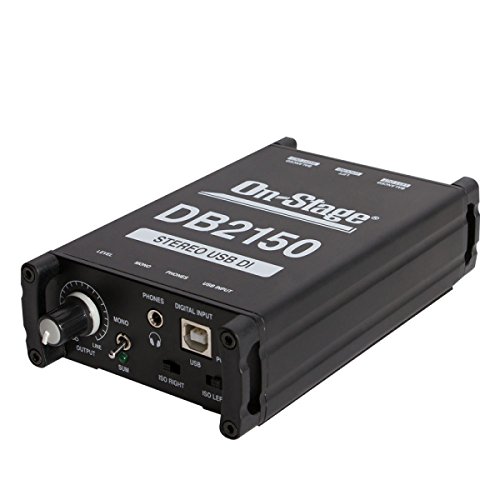
- Passive stereo design with USB connectivity
- 3.5mm headphone output and mono sum switch
- Ground lift and independent isolation switches
Best For: Windows-based stereo desktop recording
Compact Four-Channel Mixer
dbx DI4 Active 4-Channel Direct Box

- Four independent active DI channels
- Per-channel 20 dB pad and ground lift
- Volume and pan controls for mixer output
Best For: Compact multi-source studio and live rigs
Flexible Stereo Connectivity
Klark Teknik PRO DI AV 2 DI 22P

- Passive stereo design needs no power supply
- Midas transformers and high-headroom construction
- 1/4-inch, 1/8-inch TRS, and RCA inputs
Best For: Stereo and multimedia recording setups
Simple Mono Vocal Routing
Samson S-Max MD1 Passive DI Box

- Converts 1/4-inch signals to balanced XLR
- Passive design needs no power or batteries
- Ground lift and thru output add flexibility
Best For: Mono interface and console routing
Dual-Channel Isolation
Radial ProD2 Passive Direct Box

- Two passive channels for stereo operation
- Isolation transformers and lift switch
- 15 dB pad for stronger signals
Best For: Stereo chains needing isolation and attenuation
Dual-Channel Value Pick
Pyle-Pro PDC22 Dual Passive Direct Box
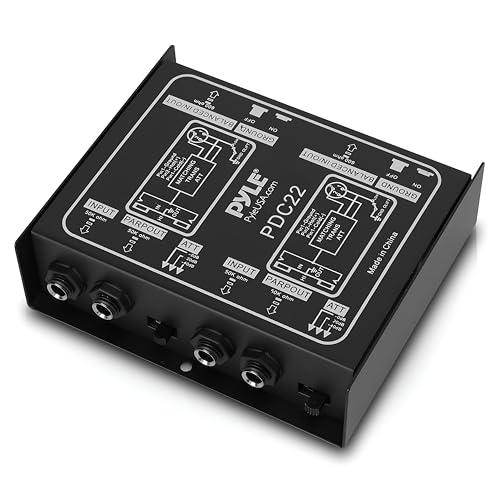
- Two-channel passive DI design
- Ground-lift buzz and hum cancellation
- Steel chassis for durable use
Best For: Studios and live rigs needing two DI channels
Simple Instrument-to-Mixer Choice
Behringer Ultra-Di DI400P Passive Direct Box

- Balanced mic-level output
- Thru/Out for an amplifier feed
- Compact metal enclosure
Best For: Guitar or bass rigs routing to a mixer
Compact Hum-Control Option
Pyle PDC21 Premium Passive DI Box

- Input attenuator for signal management
- Balanced and unbalanced XLR support
- Compact passive hum-eliminator design
Best For: Portable setups adapting instruments or line-level sources
Classic Passive Choice – Radial Pro DI Passive Direct Box
For musicians looking for DI boxes for recording vocals and other instruments, the Radial Pro DI is a straightforward passive option. Its custom transformer, mono output, XLR connectivity, and rugged I-beam construction suit live or studio setups where dependable signal handling matters.
Best For: Vocalists and small studio or live rigs that need a durable mono passive direct box.
Pros:
- Passive mono design with a custom transformer
- Rugged stainless-steel I-beam construction
- Works with acoustic guitars, bass, keyboards, drum machines, and professional snake systems
Cons:
- Mono operation limits multi-channel applications
- No wireless communication technology
The Radial Pro DI keeps the feature set focused and practical. Choose it when a robust passive box is more important than channel expansion or extra routing controls.
Multi-Channel Studio Hub – Behringer DI800 V2 Signal Direct Box
The Behringer DI800 V2 is a practical choice for setups that need several DI boxes for recording vocals or connecting multiple sources at once. It provides eight channels, XLR and 1/4-inch interfaces, and optional mains or phantom-powered operation for studio, film, and live-event use.
Best For: Recording studios, film sets, and live events requiring multiple direct channels in one unit.
Pros:
- Eight-channel configuration
- Supports optional mains or phantom-powered operation
- Servo-balanced operation provides an ultra-flat frequency response
- Accepts XLR, TRS, and TS connections
Cons:
- At 5 pounds, it is less portable than a compact single-channel DI
- Its multi-channel format may be excessive for a simple vocal setup
With eight channels and flexible power options, the DI800 V2 is built for larger routing tasks. It makes the most sense when a single box needs to handle several sources rather than one vocal chain.
USB Stereo Flexibility – OnStage DB2150 Passive Stereo USB DI Box
The OnStage DB2150 adds computer-oriented connectivity to the search for DI boxes for recording vocals. This passive stereo unit offers USB hardware connectivity, a 3.5mm headphone output, mono summing, ground lift, and independent isolation switches for left and right channels.
Best For: Computer-based Windows setups that need stereo DI connections and convenient headphone monitoring.
Pros:
- Passive stereo operation with USB connectivity
- Includes a 3.5mm headphone output
- Mono sum and ground lift switches add routing flexibility
- Custom-wound transformer and 96 kHz maximum sample rate
Cons:
- Its stereo and USB feature set may be unnecessary for a basic mono vocal chain
- Listed platform support is Windows
The DB2150 is a useful fit for producers who want stereo and computer-friendly features in one DI box. Its headphone output and switching options make it particularly practical for desktop recording workflows.
Compact Four-Channel Mixer – dbx DI4 Active 4-Channel Direct Box
The dbx DI4 combines four independent active DI units with a compact line mixer, making it a flexible option among DI boxes for recording vocals. Each channel includes a 20 dB pad and ground lift, while volume and pan controls serve the line mixer output.
Best For: Small studios and live rigs that need four active DI channels plus basic line-mixing control.
Pros:
- Four independent DI box units in a half-rack package
- Independent 20 dB pad and ground-lift switches per channel
- Independent volume and pan controls for line mixer output
- Accepts 1/4-inch jack and RCA inputs
Cons:
- Requires corded electric power
- The active, four-channel format may be more than a single vocal setup needs
The DI4 is aimed at users who need both direct injection and basic source blending. Its channel-by-channel controls make it more adaptable than a simple single-channel passive box, especially in compact multi-source systems.
Flexible Stereo Connectivity – Klark Teknik PRO DI AV 2 DI 22P
The Klark Teknik PRO DI AV 2 is a practical choice among DI boxes for recording vocals when you need stereo or multimedia connectivity. Its passive design, Midas transformers, and multiple input formats make it useful for routing sources into a recording setup without requiring a power supply.
Best For: Stereo vocal-related setups, multimedia sources, and users needing 1/4-inch, 1/8-inch TRS, and RCA inputs.
Pros:
- Passive operation requires no power supply.
- Custom-built Midas transformers are designed for signal integrity.
- Supports stereo input through 1/4-inch, 1/8-inch TRS, and RCA connectors.
- High-headroom design is suited to a range of general-purpose applications.
Cons:
- Stereo configuration may be more than needed for a simple mono vocal chain.
- The supplied notes do not specify a dedicated vocal preamp or microphone input.
Choose this model if flexible stereo and multimedia connections matter more than a streamlined single-channel vocal setup. Its passive construction keeps the signal path simple and easy to integrate.
Simple Mono Vocal Routing – Samson S-Max MD1 Passive DI Box
The Samson S-Max MD1 is a straightforward option among DI boxes for recording vocals when you need to convert a 1/4-inch instrument- or line-level source to a balanced mic-level XLR output. Its passive circuit, ground lift, and rugged steel chassis suit both studio and stage workflows.
Best For: Mono recording setups, keyboards or instrument-level sources, and routing signals to a mixer or USB audio interface.
Pros:
- Converts an unbalanced 1/4-inch signal to balanced mic-level XLR.
- Passive operation requires neither phantom power nor batteries.
- Ground-lift switch helps address buzz and hum.
- Thru output supports parallel tracking, pedals, or an amplifier connection.
Cons:
- It is a single-channel mono DI box.
- Its listed inputs are intended for line- or instrument-level sources rather than a direct microphone connection.
The MD1 is a sensible pick for a compact, no-power-needed routing solution. The balanced XLR output and ground lift are especially useful when connecting a source to an interface or console over longer cable runs.
Dual-Channel Isolation – Radial ProD2 Passive Direct Box
The Radial ProD2 is a compact stereo option among DI boxes for recording vocals and related sources. It combines two passive channels with isolation transformers, a lift switch, and 15 dB pads, making it useful when you need to manage stereo connections or higher-level signals.
Best For: Stereo recording chains and setups that benefit from transformer isolation, ground-lift control, and input attenuation.
Pros:
- Provides two passive DI channels for stereo operation.
- Isolation transformers help separate connected audio paths.
- Lift switch supports ground-management needs.
- 15 dB pad helps accommodate stronger input signals.
Cons:
- A two-channel unit may be unnecessary for a basic mono vocal setup.
- The supplied notes do not list detailed frequency-response or input-level specifications.
The ProD2 fits recording environments where stereo operation and signal isolation are priorities. Its pad and lift controls add useful routing flexibility without moving to an active DI design.
Dual-Channel Value Pick – Pyle-Pro PDC22 Dual Passive Direct Box
For recording vocals, the Pyle-Pro PDC22 is a practical companion when you need to connect keyboards, guitars, processors, or other unbalanced sources to a mixer. Its passive design provides impedance matching, buzz and hum cancellation, and two channels in a durable steel chassis.
Best For: Home studios and live setups that need a two-channel DI for instruments, processors, or consumer audio sources.
Pros:
- Two channels support multiple connected sources.
- Helps connect unbalanced signals to a PA or recording mixer.
- Ground-lift functionality helps address buzz and hum.
- Steel construction is suited to regular musician use.
Cons:
- It is a passive DI, so it does not provide active DI amplification.
- The supplied notes emphasize instrument and line-level connections rather than a dedicated vocal preamp.
The PDC22 makes the most sense when flexibility and two-channel connectivity matter. For vocal recording, pair it with an appropriate microphone preamp or mixer input rather than treating it as a standalone vocal interface.
Simple Instrument-to-Mixer Choice – Behringer Ultra-Di DI400P Passive Direct Box
The Behringer Ultra-Di DI400P is a compact passive option for recording setups that need to route an unbalanced instrument or line-level signal to a mixer. It converts the signal to balanced mic-level output, supports long cable runs, and includes a Thru/Out jack for feeding an amplifier at the same time.
Best For: Guitar and bass players who want a straightforward connection to a mixer while retaining a parallel amplifier feed.
Pros:
- Converts unbalanced line-level signals to balanced mic-level output.
- Helps reduce tone loss from impedance mismatches and long cables.
- Thru/Out jack supports simultaneous amplifier and mixer routing.
- Metal enclosure is compact and tabletop-mounted.
Cons:
- It is a single-channel mono direct box.
- The supplied information focuses on guitar, bass, and line-level sources rather than microphone-specific features.
For a vocal recording chain, the DI400P is most useful with compatible line-level equipment rather than as a direct microphone solution. Its strongest advantage is uncomplicated balanced routing with an amplifier-through option.
Compact Hum-Control Option – Pyle PDC21 Premium Passive DI Box
The Pyle PDC21 is a compact passive DI for connecting guitars, basses, keyboards, processors, and other unbalanced sources to balanced or unbalanced equipment. For recording vocals, it can help integrate compatible line-level sources into a mixer while providing an input attenuator and hum-eliminating functionality.
Best For: Small recording setups needing an affordable, compact DI with attenuation and 1/4-inch-to-XLR connectivity.
Pros:
- Includes an input attenuator for managing incoming signal levels.
- Supports balanced and unbalanced XLR connections.
- Ground-lift and hum-eliminator features can help reduce unwanted noise.
- Compact size and light weight suit portable setups.
Cons:
- It is a passive unit rather than a powered microphone preamp.
- The supplied notes do not identify a second channel.
- Its listed applications center on instruments and line-level sources.
The PDC21 is a useful signal-connection tool when space and basic noise control are priorities. For vocal recording, use it as part of a broader mixer or preamp setup, especially when adapting compatible unbalanced sources.
How We Picked the Best Di Boxes for Recording Vocals
We focused on practical features that matter in home studios, rehearsal spaces, live rooms, and project-studio recording chains. The selection includes passive and active designs, single- and multi-channel units, stereo options, and models with extra routing or attenuation controls.
We also considered connection flexibility, transformer isolation, expected noise performance, frequency response, build suitability, and how easily each unit can fit between a source and a mixer or audio interface. A DI box does not replace a quality microphone preamp, but it can make signal routing cleaner and more dependable.
Quick Comparison
- Best for a proven studio standard: Radial Pro DI Passive Direct Box.
- Best for multiple sources: dbx DI4 Active 4-Channel Direct Box with Line Mixer.
- Best for two-channel setups: Radial ProD2 or Pyle-Pro PDC22.
- Best for budget-conscious recording: Behringer Ultra-DI DI400P or Pyle Premium Direct Injection Audio Box.
- Best for stereo and USB-related routing: OnStage DB2150.
- Best for active operation and added headroom: Behringer DI800 V2.
Key Buying Factors for Di Boxes for Recording Vocals
Passive or Active Design
Passive DI boxes use transformers and generally do not require batteries or phantom power. They are simple, durable, and often effective for hot signals. Active models need power but can provide more flexibility and better matching for some low-output or high-impedance sources. For a vocal setup, the choice often depends on what is being connected alongside the microphone rather than the microphone itself.
Inputs, Outputs, and Channel Count
Check whether you need a single mono channel, stereo operation, or several independent inputs. Two-channel and four-channel boxes can reduce clutter when recording keyboards, playback devices, instruments, or multiple outputs at once. Confirm that the unit offers the connectors your system uses, such as 1/4-inch inputs, XLR outputs, or USB-related connections.
Isolation and Ground-Lift Controls
Transformer isolation and a ground-lift switch can help reduce hum caused by differences between connected electrical systems. These controls are especially useful when a computer, powered monitor, mixer, and interface are connected together. They do not fix every noise problem, so cable quality, gain staging, and power layout still matter.
Attenuation and Headroom
Pad switches or input attenuation are useful when a source is too strong for the DI input. Look for clear 0 dB, -15 dB, or similar settings if you plan to connect active instruments, mixers, or other high-level sources. Adequate headroom helps prevent clipping before the signal reaches the preamp.
Who Should Buy Which Di Boxes for Recording Vocals?
Choose a compact passive model if you want straightforward routing for one instrument or line-level source. A stereo DI is better for keyboards, stereo playback, or two-channel effects. Choose an active or multi-channel unit when you need additional gain flexibility, several sources, or centralized routing. If your main goal is eliminating hum in a simple home setup, prioritize transformer isolation and a ground-lift switch over extra features.
Before buying, map the complete signal path from source to interface or mixer. Verify connector types, phantom-power requirements, channel count, and whether the DI will handle the source level without clipping. That quick check will usually identify the best fit among these Di Boxes for Recording Vocals.