
Choosing the right direct box can make guitars, keyboards, playback devices, and other instruments easier to mix in a church sound system. The best option depends on your source, available phantom power, channel count, and the type of hum or level problems you need to solve.
This roundup compares 10 DI boxes across passive, active, mono, and stereo designs, helping worship teams match reliable signal conversion and stage-friendly features to their setup.
Best 10 Di Boxes for Church Sound Systems Picks for 2026
Rugged Passive Choice

- Passive mono direct box
- Custom transformer and rugged I-beam construction
- Works with guitars, bass, keyboards, and drum machines
Best For: Church instrument channels needing durable mono DI conversion
Stereo Keyboard Workhorse

- Dual 1/4-inch inputs for stereo sources
- Ground lift helps reduce hum
- 15 dB pads handle hot signals
Best For: Stereo keyboards, DJ controllers, and backing-track rigs
Phantom-Powered Active Pick
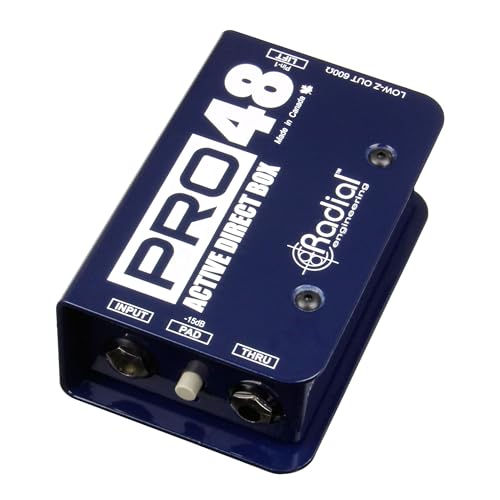
- 48-volt phantom-powered active design
- -15 dB pad for passive guitars and basses
- Steel enclosure with balanced mono XLR output
Best For: Guitar and bass channels on phantom-powered church consoles
Simple Mono Signal Tool

- High-impedance 1/4-inch input and Thru output
- Balanced XLR output with ground lift
- -15 dB pad for high-level sources
Best For: Single mono instruments and high-level sources
Best Active Pick

- 800k-ohm input impedance
- 48V phantom-powered active design
- Polarity switch and 15dB pad
Best For: Single-channel guitar or keyboard setups
Best Budget Hum Reducer

- Passive impedance-transforming DI
- Ground lift and hum cancellation
- Works with instruments and consumer sources
Best For: Affordable single-source church audio setups
Best Two-Channel Option
Radial ProD2 Passive 2-Channel DI

- Passive stereo two-channel design
- Isolation transformer and lift switch
- 15dB pad with 1/4-inch and XLR connectors
Best For: Stereo keyboards and paired church audio sources
Simple Passive DI

- Passive, no power required
- Pad and ground-lift switches
- Metal enclosure with XLR output
Best For: Single guitar or keyboard connections
Flexible Two-Channel DI
Mixer-Controlled Signal Routing

- Two independent DI channels
- Per-channel pad and ground lift
- Volume and pan controls
Best For: Multi-source church audio setups
Dual Passive DI
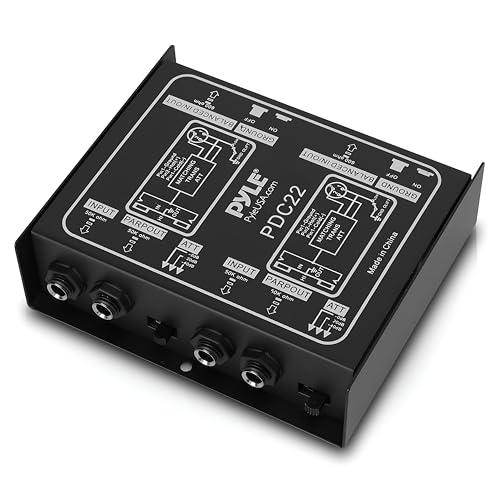
- Two passive DI channels
- Ground-lift buzz and hum control
- Steel chassis for live use
Best For: Dual-source church PA and recording setups
Rugged Passive Choice – Radial Pro DI
The Radial Pro DI is a practical passive option for church sound systems using acoustic guitars, bass, keyboards, drum machines, or professional snake systems. Its transformer-based design, mono output, and XLR connectivity suit straightforward instrument-to-mixer connections.
Best For: Churches needing a durable mono DI for live instruments and studio-style setups.
Pros:
- Passive design requires no separate power source.
- Custom transformer supports transformer-isolated signal connection.
- Rugged I-beam construction and stainless-steel enclosure are built for regular use.
- Compatible with guitars, bass, keyboards, and drum machines.
Cons:
- Mono operation is less suitable for stereo keyboard or DJ sources.
- Passive operation may not be the right fit when an active DI is specifically required.
Choose this model when reliability and simple mono routing matter more than stereo operation or active circuitry. Its broad instrument compatibility makes it a flexible addition to a church stage or production rack.
Stereo Keyboard Workhorse – Mackie MDB-2P Stereo DI
The Mackie MDB-2P is one of the more useful DI boxes for church sound systems when a stereo keyboard, DJ controller, or backing-track rig needs two channels. Its passive design, ground lift, and 15 dB pads address common hum and hot-signal problems without requiring power.
Best For: Stereo keyboards, DJ rigs, and playback systems feeding a church mixer.
Pros:
- Dual 1/4-inch high-impedance inputs handle stereo sources.
- Ground lift helps address ground-loop buzz.
- 15 dB pads accommodate hotter signals without distortion.
- Passive operation needs no power and uses a roadworthy steel case.
Cons:
- Its two-channel format may be unnecessary for a single mono instrument.
- The supplied notes do not identify a battery or phantom-powered active mode.
This is a strong fit for churches running stereo keyboards or playback equipment. The combination of ground lift and input pads gives sound volunteers useful tools for solving noise and level issues at the source.
Phantom-Powered Active Pick – Radial Pro48 Active DI
The Radial Pro48 is an active direct box for church sound systems that can provide phantom power from the mixer. It offers a balanced mono XLR output, a -15 dB pad for passive guitars and basses, and a low-noise proprietary analog circuit in a steel enclosure.
Best For: Passive guitar and bass channels where an active, phantom-powered DI is preferred.
Pros:
- Uses 48-volt phantom power for active operation.
- -15 dB pad helps accommodate passive guitar and bass signals.
- Balanced mono XLR output integrates with standard mixer and snake inputs.
- Steel enclosure and low-noise analog circuit suit live use.
Cons:
- It is mono, so it is not intended for stereo sources.
- Its active design depends on a compatible 48-volt phantom-power source.
For a church mixing console with phantom power available, the Pro48 offers a focused solution for guitar and bass channels. Select it when active circuitry and a built-in pad are more important than passive, no-power operation.
Simple Mono Signal Tool – Mackie MDB-1P Passive DI
The Mackie MDB-1P is a straightforward passive choice among DI boxes for church sound systems. It accepts a high-impedance 1/4-inch source, provides a Thru output and balanced male XLR output, and includes a ground lift and -15 dB pad for practical stage routing.
Best For: Single mono instruments or high-level sources that need balanced XLR delivery to a mixer.
Pros:
- High-impedance 1/4-inch input suits instrument-level sources.
- Thru output allows the original signal to continue to another device.
- Ground lift helps address unwanted buzz.
- -15 dB pad supports high-level sources without distortion.
Cons:
- Single-channel operation does not support stereo setups.
- The supplied notes describe a passive design, so it is not an active phantom-powered DI.
This model makes sense when the church needs a no-frills mono DI for one instrument or source at a time. Its Thru output, pad, and ground lift add useful flexibility without complicating the signal path.
Best Active Pick – StageBug SB-1
For church sound systems that need a compact, active DI box for guitar or keyboard, the Radial StageBug SB-1 combines an 800k-ohm input impedance with 48V phantom power. Its polarity switch and 15dB pad add useful flexibility for managing instrument signals.
Best For: Guitarists and keyboard players who want an active, single-channel DI with a clear, full-bodied sound profile.
Pros:
- 800k-ohm input impedance supports guitar and keyboard connections.
- 48V phantom-powered design works with compatible sound-system setups.
- Includes a polarity switch and 15dB pad for signal-management flexibility.
- Compact 8-ounce enclosure with a 2-year warranty.
Cons:
- Provides only one output channel.
- Requires phantom power or its corded-electric power arrangement.
The SB-1 is a focused choice when a church needs one active instrument DI and values high input impedance, straightforward controls, and a compact form factor.
Best Budget Hum Reducer – Pyle Premium DI Box
For church sound systems connecting guitars, basses, keyboards, or other unbalanced sources, this passive Pyle DI unit provides impedance conversion to balanced and unbalanced XLR connections. Its ground-lift capability and hum-cancellation function are useful when unwanted buzz appears in a live setup.
Best For: Budget-conscious users who need a versatile passive DI for instruments, submixers, effects processors, or consumer audio sources.
Pros:
- Connects guitars, basses, keyboards, and outboard signal processors.
- Ground-lift adapter and hum-cancellation capability help address buzz.
- Includes an input attenuator for managing incoming signal levels.
- Supports connections between 1/4-inch devices and balanced or unbalanced XLR equipment.
Cons:
- Passive design does not provide the active circuitry of a phantom-powered DI.
- Its compact enclosure may offer fewer connection options than a two-channel unit.
The Pyle is a flexible, compact option when the main priorities are basic impedance conversion, broad source compatibility, and hum reduction rather than advanced channel capacity.
Best Two-Channel Option – Radial ProD2 Passive 2-Channel DI
When a church sound system needs to handle two signals in one unit, the Radial ProD2 offers a passive stereo DI configuration. Its isolation transformer, lift switch, and 15dB pad provide practical tools for integrating instrument or line-level connections into a PA or mixer.
Best For: Stereo keyboards, paired sources, and church setups that need two DI channels with passive isolation.
Pros:
- Provides two channels in a passive stereo DI format.
- Isolation transformer helps separate connected audio paths.
- Lift switch and 15dB pad add useful signal and grounding control.
- Uses 1/4-inch and XLR connectors in a stainless-steel enclosure.
Cons:
- Heavier and larger than the single-channel StageBug SB-1.
- Passive design does not include active, phantom-powered circuitry.
The ProD2 makes the most sense when two-channel coverage and transformer isolation matter more than the smallest possible footprint or an active input stage.
Simple Passive DI – Compact Instrument Balancing
For church sound systems needing a straightforward way to connect an instrument to a mixer, this passive DI box accepts a 1/4-inch input and provides a balanced XLR output. Its pad and ground-lift switches add useful control for hot sources and grounding-related buzz.
Best For: Churches connecting a guitar or keyboard to a PA or mixing console with minimal setup.
Pros:
- Passive design requires no power.
- Ground lift can help address electrical grounding noise.
- Pad switch helps soften hot input sources.
- Metal enclosure provides a durable housing.
Cons:
- Offers one output channel.
- It has no built-in volume or pan controls.
This is a practical single-channel option when a worship setup needs basic instrument-to-XLR conversion without adding a power requirement.
Flexible Two-Channel DI – Mixer-Controlled Signal Routing
For church sound systems handling multiple sources, the dbx DJDI combines two channels with independent controls and a line mixer. Each channel includes a 20 dB pad and ground lift, while volume and pan controls provide added flexibility for line mixer output.
Best For: Church audio teams that need two-channel DI connectivity with per-channel signal and routing controls.
Pros:
- Provides two independent channels.
- Each channel has its own 20 dB pad and ground lift.
- Independent volume and pan controls support line mixer output.
- Supports 1/4-inch TS and XLR connectivity.
Cons:
- Uses corded electric power rather than a passive, no-power design.
- Its additional controls may be more than needed for a basic one-source setup.
This model is suited to more involved church rigs where two signals and independent channel adjustments are more valuable than the simplest possible DI layout.
Dual Passive DI – Rugged Church PA Connectivity
For church sound systems connecting guitars, keyboards, submixers, or other unbalanced sources, the Pyle-Pro PDC22 provides two passive DI channels with 1/4-inch device connectivity. Its ground-lift function is designed to help with buzz and hum, while the steel chassis supports regular live-use handling.
Best For: Church PA and recording setups that need dual-channel connections for instruments and other unbalanced devices.
Pros:
- Two-channel design supports multiple sources.
- Works with guitars, keyboards, processors, submixers, and consumer stereo outputs.
- Ground lift helps with buzz and hum cancellation.
- All-steel chassis is built for durability.
Cons:
- The supplied notes do not specify detailed output connector or frequency information.
- Its broader connectivity may be unnecessary for a simple single-instrument setup.
The PDC22 is a versatile choice when a church needs two DI channels and wants one rugged unit for instruments and assorted unbalanced line-level sources.
How We Picked the Best Di Boxes for Church Sound Systems
We focused on practical performance factors that matter in worship venues: balanced XLR output quality, compatibility with common 1/4-inch instrument and line-level sources, grounding and hum-control features, durability, and ease of use during services. The selection includes straightforward passive boxes, phantom-powered active models, stereo units, and budget-friendly options for churches building or expanding a signal chain.
Because church audio systems vary widely, no single DI box is ideal for every stage. A compact passive model may be the best fit for a simple guitar rig, while a stereo or dual-channel box can save space when connecting keyboards, playback gear, or other two-channel sources.
Quick Comparison
- Best general-purpose choice: A dependable passive mono DI for guitars, basses, keyboards, and playback devices.
- Best for active sources: An active DI powered by 48-volt phantom power, especially when preserving detail from passive pickups matters.
- Best for stereo setups: A dual-channel DI for keyboards, laptops, mixers, and stereo playback equipment.
- Best for tight budgets: A basic passive unit with ground lift and input attenuation, provided its construction suits regular use.
Key Buying Factors for Di Boxes for Church Sound Systems
Passive or Active Design
Passive DI boxes are simple, durable, and do not require batteries or phantom power. They are often a strong choice for keyboards, mixers, and high-output electronic instruments. Active models can provide higher input impedance and may better preserve the tone of passive guitar or bass pickups, but they require phantom power, a battery, or another power source.
Mono or Stereo Channels
Use a single-channel DI for most guitars, basses, microphones with suitable outputs, and mono instruments. Choose a two-channel model for stereo keyboards, laptops, DJ equipment, and playback sources. Confirm that the console has enough input channels and that the box supports the connections you need.
Ground Lift and Attenuation
A ground-lift switch can help reduce hum caused by electrical ground loops, although it should not be treated as a substitute for safe wiring. Input padding or attenuation is useful when connecting hot line-level outputs that could overload the DI input.
Connectors and Stage Durability
Look for secure 1/4-inch inputs, balanced XLR outputs, clear controls, and a rugged enclosure. In a church environment, equipment may be moved between services, rehearsals, and portable worship setups, so sturdy construction and simple operation are valuable.
Who Should Buy Which Di Boxes for Church Sound Systems?
Small worship teams should start with reliable passive mono DIs for guitar, bass, and occasional electronic instruments. Keyboard players and playback operators will usually benefit from dual-channel stereo models. Guitarists using passive pickups should consider an active DI when phantom power is available and tone preservation is a priority. Churches troubleshooting hum should prioritize a model with ground lift while also having an electrician or qualified audio technician inspect power and signal cabling. For permanent installations, choose the most robust option that fits the budget rather than buying solely on the lowest price.