
The best desktop computers for programming combine dependable multitasking performance, fast storage, comfortable connectivity, and enough headroom for development tools, containers, virtual machines, and testing environments.
This roundup compares 10 options across compact mini PCs, small-form-factor systems, traditional desktops, and complete PC bundles. Use the guide below to match processor power, memory, storage, upgradeability, and workspace needs to your development workflow.
Best 10 Desktop Computers for Programming Picks for 2026
Best Overall
Dell Pro i5-14500 Business Desktop

- 14-core Intel i5-14500 processor
- 16GB DDR5 and 512GB PCIe SSD
- Windows 11 Pro with Wi-Fi 6
Best For: Programming and professional multitasking
Best Compact Performance
ACEMAGICIAN S3A Ryzen 7 Mini PC

- Ryzen 7 H 255 with 8 cores and 16 threads
- Triple 4K display support
- 512GB PCIe 4.0 SSD and 2-year warranty
Best For: Compact programming and creation setups
Best Complete Starter Setup
Renewed Dell OptiPlex 5050 Bundle

- Includes a 24-inch Full HD monitor
- 32GB DDR4 RAM and 512GB NVMe SSD
- Windows 11 Pro with Wi-Fi 6
Best For: Students and first programming workstations
Best for Multi-Display Workflows

- Ryzen 7 8745HS processor
- Up to four 4K displays
- 1TB SSD and dual 2.5G LAN
Best For: Multi-monitor programming and home-server use
Best Value Workstation

- Six-core i7-8700 processor
- 32GB RAM and 512GB NVMe SSD
- Dual-monitor support with Wi-Fi and Bluetooth
Best For: Programming, multitasking, and home-office development
Best for Always-On Workloads

- 8-core/12-thread Intel processor
- Compact design with expandable RAM and storage
- Supports up to four displays
Best For: Compact development setups and sustained workloads
Best Modern SFF Choice
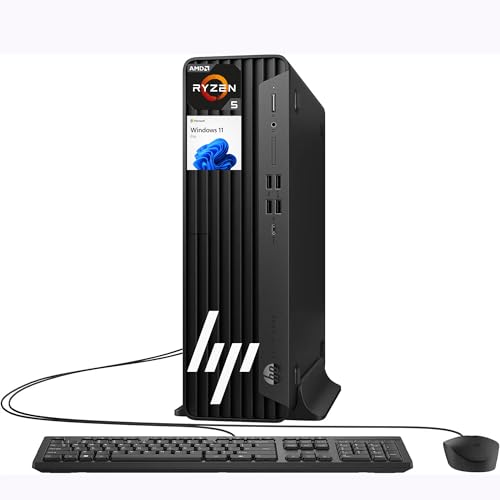
- Ryzen 5 8500G up to 5 GHz
- 16GB DDR5 RAM with Windows 11 Pro
- Compact design and dual-monitor outputs
Best For: Modern compact programming and business setups
Best Refurbished Workhorse
Dell OptiPlex 3060 with 32GB RAM

- Six-core Intel Core i5-8500 processor
- 32GB RAM and 1TB SSD
- Wi-Fi, Bluetooth, HDMI, and DisplayPort
Best For: Programming and multitasking on a refurbished business desktop
Best Newer Platform
HP OmniDesk with Ryzen 5 8500G

- Ryzen 5 8500G with 6 cores and 12 threads
- DDR5 memory and PCIe SSD
- Wi-Fi 6, USB-C, HDMI, and DisplayPort
Best For: Students and programmers wanting a newer everyday desktop platform
Best Compact Storage Setup

- Compact small-form-factor business design
- 128GB SSD plus 1TB HDD
- 16GB RAM, Wi-Fi 5, and Bluetooth
Best For: Space-conscious users who need fast startup and extra storage
Best Overall – Dell Pro i5-14500 Business Desktop
For shoppers comparing desktop computers for programming, this Dell Pro desktop offers a strong balance of processing power, memory, storage, and expandability. Its 14-core Intel Core i5-14500, 16GB of DDR5 RAM, and 512GB PCIe SSD are well suited to coding tools, multitasking, and everyday professional workloads.
Best For: Programmers who want a conventional business desktop with modern performance, Windows 11 Pro, and extensive connectivity.
Pros:
- 14 cores and 20 threads with boost speeds up to 5.0GHz
- Fast DDR5 memory and PCIe SSD storage
- Wide selection of USB, HDMI, DisplayPort, Ethernet, Wi-Fi 6, and Bluetooth connections
- Includes a wireless keyboard and mouse
Cons:
- Integrated Intel UHD Graphics 770 is not intended for demanding discrete-GPU workloads
- Only 16GB RAM and 512GB storage are included in this configuration
This is a practical pick for software development, office work, and multitasking. The TPM security chip, Windows 11 Pro, and upgrade options add useful business-oriented flexibility.
Best Compact Performance – ACEMAGICIAN S3A Ryzen 7 Mini PC
The ACEMAGICIAN S3A packs an eight-core Ryzen 7 H 255 processor and Radeon 780M graphics into a compact enclosure. For desktop computers for programming, it is a space-saving option with fast LPDDR5 memory, PCIe 4.0 storage, and support for up to three 4K displays.
Best For: Developers and creators who need strong multitasking performance in a small, flexible desktop setup.
Pros:
- Eight cores and 16 threads with speeds up to 4.9GHz
- Fast 16GB LPDDR5 memory and 512GB PCIe 4.0 SSD
- Supports up to three 4K displays through HDMI, DisplayPort, and USB4
- Three adjustable performance modes and a two-year warranty
Cons:
- Compact design uses integrated Radeon 780M graphics rather than a discrete GPU
- Memory capacity is listed as 16GB, so heavier development workloads may benefit from more RAM
Its multi-monitor support and adjustable power modes make the S3A particularly useful for coding, testing, meetings, and content work. It is a capable compact alternative to a full-size tower.
Best Complete Starter Setup – Renewed Dell OptiPlex 5050 Bundle
This renewed Dell OptiPlex 5050 bundle combines a desktop, 24-inch Full HD monitor, keyboard, and Windows 11 Pro. Among desktop computers for programming, it stands out for providing a ready-to-use workstation with 32GB of DDR4 RAM and a 512GB M.2 NVMe SSD.
Best For: Students, beginners, and home-office programmers who need a complete monitor-and-PC package.
Pros:
- Includes a new 24-inch 1920×1080 monitor
- 32GB RAM supports substantial multitasking
- 512GB M.2 NVMe SSD for responsive boot and application loading
- Built-in Wi-Fi 6 and Bluetooth 5.2
Cons:
- Older Intel i7-6700 platform than the other systems in this roundup
- It is a renewed computer rather than a new desktop
- Graphics are not specified as a discrete solution
The included monitor makes this a convenient value-oriented choice when building a workspace from scratch. Its generous RAM is helpful for coding tools and browser-heavy workflows, while the older processor limits its long-term performance headroom.
Best for Multi-Display Workflows – Glorlin Ryzen 7 Mini PC
The Glorlin mini PC is designed for developers who value a small footprint and multiple screens. Its Ryzen 7 8745HS, 16GB DDR5 RAM, 1TB NVMe SSD, and Radeon 780M graphics make it a versatile choice among desktop computers for programming, especially for coding, office work, and home-server use.
Best For: Programmers who want up to four 4K displays, fast storage, and compact networking hardware.
Pros:
- Eight-core, 16-thread Ryzen 7 8745HS processor
- 1TB NVMe SSD with dual M.2 slots for expansion
- Supports up to four 4K displays
- Dual 2.5G LAN, USB4, Wi-Fi 6, and Bluetooth 5.3
Cons:
- Single 16GB DDR5 memory configuration may be limiting for large projects or virtual machines
- Radeon 780M graphics are integrated rather than discrete
- Includes a one-year warranty
With four-display support and dual 2.5G LAN, this is a strong fit for developers managing terminals, documentation, dashboards, or local services. Its 1TB SSD also provides more initial workspace than the other mini PC in this selection.
Best Value Workstation – Dell OptiPlex 7060 i7 Desktop
For shoppers comparing desktop computers for programming, the renewed Dell OptiPlex 7060 offers a practical combination of multitasking power, generous memory, and fast NVMe storage. Its small-form-factor tower includes Windows 11 Pro, built-in wireless connectivity, and dual-monitor support.
Best For: Programmers, students, and home-office users who need strong multitasking performance and ample RAM for development tools.
Pros:
- Six-core Intel Core i7-8700 processor with speeds up to 4.60 GHz
- 32GB DDR4 RAM and a 512GB NVMe SSD support responsive workflows
- Two DisplayPort outputs, Wi-Fi, Bluetooth, and multiple USB ports
- Includes Windows 11 Pro plus a wireless keyboard and mouse
Cons:
- Integrated Intel UHD Graphics 630 is not intended for demanding graphics workloads
- Renewed condition includes a stated 90-day limited warranty
- Small-form-factor design may limit future expansion compared with larger towers
The OptiPlex 7060 is a sensible programming workstation when memory capacity and everyday responsiveness matter more than newer-generation hardware or dedicated graphics.
Best for Always-On Workloads – GEEKOM IT12 Mini PC
The GEEKOM IT12 is a compact option among desktop computers for programming, pairing an 8-core/12-thread Intel Core i3-12300HE with a 512GB NVMe SSD. Its efficient cooling and expandable memory and storage make it appealing for sustained workflows where desk space is limited.
Best For: Developers who value a compact system, long-running workloads, and flexible connectivity for multiple displays or specialized equipment.
Pros:
- Intel Core i3-12300HE is described as an 8-core/12-thread processor designed for continuous operation
- 16GB RAM, 512GB NVMe storage, and expansion options provide room to grow
- Supports up to four displays through dual USB4 and dual HDMI 2.0 outputs
- Metal structural components, full-copper cooling, and a three-year support commitment
Cons:
- Supplied notes do not specify the included operating system or graphics configuration
- Integrated graphics are better suited to productivity and display output than demanding graphics work
- Specialized industrial ports may be unnecessary for typical programming setups
Choose the IT12 if a small footprint and sustained operation are priorities. Its port selection and upgrade potential also give it unusual flexibility for a mini PC.
Best Modern SFF Choice – HP Elite SFF G9 Ryzen 5
The HP Elite SFF G9 is a modern small-form-factor pick among desktop computers for programming, using an AMD Ryzen 5 8500G processor, DDR5 memory, and Windows 11 Pro. Its compact chassis, broad port selection, and included wired peripherals make it ready for a professional or home development desk.
Best For: Programmers and business users who want a compact, current-generation system with DDR5 memory and straightforward dual-monitor connectivity.
Pros:
- Six-core Ryzen 5 8500G reaches up to 5 GHz and includes Radeon 740M integrated graphics
- 16GB DDR5-4800 RAM supports everyday development and multitasking
- HDMI and DisplayPort outputs support two monitors
- Compact chassis, 11 USB ports, Wi-Fi, Bluetooth, and a one-year manufacturer warranty
Cons:
- 256GB SSD offers less storage than the other listed systems
- Supplied specifications list the memory maximum as 16GB, limiting stated upgrade headroom
- Integrated graphics are not designed for demanding dedicated-GPU workloads
The HP is a strong fit for users who prefer newer DDR5-based hardware and a compact business-oriented chassis. Consider additional storage if your programming tools, virtual machines, or project files are sizable.
Best Refurbished Workhorse – Dell OptiPlex 3060 with 32GB RAM
For shoppers comparing desktop computers for programming, this renewed Dell OptiPlex 3060 offers a practical balance of processing power, memory, and storage. Its six-core Intel Core i5-8500, 32GB DDR4 RAM, and 1TB SSD are well suited to multitasking, development tools, web browsing, and general productivity.
Best For: Programmers and home-office users who want generous RAM and fast solid-state storage in a refurbished business desktop.
Pros:
- Six-core Intel Core i5-8500 processor with speeds up to 4.1GHz.
- 32GB DDR4 RAM and a 1TB SSD support responsive multitasking and quick program loading.
- Built-in Wi-Fi and Bluetooth, plus HDMI, DisplayPort, and multiple USB ports.
- Includes Windows 11 Pro and a 90-day warranty.
Cons:
- Integrated Intel UHD Graphics 630 is not intended for demanding graphics work or gaming.
- As a renewed 2018-era system, it has older hardware than newer desktop options.
This Dell is a strong value-oriented choice when memory capacity and storage matter more than modern integrated graphics. Confirm the included accessories and the renewed condition meet your setup needs before ordering.
Best Newer Platform – HP OmniDesk with Ryzen 5 8500G
The HP OmniDesk is a newer-style option among desktop computers for programming, pairing an AMD Ryzen 5 8500G with DDR5 memory and a PCIe SSD. It provides a responsive foundation for coding, office work, online learning, and everyday multitasking while including a wireless keyboard and mouse.
Best For: Students, programmers, and home-office users who want a current AMD platform, modern connectivity, and a one-year warranty.
Pros:
- Ryzen 5 8500G offers six cores, 12 threads, and boost speeds up to 5GHz.
- DDR5 RAM and a PCIe SSD are designed for responsive everyday workflows.
- Wi-Fi 6, USB-C, HDMI, DisplayPort 1.4, and 10 total USB ports provide flexible connectivity.
- Includes a wireless keyboard and mouse and a one-year warranty.
Cons:
- The listed configuration provides 16GB RAM and 512GB SSD storage, less capacity than some alternatives.
- AMD Radeon 740M graphics are integrated, so this is not a dedicated-GPU workstation.
- The supplied details list Windows 11 Home, while one product bullet references Windows 11 Pro; verify the installed edition.
With its newer processor platform, DDR5 memory, and broad port selection, the OmniDesk is a sensible all-around programming desktop. Its 16GB/512GB configuration may be enough for typical development, but heavier projects may benefit from future upgrades.
Best Compact Storage Setup – HP EliteDesk 800 G4 SFF
For buyers seeking space-saving desktop computers for programming, the renewed HP EliteDesk 800 G4 SFF combines a compact business-class design with an Intel Core i5-8500 and 16GB DDR4 RAM. Its 128GB SSD supports quick startup, while the additional 1TB HDD provides room for documents, media, and software.
Best For: Programmers and home-office users who need a compact desktop with both fast boot storage and extra hard-drive capacity.
Pros:
- Small-form-factor design measures approximately 14.5 by 9.6 by 4.6 inches.
- Intel Core i5-8500 and 16GB DDR4 RAM support everyday development and productivity tasks.
- Combines a 128GB SSD with a 1TB HDD for speed plus additional storage.
- Includes Wi-Fi 5, Bluetooth, DisplayPort, and DP-to-HDMI and DP-to-VGA adapters.
Cons:
- The 128GB SSD may fill quickly if development tools and projects are installed on it.
- Its integrated Intel UHD Graphics 630 is suited to standard display use rather than demanding graphics workloads.
- The renewed system uses an older eighth-generation processor platform.
This EliteDesk makes sense when desk space and storage flexibility are priorities. The dual-drive arrangement is useful, but plan to manage installation locations carefully or consider storage expansion for larger programming environments.
How We Picked the Best Desktop Computers for Programming
We evaluated these systems for programming-focused workloads rather than gaming performance alone. Our comparison emphasizes processor capability, memory, SSD speed and capacity, connectivity, physical size, operating-system readiness, and practical value. We also considered how well each computer may handle common tools such as code editors, browsers with many tabs, local databases, compilers, Docker containers, emulators, and virtual machines.
Specifications can vary by configuration or seller, so verify the exact processor, RAM, storage, included accessories, operating system, and warranty before purchasing.
Quick Comparison
| Type | Best For | Typical Strength | Potential Limitation |
|---|---|---|---|
| Mini PC | Compact workspaces and portability | Strong performance per square inch | Less internal upgrade room |
| Small-form-factor desktop | Office setups and budget-conscious developers | Affordable, quiet, and easy to deploy | Limited graphics and expansion space |
| Traditional desktop | Long development sessions and upgrades | Better cooling and expandability | Requires more desk space |
| PC bundle | First-time buyers | May include a monitor and accessories | Older components may reduce longevity |
Key Buying Factors for Desktop Computers for Programming
Processor and Multitasking
Prioritize modern multi-core processors when you compile frequently, run containers, use Android or iOS emulators, or keep several development services active. A recent Core i5 or Ryzen 5 is a sensible baseline; Core i7, Ryzen 7, or comparable chips are preferable for heavier parallel workloads.
Memory and Storage
Choose at least 16GB of RAM for general software development. Move to 32GB if you work with virtual machines, large projects, containers, data tools, or local AI workloads. An NVMe SSD makes booting, dependency installation, indexing, and project loading much faster than a hard drive. A 512GB drive is workable, while 1TB provides more comfortable room for tools and repositories.
Ports, Displays, and Networking
Check for enough USB ports, multiple display outputs, Ethernet, and reliable Wi-Fi. Developers who use two or more monitors should confirm that the system can drive their intended resolutions and refresh rates. USB4, 2.5Gb Ethernet, or newer Wi-Fi standards can be useful for fast peripherals and network storage, but they are not essential for every workflow.
Upgradeability and Long-Term Value
Business desktops often offer accessible RAM and storage upgrades, while mini PCs favor size and efficiency. Inspect the chassis before buying if you expect to add memory, replace the SSD, install expansion cards, or improve cooling. Refurbished systems can be excellent values, but check the seller’s return policy, battery-free accessories, and warranty coverage.
Who Should Buy Which Desktop Computers for Programming?
Choose a modern Ryzen 7 or Core i7 mini PC if you want strong multitasking in a compact workspace. A newer business desktop with a Core i5 or Ryzen 5 is a balanced choice for web development, general programming, and office use. Pick a 32GB refurbished OptiPlex or EliteDesk if value and memory capacity matter more than having the newest platform. A complete desktop-and-monitor bundle suits students or first-time buyers who need a ready-to-use setup. Finally, choose a larger or more upgradeable desktop if you expect to run virtual machines, local services, large builds, or multiple monitors for several years.