
Choosing studio monitors with flat response helps you hear what’s actually in your mix instead of a speaker’s color.
This roundup focuses on accurate, practical picks for home studios, project rooms, and near-field setups in 2026.
Best 10 Studio Monitors with Flat Response Picks for 2026
Neutral Reference Pick
Flat, Reveal-Every-Detail Nearfield Pair

- Sonically pure tuning with no added coloring
- Bi-amped 2-way design with 5-inch woofer
- Balanced XLR/TRS inputs for studio setups
Best For: mixing and editing in a nearfield studio
Imaging and Room Fit Pick
Wide-Sweet-Spot Reference Monitors

- Image Control Waveguide for precise, wide imaging
- Boundary EQ and HF Trim adjust to the room
- Dual 41W Class-D amps with 5-inch woofer
Best For: podcasting and mix work in flexible room setups
Budget Neutrality Pick
Affordable Flat-Response Studio Speaker

- DSP tuned for a more robust flat frequency response
- Boundary EQ helps in desks, walls, or stands
- 80W bi-amped power with 6.5-inch driver
Best For: budget studio users who need flexible placement
High-Headroom Accuracy Pick
High-Power Neutral Nearfield Monitor
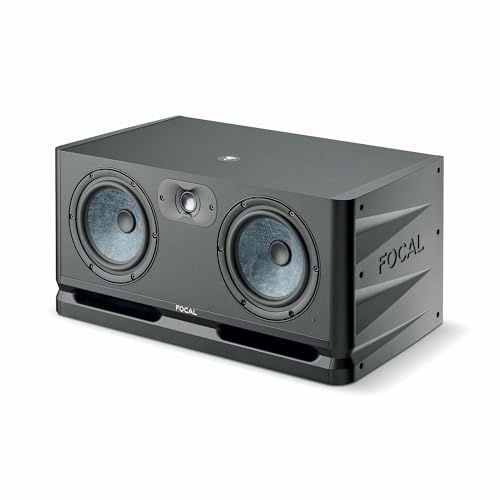
- Slatefiber cones for neutrality and low distortion
- Wide dispersion keeps tone consistent across the room
- 130W max output with XLR, TRS, and RCA inputs
Best For: larger studios needing neutral sound and strong output
Compact Nearfield Pick
Yamaha HS4 Powered Studio Monitor in Black, Pair

- 2-way powered pair with 4.5-inch woofer
- Room control and high trim for tuning
- XLR/TRS, RCA, and stereo mini inputs
Best For: Small desks, home studios, and video editing
Value Flat-Response Option
Edifier MR4 Power Studio Monitor Speakers
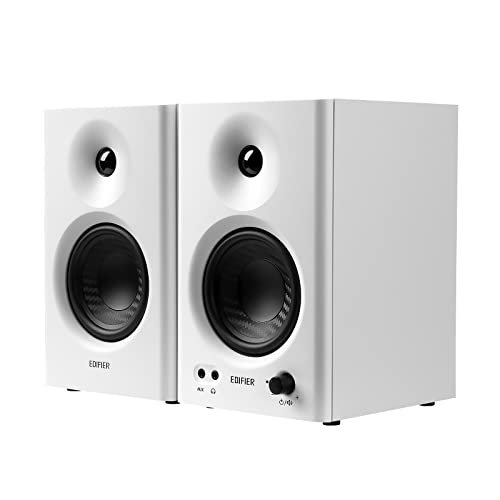
- Near-flat responsive curve for creator use
- TRS, RCA, AUX, and headphone output
- Monitor mode and music mode switch
Best For: Budget music production and desktop listening
Large-Room Reference Pair
Yamaha HS8 8-Inch Powered Studio Monitor Pair

- 8-inch woofer with 120W bi-amp power
- 38Hz to 30kHz frequency response
- XLR wired connectivity for studio use
Best For: Larger studios needing more output and bass reach
3-Way Detail for Near-Field Work
Edifier MR5 110W 3-Way Studio Monitors

- 3-way active crossover with dedicated drivers
- Room tuning via rear controls and app
- XLR, TRS, RCA, AUX, Bluetooth, headphone out
Best For: Near-field monitoring and flexible desktop setups
Reference-Style Imaging
Kali Audio IN-8 V2 8-Inch Reference Monitor

- 3-way coaxial design for precise imaging
- Flat-response tuning with boundary compensation EQ
- 140W tri-amplified output with XLR/TRS/RCA inputs
Best For: Accurate mixing and room-flexible home studios
Compact Flat-Response Value Pick
Edifier MR3 Compact Flat-Response Monitor

- 52Hz–40kHz flat-response tuning
- Music, Monitor, and Custom modes
- TRS, RCA, AUX, Bluetooth, and headphone out
Best For: Desktop studios and small-room monitoring
Neutral Reference Pick – Flat, Reveal-Every-Detail Nearfield Pair
If you want studio monitors with flat response for mixing and editing, the Yamaha HS5 pair is built to keep the sound honest rather than flattering. Its 2-way bi-amped design, 5-inch woofer, and 1-inch dome tweeter are aimed at sonic purity, with balanced XLR and TRS inputs for flexible studio hookups.
Best For: Producers and home studios that want a straightforward, uncolored reference monitor pair for critical listening.
Pros:
- Emphasizes sonic purity without coloring the original sound
- Bi-amped 2-way design with 45W LF and 25W HF amplification
- Balanced XLR and TRS inputs accept both balanced and unbalanced signals
- 5-inch woofer and 1-inch dome tweeter suit nearfield monitoring
Cons:
- 5-inch monitors may not deliver the deepest low-end on their own
- Designed for nearfield use rather than large-room playback
Overall, the HS5 is a classic choice if your priority is hearing a mix as it is, not as a speaker wants to present it. The listed frequency response and neutral tuning make it a practical option for accurate day-to-day studio work.
Imaging and Room Fit Pick – Wide-Sweet-Spot Reference Monitors
For studio monitors with flat response and dependable imaging, the JBL 305P MkII focuses on accuracy plus a wide listening area. Its patented Image Control Waveguide, dual 41-watt Class-D amps, and 5-inch woofer are tuned for clear monitoring, while Boundary EQ and HF Trim help adapt the sound to your room.
Best For: Mixers, podcasters, and creators who want a precise monitor with flexible room adjustment.
Pros:
- Patented Image Control Waveguide provides precise imaging and a wide sweet spot
- Dual 41-watt Class-D amplifiers deliver solid power and dynamic range
- Boundary EQ and HF Trim help tune the speaker for different rooms
- XLR/TRS inputs and MDF enclosure support practical studio use
Cons:
- Single 5-inch woofer may not satisfy users who want heavy bass without a sub
- Best results depend on using the room controls correctly
The 305P MkII stands out for making accurate monitoring feel easy across a broader listening area. If you need a reference speaker that stays useful in more than one room setup, this is a strong contender.
Budget Neutrality Pick – Affordable Flat-Response Studio Speaker
The Kali Audio LP-6 V2 is a strong pick if you want studio monitors with flat response without paying premium prices. Its updated DSP is designed for a more robust flat frequency response, and the front port plus boundary EQ help keep the speaker usable on a stand, against a wall, or on a desk.
Best For: Budget-conscious producers who want a detailed, neutral monitor that adapts well to different placements.
Pros:
- Updated DSP targets a more robust flat frequency response
- Front port helps reduce chuffing and hissing
- Boundary EQ supports placement on stands, walls, or desks
- 80 watts of bi-amped power with 6.5-inch driver and 1-inch tweeter
Cons:
- Sold as a single monitor, so a stereo pair requires two units
- Large enough to be less compact than 5-inch studio monitors
For the price, the LP-6 V2 offers a practical mix of neutrality, power, and placement flexibility. It is especially appealing if you want an honest monitor that can handle a variety of small-studio setups.
High-Headroom Accuracy Pick – High-Power Neutral Nearfield Monitor
If you need studio monitors with flat response and more output headroom, the Focal Alpha Twin EVO is built for professional studio monitoring. It uses Slatefiber cones for sound neutrality and low distortion, with wide dispersion and identical tonal balance at both low and high volume.
Best For: Larger project studios and users who want neutral monitoring with strong dynamics and room coverage.
Pros:
- Slatefiber cone design focuses on sound neutrality and low distortion
- Wide dispersion helps maintain the same sound across the room
- Identical tonal balance at low and high volume
- High 130-watt maximum output with XLR, TRS, and RCA inputs
Cons:
- Heavier and larger than compact nearfield options
- Single-speaker listing means you need to account for full stereo setup separately
The Alpha Twin EVO is a strong fit when accuracy needs to be paired with volume and wider coverage. It leans toward serious studio use where consistent tonal balance matters across different listening levels.
Compact Nearfield Pick – Yamaha HS4 Powered Studio Monitor in Black, Pair
If you want studio monitors with flat response for a small desk or DAW setup, the Yamaha HS4 is built for practical nearfield monitoring. This pair uses a 4.5-inch woofer and 1-inch dome tweeter, with room control and high trim adjustments to help you tailor the sound to your workspace.
Best For: Small home studios, video editing desks, and creators who need a compact wired monitor pair with flexible inputs.
Pros:
- Pair of 2-way powered monitors with a compact tabletop footprint
- Room control and high trim help adjust the response to your space
- Multiple inputs: XLR/TRS combo, RCA, and stereo mini
- Includes stereo mini to RCA cable, speaker cable, and anti-slip pad
Cons:
- 4.5-inch woofer limits low-end reach compared with larger monitors
- 26W output is modest for bigger rooms
- Best suited to close listening rather than filling a large studio
The HS4 is a straightforward choice if you want a compact monitor pair with adjustable controls and broad connectivity. For desk-based production, it offers a practical balance of size, features, and nearfield monitoring focus.
Value Flat-Response Option – Edifier MR4 Power Studio Monitor Speakers
The Edifier MR4 is a strong budget-minded choice if you want studio monitors with flat response for music creation or everyday listening. Edifier says it is professionally fine-tuned to a near-flat responsive curve, and the dual-mode design lets you switch between monitor mode and music mode.
Best For: Budget-conscious creators who want a near-flat monitor for mixing, general production, and desktop listening.
Pros:
- Professionally tuned to a near-flat responsive curve
- 1-inch silk dome tweeters and 4-inch composite woofers
- Flexible connections: TRS, RCA, AUX, and front headphone output
- Monitor mode and music mode add useful versatility
Cons:
- 4-inch woofer may feel limited for deeper bass needs
- Best for nearfield use rather than larger spaces
- Plastic enclosure is less substantial than MDF-based alternatives
The MR4 stands out for its tuned response and versatile input set, making it easy to integrate into a desktop production rig. If you want a practical entry point into flat-response monitoring, it is an easy model to consider.
Large-Room Reference Pair – Yamaha HS8 8-Inch Powered Studio Monitor Pair
The Yamaha HS8 is aimed at buyers who want studio monitors with flat response and more scale than compact desktop models. With an 8-inch woofer, 1-inch dome tweeter, and bi-amp design rated at 120W total amplification, it is built for higher-output monitoring in a studio environment.
Best For: Larger studios and engineers who need a powerful nearfield reference pair with strong low-end extension.
Pros:
- 8-inch woofer and 120W bi-amp system for more output
- 38Hz to 30kHz frequency response for broader range
- Sold as a pair for stereo studio monitoring
- XLR connectivity for wired studio setups
Cons:
- Large cabinets take up significant desk or stand space
- XLR cables are not included
- More power and size than many small home setups need
For users who can accommodate the size, the HS8 offers a more serious monitoring platform than entry-level compact speakers. It is best approached as a room-forward reference tool rather than a small-space desktop monitor.
3-Way Detail for Near-Field Work – Edifier MR5 110W 3-Way Studio Monitors
If you want studio monitors with flat response that still feel versatile enough for everyday use, the Edifier MR5 is built around a 3-way active crossover and a wide 46Hz–40kHz range. The separate woofer, mid driver, and silk dome tweeter help keep vocals, instruments, and transients clear, while the rear tuning controls and app-based room compensation make it easier to adapt the sound to your space.
Best For: Near-field monitoring, desktop studios, and listeners who want a compact speaker with tuning flexibility.
Pros:
- 3-way design with dedicated woofer, mid driver, and tweeter for detailed monitoring.
- Rear knobs and ConneX app room compensation help tailor the response to the room.
- 110W RMS output and 101dB peak SPL give it enough headroom for small to mid-sized spaces.
- XLR, TRS, RCA, AUX, Bluetooth 6.0, and headphone output add strong connectivity.
Cons:
- It is still a bookshelf-style monitor, so it is not aimed at large-room fill.
- Wireless convenience is useful, but wired setup is the better fit for critical monitoring.
The MR5 stands out if you want a practical monitor that balances flat-response intent with broad input support and room tuning controls. It is especially appealing for users who need one speaker set for both studio tasks and casual listening.
Reference-Style Imaging – Kali Audio IN-8 V2 8-Inch Reference Monitor
For buyers searching for studio monitors with flat response, the Kali Audio IN-8 V2 is designed around a 3-way coaxial layout that emphasizes point-source accuracy, precise imaging, and phase coherence. The 8-inch woofer adds extended low-end output, while boundary compensation EQ helps it adapt to placement in a room, making it a strong pick for serious monitoring setups.
Best For: Producers and home-studio users who want accurate imaging, deeper bass, and flexible placement options.
Pros:
- 3-way coaxial design supports accurate imaging and phase coherence.
- Flat-response tuning and boundary compensation EQ make room placement easier to manage.
- 140W tri-amplified power provides high headroom and low distortion.
- XLR, TRS, and RCA inputs cover pro and consumer gear.
Cons:
- It is sold as a single monitor, so stereo use requires a second unit.
- The 8-inch size is larger and less desk-friendly than compact near-field options.
The IN-8 V2 is a strong fit when accuracy and imaging matter more than convenience features. It offers a serious monitoring platform for users who want a fuller low end without giving up the flat, controlled presentation expected from a reference speaker.
Compact Flat-Response Value Pick – Edifier MR3 Compact Flat-Response Monitor
The Edifier MR3 is aimed at buyers who want studio monitors with flat response in a compact, affordable format. Its Hi-Res Audio certification, 52Hz–40kHz flat response claim, and switchable Music, Monitor, and Custom modes make it easy to use for both monitoring and everyday playback, while the app adds extra EQ control when needed.
Best For: Small home studios, desktop editing, and casual users who want an easy-to-set-up monitor with tuning options.
Pros:
- Flat-response tuning across 52Hz to 40kHz supports accurate listening.
- Music, Monitor, and Custom modes add flexibility for different uses.
- TRS, RCA, AUX, Bluetooth, and headphone output provide broad connectivity.
- MDF cabinet helps reduce distortion in a compact design.
Cons:
- 18W x 2 RMS output is modest compared with larger studio monitors.
- The smaller drivers and compact size are better suited to near-field use than bigger rooms.
The MR3 is a practical choice if you want a smaller monitor that still targets a neutral, usable sound. It is especially appealing for desktop setups where flexibility, app control, and a balanced response matter more than sheer output.
How We Picked the Best Studio Monitors with Flat Response
We focused on monitors known for neutral voicing, usable frequency extension, and dependable build quality. We also considered amplifier design, input options, cabinet size, and how well each model fits real-world spaces from compact desks to treated studios.
Quick Comparison
Smaller 4- to 5-inch models are usually better for tight rooms, desktop setups, and moderate listening levels. 6- to 8-inch monitors give you more low-end reach and headroom, which can reduce the need for a subwoofer. Coaxial and 3-way designs can improve imaging and consistency, while budget-friendly near-field speakers are often a smart entry point for beginners.
Key Buying Factors for Studio Monitors with Flat Response
Frequency Balance
Look for a monitor that stays even through the mids and doesn’t exaggerate bass or treble. A truly flat response is less about perfection and more about predictable translation to headphones, car systems, and consumer speakers.
Room Size and Placement
Match the cabinet and woofer size to your space. In smaller rooms, overly large monitors can create bass buildup and make decisions harder. Front-panel controls, EQ switches, and acoustic tuning features can help tailor the sound to your room.
Connectivity and Workflow
Choose the inputs that fit your interface or mixer, such as balanced XLR or TRS. If you’ll use them for both studio work and casual playback, consider whether extra inputs or Bluetooth add meaningful flexibility without compromising monitoring accuracy.
Power and Headroom
More wattage doesn’t automatically mean better sound, but enough clean headroom matters. You want monitors that stay controlled at your normal working level and don’t strain when you need to check low-end detail or loud transients.
Who Should Buy Which Studio Monitors with Flat Response?
Beginners and desktop producers should lean toward compact, affordable models that are easy to place and simple to set up. If you mix bass-heavy music or want a more full-range picture, step up to 6- or 8-inch monitors. Producers who need more precise imaging may prefer coaxial or three-way designs. For most buyers shopping for Studio Monitors with Flat Response, the best choice is the one that fits the room first and the genre second.