
If you want cleaner low-end decisions, studio monitors with subwoofer output can make a small room feel more accurate without overwhelming your mix.
Our 2026 roundup focuses on flexible, buyer-friendly picks for music production, editing, and home studios, with options for compact desktops and more serious monitoring setups.
Best 10 Studio Monitors with Subwoofer Output Picks for 2026
JBL Studio Bass Expander
JBL LSR310S 10-inch Studio Subwoofer
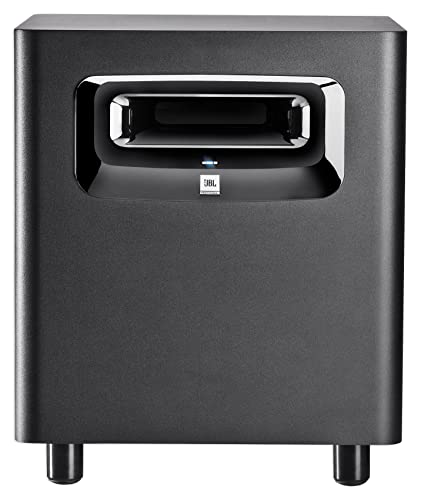
- Deep low-end response down into the 20 Hz region.
- XLF mode adds club-style bass tuning for dance tracks.
- Balanced XLR and 1/4-inch connections for studio use.
Best For: Studio setups that need extended bass and balanced connectivity
ADAM Low-End Companion
ADAM Audio T10S Active Studio Subwoofer

- Compact active subwoofer for extending low end.
- Adjustable crossover, phase, and volume for room matching.
- Footswitch bypass makes mix checking easier.
Best For: ADAM T-series monitor users who want adjustable bass extension
Yamaha Desktop Monitor Pair
Yamaha HS3 Powered Studio Monitors, Pair

- Compact 3.5-inch powered monitors for desktop use.
- Room control and high trim help shape the sound.
- XLR/TRS, RCA, and mini inputs add connection flexibility.
Best For: Small studios needing compact monitors with flexible inputs
PreSonus Bass Control Hub
PreSonus Eris Pro Sub 10 Active Studio Subwoofer

- Front-firing 10-inch subwoofer with bass-reflex port.
- Variable lowpass and switchable highpass filters for integration.
- Footswitch bypass and pass-through outputs add flexibility.
Best For: Home and pro studios that need flexible bass management
Subwoofer Expansion Pick
KRK S8.4 8" Powered Studio Subwoofer

- 8-inch woofer extends bass to 30 Hz
- Front-firing port aids placement flexibility
- Footswitch can bypass sub and crossover
Best For: Recording studios adding a dedicated powered sub
Compact Desktop Choice
ADAM Audio D3V Active Desktop Monitor Pair
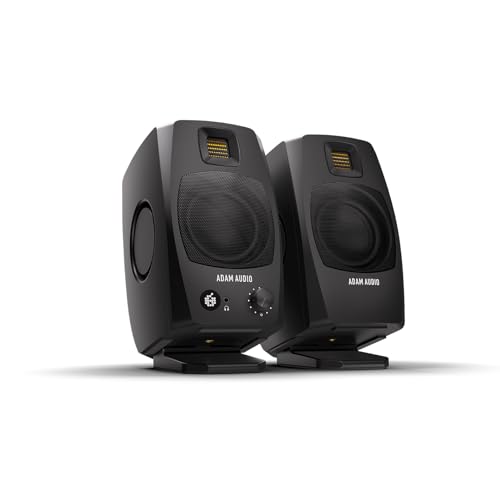
- USB-C desktop monitoring with balanced inputs
- 3.5-inch woofers and passive radiators reach 45 Hz
- Includes angled stands and mic stand mount option
Best For: Small desks, songwriters, and producers
Budget Nearfield Pair
PreSonus Eris E4.5 Studio Monitors

- Compact 4.5-inch nearfield monitor pair
- TRS, RCA, and aux inputs add flexibility
- Tone controls help match the room
Best For: Home studios and budget-conscious desktop setups
Compact Bass Add-On
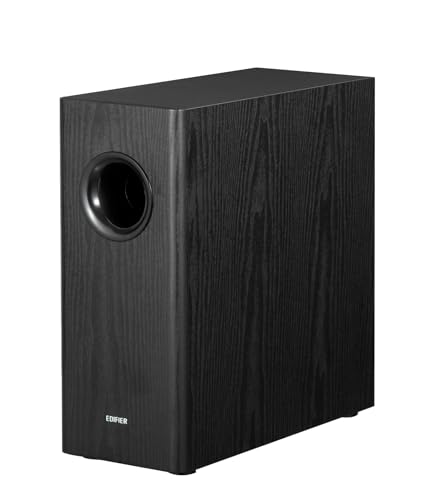
- 8-inch woofer with 70W RMS output
- Low-pass filter and phase control
- RCA and 3.5mm-to-RCA included
Best For: Compact bass expansion for active speaker setups with sub out
All-in-One Desktop Bundle
Mackie CR3.5 with CR8SBT Subwoofer

- Bundle includes monitors, subwoofer, and RCA cable
- Tone control, headphone out, and multiple inputs
- Desktop remote with crossover and level control
Best For: A ready-made 2.1 desktop setup for production, gaming, and casual listening
Flexible Near-Field Monitor
Edifier MR3 Powered Studio Monitor

- Hi-Res Audio with 52Hz to 40kHz response
- TRS, RCA, AUX, Bluetooth, and headphone out
- App-based EQ plus Music/Monitor/Custom modes
Best For: Compact near-field monitoring with broad connectivity and app tuning
JBL Studio Bass Expander – JBL LSR310S 10-inch Studio Subwoofer
If you’re building studio monitors with subwoofer output into a fuller monitoring chain, the JBL LSR310S is designed to add deep low end without getting in the way of your mains. Its patented port design and custom 10-inch driver are aimed at low-frequency extension down into the 20 Hz region, while the balanced I/O makes it easy to integrate into a professional setup.
Best For: Producers who want a studio subwoofer for accurate low-end extension, club-style bass checks, and easy balanced integration.
Pros:
- Custom 10-inch driver delivers deep low-frequency response into the 20 Hz region.
- XLF tuning adds a club-style bass option for dance-focused sessions.
- Balanced XLR and 1/4-inch inputs and XLR outputs support studio monitor systems.
- -10 dBV / +4 dBu sensitivity switch helps match different signal sources.
Cons:
- It is a floor-standing subwoofer, so it needs dedicated space in the room.
- Focuses on low-end extension rather than full-range playback.
Overall, the LSR310S is a strong fit when the goal is to extend a monitoring setup rather than replace it. Its tuning options and balanced connections make it especially practical for studios that need controlled bass with flexible routing.
ADAM Low-End Companion – ADAM Audio T10S Active Studio Subwoofer
The ADAM Audio T10S is built for studio monitors with subwoofer output when you want a compact active subwoofer that fills in the low end cleanly. It is specifically engineered to complement ADAM Audio T5V and T7V speakers, and its adjustable crossover, phase rotation, and volume controls help you adapt it to your room.
Best For: Home studios and production rooms pairing ADAM T-series monitors with an easy-to-tune bass extension.
Pros:
- Compact active design extends bass without taking over the studio footprint.
- Adjustable crossover, phase rotation, and volume help match your monitoring setup.
- Downward-facing woofer adds placement flexibility.
- Footswitch bypass lets you quickly compare mixes with and without the sub.
Cons:
- Designed specifically to complement ADAM T5V and T7V speakers.
- Uses RCA connectivity, so integration may depend on your existing gear.
If you want a straightforward way to add low-end clarity to a nearfield system, the T10S keeps the setup focused and practical. The tuning controls and bypass option make it a useful tool for checking mixes in real-world listening conditions.
Yamaha Desktop Monitor Pair – Yamaha HS3 Powered Studio Monitors, Pair
The Yamaha HS3 pair is a compact option for studio monitors with subwoofer output when you want desktop-friendly speakers that can work into a larger monitoring system. These 2-way powered monitors include room control and high trim response controls, plus XLR/TRS, RCA, and stereo mini inputs for flexible hookups.
Best For: Small studios and desktop setups that need compact monitors with multiple input options and the ability to integrate a sub.
Pros:
- Compact 3.5-inch woofer design fits small desks and tight spaces.
- Room control and high trim response controls help tailor the sound.
- XLR/TRS, RCA, and stereo mini inputs support flexible connections.
- Pair format includes cables and anti-slip pads for a ready-to-use setup.
Cons:
- Limited low-end output compared with larger studio monitors.
- Best suited to short-listening distances and smaller rooms.
The HS3 is a practical choice when you need compact monitors first and foremost, with enough connectivity to grow into a sub-assisted system. It is more about space-saving accuracy than big bass on its own.
PreSonus Bass Control Hub – PreSonus Eris Pro Sub 10 Active Studio Subwoofer
For studio monitors with subwoofer output, the PreSonus Eris Pro Sub 10 is built to handle the low-frequency foundation of a mix while keeping the mains in check. Its front-firing 10-inch transducer, variable lowpass filter, and switchable highpass filter are aimed at clean integration, and the included footswitch makes bypass checks easy.
Best For: Serious home studios and pro production rooms that want controlled bass management and flexible monitor routing.
Pros:
- Front-firing 10-inch driver and bass-reflex port are designed for strong low-end output.
- Variable lowpass and switchable highpass filters help integrate with main monitors.
- Footswitch bypass simplifies comparison of sub on/off monitoring.
- Balanced XLR, TRS, and RCA connections support a range of setups.
Cons:
- It is a substantial floor-standing subwoofer, so it is not a tiny-footprint solution.
- Primarily focused on bass extension rather than full-range playback.
The Eris Pro Sub 10 stands out for practical bass management, especially if you want to route and fine-tune a monitor system rather than just add more volume. Its combination of filters, pass-through outputs, and bypass control makes it a flexible studio tool.
Subwoofer Expansion Pick – KRK S8.4 8" Powered Studio Subwoofer
If you’re building studio monitors with subwoofer output into a fuller low-end setup, the KRK S8.4 is a focused option for adding real bass extension. Its 8-inch glass aramid composite woofer reaches down to 30 Hz, and the front-firing port plus curved cabinet design give you more flexibility when placing it in a studio space.
Best For: Producers and recording studios that need a dedicated powered sub to extend their monitor system’s low end.
Pros:
- 8-inch woofer with bass extension to 30 Hz
- Front-firing bass port and curved design help placement flexibility
- Footswitch support can enable or disable the sub and crossover filter
- Class D amplification keeps it powerful and lightweight
Cons:
- Footswitch is not included
- Designed as a subwoofer, so it is not a full monitor pair
- Wired XLR connectivity only
Overall, this is a practical sub if your priority is extending a monitoring setup with controlled low-end output. It is best viewed as a system add-on rather than a standalone desktop solution.
Compact Desktop Choice – ADAM Audio D3V Active Desktop Monitor Pair
The ADAM Audio D3V is a compact answer for studio monitors with subwoofer output-style systems when you want desktop monitoring that stays small but still reaches reasonably low. Each speaker uses 3.5-inch aluminum woofers, dual-sided passive radiators, and a 1.5-inch D-ART tweeter, with balanced 1/4-inch inputs and USB-C connection for easy desk integration.
Best For: Songwriters, producers, and music lovers who want a compact active desktop monitor pair with flexible placement and USB-C connectivity.
Pros:
- Fully active desktop monitor pair with USB-C support
- 3.5-inch woofers plus passive radiators extend response to 45 Hz
- Balanced 1/4-inch inputs and DSP switches help with placement issues
- Includes angled stands and mic stand mounting option
Cons:
- Compact 3.5-inch drivers will not match the bass output of larger monitors
- Designed for desktop use, so it is less suited to larger rooms
- Uses tabletop-focused accessories rather than a traditional studio monitor layout
For a small workspace, the D3V offers a polished mix of convenience and monitoring detail. It is a strong fit when you want nearfield accuracy without giving up too much desk space.
Budget Nearfield Pair – PreSonus Eris E4.5 Studio Monitors
The PreSonus Eris E4.5 is a practical entry point for studio monitors with subwoofer output in a compact setup, especially if you want accurate nearfield sound with room to expand later. These 4.5-inch monitors use woven-composite woofers, 1-inch silk-dome tweeters, and multiple analog connections, plus tuning controls to better match your room.
Best For: Home studios, multimedia desks, and listeners who want an affordable monitor pair that can later pair with a sub.
Pros:
- Compact 4.5-inch nearfield monitor pair with studio-focused tuning
- Balanced TRS, RCA, and 1/8-inch aux inputs cover many sources
- High- and low-frequency controls help tailor the sound to the room
- Front-panel headphone output and built-in headphone amp add convenience
Cons:
- Smaller drivers mean limited low-end on their own
- Bluetooth is not included in the monitor pair itself
- Subwoofer is sold separately if you want the fuller 2.1 setup
If you want a straightforward starter pair with plenty of connection options, the Eris E4.5 is easy to work into a desk-based setup. It makes the most sense when you value clarity and flexibility more than deep bass from the monitors alone.
Compact Bass Add-On – Edifier T5s Powered Subwoofer
If you’re building studio monitors with subwoofer output, the Edifier T5s is a straightforward way to add deeper low end without complicating the setup. Its 8-inch woofer, 70W RMS Class-D amplification, and 35Hz bass extension make it a practical match for desktop speakers or small home audio systems that need cleaner bass support.
Best For: Users who want a compact powered sub to pair with active speakers or amps that have sub out, especially for desktop listening and small-room setups.
Pros:
- 8-inch long-throw woofer with 35Hz low-end extension and 70W RMS output.
- Adjustable low-pass filter and phase selector for easier system matching.
- Includes RCA and 3.5mm-to-RCA cables for quick plug-and-play setup.
- Auto-standby helps reduce power use after inactivity.
Cons:
- Wired RCA setup only, with no wireless connectivity.
- For non-sub-out systems, the main speaker must support LINE IN.
- Designed for bass expansion, not as a full-range speaker on its own.
Overall, the T5s is best viewed as a simple, compact bass upgrade for systems that already have the right outputs. If your monitors or amp can feed a subwoofer cleanly, this model gives you useful low-end control without taking up much space.
All-in-One Desktop Bundle – Mackie CR3.5 with CR8SBT Subwoofer
For buyers looking for studio monitors with subwoofer output in a ready-made package, this Mackie bundle removes most of the setup guesswork. It pairs CR3.5 powered monitors with a CR8SBT 8-inch powered subwoofer, plus a 10-foot RCA cable, so you can build a 2.1 desktop system for music production, gaming, or casual listening.
Best For: Anyone who wants a bundled desktop monitor-and-subwoofer system with flexible inputs and simple bass-level control.
Pros:
- Includes powered CR3.5 monitors, CR8SBT subwoofer, and RCA cable in one bundle.
- CR3.5 monitors offer tone control, TRS/RCA/3.5mm inputs, and a front headphone output.
- CR8SBT sub adds deep bass with Bluetooth, RCA, and TRS connectivity.
- Desktop remote allows independent system and subwoofer level control plus crossover adjustment.
Cons:
- Bulkier and heavier than a simple monitor-only setup.
- Best suited to desk-based listening rather than minimal spaces.
- Bundle format may include more features than some users need.
This is the most plug-and-play option in the group if you want a monitor-plus-subwoofer layout from day one. The adjustable crossover and included remote make it easy to tune bass for your room and listening style.
Flexible Near-Field Monitor – Edifier MR3 Powered Studio Monitor
The Edifier MR3 is a practical choice if you’re shopping for studio monitors with subwoofer output-adjacent flexibility, thanks to its balanced TRS, RCA, AUX, and Bluetooth connectivity. It delivers Hi-Res Audio certification, a flat 52Hz to 40kHz response, and app-based tuning, making it well suited for near-field monitoring, editing, and everyday desktop use.
Best For: Creators and listeners who want compact powered monitors with broad input options and detailed sound adjustment.
Pros:
- Hi-Res Audio certified with a flat 52Hz to 40kHz response.
- Balanced TRS, RCA, AUX, headphone output, and Bluetooth with multi-point support.
- Music, Monitor, and Custom modes plus app-based EQ control.
- MDF cabinet helps reduce distortion for near-field use.
Cons:
- Not a dedicated subwoofer system, so deep bass still depends on pairing.
- 18W x 2 RMS output is modest for larger rooms.
- Best results come from careful tuning in the app.
If you want a compact monitor that can integrate cleanly into a broader audio setup, the MR3 covers the essentials well. Its wide connectivity and tuning tools make it easy to adapt for home studios, video editing, or casual desktop listening.
How We Picked the Best Studio Monitors with Subwoofer Output
We focused on Studio Monitors with Subwoofer Output that make it easier to build a balanced 2.1 system, keep bass integration under control, and match different room sizes and budgets. Priority went to models with practical connectivity, usable low-frequency extension, and strong value for home and project studios.
Quick Comparison
The best choice depends on your room and listening distance. Smaller near-field setups are ideal for desks and tight spaces, while larger monitors and dedicated subs suit producers who need more headroom and deeper bass translation. If you already own a subwoofer, choose monitors with straightforward line-level outputs and sensible crossover options.
Key Buying Factors for Studio Monitors with Subwoofer Output
Room Size and Placement
In compact rooms, smaller monitors paired with a well-placed sub often sound more controlled than oversized speakers. Desk placement, wall distance, and isolation all affect bass accuracy, so don’t rely on output power alone.
Crossover and Bass Management
The easiest systems to live with offer clear crossover control, phase adjustment, or simple integration tools. These features help the sub blend in smoothly instead of calling attention to itself.
Connectivity and Signal Routing
Look for balanced inputs, dedicated sub out connections, and any high-pass filtering options if you want your main monitors relieved of deep bass duties. For Studio Monitors with Subwoofer Output, this can make setup much cleaner and more reliable.
Accuracy Over Hype
Deep bass is useful only if it is controlled. A flatter low end, predictable midrange, and consistent stereo imaging are usually more valuable than a monitor that sounds exciting but masks mix problems.
Who Should Buy Which Studio Monitors with Subwoofer Output?
Choose compact monitors if you work at a desk, edit content, or produce in a small room. Go with larger monitors plus a sub if you want more impact and better low-end monitoring for beat-driven genres. If you are building your first serious setup, prioritize ease of integration and room fit over maximum bass output. The right Studio Monitors with Subwoofer Output should improve translation, not just add volume.