
The best power amplifiers for home use make it easier to drive passive speakers, add wireless streaming, or build a flexible entertainment system without buying a full-size receiver. This roundup compares compact Class D models, multi-channel amplifiers, and feature-rich karaoke-friendly options.
Consider your speaker requirements, available inputs, room size, and preferred listening sources before choosing. The right amplifier should provide usable power and convenient connections without paying for features you will not use.
Best 10 Power Amplifiers for Home Use Picks for 2026
Compact Power Pick

- 300W per channel claimed output
- Bass and treble controls
- RCA input for compact systems
Best For: Bookshelf speakers, bass shakers, and desktop audio
Rack-Ready Powerhouse

- Up to 2,000W bridged claim
- Bluetooth and USB MP3 playback
- TRS, XLR, and Speakon connections
Best For: Large home systems and rack-mounted setups
Customizable Bluetooth Amp
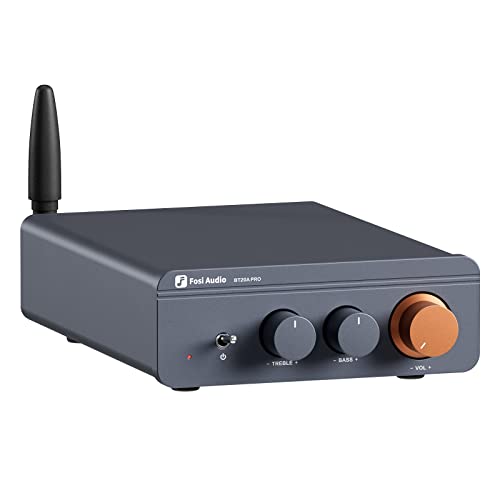
- 300W per channel claimed output
- Bluetooth 5.0 with pairing memory
- Replaceable op-amps and tone controls
Best For: Wireless stereo listening and hands-on audio tuning
Quiet Hi-Fi Hub

- 100W x2 at 4 ohms with included adapter
- Bluetooth 5.4, RCA, and AUX
- Passive cooling with anti-hijack Bluetooth
Best For: Quiet desktop, TV-console, and compact stereo systems
Flexible Desktop Power

- Four channels with up to 50W per channel
- Bluetooth 5.0, RCA, and USB playback
- Independent volume controls for four outputs
Best For: Multi-speaker desktop and compact home audio setups
Feature-Packed Stereo

- 50W + 50W rated stereo output
- Supports passive speakers and active subwoofers
- Bluetooth, digital, analog, USB, SD, and mic inputs
Best For: Karaoke, TV audio, and versatile home entertainment
Simple Mixer Amplification

- 2 x 120W stereo output for 4-ohm speakers
- Three pairs of RCA inputs plus microphone input
- Pager and mixing modes for announcements or karaoke
Best For: Basic stereo, karaoke, and small PA applications
Best Compact Pick
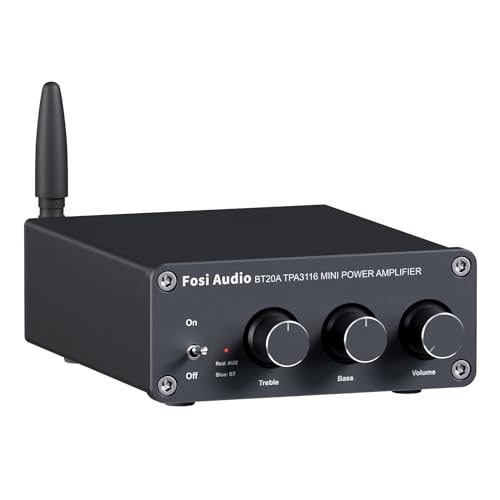
- Compact two-channel Class D amplifier
- Bluetooth and RCA inputs
- Up to 100W x 2 maximum output
Best For: Small rooms and passive bookshelf, ceiling, or patio speakers
Best Feature-Rich Pick
Pyle PTA44BT 4-Channel Amplifier

- Four-channel output with 500W peak power
- Bluetooth, USB, microSD, AUX, and FM radio
- Dual microphone inputs with echo and talk-over
Best For: Karaoke, announcements, and multi-source home entertainment
Best Versatile Stereo Pick
Pyle PDA29BU.5 Stereo Amplifier

- 100W RMS and 200W peak power
- Bluetooth, RCA, USB, SD, and FM inputs
- Microphone controls, LED display, and remote
Best For: Home stereo, computer audio, and karaoke systems
Compact Power Pick – Fosi Audio TB10D
The Fosi Audio TB10D is a compact choice among power amplifiers for home use, pairing substantial rated power with simple RCA connectivity and passive-speaker outputs. Its bass and treble controls make it practical for desktop systems, living rooms, and small home-theater setups.
Best For: Driving 2–8-ohm bookshelf speakers or bass shakers in compact home audio systems.
Pros:
- Claims 300 watts per channel from the TPA3255 amplifier chip.
- Bass and treble knobs allow straightforward sound adjustment.
- Compact design works with phones, computers, CD players, TVs, and other sources through RCA.
- Built-in protection circuits and a 24-month manufacturer warranty add reassurance.
Cons:
- It uses RCA input and passive-speaker output, so connectivity is less extensive than rack-style amplifiers.
- The supplied notes do not identify Bluetooth connectivity.
The TB10D is a sensible option when you want high claimed output and basic tone controls without a full-size receiver. Check speaker impedance and source connections before buying.
Rack-Ready Powerhouse – Pyle PTA1000BT
The Pyle PTA1000BT is a rack-mountable option for power amplifiers for home use when you need multiple connection formats and substantial output. It combines Bluetooth, USB MP3 playback, TRS and XLR inputs, and Speakon outputs in a two-channel chassis.
Best For: Larger home audio, multi-speaker, or event-style setups that benefit from rack mounting and flexible inputs.
Pros:
- Offers 1,000 watts per channel in stereo or 2,000 watts maximum in bridged mode, according to the supplied specifications.
- Includes Bluetooth, USB-A MP3 playback, TRS, XLR, Speakon, and binding-post connections.
- Front-panel LCD and LED indicators show operating and signal status.
- Built-in cooling fans help manage heat during operation.
Cons:
- Its rack-mountable, 19-inch format is considerably less convenient for a typical desktop or shelf system.
- The supplied details list a 220-volt rating and a 120-volt minimum supply specification, so power compatibility should be verified.
- Fan cooling may be less quiet than a passively cooled home amplifier.
This model is aimed at users who value connection flexibility and high claimed output over a small footprint. Confirm your household voltage, speaker impedance, and available rack or ventilation space first.
Customizable Bluetooth Amp – Fosi Audio BT20A Pro
The Fosi Audio BT20A Pro is a flexible pick among power amplifiers for home use, combining Bluetooth 5.0 with a compact two-channel design. Its bass and treble controls are joined by replaceable op-amps, giving hands-on listeners more room to tailor the system’s sound.
Best For: Bluetooth-based stereo listening with passive speakers and optional amplifier customization.
Pros:
- Provides a claimed 300 watts per channel using the TI TPA3255 chip.
- Bluetooth 5.0 includes pairing memory and a method to clear the pairing connection.
- Replaceable NE5532 op-amps support experimentation with compatible alternatives.
- Specified SNR is at least 108 dB and THD is no more than 0.005%.
Cons:
- The notes do not specify wired input options, so source compatibility should be checked if Bluetooth is not sufficient.
- Op-amp swapping requires additional compatible components and user involvement.
- It is designed for passive speakers and does not include speaker cabinets.
The BT20A Pro suits listeners who want wireless convenience but also appreciate adjustable tone and upgrade potential. Its compact size makes it easier to place than a conventional full-size receiver.
Quiet Hi-Fi Hub – Qlearsoul HiCore H2
The Qlearsoul HiCore H2 is a compact, quietly cooled choice among power amplifiers for home use. It accepts Bluetooth 5.4, RCA, and 3.5mm AUX sources, while its anti-hijack switching helps prevent unwanted Bluetooth connections when a wired input is selected.
Best For: Desks, TV consoles, and small stereo systems using passive speakers and multiple everyday sources.
Pros:
- Delivers a stated 100 watts per channel at 4 ohms with the included 30V/5A adapter.
- Bluetooth 5.4, RCA, and AUX provide three practical input options.
- RCA/AUX mode physically cuts the Bluetooth signal, and a long press clears pairing history.
- Passive cooling, a CNC aluminum chassis, and a compact 17×13×10 cm footprint support quiet placement.
Cons:
- The included power supply provides the stated 100W x2 rating; higher peak output requires a separately upgraded power supply.
- It is intended for passive speakers and does not include speakers.
- Its three-input design is simpler than a full-size home-theater amplifier.
The HiCore H2 is a well-matched option for clean, uncluttered everyday listening where quiet operation and input security matter. Its expandable power architecture is useful, but the included adapter should be treated as the standard operating configuration.
Flexible Desktop Power – Douk Audio M4
The Douk Audio M4 is a practical choice among power amplifiers for home use when you need four speaker outputs, multiple source options, and independent channel control. Its Bluetooth 5.0, RCA, and USB playback support suit desktop, office, and compact home stereo systems.
Best For: Multi-speaker home, office, or desktop audio setups.
Pros:
- Four channels rated at up to 50W each for driving most home speakers.
- Supports Bluetooth 5.0, two wired RCA inputs, and USB playback of several lossless formats.
- Four speaker outputs have independent volume controls.
- Compact aluminum-alloy enclosure is suited to desktop or shelf placement.
Cons:
- The supplied notes do not specify speaker impedance compatibility.
- Its four-channel layout may be more than needed for a basic two-speaker system.
The M4 stands out for flexible routing and compact four-channel operation. It is a strong fit if your home setup needs more than standard two-channel amplification without moving to a larger receiver.
Feature-Packed Stereo – Romicta AK55 Stereo Amplifier
The Romicta AK55 is one of the more versatile power amplifiers for home use, combining stereo amplification with Bluetooth, optical, coaxial, AUX, RCA, USB, SD, FM, and microphone inputs. It is designed for home karaoke, TV audio, gaming, and small-room theater systems.
Best For: Home karaoke, TV systems, and feature-rich stereo setups.
Pros:
- Provides 50W + 50W rated output, with a listed 500W + 500W peak figure.
- Supports passive speakers and active subwoofers.
- Offers Bluetooth 5.0 plus optical, coaxial, RCA, AUX, microphone, USB, and SD inputs.
- Includes bass, treble, and volume controls, along with a remote and FM function.
Cons:
- Bluetooth range is limited to about 30 feet without walls, according to the supplied notes.
- Its many features may be unnecessary for listeners seeking a simple amplifier.
- The product notes distinguish between peak and rated output, so the rated figure is the more practical comparison.
The AK55 is best viewed as a compact integrated audio hub rather than a minimalist power amp. Its broad input selection and microphone support make it especially useful for flexible entertainment setups.
Simple Mixer Amplification – Pyle PTA4 2-Channel Amplifier
The Pyle PTA4 is a straightforward option among power amplifiers for home use, offering two-channel amplification, RCA source inputs, microphone mixing, and basic tone controls. Its compact format works for home theater, karaoke, small PA applications, and amplified speakers.
Best For: Basic stereo, karaoke, meeting, and small PA setups.
Pros:
- Delivers 2 x 120W output for speakers with at least 4-ohm impedance per channel.
- Provides three pairs of RCA inputs, a microphone input, headphone connection, and REC output.
- Pager mode enables microphone talkover, while mixing mode supports karaoke use.
- Includes bass, treble, balance, microphone-volume, and master-volume controls.
Cons:
- It does not provide the Bluetooth streaming emphasized by the other listed models.
- The supplied warranty description is 90 days.
- Speaker impedance must be at least 4 ohms per channel in stereo mode.
The PTA4 favors hands-on control and source flexibility over wireless convenience. Choose it when microphone mixing, RCA connectivity, and talkover functionality matter more than modern streaming features.
Best Compact Pick – Fosi Audio BT20A
If you need power amplifiers for home use without a bulky receiver, the Fosi Audio BT20A is a straightforward two-channel option for passive speakers. Its compact Class D design offers Bluetooth and RCA connectivity, plus simple bass and treble controls for everyday listening.
Best For: Bedrooms, offices, living rooms, garages, patios, and other spaces using passive bookshelf or ceiling speakers.
Pros:
- Compact, lightweight design that fits easily on a shelf.
- Bluetooth and RCA inputs support wireless and wired sources.
- Simple bass and treble controls with one-touch power operation.
- Rated for up to 100W x 2 maximum output.
Cons:
- Designed for two-channel use rather than multi-channel home theater setups.
- Its feature set is intentionally basic, with no built-in radio, USB player, or microphone inputs.
The BT20A is a practical choice when you want uncomplicated amplification for passive speakers and easy phone streaming. It is especially appealing where space and simple controls matter more than a long list of extra inputs.
Best Feature-Rich Pick – Pyle PTA44BT 4-Channel Amplifier
For shoppers comparing power amplifiers for home use with karaoke or announcement features, the Pyle PTA44BT offers a broad set of connections. This four-channel receiver includes Bluetooth, USB, microSD, AUX, FM radio, microphone inputs, and a subwoofer output.
Best For: Home karaoke, PA-style entertainment, multi-speaker setups, and users who want microphone and talk-over functions.
Pros:
- Four-channel design supports multiple speakers with 4–8 ohm impedance.
- 500W peak power rating for home theater and PA-style use.
- Two 1/4-inch microphone inputs include echo and talk-over controls.
- Offers Bluetooth, USB, microSD, AUX, FM radio, and subwoofer output.
Cons:
- Its 4.31 kg weight and larger chassis are less convenient than a mini amplifier.
- The extensive controls may be more than needed for simple two-speaker listening.
The PTA44BT stands out for flexibility rather than minimalism. Choose it if your system needs several playback sources, microphone support, or four-channel capability; for basic music streaming, its extra features may be unnecessary.
Best Versatile Stereo Pick – Pyle PDA29BU.5 Stereo Amplifier
The Pyle PDA29BU.5 is a compact two-channel choice among power amplifiers for home use, combining Bluetooth streaming with physical media and microphone inputs. It delivers 100W of RMS continuous power and includes controls for microphone volume, bass, treble, and master volume.
Best For: Home stereo, computer audio, karaoke, and listeners who want Bluetooth, USB, SD, FM, and RCA source options.
Pros:
- Two-channel design supports two stereo speakers.
- Provides 100W RMS continuous power and 200W peak power.
- Includes Bluetooth, RCA, USB, SD card, FM radio, and microphone inputs.
- Digital LED display and included remote simplify source and playback control.
Cons:
- It has fewer channels than a four-channel amplifier.
- The one-year limited warranty is shorter than the warranty listed for the Fosi Audio model.
This Pyle model is a sensible middle ground for users who want more playback choices than a basic Bluetooth amp provides. Its compact enclosure and stereo layout suit everyday home or computer audio, while the microphone inputs add karaoke flexibility.
How We Picked the Best Power Amplifiers for Home Use
We focused on amplifiers suited to common home setups, including two-channel stereo systems, desktop audio, outdoor speakers, bass shakers, karaoke, and multi-speaker installations. Selection criteria included stated output, amplifier class, connectivity, speaker compatibility, size, and practical features such as Bluetooth, USB playback, microphone inputs, FM radio, and tone controls.
Because manufacturers may advertise maximum, bridged, or peak figures differently, wattage should be treated as a comparison point rather than a guarantee of continuous real-world output. System matching and listening goals matter just as much.
Quick Comparison
- Best for compact stereo: Choose a small two-channel Class D amplifier with Bluetooth and RCA or AUX inputs.
- Best for high flexibility: Look for multiple source inputs, microphone support, USB or SD playback, and tone controls.
- Best for multiple speakers: A four-channel model can provide independent channels for distributed audio.
- Best for rack or event-style setups: A rack-mount amplifier with XLR, TRS, Speakon, or bridgeable output may be more suitable.
Key Buying Factors for Power Amplifiers for Home Use
Power and Speaker Matching
Check your speakers’ impedance and recommended amplifier range before buying. An amplifier should support the speakers’ impedance, commonly 4 or 8 ohms, and provide enough clean power for your room. Excessive volume, clipping, or poor ventilation can damage equipment even when the advertised wattage looks sufficient.
Inputs and Streaming
Bluetooth is useful for phones and tablets, while RCA and AUX inputs support televisions, CD players, turntables with a preamp, and other wired sources. Optical input is helpful for compatible TVs. USB and SD playback, FM radio, or microphone inputs are valuable only if they fit your routine.
Channels, Controls, and Installation
Two-channel amplifiers are the simplest choice for conventional left-and-right stereo. Four-channel units suit multiple speaker zones or more complex installations, but they can require additional planning. Consider front-panel controls, remote operation, cooling, footprint, and whether the amplifier can sit in your cabinet safely.
Who Should Buy Which Power Amplifiers for Home Use?
Choose a compact Bluetooth stereo amp for a desktop, bedroom, small living room, or simple passive-speaker upgrade. A higher-output Class D model is a better fit for listeners who want strong stereo performance in a small chassis. Select a four-channel amplifier for distributed audio or several speaker pairs, provided the wiring and impedance are compatible.
For karaoke, parties, or mixed home entertainment, prioritize microphone inputs, echo controls, USB or SD playback, and accessible source selection over headline wattage. Rack-mount and bridgeable models make the most sense for larger systems, dedicated equipment racks, or users who need professional-style connections. Finally, verify the return policy and specifications before connecting speakers, especially when product listings use maximum rather than continuous power ratings.