
The best desktop power amplifiers make it easy to drive passive speakers without giving up valuable space. Compact Class D designs now offer substantial power, while Bluetooth, DAC, subwoofer, and pre-out features add useful flexibility.
Our selection covers affordable stereo amps, high-output models, 2.1-channel systems, tube-equipped designs, and upgrade-friendly components for desks, bookshelves, and small listening rooms.
Best 10 Desktop Power Amplifiers Picks for 2026
High-Power Desktop Amp

- Up to 300W per channel
- Bass and treble controls
- RCA input for passive speakers
Best For: High-output stereo and bass-shaker setups
Upgradeable Hi-Fi Pick

- Up to 300W per channel
- 3.5mm pre-out for expansion
- Swappable NE5532 op-amp
Best For: Customizable desktop hi-fi systems
2.1 Bass System

- 165W x2 plus 350W sub output
- Adjustable sub frequency and volume
- Bluetooth 5.0 wireless input
Best For: Desktop 2.1 systems with passive subwoofers
Best Compact Class D Value

- 50 watts per channel
- Efficient TPA3116D2 Class D design
- Compact aluminum chassis with speaker protection
Best For: Desktop and bookshelf-speaker systems needing simple stereo power
Best All-in-One Tube Amp
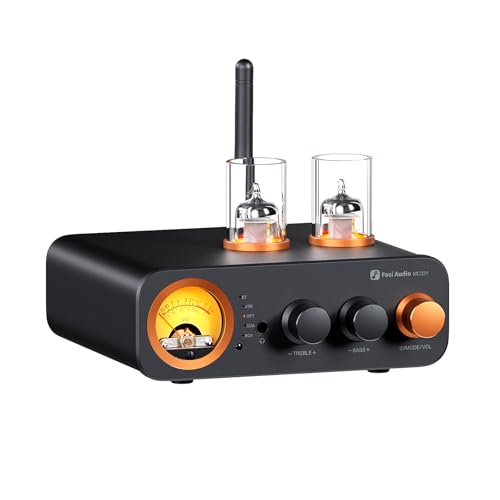
- Up to 105 watts per channel at 4 ohms
- Bluetooth, USB, optical, coaxial, and RCA inputs
- Integrated DAC, preamp, headphone amp, and tube stage
Best For: Flexible desktop systems using speakers, headphones, and multiple sources
Compact Power Pick

- Up to 300W x2 for 2–8Ω passive speakers
- TPA3255 Class D design with low noise
- Swappable op-amps and volume-controlled pre-out
Best For: High-power desktop and bookshelf speaker systems
Wireless Control Pick
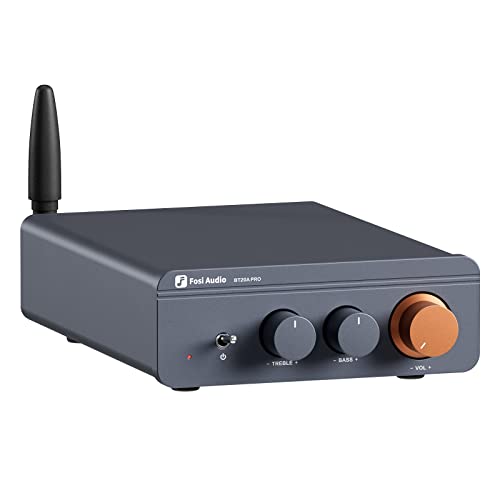
- Bluetooth 5.0 with pairing memory
- Up to 300W x2 through a TPA3255 design
- Bass and treble controls plus swappable op-amps
Best For: Wireless desktop and outdoor passive-speaker setups
Flexible System Builder

- Stereo or mono operation with up to 235W
- Balanced XLR/TRS input and 12V trigger-in
- Larger cooled chassis with swappable op-amps
Best For: Expandable desktop, subwoofer, and home-theater systems
High-Power Desktop Amp – Fosi Audio TB10D
The Fosi Audio TB10D is a strong choice among desktop power amplifiers when you want substantial output in a compact stereo component. Its TPA3255-based design delivers up to 300 watts per channel, while bass and treble controls make it easy to tailor the sound for passive speakers, gaming, or general home audio.
Best For: Driving 2–8-ohm passive bookshelf speakers, bass shakers, and compact home audio systems.
Pros:
- Up to 300 watts per channel from a Class D TPA3255 design.
- Bass and treble controls provide straightforward sound adjustment.
- RCA input and passive speaker output support common audio setups.
- Compact enclosure includes built-in protection circuits.
Cons:
- Connectivity is primarily wired, with no Bluetooth listed.
- Designed for passive speakers rather than powered speakers.
The TB10D stands out for buyers who want high output without a full-size receiver. Its simple controls and broad compatibility make it a practical desktop or room-based amplifier, provided your system uses passive speakers and a wired RCA source.
Upgradeable Hi-Fi Pick – AIYIMA A07 Power Amplifier
The AIYIMA A07 is a compact desktop power amplifier for listeners who want a simple stereo setup with room to experiment. Its TPA3255 and NE5532-based design supports up to 300 watts per channel, while the pre-out adds flexibility for powered speakers or a subwoofer.
Best For: Desktop hi-fi systems using 2–8-ohm passive speakers and optional powered subwoofer expansion.
Pros:
- High-power two-channel output with a TPA3255 Class D chip.
- 3.5mm pre-out can connect to an active speaker, amplifier, or powered subwoofer.
- Swappable NE5532 op-amp supports component experimentation.
- Full-metal housing and enhanced cooling are suited to regular use.
Cons:
- Bluetooth and Wi-Fi are not supported.
- Maximum 300W-per-channel output requires an upgraded power supply; the included supply is 32V/5A.
The A07 is a compelling option for a desktop power amplifier system that may grow over time. Its pre-out and swappable op-amp make it more configurable than a basic mini amp, though buyers should understand the included power supply and wired-only design.
2.1 Bass System – Fosi Audio BT30D Pro
The Fosi Audio BT30D Pro is a useful desktop power amplifier for systems that need dedicated subwoofer control. Its 2.1-channel layout supplies up to 165 watts per stereo channel plus 350 watts for a passive subwoofer, and Bluetooth 5.0 adds convenient wireless playback.
Best For: Desktop, bookshelf, gaming, and outdoor setups requiring stereo speakers plus a passive subwoofer.
Pros:
- Dedicated passive subwoofer output creates a straightforward 2.1 system.
- Subwoofer frequency and volume controls allow detailed bass adjustment.
- Bluetooth 5.0 supports wireless playback up to 15 meters.
- Solid all-metal body and high-quality controls provide a durable feel.
Cons:
- Requires a passive subwoofer for its dedicated bass channel.
- Its 2.1 layout is less suited to buyers who only need basic two-channel amplification.
Choose the BT30D Pro when bass integration matters as much as stereo output. The separate subwoofer controls make placement and tuning easier, while Bluetooth keeps everyday listening convenient without giving up wired speaker connections.
Compact Wireless Value – Facmogu F900S Mini Amp
The Facmogu F900S is a space-saving desktop power amplifier for smaller passive-speaker systems. It provides 50 watts per channel and combines Bluetooth 5.0, USB, and 3.5mm AUX inputs, making it a practical fit for desks, workshops, RVs, and other compact listening spaces.
Best For: Small desktop setups, racing simulators, RVs, workshops, and garages using 4–8-ohm passive speakers.
Pros:
- Compact design delivers 50 watts per channel.
- Bluetooth 5.0, USB, and 3.5mm AUX provide flexible source options.
- Includes a 12V/5A power adapter and connection cables.
- Works with spliced speaker cables or banana plugs.
Cons:
- Lower output than the TPA3255-based amplifiers in this roundup.
- Not compatible with Amazon Echo or Alexa devices.
- Plastic construction may feel less substantial than metal-bodied alternatives.
The F900S prioritizes convenience and footprint over maximum power. It is a sensible desktop power amplifier for everyday listening when you need multiple inputs and easy Bluetooth playback, but larger rooms or demanding speakers may call for a more powerful model.
Best Compact Class D Value – V1.0G Mini Stereo Amplifier
The Fosi Audio V1.0G is a straightforward choice for shoppers comparing desktop power amplifiers for a compact two-channel speaker setup. Its TPA3116D2 Class D design delivers up to 50 watts per channel, while the aluminum chassis and integrated protection circuitry suit everyday home or professional audio use.
Best For: Desktop and bookshelf-speaker systems that need a compact, efficient stereo amplifier.
Pros:
- Outputs up to 50 watts per channel in a small aluminum chassis.
- Class D design supports efficient, cool operation with low power loss.
- Built-in speaker protection and a stated dead-silent idle presentation.
- Includes the power adapter, AC cord, and a 24-month warranty.
Cons:
- Offers two-channel amplification without the broader input selection of an integrated DAC amplifier.
- Its compact output-focused design may be less suitable for shoppers wanting headphone or multiple digital inputs.
The V1.0G is a practical pick when simplicity, small size, and efficient stereo power matter more than extensive connectivity. It is especially well matched with a basic desktop or home speaker system.
Best All-in-One Tube Amp – MC331 Tube DAC Amplifier
The Fosi Audio MC331 stands out among desktop power amplifiers for buyers who want amplification, source switching, and headphone support in one compact unit. It combines a DAC, preamp, tube amplifier, and headphone amplifier, with Bluetooth, USB, optical, coaxial, and RCA inputs.
Best For: Desktop listeners building a flexible digital and analog system with bookshelf speakers and headphones.
Pros:
- Combines DAC, amplifier, preamplifier, and headphone amplifier functions.
- Supports Bluetooth, USB, coaxial, optical, and RCA sources.
- Provides up to 105 watts per channel at 4 ohms for driving bookshelf speakers.
- Includes a remote, adjustable bass and treble, replaceable tubes, VU meter, and pre-out.
Cons:
- Its larger feature set may be unnecessary for users seeking a basic amplifier only.
- Tube-based styling and replaceable tubes may not appeal to listeners who prefer a purely solid-state design.
The MC331 is the most versatile option here, particularly for a desktop setup that mixes computer or wireless audio with speakers and headphones. Its tube presentation, VU meter, and remote add flexibility and visual character.
Best Wireless Mini Amp – Nobsound Bluetooth 5.0 Amplifier
The Nobsound Mini Bluetooth 5.0 Power Amplifier is a convenient option for shoppers comparing desktop power amplifiers with wireless and computer-friendly inputs. Its compact aluminum enclosure delivers up to 50 watts per channel and accepts AUX, USB, and Bluetooth sources.
Best For: Small home, office, or desktop audio systems that need simple wired and wireless connectivity.
Pros:
- Provides up to 50 watts per channel in a one-hand-sized enclosure.
- Bluetooth 5.0 offers a stated faster and more stable wireless connection.
- USB input supports lossless computer playback without a driver.
- Includes a 19V power supply, AUX, USB, and RCA cables for quick setup.
Cons:
- Connectivity is focused on AUX, USB, and Bluetooth rather than a wider range of digital inputs.
- The 18-month limited warranty is shorter than the 24-month warranties listed for the Fosi Audio models.
The Nobsound makes sense when you want a very small amplifier with modern wireless and USB playback. Its included accessories also make it a convenient out-of-the-box choice for a basic desktop or office speaker system.
Compact Power Pick – Fosi Audio V3
For shoppers comparing desktop power amplifiers, the Fosi Audio V3 is a compact two-channel option designed to drive 2–8Ω passive speakers. With the included 48V/5A supply, it offers up to 300 watts per channel and fits desktop, bookshelf, and home-theater setups.
Best For: Desktop listeners who want substantial power, a small footprint, and the ability to experiment with op-amps.
Pros:
- Up to 300W x2 output for 2–8Ω speakers.
- TPA3255 Class D platform with low noise and distortion specifications.
- Top-and-bottom vents plus a whole-body heatsink support cooling.
- Volume-controlled pre-out and swappable 8-pin dual op-amps add flexibility.
Cons:
- Bluetooth connectivity is not listed among the supplied features.
- Its high output may be more than needed for modest desktop speakers.
The V3 is a strong choice when clean power and upgrade potential matter more than built-in wireless features. Its compact enclosure and cooling design make it practical for a powerful desktop system.
Wireless Control Pick – Fosi Audio BT20A Pro
The BT20A Pro stands out among desktop power amplifiers by combining up to 300 watts per channel with Bluetooth 5.0. It is a straightforward two-channel integrated amp for passive speakers, with front-panel bass and treble controls for quick sound adjustments.
Best For: Desktop or outdoor setups where wireless playback, adjustable tone controls, and compact size are priorities.
Pros:
- Bluetooth 5.0 provides convenient wireless playback and pairing memory.
- TPA3255 amplifier delivers up to 300W x2 with stated THD of 0.005% or less.
- Bass and treble controls can be centered for an unaltered setting.
- Replaceable NE5532 op-amps support sound customization.
Cons:
- Supplied power adapter is 32V/5A, rather than the 48V supply included with some higher-output models.
- The supplied notes do not mention a pre-out, balanced input, or trigger input.
Choose the BT20A Pro if convenience is central to your system. Its Bluetooth support and tone controls make it more immediately flexible than a strictly wired desktop amplifier.
Flexible System Builder – Fosi Audio ZA3
For buyers seeking adaptable desktop power amplifiers, the Fosi Audio ZA3 supports both stereo and mono operation. It provides up to 180 watts in stereo or 235 watts in mono, while balanced XLR/TRS input, a 12V trigger-in, and a subwoofer output expand system-building options.
Best For: Desktop and home-theater users planning balanced connections, mono expansion, or a more configurable passive-speaker system.
Pros:
- Switchable stereo and mono modes support different system layouts.
- Balanced combo input accepts XLR or 1/4-inch TRS connections.
- 12V trigger-in enables synchronized power control with compatible equipment.
- Larger chassis, side vents, and dust covers support sustained output.
Cons:
- Maximum output varies by mode, reaching 180W in stereo and 235W in mono.
- Its advanced connections and modes may be unnecessary for a simple desktop setup.
- Using two units for a stereo mono configuration increases system complexity.
The ZA3 is the most expandable option in this group. Its balanced input, trigger control, mono capability, and op-amp flexibility make it well suited to listeners building beyond a basic two-channel desktop system.
How We Picked These Desktop Power Amplifiers
We focused on compact integrated amplifiers that can serve as the heart of a desktop or small-room audio system. Selection criteria included claimed power output, amplifier topology, input options, speaker compatibility, subwoofer support, control layout, and practical installation size. We also included a range of designs, from simple analog mini amps to Bluetooth-enabled Class D models and more feature-rich units with DACs, pre-outs, or tube stages.
Power ratings are not always measured under identical conditions, so they should be treated as a comparison guide rather than a guarantee of real-world output. Your speakers’ impedance, sensitivity, and listening distance matter just as much.
Quick Comparison
| Best For | Look For |
|---|---|
| Basic desktop stereo | Simple two-channel Class D amp with the needed analog input |
| Bluetooth listening | Bluetooth 5.0 or later and convenient front-panel controls |
| High-output speakers | Higher-rated power supply, adequate cooling, and suitable impedance support |
| 2.1-channel systems | Dedicated subwoofer output and adjustable crossover or bass control |
| Flexible upgrades | Pre-outs, balanced inputs, DAC connectivity, or mono capability |
Key Buying Factors for Desktop Power Amplifiers
Power and Speaker Matching
Choose an amplifier that comfortably suits your speakers rather than selecting the largest wattage number. Efficient bookshelf speakers may need only modest power, while insensitive speakers and larger rooms benefit from additional headroom. Check the amplifier’s supported impedance and avoid operating it beyond its stated limits.
Inputs and Connectivity
Bluetooth is convenient for phones and tablets, while RCA, AUX, USB, optical, or DAC inputs may provide better integration with computers and source components. A pre-out can connect to another amplifier or powered subwoofer, but confirm whether it is variable or fixed.
System Design
Two-channel amps suit standard passive-speaker pairs. A 2.1 model is more appropriate when you want separate subwoofer control. Some compact amplifiers also support mono operation or balanced connections, which can make them useful in larger or more specialized systems.
Controls, Heat, and Placement
Look for accessible volume and tone controls if the amplifier will sit on a desk. Class D units are generally compact and efficient, but every amp needs ventilation. Leave space around the chassis and use appropriately sized speaker wire and connectors.
Who Should Buy Which Desktop Power Amplifiers?
Choose a straightforward mini stereo amplifier for a simple computer-and-bookshelf-speaker setup. Bluetooth-focused buyers should prioritize reliable wireless input and easy controls. If you want fuller low-end reproduction, select a model with a dedicated subwoofer output and suitable crossover controls.
Higher-powered TPA3255-based options are worth considering for demanding speakers, larger listening spaces, or future system upgrades. Buyers who want digital sources should favor a built-in DAC, while listeners seeking a warmer presentation may prefer a tube-equipped integrated design. Before ordering, verify the included power supply, speaker impedance requirements, output connections, and whether the advertised wattage matches your intended listening conditions.