
The best energy-efficient mini refrigerators keep drinks, snacks, and everyday essentials cold without taking over a dorm room, bedroom, office, or studio apartment. The right model balances verified efficiency with useful capacity, quiet operation, and freezer space.
Our roundup includes compact single-door units, two-door designs, and freezer-equipped options in several sizes. Use the guide below to narrow your choices based on storage needs, available space, noise tolerance, and expected energy use.
Best 10 Energy Efficient Mini Refrigerators Picks for 2026
Top Freezer Pick

- Energy Star certified at 270 kWh per year
- Separate 0.92-cu.-ft. top freezer
- Reversible door and adjustable glass shelves
Best For: Compact freezer-and-refrigerator storage
Most Efficient All-Refrigerator

- Energy Star certified at 258 kWh per year
- Full 3.2 cu. ft. freezerless interior
- Three shelves and three removable door bins
Best For: Fresh-food storage without a freezer
Best Ultra-Compact Option

- Energy Star certified at 207 kWh per year
- Compact 1.6-cu.-ft. capacity
- Less-than-42-dB operation and reversible door
Best For: Personal cooling in bedrooms and tight spaces
Best Quiet Freezer Combo

- Energy Star certified at 206 kWh per year
- Quiet 38-dB operation
- 0.3-cu.-ft. freezer with crisper drawer
Best For: Quiet rooms needing chilled and limited frozen storage
Simple Frozen Storage Pick

- 3.2 cu. ft. capacity with a separate freezer
- Adjustable mechanical temperature control
- Glass shelves and automatic defrost
Best For: Compact food and drink storage with basic frozen-food capability
Quiet Two-Zone Choice
Feelfunn 3.2 Cu. Ft. Mini Fridge

- 0.96 cu. ft. separate freezer compartment
- ≤38 dB operation for quiet rooms
- Reversible door and adjustable storage
Best For: Bedrooms and dorms needing quiet operation and more freezer space
Lowest-Use Energy Pick
3.2 Cu. Ft. Mini Fridge with Freezer

- 210 kWh listed annual energy consumption
- 0.35 cu. ft. separate upright freezer
- Reversible door and organized interior
Best For: Energy-conscious users needing compact everyday refrigeration
Best Overall
Upstreman 3.1 Cu. Ft. Double-Door Mini Fridge
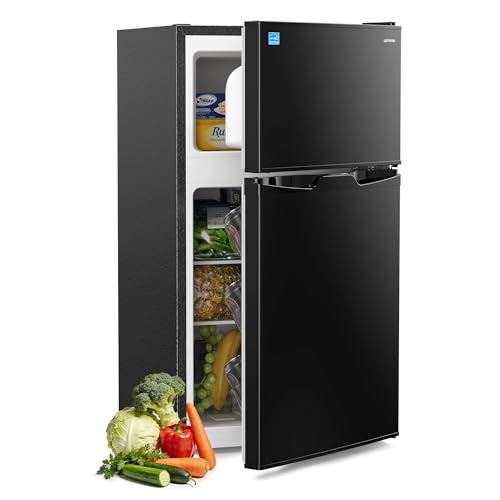
- Energy Star certified with a stated $0.13 daily operating cost
- Separate refrigerator and freezer compartments
- Quiet, organized design with reversible door
Best For: Everyday dorm, bedroom, or apartment use
Best Value
3.2 Cu. Ft. Energy-Saving Mini Fridge

- Stated use of 0.55 kWh and $0.07 per day
- Quiet compressor rated below 37 dB
- One-touch defrosting with flexible shelf storage
Best For: Low-cost bedroom, office, or dorm cooling
Best Large Capacity
4.5 Cu. Ft. Two-Door Mini Fridge

- Largest capacity with a 3.65-cu.-ft. refrigerator
- Separate 0.85-cu.-ft. freezer for frozen goods
- Removable shelves and reversible door aid organization
Best For: Shared rooms and spaces needing extra storage
Top Freezer Pick – Midea 3.1 Cu. Ft. Mini Fridge
For shoppers comparing energy efficient mini refrigerators with separate freezer space, this Midea model combines a 3.1-cubic-foot capacity with an Energy Star-certified compressor rated at 270 kWh per year. Its compact footprint and flexible interior make it practical for dorms, offices, bedrooms, and apartments.
Best For: Buyers who want a compact refrigerator with a usable top freezer and flexible placement.
Pros:
- Separate 0.92-cubic-foot freezer for frozen foods.
- Energy Star certified, with stated annual consumption of 270 kWh.
- Reversible door, adjustable glass shelves, crisper drawer, and interior LED light.
- Temperature controls cover 32°F to 50°F for the refrigerator and -11.2°F to 5°F for the freezer.
Cons:
- Manual defrost requires periodic maintenance.
- Its 33-inch height may not fit under every counter or shelf.
This is a well-rounded choice when freezer capability matters as much as energy-conscious operation. The reversible door and removable shelves add useful flexibility in tight rooms.
Most Efficient All-Refrigerator – Upstreman 3.2 Cu. Ft. CR32
This Upstreman all-refrigerator is a strong option among energy efficient mini refrigerators if you do not need a freezer. It provides 3.2 cubic feet of refrigerated storage while using a stated 258 kWh per year, with three shelves and three door bins for organized access.
Best For: Dorms, offices, and bedrooms that need maximized fresh-food and beverage storage without a freezer.
Pros:
- Energy Star certified with stated annual consumption of 258 kWh.
- Freezerless design provides the full 3.2 cubic feet for refrigerated items.
- Three adjustable glass shelves and three removable door bins support flexible organization.
- Reversible door, automatic LED lighting, and adjustable leveling feet add convenience.
Cons:
- No freezer compartment for frozen foods or ice.
- Automatic temperature control has seven settings rather than a separate freezer range.
Choose this model when fresh-food capacity and organization are higher priorities than freezing. Its space-gray finish and hidden handle also suit modern office or bedroom setups.
Best Ultra-Compact Option – Midea 1.6 Cu. Ft. Mini Fridge
When space is especially limited, this 1.6-cubic-foot Midea is one of the more practical energy efficient mini refrigerators to consider. It uses a stated 207 kWh per year, measures 18.6 by 17.7 by 19.4 inches, and operates at less than 42 dB according to the supplied specifications.
Best For: Bedrooms, dorms, garages, apartments, or kitchens needing a small personal refrigerator.
Pros:
- Compact 1.6-cubic-foot design for tight spaces.
- Energy Star certified with stated annual consumption of 207 kWh.
- Less-than-42-dB operation is designed for quieter environments.
- Reversible door, removable glass shelf, chiller box, and 2-liter bottle rack.
Cons:
- Smaller capacity than the 3.1- and 3.2-cubic-foot models in this roundup.
- Uses manual defrost.
- Its compact internal freezer section limits available fresh-food space.
This model makes the most sense for personal portions, drinks, and a few snacks rather than full grocery storage. Its low stated energy use and quiet design are especially useful beside a bed or desk.
Best Quiet Freezer Combo – Upstreman 3.2 Cu. Ft. BR321
The Upstreman BR321 balances freezer access, compact dimensions, and energy-conscious operation. This 3.2-cubic-foot mini refrigerator has a 0.3-cubic-foot freezer, stated annual consumption of 206 kWh, and a listed operating noise level of 38 dB for bedrooms, dorms, and offices.
Best For: Buyers wanting a quiet mini fridge with a small freezer for everyday chilled foods and limited frozen storage.
Pros:
- Energy Star certified with stated annual consumption of 206 kWh.
- 38-dB operation is suited to sleep, study, and work areas.
- Two adjustable glass shelves, crisper drawer, and three door shelves support organization.
- Reversible door, adjustable leveling feet, and five temperature settings add flexibility.
Cons:
- The 0.3-cubic-foot freezer is limited in size.
- The supplied notes state it is not suitable for storing ice cream and ice cubes.
- Manual defrost requires occasional maintenance.
This is a compelling fit for quiet spaces where a small freezer is still useful. Its low stated energy consumption and practical storage layout make it a versatile dorm or office refrigerator.
Simple Frozen Storage Pick – Igloo 3.2 Cu. Ft. Mini Fridge
If you want energy efficient mini refrigerators with straightforward controls and a separate freezer, the Igloo 3.2 Cu. Ft. model offers practical storage for compact spaces. Its compressor cooling system, adjustable mechanical thermostat, and 304 kWh annual energy consumption make it a useful option for dorms, offices, and homes.
Best For: Shoppers who want a compact refrigerator with dedicated frozen-food storage and simple temperature control.
Pros:
- 3.2 cu. ft. total capacity with a separate 0.2 cu. ft. freezer compartment.
- Adjustable mechanical temperature control supports a 32–50°F refrigerator range.
- Two glass shelves and two door shelves help organize food and drinks.
- Automatic defrost system and freestanding design simplify everyday use.
Cons:
- The freezer compartment is relatively small for larger frozen-food loads.
- The single-door design provides less compartment separation than a two-door model.
- Its listed annual energy consumption is higher than some alternatives in this roundup.
This Igloo is a sensible choice when reliable compressor cooling, glass shelving, and a small freezer matter more than the lowest listed energy use. Its compact 17.13-inch width also makes it suitable for many tight installations.
Quiet Two-Zone Choice – Feelfunn 3.2 Cu. Ft. Mini Fridge
Among energy efficient mini refrigerators, the Feelfunn stands out for its quiet operation and clearly divided refrigerator and freezer areas. It uses an R600a compressor, consumes a listed 0.98 kWh per day, and adds flexible storage features for bedrooms, dorms, offices, RVs, and garages.
Best For: Bedroom or dorm users who prioritize low noise, a larger freezer, and flexible organization.
Pros:
- Separate 2.24 cu. ft. refrigerator and 0.96 cu. ft. freezer zones.
- Listed operating noise is ≤38 dB, making it suitable for quiet rooms.
- Reversible door, adjustable front legs, adjustable glass shelves, and an interior LED light improve convenience.
- Three temperature levels cover refrigerator temperatures of 32–50°F and freezer temperatures down to -0.4°F.
Cons:
- Its listed annual energy consumption is 356 kWh, higher than the other products here.
- The manual defrost system requires occasional maintenance.
- It should remain upright for 6–12 hours before plugging in after transport.
The Feelfunn offers the most substantial dedicated freezer among these options and useful bedroom-friendly touches such as low-noise operation and LED lighting. Consider it when freezer capacity and quiet use outweigh the higher listed energy consumption.
Lowest-Use Energy Pick – 3.2 Cu. Ft. Mini Fridge with Freezer
For shoppers comparing energy efficient mini refrigerators by stated power use, this 3.2 cu. ft. upright model lists just 210 kWh of annual energy consumption and an average use of 0.6 kWh per day. It combines a compact footprint with a separate 0.35 cu. ft. freezer, reversible door, and mechanical temperature dial.
Best For: Budget-conscious users seeking the lowest listed energy consumption and flexible placement in a dorm, bedroom, or office.
Pros:
- Lowest listed annual energy consumption in this comparison at 210 kWh.
- Separate 0.35 cu. ft. freezer reaches listed temperatures from -6°F to -11°F.
- Reversible door supports left- or right-opening installation.
- Three shelves, door bins, a fresh drawer, beverage rack, and freezing mold support organization.
Cons:
- Manual defrost requires hands-on maintenance.
- The freezer is smaller than the Feelfunn’s 0.96 cu. ft. compartment.
- The manufacturer recommends allowing the unit to rest for about 12 hours before initial use.
This model is the strongest fit if energy consumption is your primary buying criterion. Its 210 kWh annual rating, compact dimensions, and reversible door provide an efficient and adaptable setup, while the modest freezer is best for ice and short-term frozen storage.
Best Overall – Upstreman 3.1 Cu. Ft. Double-Door Mini Fridge
If you want one of the more complete energy efficient mini refrigerators for a dorm, bedroom, or apartment, the Upstreman TM31 combines a separate freezer with organized fresh-food storage. Its Energy Star certification, adjustable temperature control, and quiet operation make it a practical everyday option.
Best For: Shoppers who want a certified energy-efficient mini fridge with a separate freezer and flexible storage.
Pros:
- Energy Star certified and rated at $0.13 per day in operating cost.
- Separate 2.22-cu.-ft. refrigerator and 0.88-cu.-ft. freezer compartments help prevent odor transfer.
- Reversible door, adjustable glass shelves, crisper drawer, beverage rack, and interior lighting improve usability.
- Quiet operation is rated as low as 40 dB.
Cons:
- Manual defrosting requires occasional maintenance.
- At 48.5 pounds, it is less convenient to move than smaller compact models.
The TM31 is a strong all-around choice when freezer capacity, organization, and certified efficiency matter more than the smallest footprint. Its 3.1-cu.-ft. capacity should suit daily essentials without taking up full-size refrigerator space.
Best Value – 3.2 Cu. Ft. Energy-Saving Mini Fridge
This 3.2-cu.-ft. compact refrigerator is a practical pick among energy efficient mini refrigerators for bedrooms, offices, and dorms. It emphasizes low reported energy use, quiet operation, straightforward organization, and a one-touch defrosting system.
Best For: Budget-conscious buyers who prioritize low daily energy use and quiet operation.
Pros:
- Claims energy use of 0.55 kWh per day and an operating cost of $0.07 per day.
- Quiet compressor operation is rated below 37 dB.
- Includes two detachable glass shelves, a crisper drawer, LED lighting, and a reversible door.
- One-touch defrosting and a detachable door seal simplify maintenance.
Cons:
- The freezer capacity is only 0.2 cubic feet.
- It is not listed as Energy Star certified and has a fixed left-door orientation in the supplied details.
This model offers useful fresh-food capacity and exceptionally low stated daily energy use for a compact refrigerator. Choose it when quiet performance and easy defrosting are more important than having a roomy freezer.
Best Large Capacity – 4.5 Cu. Ft. Two-Door Mini Fridge
For shoppers needing more room, this 4.5-cu.-ft. refrigerator is one of the larger energy efficient mini refrigerators in this roundup. It offers a 3.65-cu.-ft. fresh-food compartment, a dedicated 0.85-cu.-ft. freezer, adjustable shelves, and a reversible door for flexible placement.
Best For: Dorm rooms, offices, and bedrooms that need more fresh-food and freezer storage.
Pros:
- Offers a spacious 3.65-cu.-ft. refrigerator and separate 0.85-cu.-ft. freezer.
- High-efficiency compressor is designed for fast cooling and low noise.
- Removable glass shelves, crisper, door bin, LED light, and reversible door support convenient organization.
- Adjustable feet help level the refrigerator on uneven floors.
Cons:
- Its stated energy use is 1 kWh per day and 356 kWh annually, higher than the smaller options.
- At 42.91 inches tall and 56.2 pounds, it needs more space and is harder to relocate.
- Manual defrosting requires periodic attention.
The BCD-127B is the better fit when capacity takes priority over the smallest energy footprint. Its two-door layout keeps frozen and fresh items separate while giving you more usable storage for shared spaces.
How We Picked the Best Energy Efficient Mini Refrigerators
We focused on compact refrigerators that suit dorms, bedrooms, offices, guest rooms, and other space-limited settings. The selection emphasizes models with energy-saving claims or Energy Star certification where stated, along with practical capacity, adjustable temperature control, freezer availability, and low-noise operation.
Because advertised energy performance can vary by climate, placement, temperature setting, and usage, treat certification and manufacturer specifications as starting points rather than guarantees. We also considered storage layout, door style, footprint, and the convenience of features such as removable shelves and separate freezer compartments.
Quick Comparison
| Best For | Recommended Type | What to Look For |
|---|---|---|
| Dorm rooms and offices | 3.1–3.2 cu. ft. single-door model | Compact footprint, adjustable thermostat, and useful freezer space |
| Bedrooms and quiet spaces | 1.6–3.2 cu. ft. low-noise model | Published noise claims, stable temperature control, and smooth operation |
| More frozen storage | Two-door refrigerator | Separate freezer compartment and better organization |
| Shared rooms or small apartments | 4.5 cu. ft. model | Higher capacity, adequate ventilation clearance, and stronger storage flexibility |
Key Buying Factors for Energy-Efficient Mini Refrigerators
Capacity and Layout
Capacity matters more than exterior size alone. A 1.6-cubic-foot refrigerator works for drinks and a few snacks, while 3.1 to 3.2 cubic feet is more versatile for dorm or office use. A 4.5-cubic-foot unit offers additional room but requires more floor space. Check interior dimensions if you need to store tall bottles, meal containers, or specific food packages.
Freezer Design
Choose an all-refrigerator model if chilled storage is your priority. For frozen meals or ice, select a freezer-equipped design. Single-door units are often simpler and more compact; two-door models usually separate frozen and fresh foods more effectively.
Energy Use and Ventilation
Look for Energy Star certification or clear manufacturer energy information when available. Leave the clearance recommended in the manual, keep the condenser area unobstructed, and avoid placing the refrigerator beside heat-producing appliances. Correct placement helps the compressor work efficiently.
Noise, Controls, and Maintenance
For bedrooms, prioritize models that publish low-noise specifications, but remember that compressor cycling is normal. Adjustable thermostats make it easier to balance food safety and energy use. Removable shelves, easy-clean interiors, and a reversible door can also improve everyday usability.
Who Should Buy Which Energy Efficient Mini Refrigerators?
- Choose a compact 1.6-cubic-foot model if you need basic cold storage in a bedroom, office, or small personal space.
- Choose a 3.1- to 3.2-cubic-foot refrigerator for the best all-around balance of footprint, food storage, and freezer capability.
- Choose a two-door model if you regularly store frozen meals, ice, or longer-term frozen items.
- Choose the 4.5-cubic-foot option if multiple people will share the refrigerator or you need room for larger groceries.
Before ordering, measure the available opening, confirm the door swing, check the outlet requirements, and verify the return policy. These simple checks help ensure your new mini refrigerator fits both your space and your daily routine.