
Choosing the best DJ mixer for clubs means balancing sound quality, dependable controls, channel count, and compatibility with the booth’s existing setup. The right system should handle long sets without slowing down transitions or limiting creative performance.
This roundup compares 10 club-ready mixers and DJ systems, from straightforward four-channel mixers to standalone controllers with touchscreens, streaming, stems, and advanced track separation.
Best 10 Dj Mixer for Clubs Picks for 2026
Versatile Club Workhorse

- Four-channel layout with dedicated EQ and cue controls
- USB mixing and recording for Mac and PC
- Broad input and output selection
Best For: Club, mobile, party, and practice DJs needing flexible four-channel control
Standalone Streaming Hub
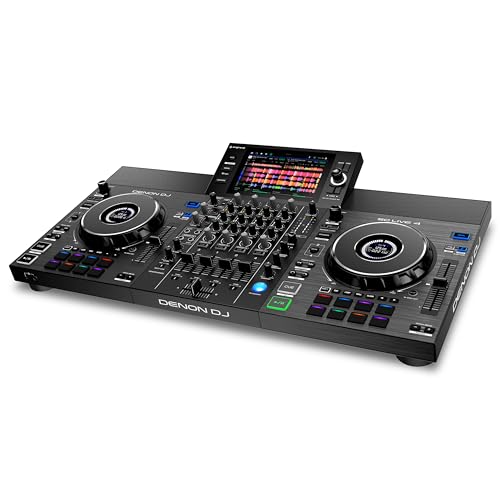
- Laptop-free four-deck performance with Engine DJ
- 7-inch touchscreen plus USB and SD media inputs
- XLR, RCA, booth, mic, Bluetooth, and Wi-Fi connectivity
Best For: Club, mobile, and streaming DJs wanting an all-in-one performance system
Compact All-in-One System

- Two-channel integrated digital DJ system
- 7-inch touchscreen and velocity pads included
- USB connectivity for digital DJ workflows
Best For: Practice, demo, and compact performance setups
Budget BPM Mixer

- Three dual-input stereo channels
- Dual auto-BPM counter and three-band kill EQ
- Crossfader rated for up to 500,000 life cycles
Best For: Budget-minded DJs wanting traditional three-channel mixing controls
Club-Ready Performance

- Motorized 7-inch platters and responsive MAG FOUR crossfader
- Advanced stems, FX, pads, and OLED performance displays
- Professional XLR, TRS, and RCA connectivity
Best For: Club DJs seeking tactile Serato performance control
Venue Command Center

- Standalone four-channel system with a 10.1-inch touchscreen
- Streaming, stems, sampler, and extensive media support
- Dedicated zone output and multiple microphone controls
Best For: Venues needing flexible computer-free performance
Portable Club Companion

- Battery-powered standalone controller with built-in speakers
- Wi-Fi streaming, SD, USB, and Dropbox music access
- Compact two-deck design with XLR main outputs
Best For: Mobile DJs and compact event setups
Classic Control Pick

- Six channels with flexible source routing
- 10-band EQ and built-in effects
- Rack-mount design with Bluetooth
Best For: Hands-on club mixing and installed setups
Professional Performance Pick

- Four-channel club-standard workflow
- Separates vocals, drums, and instruments
- Works with rekordbox and Serato DJ Pro
Best For: Advanced live performance and open-format DJing
Beginner-Friendly Pick
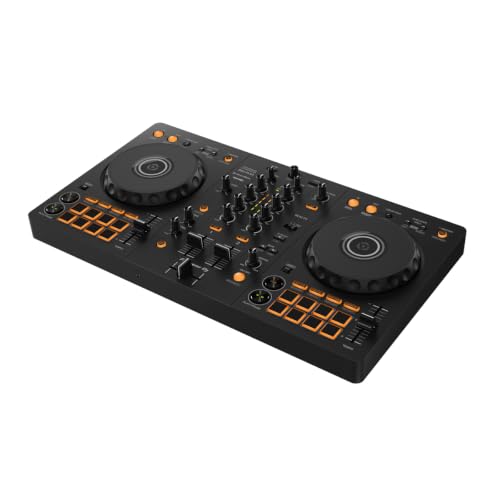
- Simple two-deck layout for learning
- Smart Fader assists beatmatching
- Portable and streaming-ready
Best For: New DJs, practice, and livestreaming
Versatile Club Workhorse – Numark M6 USB
The Numark M6 USB is a practical dj mixer for clubs that need four-channel flexibility, straightforward controls, and broad connection options. Its USB interface also supports laptop mixing and recording sets.
Best For: Club DJs, mobile performers, weddings, parties, and practice setups requiring four channels.
Pros:
- Four channels with dedicated level faders, cue controls, and three-band EQ.
- Multiple phono, line, and microphone inputs plus master, record, booth, and headphone outputs.
- Plug-and-play USB connectivity for Mac and PC mixing or recording.
- Replaceable, slope-adjustable crossfader and LED monitoring.
Cons:
- Requires corded power.
- Does not include the standalone performance features of an all-in-one DJ system.
The M6 USB is a strong choice when connection flexibility and traditional mixer control matter more than built-in decks or touchscreen features.
Standalone Streaming Hub – Denon DJ SC LIVE 4
The Denon DJ SC LIVE 4 is a dj mixer for clubs and performers who want an all-in-one, laptop-free setup. Its Engine DJ platform, touchscreen, streaming support, and professional outputs make it adaptable for club, mobile, and streaming work.
Best For: DJs seeking standalone four-deck performance, wireless streaming, and flexible club or mobile connectivity.
Pros:
- Runs professional performances without a computer using Engine DJ OS.
- 7-inch touchscreen, SD storage, two USB inputs, and access to supported streaming services.
- Includes XLR main, RCA main, booth, microphone, Bluetooth, and Wi-Fi connectivity.
- Supports Serato DJ and VirtualDJ compatibility, with built-in speakers for portable use.
Cons:
- Larger and heavier than a traditional mixer, at 28.3 inches wide and 13.6 pounds.
- Its many features may be more than needed for DJs who only want a basic club mixer.
The SC LIVE 4 is best suited to DJs who value an integrated booth, broad media access, and professional outputs in one unit.
Compact All-in-One System – Pioneer DJ XDJ-RR
The Pioneer DJ XDJ-RR is a compact digital DJ system for performers who want an integrated setup rather than a separate dj mixer for clubs. Its two-channel design includes USB connectivity, a 7-inch touchscreen, and velocity pads.
Best For: DJs wanting a straightforward two-channel digital system for practice, demos, and compact performance setups.
Pros:
- All-in-one digital DJ system with two channels.
- Includes a 7-inch touchscreen and velocity pads.
- USB connectivity supports a streamlined digital workflow.
Cons:
- Two channels provide less mixing capacity than four-channel alternatives.
- The supplied notes do not specify extensive analog input or output options.
The XDJ-RR makes sense for DJs prioritizing an integrated, relatively compact digital setup over a traditional multi-input club mixer.
Budget BPM Mixer – Behringer DX626
Behringer Pro Mixer Dx626 Professional 3-Channel Dj Mixer With Bpm Counter, Black
Check Price On AmazonThe Behringer DX626 is a straightforward dj mixer for clubs, small venues, and DJs who want traditional controls with an integrated BPM counter. It provides three dual-input stereo channels, kill EQ, and a durable crossfader design.
Best For: Budget-conscious DJs needing a conventional three-channel mixer with BPM counting and flexible stereo inputs.
Pros:
- Dual auto-BPM counter supports beat-matching workflow.
- Three dual-input stereo channels with gain and three-band kill EQ.
- Ultraglide crossfader is rated for up to 500,000 life cycles.
- One channel can switch to a studio-grade microphone input, with PFL monitoring.
Cons:
- Uses RCA outputs and inputs rather than the broader professional output selection found on some newer systems.
- Does not provide the standalone decks, touchscreen, or streaming features of integrated DJ systems.
The DX626 is a sensible fit when essential channel mixing, BPM assistance, and a long-life crossfader are the priorities.
Club-Ready Performance – RANE PERFORMER
The RANE PERFORMER is a strong choice for DJs seeking a club-focused dj mixer for clubs with motorized platters, responsive faders, and extensive performance controls. Its solid metal construction and professional outputs suit demanding booth setups.
Best For: DJs who want tactile turntable-style control, advanced Serato performance features, and robust club connectivity.
Pros:
- Two 7-inch motorized, high-torque aluminum platters with magnetic acrylic discs
- MAG FOUR crossfader and adjustable-tension volume faders for precise control
- Multiple XLR, TRS, and RCA inputs and outputs, plus DVS support
- Dedicated stem controls, customizable FX, OLED displays, and performance pads
Cons:
- Its 28.2-pound weight and large footprint make it less portable
- Designed around Serato DJ Pro and requires a computer for the software-based workflow
The RANE PERFORMER prioritizes hands-on expression and dependable connections over portability. It is especially compelling for club DJs who value motorized platter feedback and a traditional mixer-style performance layout.
Venue Command Center – Denon DJ PRIME 4+
The Denon DJ PRIME 4+ is a versatile standalone dj mixer for clubs built for computer-free performances, guest requests, and multi-room sound. Its four channels, streaming support, touchscreen, and dedicated zone output make it well suited to larger venue workflows.
Best For: DJs and mobile entertainers who need standalone four-deck control, broad music access, and flexible venue routing.
Pros:
- Standalone four-channel operation with USB, SD, SATA, streaming, and Dropbox support
- 10.1-inch touchscreen, 25-plus Main FX, Sweep FX, Touch FX, and Drop Sampler
- Dedicated XLR Zone output for sending different music to another room
- Four line/phono inputs, dual microphone sections, and multiple XLR speaker outputs
Cons:
- Its 28.68-inch width requires substantial booth or table space
- Standalone stems require pre-rendering with Engine DJ Desktop
- Serato DJ Pro and VirtualDJ controller use requires a license
The PRIME 4+ is more than a basic mixer: it is a complete standalone performance system. Its zone routing, microphone controls, and wide media support make it a practical fit for venues where flexibility and independent operation matter.
Portable Club Companion – Numark Mixstream Pro Go
The Numark Mixstream Pro Go offers a portable approach to a dj mixer for clubs, combining standalone Engine DJ operation with battery power, built-in speakers, and wireless music access. It is useful for smaller events, warm-up sets, and DJs who need to move between locations.
Best For: Mobile DJs, pop-up events, and performers who prioritize battery-powered operation, streaming, and compact setup flexibility.
Pros:
- Battery-powered standalone operation with built-in speakers
- Wi-Fi streaming, SD card support, two USB ports, and Dropbox library access
- 7-inch touchscreen, 6-inch jog wheels, and Serato DJ and VirtualDJ integration
- Balanced XLR main outputs, microphone input, and wireless DJ light control
Cons:
- Its two-deck layout is less suited to complex four-channel club mixing
- Built-in speakers and compact connections may not replace a full venue sound system
- Standalone stems require pre-rendering, and the listed battery runtime is not specified
The Mixstream Pro Go trades large-venue routing for convenience and mobility. It can serve club-adjacent applications well, but DJs running complex multi-deck sets or larger booth systems may prefer a more substantial four-channel unit.
Classic Control Pick – Pyle PYD1964B.5
The Pyle PYD1964B.5 is a practical dj mixer for clubs that favors hands-on control over software-driven workflows. Its six channels, 10-band graphic equalizer, Bluetooth connectivity, rack-mount design, and dedicated effects make it suitable for DJs who want traditional sliders and dials with flexible routing.
Best For: DJs who prefer analog-style controls, multiple inputs, vocal adjustment, and rack-mounted installation.
Pros:
- Six-channel layout supports flexible source routing and remixing.
- 10-band equalizer plus echo, delay, repeat, and digital effects provide extensive output control.
- Includes two microphone inputs with bass, mid, high, and frequency-kill controls.
- Bluetooth connectivity and XLR audio connections add setup flexibility.
Cons:
- Its traditional slider-and-dial design may feel less streamlined than a modern software controller.
- It is a corded, 5U rack-mount unit rather than a lightweight portable controller.
Choose the Pyle if your club setup benefits from numerous inputs, physical controls, and built-in sound-shaping options. It is especially appealing for installations or performers who want straightforward, tactile mixing.
Professional Performance Pick – Pioneer DJ DDJ-FLX10
The Pioneer DJ DDJ-FLX10 is a forward-looking dj mixer for clubs built around a four-channel workflow that mirrors a CDJ and DJM booth setup. It adds track separation for live vocal, drum, and instrument mashups, while rekordbox and Serato DJ Pro compatibility gives experienced DJs room to work across platforms.
Best For: Serious hobbyists, mobile DJs, and professionals who want four-channel control, advanced remixing, and lighting integration.
Pros:
- Four-channel layout translates well to a club-standard booth workflow.
- Track Separation enables live manipulation of vocals, drums, and instruments.
- Large jog wheels feature multicolor displays for waveforms, artwork, and playing parts.
- Supports rekordbox and Serato DJ Pro, with built-in DMX output for lighting control.
Cons:
- Its 14.8-pound build is less convenient for DJs seeking a highly portable controller.
- The advanced feature set may be more than beginners need for basic two-deck mixing.
The DDJ-FLX10 is the strongest fit here for performance-focused users who want a controller that feels at home in a club-style environment. Its four-channel layout and creative separation features support complex live sets without requiring pre-prepared remixes.
Beginner-Friendly Pick – Pioneer DJ DDJ-FLX4
The Pioneer DJ DDJ-FLX4 is a compact dj mixer for clubs and practice spaces aimed at newcomers who want a simple path into DJing. Its two-deck layout, Smart Fader, performance pads, built-in sound card, and support for rekordbox, Serato DJ Pro, and DJay make it easy to learn while leaving room to develop.
Best For: Beginners, bedroom DJs, livestreamers, and performers who need a portable two-channel controller.
Pros:
- User-friendly layout is based on Pioneer DJ professional gear.
- Smart Fader automatically adjusts volume, bass, and BPM for easier transitions.
- Sixteen performance pads support hot cues, pad effects, beat jumping, and sampling.
- USB and Bluetooth connectivity work with PC, Mac, iPhone, iPad, and Android devices.
Cons:
- Its two-channel, two-deck design offers less control than four-channel club controllers.
- Advanced club setups may outgrow its compact feature set.
The DDJ-FLX4 is a sensible starting point for learning club-style techniques without carrying a large controller. It is particularly useful when portability, streaming support, and accessible automatic mixing features matter more than extensive channel capacity.
How We Picked the Best Dj Mixer for Clubs
We focused on systems that suit club performance, practice rooms, mobile venues, and professional booths. Our comparison considers channel capacity, layout, connectivity, performance controls, software or standalone operation, portability, and how easily each option can fit into an existing DJ setup.
The selection includes traditional mixers and all-in-one DJ controllers because many modern club systems combine mixing, decks, effects, and media playback in one unit. Features such as balanced outputs, reliable cueing, multiple inputs, USB connectivity, and clear visual feedback can make a meaningful difference during a live set.
Quick Comparison
- Best for a traditional mixer setup: Numark M6 USB offers four channels and straightforward controls.
- Best for standalone performance: Denon DJ PRIME 4+ and SC LIVE 4 reduce reliance on a laptop.
- Best for advanced creative mixing: RANE PERFORMER and Pioneer DJ DDJ-FLX10 provide extensive performance features.
- Best for portability: Numark Mixstream Pro Go is designed for flexible, wireless-friendly use.
- Best for beginners: Pioneer DJ DDJ-FLX4 provides a more approachable two-channel layout.
Key Buying Factors for a Dj Mixer for Clubs
Channel Count and Setup Compatibility
Four channels give DJs more room for layered transitions, multiple media players, external instruments, or backup sources. A two- or three-channel mixer may be sufficient for simpler sets, while a standalone four-deck controller can replace several separate components. Check the club’s existing equipment and input requirements before choosing.
Outputs, Inputs, and Sound System Integration
Look for professional master outputs, booth output control, microphone inputs, and suitable line or phono connections. Balanced outputs are especially useful for longer cable runs and professional sound systems. If you plan to connect turntables, media players, or external effects, confirm that the mixer supports those sources.
Workflow and Performance Controls
Large jog wheels, responsive faders, performance pads, effects, track separation, stems, and sampler functions can improve live creativity. However, extra controls are only valuable if they match your workflow. Prioritize familiar layouts and reliable operation over feature lists you may rarely use.
Standalone Features and Software Support
Standalone units can simplify setup by loading music directly from internal storage, USB drives, or supported streaming services. Laptop-based controllers may offer broader software flexibility. Confirm software compatibility, music-library requirements, Wi-Fi needs, and update support before buying.
Who Should Buy Which Dj Mixer for Clubs?
Choose a conventional mixer if you already own media players or turntables and want a central mixing hub. Pick a standalone controller if you want an all-in-one system for club nights, events, or laptop-free operation. Advanced performers should consider four-channel systems with stems, track separation, and customizable performance controls.
For newer DJs, a compact two-channel controller is easier to learn and transport. Mobile performers may prefer a portable standalone model, while budget-focused buyers should concentrate on dependable channel control, outputs, and build quality rather than decorative lighting or rarely used features.