
If you want more than audio and video, baby monitors with oxygen tracking can add an extra layer of reassurance at home. They’re designed to help you watch trends and get notified when readings move outside your comfort zone.
Below, we’ve focused on options that combine meaningful health tracking, practical monitoring features, and everyday usability for new parents.
Best 10 Baby Monitors with Oxygen Tracking Picks for 2026
FDA-Cleared Pulse & Oxygen Monitor
Owlet Dream Sock Smart Baby Monitor
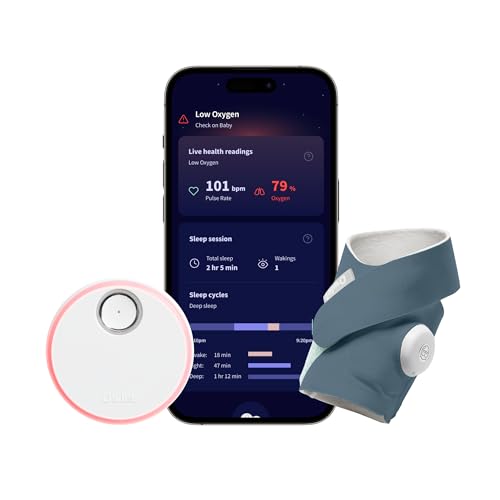
- Tracks pulse rate and oxygen in real time
- Sends alerts when readings leave preset zones
- Includes app access, fabric socks, and charging base
Best For: Parents wanting real-time oxygen alerts and sleep peace of mind
Wearable-Free Sleep Tracking
Philips Avent Premium Connected Baby Monitor

- SenseIQ tracks sleep and breathing rate without wearables
- Includes 1080p camera and 5-inch HD screen
- Private encrypted Wi‑Fi connection with app insights
Best For: Parents who want wearable-free breathing tracking and video monitoring
Portable Continuous Oximeter
Medical Grade Infant Pulse Monitor

- Tracks SpO2 and pulse rate with wrap probe
- Continuous monitoring with customizable alarms
- Portable design with large LCD display
Best For: Portable oxygen and pulse tracking with alert settings
Smart Sock Sleep Monitor
Owlet Dream Sock Smart Baby Monitor

- Real-time pulse rate and oxygen tracking
- Alerts on Base Station and phone
- Predictive Sleep Technology plus 16-hour battery life
Best For: Healthy infants 1–18 months needing wearable oxygen alerts
FDA-Cleared Starter Bundle
Owlet Dream Duo (Gen 1) Smart Baby Monitor

- Tracks pulse rate and oxygen in real time
- Includes 1080p HD camera and app viewing
- Base Station alerts when readings leave preset ranges
Best For: Parents wanting an all-in-one health plus video monitor
Sleep-Focused Health Monitor
Owlet Dream Sock Smart Baby Monitor

- Tracks pulse rate and oxygen in real time
- Alerts on phone and Base Station when readings shift
- Includes sleep trend and wake-window insights
Best For: Parents who want a wearable monitor without video
Advanced 2K Monitoring System
Owlet Dream Duo 3 Smart Baby Monitor System

- Tracks pulse rate and oxygen with real-time alerts
- Adds a 2K HD camera with wide-angle view and zoom
- Monitors room temperature and humidity too
Best For: Parents wanting the most complete Owlet monitor system
FDA-Cleared Pulse + Video Monitoring
Owlet Dream Duo 2 Smart Baby Monitor System

- Tracks pulse rate, oxygen, wakings, and sleep trends
- Includes FDA-cleared Dream Sock plus HD camera
- Offers real-time app and Base Station alerts
Best For: Parents wanting oxygen tracking with built-in video monitoring
Advanced 2K Health + Sleep Monitoring
Owlet Dream Duo 3 Smart Baby Monitor System

- Tracks pulse rate and oxygen with medical-grade pulse oximetry
- Adds 2K HD video, 4x zoom, and wide-angle viewing
- Monitors room temperature, humidity, sound, movement, and crying
Best For: Parents wanting the most advanced all-in-one oxygen and video monitor
Best Simple Pick
Owlet Dream Duo 3 Smart Baby Monitor System

- Medical-grade pulse oximetry tracks oxygen and pulse
- 2K HD camera adds sharp live video and zoom
- Predictive Sleep Technology supports wake-window planning
Best For: Parents who want advanced oxygen tracking with sleep-focused app tools
FDA-Cleared Pulse & Oxygen Monitor – Owlet Dream Sock Smart Baby Monitor
If you’re comparing baby monitors with oxygen tracking, the Owlet Dream Sock is built for parents who want real-time pulse rate and oxygen readings plus alerts when measurements leave preset zones. Its fabric sock design, phone app, and Base Station make it a practical choice for overnight reassurance without adding extra nursery hardware.
Best For: Parents of healthy infants 1–18 months who want real-time oxygen and pulse alerts for nighttime peace of mind.
Pros:
- Tracks pulse rate and oxygen levels in real time with preset-zone alerts.
- Includes a comfortable fabric sock and wireless charging Base Station.
- Works with Bluetooth and 2.4 GHz Wi‑Fi, with app-based monitoring.
- Offers Predictive Sleep Technology for sleep trends and wake windows.
Cons:
- Compatible only in the United States.
- Not currently compatible with 5 GHz Wi‑Fi during setup or use.
- Designed for healthy infants in the stated weight and age range.
Overall, this is a strong fit if your priority is a baby monitor with oxygen tracking and you want actionable alerts rather than passive data. The tradeoff is setup compatibility limits, but the core monitoring features are focused and robust.
Wearable-Free Sleep Tracking – Philips Avent Premium Connected Baby Monitor
For families shopping baby monitors with oxygen tracking who prefer not to put anything on the baby, the Philips Avent Premium Connected Baby Monitor uses SenseIQ Technology to track sleep and breathing rate from the nursery camera. It combines a 1080p camera, 5-inch HD screen, and app insights for a more complete picture of nighttime monitoring.
Best For: Parents who want wearable-free sleep and breathing tracking with a video monitor and private connection.
Pros:
- Wearable-free monitoring uses SenseIQ Technology to track sleep and breathing rate.
- Includes a 1080p camera and 5-inch HD parent screen with night vision.
- Provides app-based sleep insights and a customized sleep diary.
- Secure Connect System offers a private, encrypted Wi‑Fi connection.
Cons:
- Tracks sleep and breathing motion rather than a sock-style oxygen monitor.
- Cry translation is offered through an external service provider.
- App availability is limited to the USA, Canada, and Mexico.
This monitor stands out if you want breathing-focused tracking without wearable gear and also want a strong video setup. It’s less specialized than a dedicated pulse-and-oxygen monitor, but it brings helpful smart nursery features together in one system.
Portable Continuous Oximeter – Medical Grade Infant Pulse Monitor
If you’re specifically looking for baby monitors with oxygen tracking, this handheld pulse oximeter focuses on continuous SpO2 and pulse rate measurement with a wrap probe and adjustable alarms. It’s more of a medical-style monitoring tool than a nursery camera, making it useful when you want portable, on-demand oxygen readings for infants, kids, or adults.
Best For: Families who need portable continuous SpO2 and pulse monitoring with customizable alarms.
Pros:
- Measures SpO2 and pulse rate with fast 8–10 second readings.
- Supports continuous monitoring with 3-in-1 adjustable alarms.
- Large 2.4-inch LCD is easy to read, even in low light.
- Wrap probe is designed for comfortable long-term use.
Cons:
- Not a traditional baby monitor with camera or app features.
- Notes state it is not intended for medical purposes.
- AAA batteries are required and not included.
This is the most straightforward oxygen-focused option in the group, but it serves a different role than a full baby monitor system. Choose it if your priority is portable saturation and pulse tracking with alarms, not nursery video or sleep features.
Smart Sock Sleep Monitor – Owlet Dream Sock Smart Baby Monitor
Among baby monitors with oxygen tracking, the Owlet Dream Sock is designed to give parents real-time pulse rate and oxygen readings with alerts when values leave preset zones. The fabric sock, wireless charging Base Station, and app support make it a polished option for overnight monitoring and routine building.
Best For: Parents of healthy infants 1–18 months who want a wearable monitor with real-time oxygen alerts.
Pros:
- Tracks pulse rate and oxygen levels in real time.
- Sends alerts to the Base Station and your phone when readings leave preset zones.
- Includes Predictive Sleep Technology for wake windows and sleep trends.
- Comfortable fabric sock and 16-hour battery life support nightly use.
Cons:
- Compatible only in the United States.
- Not currently compatible with 5 GHz Wi‑Fi.
- Intended for healthy infants within the listed age and weight range.
If you want a dedicated oxygen-tracking baby monitor with app alerts and sleep insights, this one is highly focused on the essentials. It’s best for parents who value wearable monitoring and don’t mind the Wi‑Fi setup restrictions.
FDA-Cleared Starter Bundle – Owlet Dream Duo (Gen 1) Smart Baby Monitor
If you want baby monitors with oxygen tracking plus video in one system, the Owlet Dream Duo (Gen 1) combines the FDA-cleared Dream Sock with the Owlet Cam 2. It gives you real-time pulse rate and oxygen readings in the app while also showing your baby in 1080p HD, making it a practical pick for parents who want both health data and visual check-ins.
Best For: Parents who want an FDA-cleared health monitor with built-in video viewing.
Pros:
- Tracks pulse rate and oxygen in real time through the Dream App.
- Includes 1080p HD video plus 48 hours of free clip storage.
- Base Station gives real-time lights and sounds when readings leave preset ranges.
- Comes with Dream Sock and Owlet Cam 2 in one package.
Cons:
- U.S. version only and will not work outside the United States.
- Requires 2.4 GHz Wi-Fi for setup and use.
Overall, this bundle is a strong fit if you want a single ecosystem for oxygen tracking and video monitoring. The included alerts, app access, and camera make it a straightforward all-in-one option for day-to-day use.
Sleep-Focused Health Monitor – Owlet Dream Sock Smart Baby Monitor
The Owlet Dream Sock is one of the most focused baby monitors with oxygen tracking, built to watch your baby’s pulse rate and oxygen levels in real time. It is designed for healthy infants and pairs with the app and Base Station to send alerts when readings move outside preset zones, so you can keep tabs without constant checking.
Best For: Parents who want a simple wearable monitor centered on oxygen and pulse alerts.
Pros:
- Tracks pulse rate and oxygen levels in real time.
- Sends alerts on the Base Station and phone when readings leave preset zones.
- Includes Predictive Sleep Technology for sleep trends and wake-window insights.
- Comfortable fabric sock and 16-hour battery life support nightly use.
Cons:
- U.S. version only and intended for healthy infants 1-18 months.
- Setup requires Bluetooth and 2.4 GHz Wi-Fi.
- Does not include a camera.
If your priority is health monitoring over video, this model keeps the experience simple and targeted. It is a good fit for families who value real-time oxygen tracking, sleep insights, and a wearable design that stays on through the night.
Advanced 2K Monitoring System – Owlet Dream Duo 3 Smart Baby Monitor System
For families comparing baby monitors with oxygen tracking, the Owlet Dream Duo 3 adds a 2K HD camera to the FDA-cleared Dream Sock. The result is a connected system that tracks pulse rate and oxygen while also giving you a sharper live view, along with room temperature and humidity monitoring in the app.
Best For: Parents who want the most complete Owlet setup with 2K video and health tracking.
Pros:
- Dream Sock tracks pulse rate and oxygen with real-time alerts.
- 2K HD camera offers a 130-degree wide-angle lens and 4x zoom.
- Tracks room temperature and humidity with customizable notifications.
- Uses 256-bit encryption, and the camera has the SGS Cybersecurity Mark.
Cons:
- U.S. version only and requires initial setup on 2.4 GHz Wi-Fi for the sock.
- More feature-rich than a basic monitor, so it may be more than some buyers need.
This is the strongest pick if you want detailed video alongside medical-grade oxygen monitoring in one app. It is especially appealing for parents who want a system that can grow beyond infancy while still covering the key monitoring basics.
FDA-Cleared Pulse + Video Monitoring – Owlet Dream Duo 2 Smart Baby Monitor System
If you want baby monitors with oxygen tracking in a system that also adds live video, the Owlet Dream Duo 2 is built around real-time health readings and app-based alerts. It combines the Dream Sock with the Owlet Cam 2 so you can see pulse rate, oxygen, wakings, and sleep trends from anywhere.
Best For: Parents who want FDA-cleared oxygen and pulse tracking plus a camera in one connected setup.
Pros:
- Tracks pulse rate, oxygen, wakings, and sleep trends in real time
- Includes FDA-cleared Dream Sock and HD video camera
- Real-time notifications through the Base Station and app
- Includes 48 hours of free video clip storage
Cons:
- U.S. version only
- Storage upgrade requires Owlet360
- Designed for healthy infants 1-18 months, 6-30 lbs
The Dream Duo 2 is a strong pick if you value medical-style readings alongside video access, but it is most useful when you stay within its age and weight range. The included camera and app make it a practical all-in-one monitor for families who want one view of health and sleep.
Advanced 2K Health + Sleep Monitoring – Owlet Dream Duo 3 Smart Baby Monitor System
For buyers comparing baby monitors with oxygen tracking, the Owlet Dream Duo 3 adds 2K HD video to the FDA-cleared Dream Sock so you can monitor health and see the nursery in one app. It tracks pulse rate and oxygen level with medical-grade pulse oximetry, then sends real-time alerts when readings leave preset zones.
Best For: Families who want advanced oxygen tracking, sharper 2K video, and room-environment monitoring in one system.
Pros:
- FDA-cleared Dream Sock tracks pulse rate and oxygen level
- 2K HD camera with 130-degree wide angle and 4x zoom
- Tracks room temperature and humidity with custom alerts
- 256-bit encryption and SGS Cybersecurity Mark for the camera
Cons:
- U.S. version only
- Initial Dream Sock setup requires 2.4 GHz Wi-Fi availability
- Best features depend on the Owlet Dream App
This version is the most feature-rich of the group, especially if you want clearer video and more environment data alongside oxygen tracking. It is a smart fit for parents who want a monitor that grows with the child and supports longer-term use.
Best Simple Pick – Owlet Dream Duo 3 Smart Baby Monitor System
The Owlet Dream Duo 3 is a practical option if you want baby monitors with oxygen tracking and a clearer view of the nursery. It pairs the FDA-cleared Dream Sock with a 2K HD camera, giving you pulse rate and oxygen readings plus live video in a single connected app.
Best For: Parents looking for oxygen tracking, 2K HD video, and app-based sleep insights in one system.
Pros:
- Tracks pulse rate and oxygen level with medical-grade pulse oximetry
- 2K HD camera with 130-degree wide-angle lens and 4x zoom
- Predictive Sleep Technology helps identify optimal wake windows
- Custom notifications for sound, movement, crying, temperature, and humidity
Cons:
- U.S. version only
- 2.4 GHz Wi-Fi must remain available for Dream Sock connection
- Setup and features are centered on the Owlet app ecosystem
This model is best if you want the same advanced monitoring package with a strong focus on sleep routines and connected app features. The combination of health tracking, room data, and high-definition video makes it easy to keep tabs on both safety and comfort.
How We Picked These Baby Monitors with Oxygen Tracking
We prioritized monitors that offer a clear mix of oxygen monitoring, reliable alerts, easy setup, and family-friendly app or screen access. We also looked at how well each option fits real-world nursery use, from overnight monitoring to quick checks during naps.
Because Baby Monitors with Oxygen Tracking can vary a lot in design, we favored products that were easier to use consistently, since consistency matters more than extra features you may never rely on.
Quick Comparison
Some models are built around sock-style wearable tracking, while others pair oxygen-focused monitoring with a camera for a more complete nursery view. A handheld pulse oximeter can be useful for spot checks, but it is a different category from a dedicated baby monitor system.
If you want the most complete setup, look for a monitor that combines oxygen and pulse tracking with live video. If you want a simpler approach, a wearable monitor may be the better fit.
Key Buying Factors for Baby Monitors with Oxygen Tracking
Tracking Method
Check whether the monitor uses a wearable sock, wrap probe, or another sensor style. Wearables are often designed for ongoing overnight use, while handheld devices are better for occasional checks.
Alert Quality
Good alerts should be clear, timely, and easy to understand. Look for systems that notify you about oxygen or pulse changes without creating unnecessary confusion.
Comfort and Fit
For wearable monitors, fit matters. The sensor should stay in place securely without being too tight or irritating for long sleep stretches.
Camera and App Features
Many Baby Monitors with Oxygen Tracking also include video, temperature readings, and app-based access. These extras can be helpful, but they should not distract from the core monitoring function.
Ease of Use
A monitor that is hard to set up or charge consistently is less useful in daily life. Choose a system that fits your routine and is simple enough to use every night.
Who Should Buy Which Baby Monitors with Oxygen Tracking?
Parents who want continuous overnight monitoring and app alerts may prefer a sock-based smart monitor. Families who want both health tracking and a live nursery view should consider a combined camera-and-wearable system. If you only need occasional oxygen checks, a handheld pulse oximeter may be the more practical choice.
Ultimately, the best choice depends on whether you want comfort, convenience, camera coverage, or the most hands-on medical-style reading approach. For most families comparing Baby Monitors with Oxygen Tracking, the best option is the one that matches how you actually plan to use it every day.