
The Hepa air purifier is aimed at homes that need broad coverage without turning the room into a white-noise machine.
If you want a large-room purifier with H13 HEPA filtration, carbon odor control, and an auto mode, this model is built around that job.
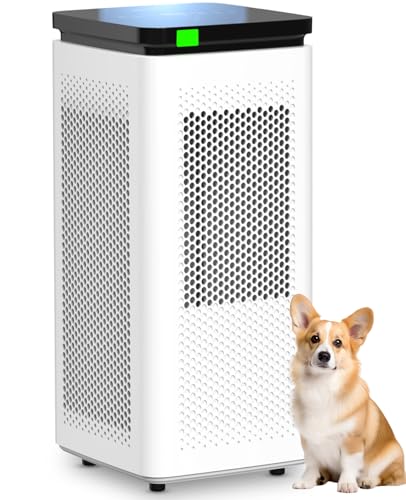
Hepa purifier Review Summary
The Hepa air purifier makes the most sense for buyers who need one unit to handle a living room, basement, open-plan space, or a pet-heavy bedroom.
Its appeal is not flashy styling or smart-home extras; it is the combination of 235 CADR, dual-sided airflow, and a quiet 30dB sleep mode wrapped in a floor-standing design that looks meant for daily use.
The listing positions this model as a cleaner-air workhorse for dust, pollen, pet hair, smoke, VOCs, and odors.
That combination matters because many purifiers either focus on particle removal or on odor reduction, but this one pairs H13 True HEPA with an activated carbon filter so it can address both.
The air quality display and auto mode make it easier to leave running, while child lock, timer, and dimmer settings help it fit into family spaces.
Review Scorecard
| Category | Score | Why it scores that way |
|---|---|---|
| Particle filtration | 9/10 | H13 True HEPA is well suited to dust, pollen, pet dander, and fine particles. |
| Odor handling | 8/10 | The carbon filter adds useful support for smoke, cooking smells, and everyday odors. |
| Room coverage | 9/10 | The 235 CADR and stated large-room coverage make it a strong fit for bigger spaces. |
| Noise profile | 8/10 | The 30dB sleep mode is a meaningful advantage for bedrooms and overnight use. |
| Ease of use | 8/10 | Auto mode, display, filter indicator, and timer reduce day-to-day friction. |
| Family and shared-space fit | 8/10 | Child lock, dimmer, and floor-standing format make it practical in homes with kids or pets. |
| Long-term practicality | 7/10 | ENERGY STAR claims and replacement-filter guidance help, but filter ownership still matters. |
Bottom line: the Hepa air purifier is a sensible buy if you want a quiet, large-room cleaner that handles both particles and odors.
It is less compelling if you want app control, air quality integrations, or a compact purifier for a small desk or studio.
Key Features and Specifications of Hepa purifier
The core feature set is straightforward and relevant to the intended use case.
The purifier uses H13 True HEPA plus an activated carbon filter, which is the right pairing when the goal is to capture airborne particles while also reducing odors and smoke.
The listing specifically calls out dust, pollen, pet dander, pet hair, cigarette smoke, wildfire smoke, VOCs, and general particulates.
The performance story centers on 235 CFM CADR and dual-inlet airflow.
According to the listing, that design can clean 500 sq. ft. in 15 minutes and cover up to 3500 ft².
Those numbers suggest a machine designed for circulation and room turnover rather than a tiny personal purifier.
Useful practical details include:
- Sleep mode at 30dB for quieter nighttime operation
- Air quality monitor and PM2.5 display for live feedback
- Auto mode that adjusts fan speed based on air quality
- Dimmer for lowering panel brightness at night
- Timer for scheduled operation
- Child lock for family-friendly use
- Floor-standing design for living rooms, bedrooms, offices, and shared spaces
The listing also states third-party testing and certifications, including CARB, DOE, EPA, and UL, plus ENERGY STAR certification.
It further claims usage as low as 0.66 kWh per day based on ENERGY STAR test data.
Those are helpful confidence signals for a buyer evaluating daily operation and safety, though they still should be read as listing claims rather than independent proof of your exact use case.
Pros and Cons of Hepa purifier
Pros
- Strong coverage for large spaces. The 235 CADR and large-room positioning are the standout practical benefits.
- Good two-part filtration approach. H13 HEPA plus carbon is the right combination for dust and odors.
- Quiet enough for sleep. The 30dB sleep mode is a real advantage for bedrooms.
- Helpful everyday controls. Auto mode, display, timer, dimmer, and child lock make it easier to live with.
- Built for mixed household needs. Pets, cooking odors, dust, and smoke are all explicitly in scope.
Cons
- No clear smart-home feature set. If you want app control or voice assistant support, this is not positioned that way.
- Large-room focus may be overkill for small spaces. Buyers with compact bedrooms or offices may not need this much capacity.
- Filter ownership still matters. The listing recommends periodic replacement, so long-term upkeep is part of the deal.
- The value proposition is utilitarian. This is a function-first appliance, not a premium design object.
Overall, the pros are concentrated in the exact areas a buyer would care about for a home purifier.
The cons are mostly about what is missing rather than what is broken.
Who Should Buy Hepa purifier?
Buy the Hepa air purifier if you need one unit for a large shared area and you care about both particle removal and odor reduction.
It fits homes with pets, households dealing with dust or seasonal pollen, and buyers who want a purifier they can leave running in auto mode instead of constantly adjusting.
It also makes sense for people who want a purifier in a bedroom but do not want a noisy fan at night.
The sleep mode, dimmer, and child lock make it a better fit for family use than many bare-bones models.
You should probably skip it if you want a compact purifier for a desk, dorm shelf, or very small bedroom.
It is also not the right match if your shopping list starts with app control, connected-home features, or a decorative appliance that disappears into the room.
Hepa purifier Large-Room Performance
Coverage and Circulation
The biggest reason to consider this Hepa air purifier is the stated coverage.
A purifier with 235 CADR and dual-sided airflow is meant to move a lot of air, which is what matters when the space is large or frequently occupied.
That makes it more appropriate for open-concept living spaces and family rooms than a small single-purpose desktop unit.
Noise and Night Use
The 30dB sleep mode changes how this product can be used day to day.
Quiet operation is not a luxury on a bedroom purifier; it is the difference between a unit that gets turned off and one that stays on.
The dimmer helps too, because bright panels can be distracting at night even when the fan itself is acceptable.
Filtration and Odor Control
The H13 True HEPA plus carbon filter pairing is the key functional choice.
HEPA is the particle side of the equation, while carbon helps with odors and smoke.
For buyers dealing with pet smells, cooking residue, or seasonal wildfire smoke, that combination is more useful than particle filtration alone.
Everyday Controls
The auto mode and PM2.5 display help reduce guesswork.
Instead of forcing the user to decide fan speed all the time, the purifier can react to air quality changes.
Timer and child lock are not glamorous features, but they make a difference in homes where the purifier runs daily and shares space with kids or pets.
Alternatives to Hepa purifier
If you want a comparable large-room purifier, look at the Coway Airmega line, the Levoit Core larger-room models, and the Blueair Blue Pure family.
Each is a credible Amazon search target if you want to compare room-size fit, noise, and feature sets before choosing.
Coway is often the cleaner benchmark if you want a reputation for dependable air cleaning and a more polished consumer experience.
Levoit is worth a look if you want broad availability and a range of room sizes.
Blueair is a sensible comparison if you care about strong airflow and a simpler visual style.
Is Hepa purifier Worth It?
The Hepa air purifier is worth it if your priority is clean air in a large room with low noise at night.
Its feature set is coherent: H13 HEPA for particles, carbon for odors, auto mode for convenience, and sleep mode for bedrooms.
It is a good buy for pet owners, families, and anyone who wants one purifier to cover a living space instead of buying a weaker unit and hoping for the best.
It is less compelling if you only need a small-room purifier or if you want smart-home integration.
If your use case matches the listing, this is a practical, buyer-friendly option rather than a gimmicky one.
For large-room daily use, the Hepa air purifier looks worth considering.