
A network audio player with balanced outputs can bring streaming convenience to a serious stereo system while helping you preserve clean signal paths and flexible connectivity. The best choice depends on more than DAC specifications: your amplifier inputs, music services, room setup, and desired level of control all matter.
We’ve gathered 10 compelling options for 2026, ranging from streamlined network streamers and CD players to feature-rich DAC/preamp units and distributed-audio hardware. Use the guide below to narrow the field by system compatibility, sound-focused features, and long-term usability.
Best 10 Network Audio Player with Balanced Outputs Picks for 2026
Balanced Streaming Essential

- ESS Sabre ES9028Q2M DAC
- HDMI eARC and versatile digital inputs
- Balanced XLR output
Best For: Flexible stereo and home cinema systems
Feature-Rich Hi-Fi Hub

- Dual-mono ESS SABRE DAC design
- BluOS multi-room streaming
- Balanced XLR and HDMI eARC
Best For: Expandable hi-fi and whole-home audio systems
Disc-and-Stream Versatility

- CD playback and network streaming
- PCM 384 kHz/32-bit and DSD 128 support
- HDMI ARC and digital preamp
Best For: CD-focused systems with modern digital sources
Balanced Digital Control Center

- ES9039PRO DAC with isolation system
- Fully balanced XLR/RCA preamp circuit
- Room correction and dual subwoofer outputs
Best For: High-end systems needing streamer, DAC, and preamp functions
Best Multi-Room Matrix

- Eight sources and eight zones
- 75 WPC or 260 W bridged
- Wi-Fi and app-based zone control
Best For: Centralized wired whole-home audio installations
Best Digital Transport

- Wi-Fi 6, Ethernet, and SFP fiber
- OCXO clock with external clock inputs
- 40-band DSP and broad service support
Best For: Expandable high-resolution digital audio systems
Best Balanced Streaming Hub
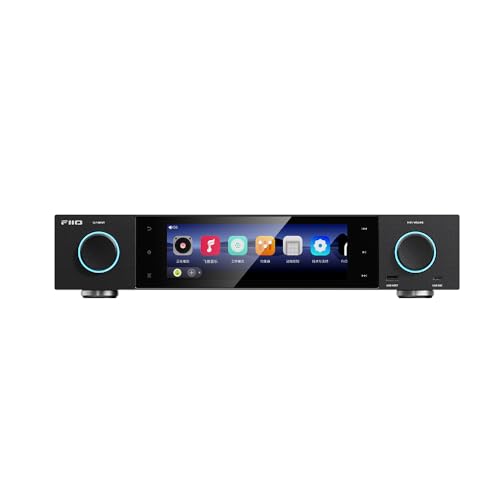
- XLR balanced line output
- Android, Roon, AirPlay, and DLNA support
- Large touchscreen and extensive I/O
Best For: All-in-one network and local music playback systems
Isolated Digital Transport

- Balanced AES/EBU XLR digital output
- Electrical isolation across digital outputs
- Supports high-resolution streaming and DSD512
Best For: External-DAC systems prioritizing isolated digital transport
Full-Size Balanced Streamer DAC

- XLR balanced and RCA analog outputs
- Open Android 12 with major streaming apps
- Extensive network, HDMI, and local playback support
Best For: Full-size systems needing streaming, DAC, and preamp functions
All-in-One Balanced Source

- Streamer, DAP, DAC, and preamp in one unit
- Dual ESS9039PRO DACs with DSD512 support
- Large storage and NAS library capabilities
Best For: High-resolution systems centered on local and network music libraries
Balanced Streaming Essential – Cambridge Audio EXN100
The Cambridge Audio EXN100 is a practical network audio player with balanced outputs for listeners who want flexible digital connectivity and premium stereo integration. Its ESS Sabre ES9028Q2M DAC, Bluetooth 5 with aptX HD, HDMI eARC, USB, optical, and coaxial inputs make it adaptable to both music systems and home theaters.
Best For: Stereo listeners building a flexible network and digital source component with XLR connectivity.
Pros:
- Balanced XLR output supports premium system connections.
- ESS Sabre ES9028Q2M DAC is designed for high-quality sound conversion.
- HDMI eARC enables straightforward home cinema integration.
- Includes USB, Toslink, SPDIF, Ethernet, and Bluetooth connectivity.
Cons:
- The supplied specifications do not identify the supported streaming services or software platform.
- Software update support is listed as unknown.
The EXN100 is a strong fit when connection flexibility matters as much as streaming. It is especially appealing for systems that can take advantage of balanced XLR output and HDMI eARC.
Feature-Rich Hi-Fi Hub – Bluesound NODE ICON
The Bluesound NODE ICON is a network audio player with balanced outputs aimed at listeners who want advanced streaming, multi-room control, and a broad set of high-end features. Its dual-mono ESS SABRE DAC design, balanced XLR outputs, HDMI eARC, BluOS, AirPlay 2, aptX Adaptive Bluetooth, and optional Dirac Live room correction give it wide system appeal.
Best For: Hi-fi listeners who want multi-room streaming, balanced connectivity, headphone support, and extensive digital features.
Pros:
- Dual-mono design uses two ESS SABRE ES9039Q2M DACs.
- Balanced XLR outputs support high-performance stereo setups.
- BluOS supports whole-home multi-room control.
- Includes HDMI eARC, AirPlay 2, aptX Adaptive Bluetooth, and THX AAA headphone amplification.
Cons:
- Dirac Live requires an upgrade and a separately purchased calibration microphone.
- The extensive feature set may be more than a simple streaming setup requires.
With its display, dual-mono DAC architecture, and broad connectivity, the NODE ICON is designed as a central digital hub rather than a basic streamer. It is a compelling choice for systems that may expand into multi-room audio or room correction.
Disc-and-Stream Versatility – Marantz CD 50n
The Marantz CD 50n combines disc playback with network audio functionality for listeners seeking a versatile digital source. While the supplied notes do not specify balanced outputs, its support for PCM up to 384 kHz/32 bit and DSD 128, HDMI ARC, network streaming, and built-in digital preamp make it worth considering alongside a network audio player with balanced outputs.
Best For: Listeners who want CD playback, high-resolution digital audio, and convenient TV integration in one component.
Pros:
- Plays CDs while also supporting network audio streaming.
- Supports PCM up to 384 kHz/32 bit and DSD 128.
- HDMI ARC provides a single-cable connection for TV, movies, and games.
- Built-in digital preamp allows output-volume adjustment when driving a power amplifier.
Cons:
- The supplied details do not list balanced XLR outputs.
- The listed headphone jack is 3.5mm, which may not suit every headphone setup.
The CD 50n is best understood as a comprehensive CD and network source rather than a confirmed balanced-output specialist. Choose it when physical discs and high-resolution playback are priorities, and verify output requirements before pairing it with balanced equipment.
Balanced Digital Control Center – EVERSOLO DMP-A10
The EVERSOLO DMP-A10 is a network audio player with balanced outputs that also functions as a DAC and preamplifier. Its ES9039PRO DAC, fully balanced analog preamp circuit, XLR/RCA analog inputs, room correction, isolated circuitry, touchscreen, and broad streaming-service support make it suited to ambitious digital audio systems.
Best For: High-end systems needing a streamer, DAC, and balanced preamp with room correction and subwoofer management.
Pros:
- Fully balanced preamp circuit supports XLR and RCA analog inputs.
- ES9039PRO DAC and isolation system target low noise and distortion.
- Built-in room correction can tailor playback to the listening environment.
- Offers TIDAL, Qobuz, Amazon Music, and other streaming services through its interface and app.
Cons:
- Its many preamp, DAC, room-correction, and subwoofer features may be excessive for basic streaming.
- Subwoofer functionality is limited to PCM signals below 192 kHz.
- The supplied notes do not specify every supported streaming service or input/output detail.
The DMP-A10 is the most system-oriented option in this group, combining source, conversion, and preamp duties. Its balanced architecture and room-correction tools make it particularly attractive when you want to simplify a high-end setup without giving up adjustment options.
Best Multi-Room Matrix – Dayton Audio DAX88
If you need a network audio player with balanced outputs for a wired whole-home system, the Dayton Audio DAX88 is primarily a powerful multi-zone matrix amplifier. It supports eight sources and eight zones, with integrated Wi-Fi, streaming options, and app control for routing audio throughout your home.
Best For: Homeowners building a customizable, wired multi-room audio system with centralized amplification.
Pros:
- Supports eight independent sources and eight dedicated zones.
- Delivers 75 watts per channel, or up to 260 watts when channels are bridged.
- Offers analog and digital inputs and outputs plus integrated Wi-Fi.
- iOS and Android control is available through the Dayton Audio Matrio app.
Cons:
- Its large 21.5 x 20 x 9-inch chassis is better suited to a dedicated installation than a compact setup.
- It is a distributed amplifier and matrix rather than a simple standalone streaming player.
The DAX88 stands out when zone flexibility and speaker power matter more than a compact, audiophile desktop design. Its five-year warranty is also useful for a permanent home installation.
Best Digital Transport – Eversolo T10 Music Streamer
The Eversolo T10 is a high-end digital music transport for listeners seeking a network audio player with balanced outputs elsewhere in the signal chain. It combines Wi-Fi 6, Ethernet, SFP fiber networking, broad streaming-service support, and a temperature-stable OCXO clock in a substantial aluminum chassis.
Best For: Advanced listeners who want a flexible digital source and transport for a high-resolution audio system.
Pros:
- Supports Wi-Fi 6, traditional RJ45 Ethernet, and SFP fiber networking.
- Includes an OCXO clock plus external 10 MHz and 25 MHz master-clock inputs.
- Offers native access to services including TIDAL, Qobuz, Amazon Music, and Deezer.
- Provides 40-band DSP tools, FIR filter import, and room-correction PEQ support.
Cons:
- An SFP module is required separately for fiber networking.
- Its 365 x 310 x 88 mm chassis requires considerable shelf or rack space.
- The transport-focused design may require a separate DAC or amplifier for a complete system.
The T10 is aimed at system builders who value networking flexibility, clocking options, and extensive digital tuning. It is a stronger fit for an expandable high-resolution setup than for casual plug-and-play listening.
Best Balanced Streaming Hub – FiiO S15 HiFi Streamer & DAC
The FiiO S15 is a versatile network audio player with balanced outputs, including an XLR balanced line output alongside extensive digital connectivity. Its Android 12 platform, large touchscreen, flagship AKM DAC architecture, and support for Roon Ready, AirPlay, DLNA, NAS, and local playback make it a flexible source for a modern audio system.
Best For: Listeners who want one streamer, DAC, and control interface for both network and local music playback.
Pros:
- Includes XLR balanced line output, I2S, AES, coaxial, optical, RCA, and HDMI connections.
- Supports Android streaming apps, Roon Ready, AirPlay, DLNA, UPNP, SMB, and WebDAV.
- Uses the AK4191 and AK4499EX DAC combination with separated digital and analog architecture.
- Offers a 7.84-inch display plus knob, remote, Bluetooth, and app control.
Cons:
- Its broad feature set and open Android platform may be more than basic streaming needs require.
- The 430 mm-wide chassis takes standard full-size component space.
- It carries a one-year warranty according to the supplied details.
For systems that specifically need a balanced analog connection and many digital inputs, the S15 is the most directly equipped option here. It also works well as a central library player for NAS, local storage, and streaming services.
Isolated Digital Transport – Eversolo T8
The Eversolo T8 is a focused choice for listeners building a network audio player with balanced outputs around an external DAC. It emphasizes electrically isolated digital connections, dual femtosecond clocks, and broad support for streaming services including TIDAL, Qobuz, Spotify Connect Lossless, Roon Ready, and TIDAL Connect.
Best For: Audiophiles who want a premium streaming transport with AES/EBU, IIS, USB, coaxial, and optical outputs.
Pros:
- Balanced AES/EBU output uses an XLR connection for noise resistance and long-distance transmission.
- Electrical isolation is applied across the digital output ports to help reduce ground-loop noise.
- Dual femtosecond clocks and support up to DSD512 Native and PCM 768kHz/32-bit through IIS and USB Audio.
- Wi-Fi 6, an isolated SFP network module, touchscreen controls, remote control, and app support provide flexible operation.
Cons:
- SFP modules are sold separately and must be compatible with the selected SFP switch.
- It is primarily a digital transport, so users will need a separate DAC or compatible downstream component.
The T8 stands out when clean digital delivery and balanced AES/EBU connectivity matter more than built-in analog outputs. Its extensive isolation and clocking features make it especially suitable for a carefully assembled high-resolution system.
Full-Size Balanced Streamer DAC – FiiO S15
The FiiO S15 combines streaming, digital conversion, and preamp functionality in a full-width component, making it a practical network audio player with balanced outputs for a larger desktop or hi-fi rack. Its open Android 12 platform supports major streaming apps, while Roon Ready, AirPlay, DLNA, NAS, and local playback expand source options.
Best For: Larger audio systems that need a feature-rich streamer DAC with both XLR balanced and RCA line outputs.
Pros:
- Includes XLR balanced line output alongside RCA, plus AES, coaxial, optical, HDMI, USB, and I2S connectivity.
- AK4191 plus AK4499EX DAC architecture uses separated digital and analog sections.
- Open Android 12 supports streaming applications, while Roon Ready, AirPlay, DLNA, UPNP, SMB, and WebDAV support add flexibility.
- Large 7.84-inch display, dual knobs, virtual buttons, Bluetooth remote control, and app control simplify operation.
Cons:
- Its 430mm-wide chassis and approximately 6kg weight require suitable shelf or rack space.
- The supplied notes identify HDMI and other extensive connectivity, but do not specify the maximum decoding rate in the product details provided.
The S15 is the most system-oriented option here, pairing balanced analog output with a broad set of digital inputs, outputs, and network protocols. Choose it when you want a streamer and DAC that can serve as a central source component rather than a transport alone.
All-in-One Balanced Source – Kaiboer DMP-K7 PRO II
The Kaiboer DMP-K7 PRO II is an all-in-one network audio player with balanced outputs that also works as a DAP, DAC, and preamp. It combines dual ESS9039PRO DACs, high-resolution decoding, NAS and cloud access, internal storage expansion, and a large touchscreen for users who want one versatile source component.
Best For: Listeners seeking a high-resolution streamer, DAC, and preamp with substantial local-storage and library-management options.
Pros:
- Dual ESS9039PRO DACs support up to 768kHz/32-bit and DSD512, with stated 140dB dynamic range and 135dB SNR.
- Dual femtosecond clocks and separate digital and analog power arrangements are designed to reduce timing and switching noise.
- Supports NFS, SMB, WebDAV, AirPlay, DLNA, Wi-Fi 6, and control from iOS, Android, Windows, and Mac.
- 8GB DDR4, 64GB eMMC, internal M.2 NVMe support, and external USB storage support up to 20TB.
Cons:
- Bluetooth is not supported.
- Its many functions and storage options may be more than needed for buyers seeking a simple network transport.
The DMP-K7 PRO II is a strong fit for a digitally focused system that benefits from local libraries, NAS playback, and extensive software control. Its all-in-one design reduces the need for separate source and conversion components, while the supplied notes emphasize high-resolution and balanced-system use.
How We Picked the Best Network Audio Player with Balanced Outputs
We focused on products that combine network playback with serious system connectivity, prioritizing models offering balanced analog outputs or a clear role in balanced-output hi-fi systems. We also considered support for major services such as Tidal, Qobuz, Spotify, and Amazon Music; high-resolution formats; app and screen usability; digital inputs and outputs; room correction; and integration with amplifiers, televisions, or multi-room systems.
Because these products serve different buyers, the list includes dedicated streamers, streamer-DACs, CD/network players, transports, and a distributed-audio amplifier. Check each product’s specifications carefully: some models provide balanced analog line outputs, while others provide balanced digital or professional-style connectivity and still require an external DAC or preamp.
Quick Comparison
| Best For | Look For | Typical Strength |
|---|---|---|
| Traditional hi-fi system | Balanced analog outputs and a reliable control app | Simple, high-quality streaming |
| Digital-focused setup | Balanced digital output, clocking, and isolation | Pairing with an external DAC |
| All-in-one control | DAC, preamp, volume control, and room correction | Fewer separate components |
| TV and modern sources | HDMI ARC, USB, and broad input selection | Flexible system integration |
| Whole-home audio | Multiple zones, app control, and amplifier channels | Distributed playback |
Key Buying Factors for a Network Audio Player with Balanced Outputs
Confirm the Output Type
Balanced XLR analog outputs are useful when your amplifier or active speakers accept XLR inputs, particularly with longer cable runs or equipment designed around differential signal paths. Do not assume that every product described as balanced includes analog XLR outputs; verify the rear-panel connections and manual.
Match the Digital and Analog Architecture
A streamer with a built-in DAC is convenient and may reduce box count. A transport is better suited to buyers who already own a preferred DAC. If you want direct connection to a power amplifier, choose a model with a properly implemented preamp and volume control, not merely fixed line outputs.
Check Services, Files, and Control
Confirm native support for your preferred services, gapless playback, local USB or network libraries, and the formats you use most. A responsive app and clear display can matter more day to day than small differences in maximum sample-rate claims.
Consider Room and System Integration
Room correction can be valuable in difficult spaces, while HDMI ARC is useful for adding a television. Multi-room buyers should verify zone limits, amplifier power, wireless requirements, and whether the platform will remain compatible with their existing equipment.
Who Should Buy Which Network Audio Player with Balanced Outputs?
Choose a dedicated streamer such as the Cambridge Audio, Bluesound, or Marantz option if you want a polished source for an existing stereo system. Consider an Eversolo, FiiO, or DMP-K7-style component if you want a larger display, extensive digital support, DAC functionality, preamp control, or advanced configuration. A transport such as the Eversolo T8 or T10 makes the most sense when your system already has a separate DAC and you want a refined digital source. For whole-home playback, the Dayton Audio matrix amplifier is the specialist choice because it combines source distribution, amplification, and zone management rather than functioning like a conventional two-channel streamer.
Before buying, map every connection in your system: source, DAC or preamp, amplifier, speakers, television, and network. The best Network Audio Player with Balanced Outputs is the one that fits that signal path cleanly and supports the services you will actually use.