
Choosing the best meat grinder for bones depends on more than motor wattage. Bone hardness, grinding capacity, feed design, cleanup, and intended use all affect performance and safety.
We compare 10 electric grinders ranging from home-friendly models for soft bones and pet food to commercial bone-crushing machines for higher-volume processing.
Best 10 Meat Grinder for Bones Picks for 2026
Top Heavy-Duty Pick
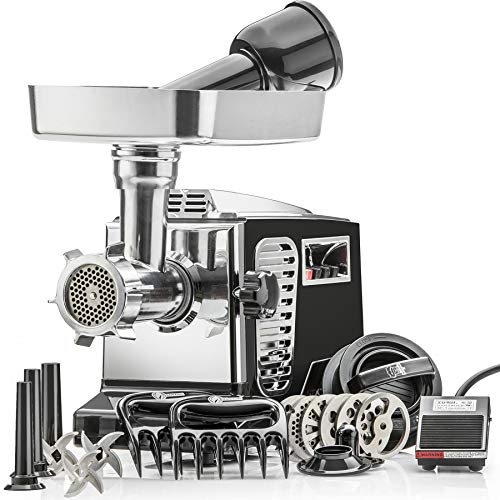
- Grinds soft poultry and small-game bones
- 2000-watt maximum motor with air cooling
- Includes plates, sausage tools, and patty press
Best For: High-volume home meat and soft-bone processing
Best for Wild Game
AAOBOSI #12 Heavy-Duty Grinder

- 3000-watt peak motor rated at 7 lb/min
- All-metal gearbox and stainless housing
- Reverse function helps clear grinding jams
Best For: Fast, repeated wild-game processing
Best Value Soft-Bone Option
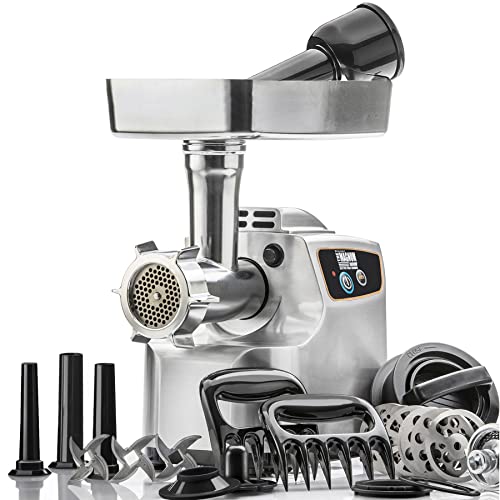
- Handles specified poultry and small-game soft bones
- Size No. 12 design with high-capacity tray
- Includes five plates and sausage attachments
Best For: Versatile home grinding with soft-bone capability
Best for Pet Food

- Explicitly grinds poultry, ribs, and small-game bones
- Touchscreen speed control with reverse function
- Dishwasher-safe plates and blades
Best For: Raw pet-food preparation with controlled bone grinding
Home Meat Grinder Pick

- Large 3-pound hopper for prepared meat
- Includes plates, blades, sausage, kubbe, and burger attachments
- Not designed to grind bones
Best For: High-volume home meat preparation without bones
Commercial Bone Processing Pick

- Processes up to 200–230 kg per hour
- Handles chicken, duck, and fish bones
- Avoid beef and other hard bones
Best For: High-volume soft-bone and poultry-bone processing
Soft-Bone Pet Food Pick
Sinyder 3500W Touch-Screen Grinder

- Handles soft bones, cartilage, and fish
- Processes 5–7 pounds per minute
- Not intended for hard pork or beef bones
Best For: Home raw pet-food preparation with soft bones
Industrial Bone-Capable Grinder
High-Output Stainless Steel Crusher

- 2.2 kW motor for high-volume processing
- Handles meat and selected soft poultry or fish bones
- Not suitable for hard, beef, large, or frozen bones
Best For: Bulk feed processing and soft-bone grinding
Home Kitchen Mincer
Sausage and Meat Grinder Combo

- Three plates and three sausage tubes included
- Overload protection and removable cutting attachment
- Bone-grinding capability is not specified
Best For: Home meat grinding and sausage making
Pet Food Bone Grinder

- Designed for poultry and soft-bone pet food
- 2000 W motor with five speeds and auto-reverse
- Excludes large leg bones
Best For: Homemade pet food and soft-bone grinding
Top Heavy-Duty Pick – STX Turboforce II 4000
If you need a meat grinder for bones as well as large meat batches, the STX Turboforce II 4000 offers a high-capacity setup with soft-bone capability. Its size No. 12 design, 2-inch feed tube, and included accessories make it suited to home users who want more than basic grinding.
Best For: Home processing of meat and soft bones such as chicken, rabbit, squirrel, and quail bones.
Pros:
- Handles soft bones and is rated for approximately 220 to 260 pounds of meat per hour, depending on the plate and meat.
- Includes six grinding plates, three stainless steel blades, sausage tubes, a Kubbe maker, meat claws, and a patty press.
- Features a 2000-watt maximum motor, circuit breaker, air-cooling system, and foot pedal.
Cons:
- Its large size No. 12 build may be more machine than occasional users need.
- The warranty terms include geographic and return-condition restrictions.
This is a versatile, high-output choice for shoppers who regularly process meat and need soft-bone capability, along with a broad set of attachments for sausage and burger preparation.
Best for Wild Game – AAOBOSI #12 Heavy-Duty Grinder
For hunters seeking a meat grinder for bones and wild game, the AAOBOSI #12 emphasizes fast batch processing and durable construction. Its 3000-watt peak motor, all-metal gearbox, reverse function, and portable handle are practical features for repeated use after a hunt.
Best For: Hunters processing venison, elk, wild boar, and other game into ground meat, sausages, or burgers.
Pros:
- Powerful 3000-watt peak motor is rated to process up to 7 pounds of meat per minute.
- Stainless housing, copper motor, and all-metal gearbox are designed for heavy-duty use.
- Includes a reverse function for clearing jams, plus four plates, sausage tubes, a Kibbe kit, burger press, and meat claws.
Cons:
- The supplied notes emphasize meat and wild-game processing but do not specifically state a bone-grinding rating.
- At 16.5 pounds, it is substantial to move despite the carry handle.
This grinder stands out for game-meat throughput and rugged construction. If bone grinding is your primary requirement, confirm the intended bone types before buying because the supplied specifications do not explicitly identify bone capacity.
Best Value Soft-Bone Option – STX Magnum 1800W
The STX Magnum 1800W is a practical meat grinder for bones for home users who want soft-bone capability without stepping up to the brand’s larger Turboforce model. It uses a size No. 12 grinding system, includes a high-capacity tray, and provides multiple plates and food-making attachments.
Best For: Home cooks processing meat and soft chicken, rabbit, squirrel, or quail bones.
Pros:
- Designed to handle the listed soft bones and approximately 220 to 260 pounds of meat per hour, depending on setup and meat type.
- Includes five grinding plate sizes, three stainless steel blades, sausage tubes, a Kubbe maker, meat claws, and a burger-slider press.
- High-capacity tray holds more than 3 pounds, while the circuit breaker and air-cooling system support operation.
Cons:
- The 1800-watt maximum rating is lower than the Turboforce II 4000’s stated 2000-watt maximum.
- The one-year fix-or-replace guarantee is shorter than the three-year guarantee stated for the Turboforce II.
This model offers a strong balance of soft-bone functionality, included accessories, and home-oriented capacity. It is a sensible fit when you want a versatile grinder without prioritizing the highest listed motor rating.
Best for Pet Food – Huanyu 1.3HP Bone Grinder
Designed specifically for shoppers looking for a meat grinder for bones and raw pet food, the Huanyu Commercial Heavy Duty Grinder explicitly targets poultry, ribs, and small game bones. Its touchscreen speed control, reverse function, and dishwasher-safe grinding parts make it oriented toward controlled, repeatable preparation.
Best For: Pet owners and hunters making raw pet food from poultry, ribs, small game, and meat.
Pros:
- Explicitly designed to grind most bones, including poultry, ribs, and small game.
- 1.3HP copper motor processes up to 4.4 pounds per minute and is specified for up to 60 minutes of continuous operation.
- Offers touchscreen speed adjustment, one-touch reverse, three plate sizes, and dishwasher-safe blades and plates.
Cons:
- Its stated throughput is lower than the 7-pound-per-minute rating of the AAOBOSI model.
- The construction combines aluminum, plastic, and stainless steel rather than being all metal.
- The listed 1000-watt rating may appeal less to buyers seeking maximum motor power.
This is the clearest match for bone-focused pet-food preparation because the product specifications directly identify bone grinding and intended pet-food use. Variable speed and easy-clean components add control and convenience for frequent batches.
Home Meat Grinder Pick – STX Turboforce 3000 Classic
The STX Turboforce 3000 is a high-capacity home grinder with useful sausage and burger-making accessories. However, shoppers specifically seeking a meat grinder for bones should note that the manufacturer explicitly says not to grind bones, tendons, vegetables, nuts, or fruit with this model.
Best For: Home cooks who want a powerful, high-volume grinder for properly prepared meat, sausage, kubbe, and burgers—not bone processing.
Pros:
- Large hopper holds approximately 3 pounds of prepared meat.
- Rated to process about 180–240 pounds of meat per hour when properly prepared.
- Includes five plates, three stainless steel blades, sausage tubes, kubbe attachment, and burger press.
- Backed by a 3-year warranty, with terms applying.
Cons:
- Manufacturer specifically states that it will not grind bones.
- Intended for home use rather than commercial processing.
- Requires meat to be stripped or cubed before grinding.
Despite its high advertised wattage and substantial capacity, this is not a suitable meat grinder for bones. Choose it for versatile household meat preparation instead, and look elsewhere if bone grinding is essential.
Commercial Bone Processing Pick – Electric Bone Crusher Grinder
This electric bone crusher is the most purpose-built meat grinder for bones in this lineup, with a stated output of 200–230 kg per hour. It can process fish, chicken, and duck bones, but the supplied guidance says not to use it for beef bones or other hard bones.
Best For: High-volume processing of meat, poultry, fish, and softer chicken, duck, or fish bones for feed or similar applications.
Pros:
- High stated processing capacity of 200–230 kg per hour.
- Designed to process chicken, duck, and fish bones normally.
- Cast-iron body, stainless steel hopper, and stainless steel safety cover.
- Emergency stop switch and four casters support safer, more mobile operation.
Cons:
- Not suitable for beef bones or other hard bones.
- Ingredients must be cut into small pieces before feeding.
- Should not be run empty for extended periods because the blades may be damaged.
This is the strongest match for buyers who need a dedicated bone-processing machine, provided the intended material is within its stated limits. Confirm the 220V requirement and avoid hard bones that could exceed its design range.
Soft-Bone Pet Food Pick – Sinyder 3500W Touch-Screen Grinder
The Sinyder is a heavy-duty home grinder designed for meat and soft bones, making it a practical meat grinder for bones when preparing raw pet food. Its product notes specifically mention chicken wings, cartilage, and fish, while warning against hard pork and beef bones.
Best For: Pet parents and home cooks processing soft bones, cartilage, chicken, fish, and meat in controlled household batches.
Pros:
- 3500W peak motor is rated for 5–7 pounds of meat per minute.
- Suitable for soft chicken bones, cartilage, and fish for raw pet diets.
- Six touch-screen speed modes include digital timing control.
- Includes coarse, medium, and fine plates plus sausage, kubbe, and grating attachments.
Cons:
- Not intended for hard pork or beef bones.
- Designed for heavy-duty home use, not continuous commercial processing.
- Food-contact parts require hand washing in warm water no hotter than 122°F (50°C).
For home raw-food preparation, the Sinyder offers more bone-focused capability than a standard meat grinder, but its limits matter. Use only soft bones and cartilage as specified, rather than treating it as an all-purpose hard-bone crusher.
Industrial Bone-Capable Grinder – High-Output Stainless Steel Crusher
For buyers seeking a meat grinder for bones, this industrial-style 2.2 kW machine is built for high-volume processing of meat, fish, poultry, and selected soft bones. Its stainless steel construction, large hoppers, and casters suit demanding prep environments, but the stated limitations are important: it is not designed for beef bones, large bones, hard bones, or frozen meat.
Best For: High-volume grinding of meat, fish, chicken, duck, and soft poultry or fish bones for feed processing.
Pros:
- Powerful 2.2 kW motor with a stated output of about 400 lb per hour.
- Stainless steel body, feed hopper, discharge hopper, and rotating feeder.
- Casters make the large machine easier to reposition.
- Threaded screw design helps produce a finer minced texture.
Cons:
- Cannot grind beef bones, other hard bones, or large bones.
- Materials must be cut into small pieces before processing.
- Frozen meat must be thawed first.
This is the strongest fit for commercial-style or bulk work when its bone restrictions match your ingredients. Confirm that your available electrical supply supports the listed 220-volt requirement before ordering.
Home Kitchen Mincer – Sausage and Meat Grinder Combo
If you need a meat grinder for bones primarily for everyday kitchen prep, this compact stainless steel model emphasizes versatility rather than dedicated hard-bone grinding. It handles beef, chicken, pork, venison, fish, vegetables, sausages, and kibbeh, with multiple plates and overload protection, but the supplied notes do not specifically confirm bone-grinding capability.
Best For: Home cooks who want a versatile grinder for meat, sausage stuffing, kibbeh, burgers, and vegetable processing.
Pros:
- Includes 2 mm, 5 mm, and 7 mm grinding plates for different textures.
- Comes with two blades and three sausage-stuffer tubes.
- Overload protection shuts the unit off during overheating or overloading.
- Removable cutting attachment is designed for easier cleaning.
Cons:
- Supplied information does not establish that it is suitable for bones.
- Listed motor rating is 300 W, with 3200 W maximum locked power rather than continuous output.
- Attachments should not be placed in the dishwasher.
This is a practical household mincer for meat and sausage projects, but shoppers specifically seeking a bone grinder should choose a model with clearly stated bone-processing specifications instead.
Pet Food Bone Grinder – 2000W Touch-Control Mincer
This Huanyu model is a strong option for shoppers looking for a meat grinder for bones at home, particularly for homemade pet food. Its 2000 W motor is designed for chicken frames, poultry, and soft bones, while five speed settings, auto-reverse, and multiple plates provide control over texture. It still excludes large leg bones.
Best For: Homemade pet food, venison, wild boar, and soft-bone grinding in a home kitchen.
Pros:
- Designed for chicken frames, poultry, and soft bones without pre-deboning.
- 2000 W pure copper motor reportedly processes about 5 lb per minute.
- Five touch-controlled speeds and three-second auto-reverse help manage texture and jams.
- Includes three plates, two blades, sausage and Kubbe accessories, and dishwasher-safe frequently used parts.
Cons:
- Not intended for large leg bones.
- Some components still require hand washing.
- The supplied details do not specify a continuous-duty commercial rating.
Among these options, this is the clearest match for bone-inclusive pet-food preparation because the manufacturer explicitly identifies soft-bone use. Keep large leg bones out of the feed path and use the controls to match the desired grind.
How We Picked the Best Meat Grinder for Bones
We focused on the specifications that matter when processing meat with bones: motor power, stated bone-grinding capability, grinder size, throughput, included plates, construction, controls, and intended workload. We also separated kitchen-oriented grinders from commercial machines, since a compact home model and a high-volume bone crusher serve very different buyers.
Product claims should be matched to the material being processed. “Soft bones” generally refers to smaller poultry, fish, rabbit, or similarly manageable bones. Hard, large, or weight-bearing bones may require a dedicated commercial bone crusher rather than a standard household grinder.
Quick Comparison
| Best For | What to Prioritize | Suitable Type |
|---|---|---|
| Pet food and occasional batches | Soft-bone capability, easy cleaning, manageable size | Home or mid-duty electric grinder |
| Wild game processing | Large tray, sustained motor power, durable plates | Heavy-duty #12 grinder |
| Frequent pet-food production | Throughput, metal construction, overload protection | Commercial-style bone grinder |
| Animal feed or small poultry | Rated capacity, dedicated crushing design, stable operation | Commercial bone crusher |
Key Buying Factors for a Meat Grinder for Bones
Bone Compatibility
Confirm exactly what the manufacturer says the machine can process. A grinder rated for soft bones is not automatically suitable for beef, pork, or large game bones. Cut material into appropriately sized pieces and follow the manual’s feed and safety instructions.
Motor Power and Duty Cycle
Higher advertised wattage can help with demanding loads, but it does not tell the whole story. Look for a robust gearbox, overload protection, cooling design, and a stated continuous or intermittent duty cycle. Commercial units are usually better suited to repeated batches.
Capacity and Throughput
Tray size, throat opening, plate diameter, and pounds-per-hour ratings affect how quickly you can work. Large throughput figures may reflect ideal conditions, so leave headroom for tougher material and avoid choosing solely by the headline rating.
Plates, Blades, and Cleanup
Multiple plate sizes improve control over texture, while stainless components can resist corrosion and simplify maintenance. Check whether parts are removable, hand-wash only, or dishwasher-safe, and dry cutting components promptly after cleaning.
Electrical and Workspace Requirements
Verify voltage, plug type, footprint, noise, and weight before buying. Large commercial machines may need a dedicated, stable work surface and more ventilation than a countertop model.
Who Should Buy Which Meat Grinder for Bones?
Choose a compact home grinder if you need occasional batches of ground meat, pet food, or small soft bones and value easier storage. A heavy-duty #12 model is a better fit for hunters and families processing larger quantities of game. For frequent pet-food production, prioritize a commercial-style machine with a durable feed system and dependable cooling. If you need to crush poultry, fish, or other feed ingredients at high volume, select a purpose-built bone crusher and confirm its rated materials, capacity, and electrical requirements before purchase.