
If you are searching for a 3D Night Vision Goggles review, this model is best understood as a wearable observation tool rather than a casual gadget.
It is built for low-light viewing, hands-free use, and recording with a clear emphasis on nighttime visibility and long-form outdoor sessions.
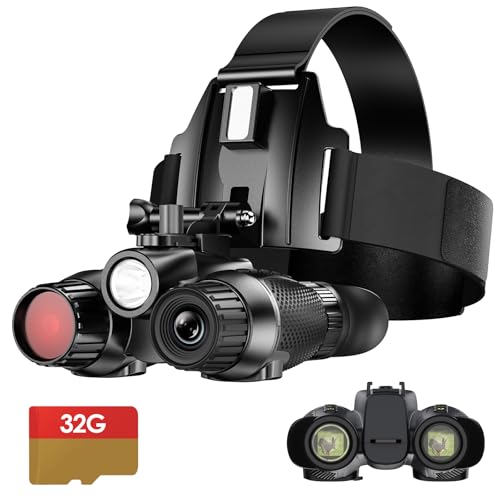
3D Night Vision Goggles Review Summary
The 3D Night Vision Goggles make sense for buyers who want a head-mounted, binocular-style night vision device with enough control to tune the image for a specific environment.
The listing centers on 3D naked-eye viewing, 850nm infrared assistance, white supplemental lighting, manual focus, and an adjustable headband or helmet mount, which points to a product aimed at hunting, scouting, wildlife observation, and other hands-free night tasks.
What stands out most is the mix of wearability and tuning options.
A lot of night vision products lean either toward handheld convenience or fixed, simple operation.
This one instead tries to give the user more control over how the image looks at distance, how bright the scene appears in the dark, and how comfortably the unit can be worn for longer sessions.
That makes it more specialized, but also more useful if you already know you want binocular night vision with a mounted form factor.
Review Scorecard
| Category | Score | Rationale |
|---|---|---|
| Low-light visibility | 8/10 | 850nm IR support and a white fill light suggest strong adaptability in darker conditions. |
| Wearability | 9/10 | The headband plus helmet adapter make this clearly built for hands-free use. |
| Image control | 8/10 | Manual focus, IR adjustment, and eyepiece tuning give the user real control over the view. |
| Versatility | 7/10 | Useful for hunting, scouting, and recording, but the design is specialized rather than general-purpose. |
| Learning curve | 6/10 | The listing includes multiple settings and adjustment steps, so setup is not fully plug-and-play. |
| Recording usefulness | 8/10 | 36MP photos, ultra-high-definition video, and TF card support make capture part of the appeal. |
| Buyer confidence | 7/10 | The feature set is clear, but buyers should expect a niche device with a specific use case. |
Key Features and Specifications of 3D Night Vision Goggles
The core product story is straightforward: these are wearable night vision binoculars with dual-eyepiece 3D viewing, infrared illumination, and built-in recording features.
The listing says the device supports 36MP photos and ultra-high-definition video, and that it includes a TF card.
It also highlights FHD daytime use and black-and-white night vision modes, plus multiple color effects.
Key listed features include:
- 3D naked-eye viewing with dual-screen, dual-eyepiece design
- White supplemental light that can be activated with an IR setting
- 850nm infrared lighting with 7-level brightness adjustment
- 8x zoom for magnifying distant subjects
- Manual focus and eyepiece diopter adjustment
- Helmet mount adapter plus adjustable headband
- TF card support included in the package
- Color modes including color, fluorescent green, infrared light, and black-and-white
The viewing setup appears to be one of the most important parts of the product.
The listing specifically says to close one eye, adjust the left and right eyepiece diopters until clear, then use the manual focus wheel for a sharp image.
That matters because this is not a passive, fixed-focus product.
It is designed for users who are willing to spend a little time dialing in the view.
The form factor also matters.
A helmet-compatible, head-mounted night vision unit is not just about image quality.
It is about keeping both hands free while scanning, moving, or recording.
For outdoor work, that can be a bigger advantage than a simpler handheld viewer.
Pros and Cons of 3D Night Vision Goggles
Pros
- Hands-free design is the clearest advantage here, especially for outdoor users who want to move while observing.
- Multiple illumination options give the user more flexibility than a basic fixed-light device.
- Manual focus and eyepiece adjustment make it easier to sharpen the image for different eyes and distances.
- Recording features add value for users who want to document what they see.
- Helmet compatibility broadens the product’s use beyond casual viewing.
Cons
- The feature set is more complex than a simple point-and-view viewer, so it may take time to learn.
- The listing suggests a specialized use case, which means it is not the best fit for someone wanting a simple all-purpose night camera.
- Some buyers may prefer a lighter or more minimal design if they do not need helmet mounting or detailed adjustment.
- Because the product emphasizes multiple modes, the best results likely depend on proper setup rather than default operation.
Overall, the pros are strongest when the buyer actually needs a wearable night vision rig.
If that is the goal, the feature bundle looks purposeful.
If not, the device may feel like more machine than you need.
Who Should Buy 3D Night Vision Goggles?
Buy these if you want binocular night vision with a mounted, hands-free design.
That includes hunters, wildlife watchers, security-minded users, and outdoor hobbyists who want to keep both hands free while viewing in low light.
The adjustable headband and helmet adapter make the product especially relevant for users who already work with protective headgear or tactical-style setups.
This is also a reasonable choice if you care about image tuning.
The combination of IR brightness levels, manual focus, and eyepiece adjustment suggests a product that rewards patience and setup.
Buyers who like dialing in equipment will probably appreciate that.
Skip it if you want a simple, lightweight, low-maintenance night vision tool.
This is not positioned as a bare-bones viewer.
It is a more involved device with more parts of the experience to manage, and that is a fair trade only if you actually need the extra control and wearability.
Using 3D Night Vision Goggles in the Field
Infrared and White Light
The listing’s most practical claim is that the device combines 850nm infrared lighting with a white fill light.
That combination matters because low-light conditions are not all the same.
Some scenes need additional illumination, while others benefit from the infrared approach and brightness control.
The 7-level IR adjustment is useful here because it gives the user a way to increase or reduce intensity instead of relying on one fixed setting.
Fit and Eye Alignment
The goggles are clearly designed to be adjusted to the wearer.
The instructions call for closing one eye, tuning each eyepiece until clear, and then using manual focus.
That is a strong sign that the device expects users to optimize alignment for their own vision.
For a head-mounted binocular product, that is a real strength because comfort and clarity are tightly linked.
Image Capture and Memory
The built-in recording angle is part of the appeal.
The listing mentions 36MP photos, ultra-high-definition video, and TF card inclusion, which makes the product more than a night viewer.
Buyers who want to document outings or keep a record of observations will likely see value here.
If you only want live viewing, this is still useful, but the capture features make the package feel more complete.
Wearability and Use Cases
The helmet mount adapter is not a trivial add-on.
It shows that the product is meant for longer sessions and active use, not just stationary viewing.
That matters for hunting reconnaissance, patrol-like tasks, or anyone moving through an area and wanting both hands available.
In that context, the wearable design is one of the main reasons to consider this model over a simpler binocular option.
Alternatives to 3D Night Vision Goggles
If you want a broader comparison, look at BinoX-style digital night vision binoculars, Pulsar night vision goggles, or ATN night vision binoculars.
These lines are worth checking because they often appeal to buyers who want a more established brand ecosystem or a different balance of wearability, optics, and recording features.
Another useful search is for helmet mount night vision binoculars if the head-mounted use case matters more than the exact feature mix.
That can help you compare similar wearable designs before deciding whether this 3D model is the right fit.
Is 3D Night Vision Goggles Worth It?
Yes, if you specifically want wearable, adjustable, hands-free night vision binoculars. The combination of 3D viewing, IR brightness control, white supplemental lighting, manual focus, and helmet compatibility makes this a purposeful tool for buyers who need more than a basic low-light viewer.
No, if you want simplicity above all else. This product looks strongest for users who will benefit from its multiple settings and mounted form factor.
If that is your use case, it is worth serious consideration; if not, a simpler night vision device may be a better fit.